Relocation success is not measured by the move itself, but by the legal stability and familial peace established before the first box is packed. Many international families view a move between the United States and Israel as an insurmountable legal hurdle, yet the most inspiring Relocation Success Stories often begin with a sober assessment of risks rather than a leap of faith. For parents living between these two jurisdictions, the fear of being accused of international child abduction under the Hague Convention is a heavy burden that can often paralyze decision-making.
It’s natural to feel overwhelmed by the conflicting rules of US and Israeli courts or to worry about how a move might impact your long-term relationship with your children. You’ll discover how families successfully manage these complexities while keeping their parental rights intact and their children’s well-being at the forefront. This article provides a strategic framework for approaching the other parent or the court, alongside a clear explanation of the legal criteria used to determine the best interests of the child in 2026. This content is published on an independent advisory platform and is for educational purposes only; it’s not formal legal representation.
Key Takeaways
- Understand why formal court consent is the essential factor in avoiding the risk of international child abduction claims.
- Discover the specific financial strategies used in US-Israel moves to prevent “stay of exit” orders from delaying your transition.
- Explore how mediation serves as a critical tool for families moving from Israel to the US to bypass complex Hague Convention litigation.
- These Relocation Success Stories highlight the importance of establishing jurisdictional clarity before any physical move occurs.
- Learn the four essential pillars of a relocation blueprint that protect both parental rights and the child’s long-term well-being.
What Defines a Relocation Success Story in International Family Law?
For many international families, the idea of a success story starts with a professional opportunity or a desire to return home. However, in the context of international family law, a job offer is merely a catalyst, not the conclusion. True success is defined by achieving legal finality that survives the scrutiny of two different judicial systems. Without a formal court order or a signed agreement, a move is simply a change of address that remains vulnerable to legal challenges for years to come.
To better understand the emotional and practical weight of these transitions, watch this helpful video:
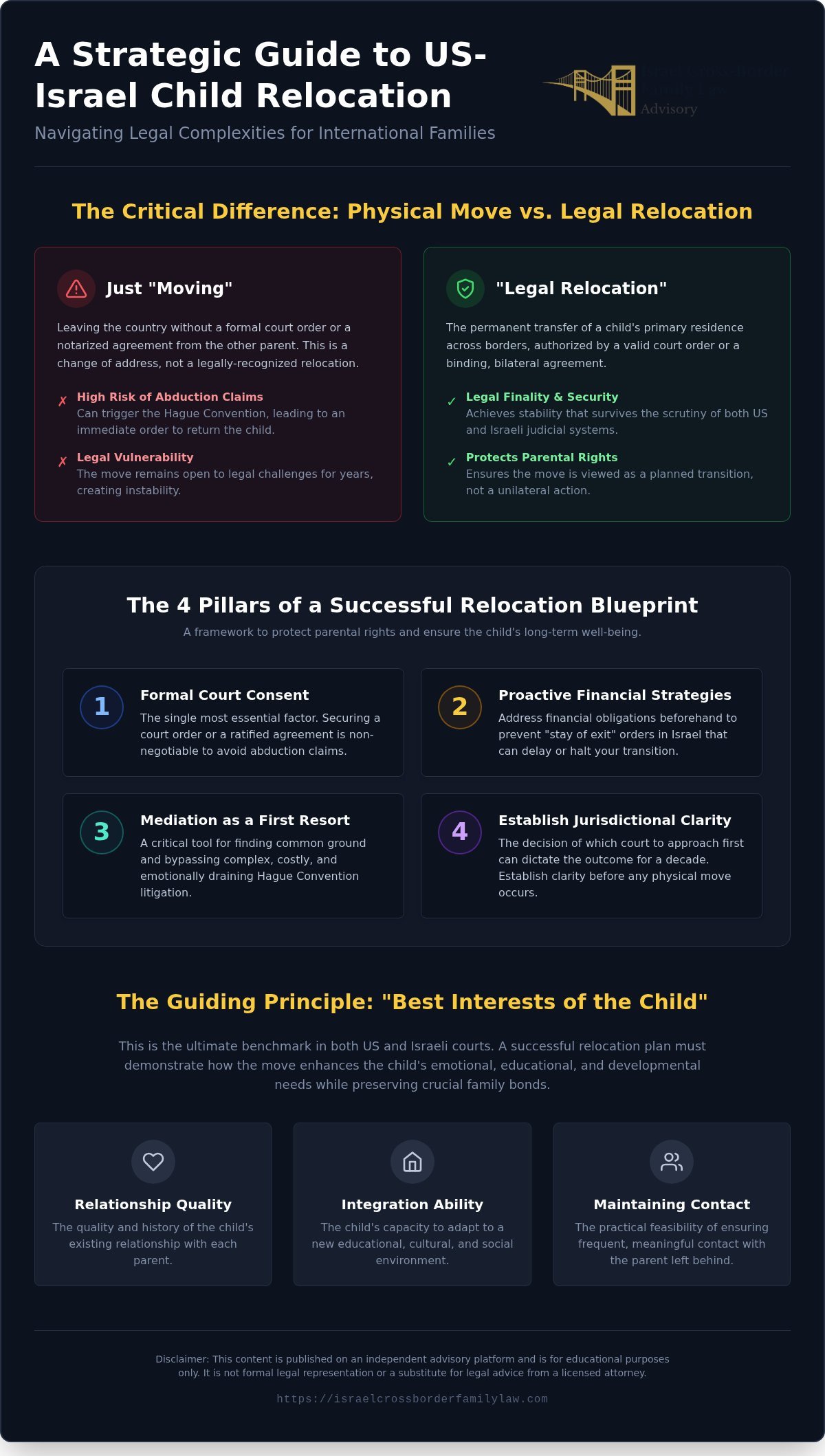
We measure Relocation Success Stories by the lack of future litigation and the long-term stability of the child’s routine. The ultimate benchmark in both US and Israeli courts is the “Best Interests of the Child,” a standard that evaluates emotional, educational, and developmental needs. In 2026, Israeli courts have shown an increasing trend toward favoring joint parental responsibility, making it vital to demonstrate how a move maintains the child’s bond with both parents. Key factors typically include:
- The quality of the existing relationship with each parent.
- The child’s ability to integrate into a new educational and social environment.
- The practical feasibility of maintaining frequent contact with the parent left behind.
The Difference Between “Moving” and “Legal Relocation”
Relocating involves more than just booking flights and packing boxes. If you leave your current country without explicit court consent or a notarized agreement from the other parent, you risk being accused of international parental child abduction. This can trigger the Hague Convention on the Civil Aspects of International Child Abduction, a treaty designed to return children to their country of “habitual residence” immediately. Success requires updating existing custody orders before you depart to avoid these severe consequences.
Many parents mistakenly believe that a “temporary” move for a one-year work contract doesn’t require formal legal changes. In reality, these temporary arrangements often evolve into permanent disputes where the court must decide where the child truly belongs. You should seek guidance on international custody and relocation to ensure your paperwork reflects your actual intentions and protects your rights.
Why US-Israel Moves Require a Specific Legal Strategy
The legal systems in Israel and the United States operate on different cultural and procedural foundations. While US state courts focus on specific statutes, Israeli Family Courts often weigh the “Best Interests of the Child” through a more holistic lens, frequently involving social workers and court-appointed experts. Early decisions, such as which court you notify first, can dictate the jurisdiction of your case for a decade. In a US-Israel legal context, relocation is the permanent transfer of a child’s primary residence across international borders, requiring either a valid court order or a binding, bilateral agreement to be legally recognized.
Relocating from the US to Israel: Case Studies in Success
While logistics like shipping and housing dominate most Aliyah checklists, the most enduring Relocation Success Stories are built on a foundation of legal foresight. In one notable case involving a family moving to Ra’anana, the parents avoided years of conflict by securing a comprehensive custody agreement in their home US state before the move. This agreement was specifically designed to transition into the Israeli system, addressing how the child’s routine would shift from a suburban US environment to a bustling Israeli community. By defining these terms early, the family ensured that the move was viewed by both jurisdictions as a planned transition rather than a unilateral flight.
A critical component of success in Israel is managing the risk of a “stay of exit” order. These orders can prevent a parent or child from leaving the country if there are concerns about unpaid child support or a permanent move without consent. We’ve seen families navigate this by creating proactive financial agreements. For instance, a parent might provide a bank guarantee of ₪75,000 to ₪150,000 held in escrow to secure future support payments. This financial transparency often reassures the Israeli courts and the other parent, allowing the relocation to proceed without the looming threat of travel restrictions. Such strategic planning is a hallmark of the most stable Relocation Success Stories.
Incoming families must also prepare for the “Social Worker Report” (tazkir). In Israel, court-appointed social workers play a central role in determining the child’s best interests. Success stories often involve parents who can clearly demonstrate a detailed integration plan, including school registrations in Tel Aviv or Jerusalem and a network of local family support. This proactive approach shows the court that the move is stable and well-considered.
Securing Permission from US Courts to Move to Israel
US courts generally require a high burden of proof that a move to Israel serves the child’s best interests. Successful parents often present evidence of superior educational opportunities or a stronger familial support system in Israel. To ensure these decisions hold weight across borders, we recommend using a “Mirror Order.” This is a legal strategy where the US court order is formally recognized and registered in the Israeli Family Court. You can learn more about the mechanics of international custody and relocation to understand how these orders protect your rights in both countries.
Success in Cities Like Tel Aviv and Jerusalem
In international hubs like Tel Aviv, success is often measured by how well the family manages Relocation and Co-Parenting dynamics. Maintaining a bond with the parent remaining in the US requires a robust digital communication schedule and clear travel arrangements for summer and winter breaks. Early legal clarity allows new Olim to focus on integration rather than litigation. If you’re considering a move, it’s wise to seek a strategic review of your specific situation before making firm commitments.
Moving from Israel to the US: Overcoming Hague Convention Fears
For many expats and English-speaking Israelis, the prospect of moving from Israel to the United States is often shadowed by the fear of legal retaliation. The primary hurdle in these transitions is the Hague Convention, which treats any move without the other parent’s explicit consent as international child abduction. Authentic Relocation Success Stories in this direction almost always involve a shift from adversarial litigation to collaborative mediation before any travel arrangements are finalized.
In one successful case, a parent planning a move to New Jersey avoided a potential abduction filing by engaging in mediation early. Instead of a surprise departure, the parent presented a detailed relocation plan that included specific visitation windows and shared flight costs, which can range from ₪10,000 to ₪30,000 annually. This transparency allowed the parents to draft a Heskem Mamon (Financial Agreement) that the Israeli court could approve, providing both parties with the security they needed to move forward. Such cases are typical Relocation Success Stories because they prioritize the child’s stability over parental conflict.
A key concept in these cases is “habitual residence,” which refers to the country where the child has established a routine and a sense of normalcy. As of 2026, courts in both Israel and the US place significant weight on this factor when determining jurisdiction. By reaching an agreement before leaving, parents can define when the US will officially become the child’s new habitual residence, effectively transferring jurisdictional authority in a controlled and legal manner.
The Strategic Advantage of a Negotiated Agreement
Relying on a judge to decide your family’s future is a high-risk strategy that often leads to unpredictable outcomes. A negotiated agreement allows you to customize clauses for summer visits and international travel expenses, ensuring that both parents maintain a meaningful relationship with the child. You can see how it works when you prioritize a strategic framework over a purely legalistic one.
Preventing “Stay of Exit” (Zav Ikuv Yetzia) Orders
In Israel, it’s common for a parent to request a Zav Ikuv Yetzia (Stay of Exit order) to prevent the child from leaving the country during a dispute. These orders can be issued quickly and remain in place until the court is satisfied that the move is permanent and legal. Success involves building trust through legal bonds, such as providing a financial guarantee held in an Israeli bank to secure future child support. Moving a child from Israel to the US without explicit, written, and notarized consent is a criminal act that can lead to immediate return orders and severe legal penalties.
The 4 Pillars of a Successful Relocation Blueprint
Success in international relocation is rarely a matter of luck; it’s the result of a deliberate, four-pillar blueprint designed to withstand the pressures of two different legal systems. When we analyze Relocation Success Stories, we find that the most stable families followed a structured approach long before they reached the airport. This blueprint minimizes the risk of sudden legal challenges that can arise months or even years after the move is complete. Every successful move starts with a strategy, and these Relocation Success Stories prove that preparation is the best defense against legal uncertainty.
- Pillar 1: Legal Consent. You must never move without a written, court-approved agreement. Verbal promises or informal emails are insufficient protection against future legal claims of abduction.
- Pillar 2: Jurisdictional Clarity. You need to know which country’s laws will apply to your child’s future. Without this clarity, you risk a “jurisdictional vacuum” where neither court can effectively resolve disputes.
- Pillar 3: Continuity of Relationship. A successful move includes a robust plan for the parent left behind. This ensures the child’s emotional stability and satisfies the court’s requirement for ongoing parental contact through scheduled video calls and visitation.
- Pillar 4: Risk Mitigation. Use “Mirror Orders” and financial bonds to ensure compliance. Registering an order in both countries creates a seamless legal bridge between the US and Israel.
Establishing the “Best Interests of the Child”
Israeli and US courts evaluate success based on whether the child will thrive in the new environment. They examine emotional and social ties, such as the child’s proximity to extended family and the quality of local schools. A move is considered successful only when it supports the child’s well-being, rather than just the parent’s career goals. Judges look for evidence that the child’s relationship with both parents will remain meaningful despite the geographical distance. This often involves looking at the child’s daily routine and how it will be replicated or improved in the destination city.
Navigating Financial and Support Obligations
Relocation significantly impacts child support cross-border enforcement. Parents must account for the high cost of international visitation, where round-trip flights between Tel Aviv and the US can cost between ₪4,000 and ₪12,000 per person. Agreements should clearly state who bears these costs and how support payments will be adjusted to reflect the new cost of living. Managing these financial complexities early prevents future friction and ensures the long-term viability of the relocation. To ensure your move is built on these four pillars, request a strategic review of your relocation plan before taking any irreversible steps.
Building Your Relocation Strategy: Next Steps
The most resilient Relocation Success Stories don’t begin with a surprise announcement or a court filing. They start with a quiet, strategic assessment of the legal landscape. Notifying the other parent of your intent to move before you’ve secured a clear strategic framework can trigger immediate legal retaliation, such as a “stay of exit” order. By conducting a confidential review first, you can identify potential friction points and develop a plan that addresses the other parent’s concerns before they escalate into a conflict. This proactive approach is designed to protect your parental rights while keeping the child’s well-being at the center of the transition.
Adopting a “Strategy First” mentality is often the deciding factor in whether a move becomes a success or a multi-year legal battle. Litigation in cross-border cases is notoriously expensive and unpredictable, with contested international relocation cases in Israel potentially costing between ₪75,000 and ₪225,000 in legal fees. Strategic planning focuses on risk reduction and finding a path to consent, which is far more stable than a court-imposed solution. These Relocation Success Stories demonstrate that families who prioritize negotiation and jurisdictional clarity early on are much more likely to achieve a peaceful and permanent transition.
The Role of an International Family Law Advisor
An international family law advisor serves as a critical bridge between the US and Israeli legal systems, helping you understand how divergent business and legal cultures will impact your case. Success requires an expert who understands the nuances of both US state courts and the Israeli Family Court system. To prepare for a productive consultation, you’ll need to gather relevant documents, including existing custody orders, school records, and a detailed outline of your proposed relocation timeline. You can begin this process by requesting a confidential case review to gain clarity on your specific situation.
A Note on Independent Advisory Platforms
It’s important to understand that this content is published on an independent advisory platform and is intended for informational and educational purposes only. This is not formal legal representation, and an attorney-client relationship is only established through a separate, formal engagement with a licensed attorney. Our focus is on providing high-level strategy and decision-making guidance to help you navigate the inherent complexities of cross-border family law. For more detailed insights into specific legal scenarios, we encourage you to watch the expert videos available on our YouTube channel: Israel Family Law.
Get clarity before you commit. Request a confidential consultation.
Securing Your Family’s Global Future
Successful international moves require more than just logistical planning; they demand a robust legal architecture that spans two continents. By prioritizing the four pillars of consent, jurisdiction, continuity, and risk mitigation, you can transform a complex transition into one of the many Relocation Success Stories that define stable cross-border families. The weight of early decisions cannot be overstated, particularly when navigating the significant differences between US state courts and the Israeli legal system.
We provide specialized US-Israel cross-border expertise to help you manage the inherent complexity of these cases. Our advisory focuses on strategy and risk reduction, offering authoritative guidance on Hague Convention risks to ensure your move remains legally sound. Before you notify the other parent or sign any binding documents, it’s essential to understand the long-term implications of your strategy. You deserve a clear path forward that protects your parental rights and your child’s well-being.
Get clarity before you commit. Request a confidential consultation.
Your family’s next chapter starts with a solid foundation. With the right strategic framework, you can move forward with confidence and peace of mind.
Frequently Asked Questions
Can I move back to the US from Israel with my children if I am divorced?
You can move back to the US, but only with a notarized agreement from the other parent or a formal court order from an Israeli Family Court. Moving without these legal foundations is considered a violation of the child’s rights and the other parent’s custody. To ensure your journey becomes one of the many Relocation Success Stories, you should secure a court-approved agreement that specifically addresses jurisdictional shifts before you depart.
What happens if I move my child without the other parent’s consent?
Moving a child without consent triggers the Hague Convention, an international treaty designed to return children to their country of “habitual residence.” Israeli courts aim to reach a final verdict in these urgent cases within six weeks of the initial filing. A unilateral move can lead to criminal charges and an immediate order for the child’s return to Israel, regardless of your long-term intentions or the quality of life in the US.
How does the Israeli court decide on relocation requests?
Israeli courts use the “Best Interests of the Child” as the ultimate legal benchmark for relocation requests. Judges evaluate the child’s emotional, educational, and developmental needs while considering the impact on their relationship with the parent remaining in Israel. In 2026, courts are increasingly favoring shared parenting arrangements, meaning you must demonstrate a robust plan for maintaining the child’s bond with both parents across international borders.
Do I need a new custody agreement if I am moving countries?
You definitely need a new or modified custody agreement when moving between countries. A standard local agreement does not account for the multi-jurisdictional complexity of international life, such as global visitation schedules or flight costs ranging from ₪10,000 to ₪30,000 annually. A cross-border agreement provides the legal clarity required to prevent future disputes and ensures that both the US and Israeli legal systems recognize your parental rights.
Can a US court order be enforced in Israel regarding relocation?
A US court order is not automatically enforceable in Israel; it must be formally recognized and registered by the Israeli Judicial Authority. This process involves a legal “bridge” where the Israeli court adopts the US terms into a local order. Without this formal recognition, the parent in Israel may find it difficult to enforce visitation or support terms if the other parent fails to comply with the original US agreement.
What is a “Mirror Order” and why is it successful in relocation cases?
A Mirror Order is a court order issued in one jurisdiction that matches the exact terms of an order from another. These are vital for Relocation Success Stories because they provide double enforceability in both the US and Israel. By having identical orders in both countries, parents mitigate the risk of one party seeking a “jurisdictional vacuum” to avoid their responsibilities or to change custody terms unilaterally after the move.
How long does the legal process for relocation typically take in Israel?
The timeline for relocation cases in Israel varies significantly based on the level of parental agreement. While Hague Convention cases for wrongful removal target a six-week resolution, a contested relocation claim in the Family Court can take several months or even over a year. The process often includes reports from court-appointed social workers and experts, making early strategic planning essential for families who need to meet specific school or work deadlines.
Is it possible to stop the other parent from relocating with our children?
You can stop a relocation by filing for a “Stay of Exit” order (Zav Ikuv Yetzia) in the Israeli Family Court. This order prevents the child from leaving Israel until the court determines whether the move is in the child’s best interests. This is a common defensive strategy used when there is a risk that the other parent might move the child permanently without a formal, court-approved relocation agreement or parental consent.

Article by
Gabriel Lior
A Personal Journey That Became a Mission
The advisory was founded by an American father Gabriel Lior, LLB, MBA , global entrepreneur, and cross-border advisor who spent more than a decade navigating the Israeli family court system firsthand and now lives in Singapore with his son.
As a divorced parent in a cross-border family, Gabriel faced nearly every legal challenge a foreign parent can encounter in Israel — including child custody disputes, child support proceedings, property matters in Israel and abroad, false accusations, and complex immigration and relocation proceedings.
Over the years, he learned the hard way how difficult it is for non-Israeli parents to understand the system, identify the right legal strategy, and choose the right legal representation — especially when language, culture, and jurisdictional differences are involved. He also witnessed how foreign parents and new immigrants are often disadvantaged or taken advantage of by service providers and institutions simply because they lack local knowledge or fluency.
From Client to Advisor
To truly understand — and survive — the system, Gabriel pursued formal legal education in Israel, completing two Israeli law degrees, alongside a BA and MBA earned in the United States. This was never about becoming a practicing attorney, but about gaining a deep, structural understanding of how the system works — and where it breaks down for foreign parents.
This rare combination of:
Firsthand client experience
Israeli legal and US business education
International business and negotiation training
Decades of commercial execution
created a unique perspective – one that understands both sides of the table.
After years of litigation, persistence, and at times self-representation, he ultimately succeeded in securing custody of his son and relocating abroad through a rare legal victory in the Israeli Supreme Court — becoming one of the first fathers in Israel to do so under these circumstances.
Disclaimer
Important Disclaimer:
The information provided on this website and in its content is for general informational and educational purposes only and does not constitute legal advice, legal opinion, or legal representation.
Gabriel Lior is not licensed to practice law in Israel (nor is he interested in doing so) and does not provide legal services, despite having completed 2 Law Degrees. The services offered are advisory in nature and are intended to provide general guidance, strategic insight, and information regarding cross-border family law considerations.
No attorney-client relationship is formed by accessing this website, reading its content, or communicating with us.
Any decisions made based on this information are at your own discretion and risk. For legal advice specific to your situation, you should consult a licensed attorney in the relevant jurisdiction.
Where appropriate, we may refer clients to independent, licensed attorneys or professionals. Such referrals do not constitute legal representation and no liability is assumed for services provided by third parties.