Navigating the complexities of a cross-border inheritance can be a formidable task, particularly when faced with a foreign legal system, potential language barriers, and the critical question of which country’s laws will govern the estate. For non-residents, a comprehensive understanding of Israeli inheritance law for foreigners is the crucial first step toward securing your rightful assets and honoring the decedent’s final wishes. The process, while intricate, does not have to be overwhelming when you are equipped with authoritative guidance.
This definitive guide is designed to provide that clarity. We will navigate you through the core principles of Israeli succession, from determining jurisdiction to the validation of foreign wills by Israeli courts. You will gain a clear understanding of the probate or succession order process, the documentation required, and the key challenges you may face when managing Israeli assets from abroad. Our objective is to provide you with the knowledge to proceed with confidence, ensuring you are fully prepared for the legal steps ahead.
Core Principles of the Israeli Succession Law for Foreign Heirs
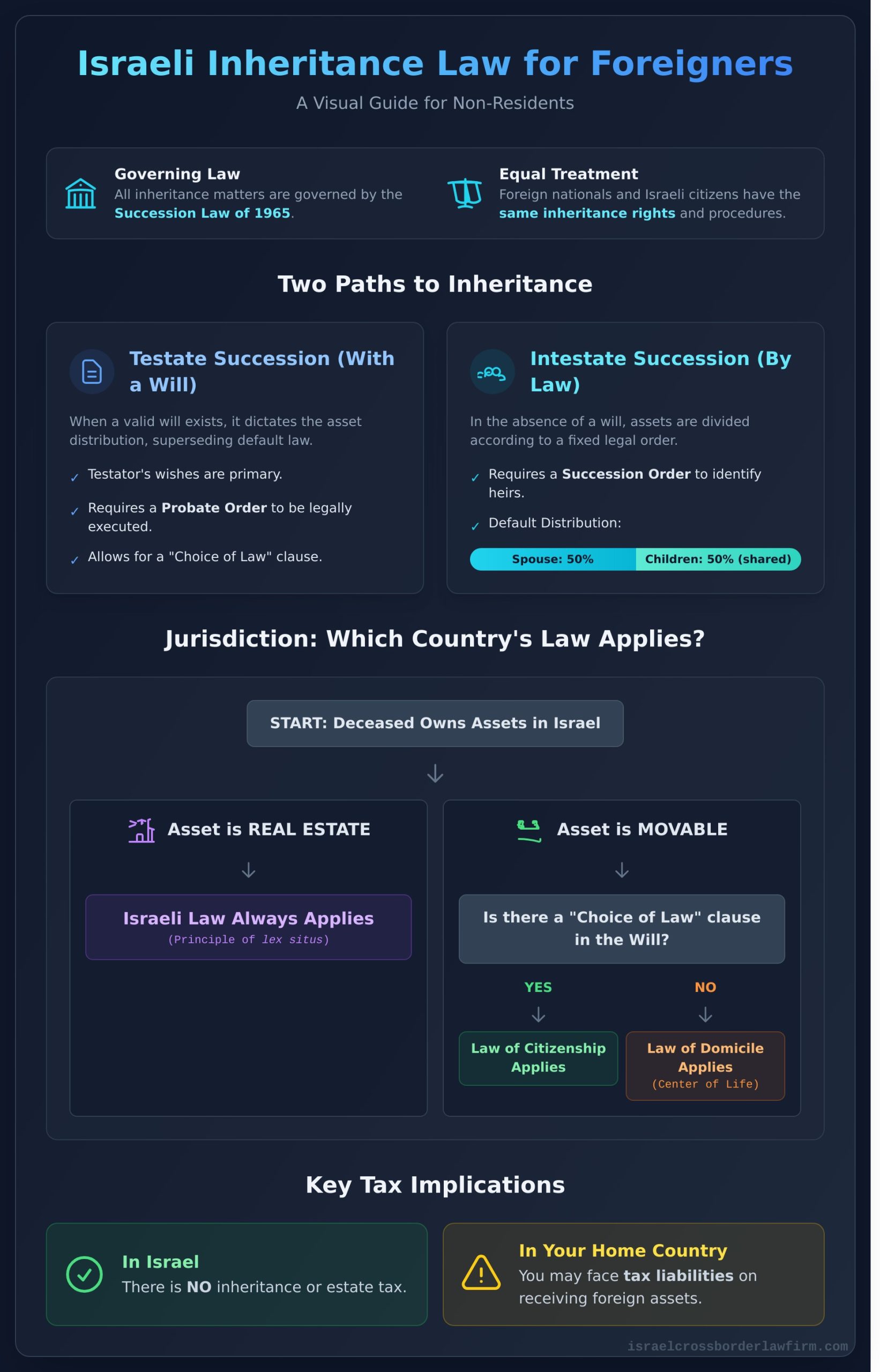
Navigating cross-border estate matters requires a deep understanding of the governing legal framework. In Israel, all succession issues are governed by the Succession Law of 1965. This comprehensive statute provides the definitive rules for the transfer of a deceased person’s assets. A fundamental principle of this law is its territorial jurisdiction: it applies to all property, real or movable, located within the State of Israel, irrespective of the deceased’s nationality, residency, or religion. Crucially, the law upholds the principle of equal treatment, ensuring that foreign nationals and Israeli citizens have the same inheritance rights and are subject to the same legal procedures.
For a clear overview of how these principles are applied in practice, the following video provides valuable insights into the Israeli inheritance law for foreigners.
The Israeli legal system delineates two distinct pathways for inheritance: succession by will (testate) or succession by law (intestate). This dual approach is common to many global inheritance laws and provides a clear structure for asset distribution. A significant advantage for beneficiaries is that Israel does not levy an inheritance or estate tax. However, foreign heirs must remain cognizant of potential tax liabilities in their own country of residence, which may tax the receipt of foreign assets. Understanding this distinction is a critical component of effective international estate planning.
Inheritance by Will (Testate Succession)
When a person leaves a legally valid will, this document serves as their primary instruction for the distribution of their Israeli assets. Israeli law recognizes several forms of valid wills, including those that are handwritten, made before witnesses, or executed before a judicial or public authority. A valid will supersedes the default statutory rules of succession, allowing the testator full discretion over their estate. To execute the will’s provisions, it must be validated through a Probate Order (Tzav Kiyum Tzava’a), a legal decree issued by the Inheritance Registrar.
Inheritance by Law (Intestate Succession)
In the absence of a valid will, the estate is distributed according to the default provisions of the Succession Law. This process, known as intestate succession, follows a prescribed statutory order. The primary heirs are the deceased’s spouse and children. By law, the surviving spouse is entitled to half of the estate, with the remaining half divided equally among the deceased’s children. If there are no children, the spouse inherits a larger portion. To legally transfer assets under this framework, the heirs must obtain a Succession Order (Tzav Yerusha) to formally identify them and their respective shares.
Jurisdiction: Determining Which Country’s Law Governs the Inheritance
For foreign nationals with assets in Israel, the most critical preliminary question is: which country’s law will govern the distribution of their estate? The answer to this complex jurisdictional issue is foundational to any cross-border estate planning strategy. Under Israel’s Succession Law of 1965, the default rule is that the law of the deceased’s domicile at the time of death dictates the inheritance of their assets.
However, this general principle is subject to a significant exception for real property. All matters concerning the inheritance of real estate located in Israel are exclusively governed by Israeli law, a principle known as lex situs. This creates a dual-jurisdiction scenario for many foreigners who own both a residence and financial assets in the country.
The ‘Domicile’ Rule Explained
In the context of Israeli law, ‘domicile’ is a more profound concept than mere residency. It signifies a person’s “center of life.” An individual may reside in Israel on a temporary visa but remain domiciled in their home country. Israeli courts assess objective factors to determine domicile, including the location of family, permanent home, business interests, and social affiliations. For instance, a US citizen domiciled in Florida with a bank account in Israel would typically have Florida’s succession laws apply to that account, while their apartment in Jerusalem would be subject to Israeli law.
Choice of Law in a Will
A key provision within the israeli inheritance law for foreigners allows individuals to proactively address jurisdictional uncertainty. A testator may explicitly state in their will that the law of their country of citizenship should govern their estate. For this choice-of-law clause to be valid, it must be clearly articulated within a legally executed will. Including such a clause is a powerful strategic tool that provides clarity, minimizes potential disputes among heirs, and ensures the testator’s intentions are honored across borders.
Practical Implications for US Citizens
When an Israeli court is presented with a will stipulating the application of a foreign jurisdiction, such as New York law, it will apply the substantive inheritance laws of that state to the decedent’s movable assets in Israel. To do so, the court requires an expert legal opinion from a qualified attorney, attesting to the content and application of the relevant foreign law. These probate proceedings, which fall under the purview of bodies such as the Israeli Ministry of Justice, underscore the need for specialized legal support. Navigating these multi-jurisdictional conflicts requires expert guidance. Consult our cross-border specialists.
The Israeli Inheritance Process for Non-Residents: A Step-by-Step Overview
Navigating the administration of an Israeli estate from abroad involves a structured, primarily administrative process overseen by a specific governmental body. The key authority is the Registrar of Inheritance Affairs (ha-Rasham le-Inyanei Yerusha), which handles the legal recognition of heirs’ rights. The procedure remains administrative unless an objection is filed, at which point the matter is transferred to the Family Court for a judicial ruling. Critically, non-residents cannot file applications directly; all submissions must be managed by a local representative, typically an experienced Israeli attorney adept at guiding clients through the nuances of israeli inheritance law for foreigners.
Step 1: Initiating the Process and Gathering Documents
The foundational step is the meticulous collection and authentication of all necessary documentation. While specific requirements can vary, the core file will generally include:
- The original Death Certificate of the deceased.
- The original Last Will and Testament, if one exists.
- Official documents proving the identity and relationship of the heirs (e.g., birth or marriage certificates).
- A legal opinion from a foreign law expert if the will was executed abroad.
All official documents issued outside of Israel must be authenticated with an Apostille stamp pursuant to the 1961 Hague Convention. Furthermore, every foreign-language document must be accompanied by a notarized Hebrew translation.
Step 2: Filing for a Probate or Succession Order
With the complete and authenticated document package, your Israeli legal counsel will file a formal application with the Registrar. The type of application depends on whether a will exists. An application for a Probate Order (Tzav Kiyum Tzava’a) is filed to validate a will, while an application for a Succession Order (Tzav Yerusha) is filed when the deceased died intestate (without a will). Upon submission, the Registrar publishes a notice of the application, providing a window for any interested party to file an objection.
Step 3: Executing the Order and Distributing Assets
Once the Registrar issues the Probate or Succession Order, it serves as the definitive legal instrument confirming the heirs’ rights to the estate’s assets. Heirs, or their legal representative, can then present this order to relevant Israeli institutions, such as banks, to access accounts, and to the Land Registry Office (Tabu) to formally transfer title of real property. If the will appoints an estate manager (executor), or if the court deems one necessary for a complex estate, that individual is empowered by the order to manage assets, settle debts, and distribute the inheritance according to law.
Validating a Foreign Will in Israeli Courts
A frequent and complex scenario in cross-border estate administration involves a foreign national who passes away leaving assets in Israel, with their estate governed by a will drafted and executed abroad, for instance, in the United States or the United Kingdom. Israel’s legal framework provides a clear principle for such situations: a foreign will is recognized as valid if it was legally valid in the jurisdiction where it was created. However, proving this validity to an Israeli court or the Inheritance Registrar requires a specific and formal process, a key aspect of israeli inheritance law for foreigners.
Proving the Will’s Validity
To probate a foreign will in Israel, the petitioner must provide clear evidence that the document adheres to the legal formalities of its home jurisdiction. This is not a matter of simple assertion; it requires structured, authenticated proof. The Israeli authority will mandate the submission of several key documents:
- The original, signed will.
- A notarized Hebrew translation of the will, certified for its accuracy.
- A formal legal opinion from a licensed attorney in the will’s jurisdiction of origin. This opinion must confirm that the will was executed in full compliance with local laws regarding signatures, witnesses, and other required formalities.
Common Challenges with Foreign Wills
Navigating the validation process can present several challenges. Ambiguities in the text, when translated, can lead to disputes over the testator’s intent. More significantly, certain clauses, while valid abroad, may conflict with Israeli public policy and could be contested. Practical issues also arise, such as locating the original will or dealing with handwritten amendments (codicils) that may have different validity standards. If the original will cannot be produced, petitioning the court to accept a copy is a far more complex and uncertain procedure.
Why a Separate Israeli Will Can Be Advantageous
While Israel recognizes foreign wills, relying on one can significantly complicate and delay the probate process for your Israeli assets. Drafting a separate, specific will for your property and accounts in Israel is a strategic decision that offers considerable benefits. It eliminates the need for costly and time-consuming translations, foreign legal opinions (which can cost thousands of shekels), and the potential for multi-jurisdictional legal disputes. An Israeli will provides clarity and expedites the transfer of assets to your beneficiaries. Unsure if your foreign will is sufficient? Let us review your estate plan.
Practical Considerations for Foreign Beneficiaries
Securing an Israeli inheritance or probate order is a significant milestone, but it marks the beginning of a new, complex phase: managing or liquidating the estate’s assets from abroad. While Israel provides a favorable environment by not imposing any estate or inheritance tax, beneficiaries must remain vigilant. It is imperative to consult with tax advisors in your country of residence to understand and plan for potential obligations, such as US estate tax for American citizens or capital gains tax on the eventual sale of inherited assets in your home jurisdiction.
Managing Israeli Real Estate
Once you inherit a property, the inheritance order must be officially registered with the Israel Land Registry (known as the Tabu) to legally transfer the title into your name. Following this transfer, you have several strategic options:
- Retain and Rent: Generate ongoing income by leasing the property, which requires local management.
- Personal Use: Utilize the property as a personal residence or holiday home.
- Sell and Liquidate: Convert the asset to cash. Be aware that selling Israeli real estate may trigger Land Appreciation Tax (Mas Shevach), a capital gains tax on the property’s appreciation since its acquisition.
Accessing Israeli Bank Accounts and Financial Assets
To gain control over inherited financial accounts, the legally authenticated inheritance order must be presented to the relevant Israeli banks or financial institutions. Each institution has specific internal procedures for verifying the order, granting access to the beneficiary, closing accounts, and facilitating international wire transfers. This process can be further complicated by global regulatory frameworks, such as FATCA (Foreign Account Tax Compliance Act) for U.S. citizens, which demand meticulous documentation and reporting to prevent delays.
The Necessity of Local Legal Representation
Attempting to navigate Israeli bureaucracy from overseas is fraught with practical challenges, including language barriers, unfamiliar legal procedures, and the need for a physical presence. Engaging an experienced legal team on the ground in Israel is not a luxury but a strategic necessity. A firm with deep expertise in israeli inheritance law for foreigners provides an essential bridge between jurisdictions, handling all necessary filings, official translations, and communications with banks and government authorities. Effectively managing these final steps ensures your inheritance is secured efficiently and in full compliance with both Israeli and international regulations. To navigate these multi-jurisdictional challenges, it is vital to seek sophisticated legal counsel.
Navigating Your Cross-Border Inheritance with Confidence
Navigating the complexities of israeli inheritance law for foreigners demands a clear understanding of critical legal tenets, from determining the governing jurisdiction to the procedural intricacies of validating a foreign will before Israeli courts. The process, while structured, involves multi-jurisdictional challenges that require sophisticated legal counsel to ensure your rights as a beneficiary are fully protected and the decedent’s final wishes are honored without undue delay.
ICBFL provides independent advisory and informational support to help you organize an inheritance matter involving Israel and another country. We help you prepare the facts and questions for your next step. Where appropriate, we may introduce you to independent licensed lawyers. Legal advice, filings and representation are provided by those lawyers through their own law firms.
Request a confidential review of your inheritance situation. Start with a brief outline of the countries involved, the known assets and any deadline or application already filed.
Frequently Asked Questions About Israeli Inheritance Law
Do I need to travel to Israel to claim my inheritance?
It is generally not necessary for an heir to be physically present in Israel to manage the inheritance process. Foreign nationals can execute a limited Power of Attorney (POA), properly authenticated by an apostille or an Israeli consulate. This legal instrument empowers an Israeli attorney to act on your behalf, handling all requisite filings with the Inheritance Registrar, managing estate assets, and navigating the complexities of the probate or succession order, ensuring a seamless process without international travel.
How long does the inheritance process typically take in Israel for a foreigner?
The duration of the inheritance process is contingent upon the complexity of the estate and whether the will is contested. A straightforward, uncontested probate or succession order can often be obtained within three to six months. However, for multi-jurisdictional estates with complex assets, or in cases involving litigation from other beneficiaries, the proceedings can extend significantly, potentially lasting from one to several years. Proactive legal guidance is critical to mitigating these potential delays.
What happens if another family member contests the will in Israel?
Should a will be contested, an objection is formally filed with the Inheritance Registrar, which then transfers the case to the jurisdiction of the Family Court for adjudication. The court will examine the grounds for the contest, which may include allegations of undue influence, lack of testamentary capacity, or improper execution of the will. This initiates a complex litigation process requiring comprehensive evidence and expert legal representation to defend the validity of the testamentary document and the testator’s intentions.
Can I refuse an inheritance if it comes with debts?
Yes, under Israeli law, an heir has the right to renounce their share of an estate, an irrevocable decision often considered if the estate’s debts exceed its assets. While an heir is typically not liable for debts beyond the value of their inherited portion, renunciation prevents complex entanglements with creditors. Navigating this aspect of israeli inheritance law for foreigners requires a sophisticated analysis of the estate’s financial standing to ensure a strategically sound decision is made on your behalf.
Are verbal promises about inheritance legally binding in Israel?
Verbal promises regarding inheritance are generally not legally binding in Israel. The Israeli Inheritance Law of 1965 stipulates stringent formal requirements for a valid will, which must be in writing. The only exception is a “deathbed will” (oral will), which is subject to very specific and strict conditions, such as the testator imminently facing death and making the will before two witnesses. Proving the validity of such a will presents an exceptionally high legal hurdle.
How are digital assets or cryptocurrency treated under Israeli inheritance law?
Digital assets, including cryptocurrency, are recognized as property and form part of the deceased’s estate under Israeli law. The primary challenge is not one of legal recognition but of practical access, such as locating private keys and passwords. It is imperative for testators to include explicit provisions and secure access instructions for these assets in their wills. Without such planning, recovering these sophisticated assets can become a complex and costly forensic and legal endeavor for the beneficiaries.

Article by
Gabriel Lior
A Personal Journey That Became a Mission
The advisory was founded by an American father Gabriel Lior, LLB, MBA , global entrepreneur, and cross-border advisor who spent more than a decade navigating the Israeli family court system firsthand and now lives in Singapore with his son.
As a divorced parent in a cross-border family, Gabriel faced nearly every legal challenge a foreign parent can encounter in Israel — including child custody disputes, child support proceedings, property matters in Israel and abroad, false accusations, and complex immigration and relocation proceedings.
Over the years, he learned the hard way how difficult it is for non-Israeli parents to understand the system, identify the right legal strategy, and choose the right legal representation — especially when language, culture, and jurisdictional differences are involved. He also witnessed how foreign parents and new immigrants are often disadvantaged or taken advantage of by service providers and institutions simply because they lack local knowledge or fluency.
From Client to Advisor
To truly understand — and survive — the system, Gabriel pursued formal legal education in Israel, completing two Israeli law degrees, alongside a BA and MBA earned in the United States. This was never about becoming a practicing attorney, but about gaining a deep, structural understanding of how the system works — and where it breaks down for foreign parents.
This rare combination of:
Firsthand client experience
Israeli legal and US business education
International business and negotiation training
Decades of commercial execution
created a unique perspective – one that understands both sides of the table.
After years of litigation, persistence, and at times self-representation, he ultimately succeeded in securing custody of his son and relocating abroad through a rare legal victory in the Israeli Supreme Court — becoming one of the first fathers in Israel to do so under these circumstances.
Disclaimer
Important Disclaimer:
The information provided on this website and in its content is for general informational and educational purposes only and does not constitute legal advice, legal opinion, or legal representation.
Gabriel Lior is not licensed to practice law in Israel (nor is he interested in doing so) and does not provide legal services, despite having completed 2 Law Degrees. The services offered are advisory in nature and are intended to provide general guidance, strategic insight, and information regarding cross-border family law considerations.
No attorney-client relationship is formed by accessing this website, reading its content, or communicating with us.
Any decisions made based on this information are at your own discretion and risk. For legal advice specific to your situation, you should consult a licensed attorney in the relevant jurisdiction.
Where appropriate, we may refer clients to independent, licensed attorneys or professionals. Such referrals do not constitute legal representation and no liability is assumed for services provided by third parties.