Securing a favorable judgment in a United States court is a significant legal victory, but its power can feel diminished when the opposing party resides in Israel and disregards the ruling. The prospect of navigating a foreign legal system, with its distinct procedures and language barriers, often creates uncertainty and apprehension regarding the order’s validity and the potential for a costly, protracted enforcement battle. For individuals and corporations facing this complex, multi-jurisdictional challenge, a clear understanding of the process for registering a US judgment is not merely beneficial-it is critical.
This definitive guide provides the strategic roadmap you need. We will demystify the Israeli legal framework for foreign judgment recognition, outlining the clear, step-by-step procedure required to transform your American court order into a legally binding and enforceable instrument within Israel. By following this guide, you will gain the confidence and clarity necessary to successfully enforce your rights, whether you are seeking to collect a monetary award or ensure compliance with a crucial family court decision.
Key Takeaways
- Your US court order has no direct legal standing in Israel due to national sovereignty, requiring a specific recognition procedure before it can be enforced.
- The official process for registering a US judgment involves initiating a new, dedicated lawsuit within the Israeli court system for the sole purpose of recognition.
- This cross-border enforcement mechanism applies to a wide range of civil matters, including commercial disputes, tort claims, and family law decisions.
- Recognition is not automatic; a defendant has a statutory right to raise specific, limited defenses to contest the judgment’s validity in Israel.
- Successfully registering the judgment grants it the full legal status of an Israeli court order, unlocking the final stage of active enforcement against assets in Israel.
Why Your US Judgment Isn’t Automatically Enforceable in Israel
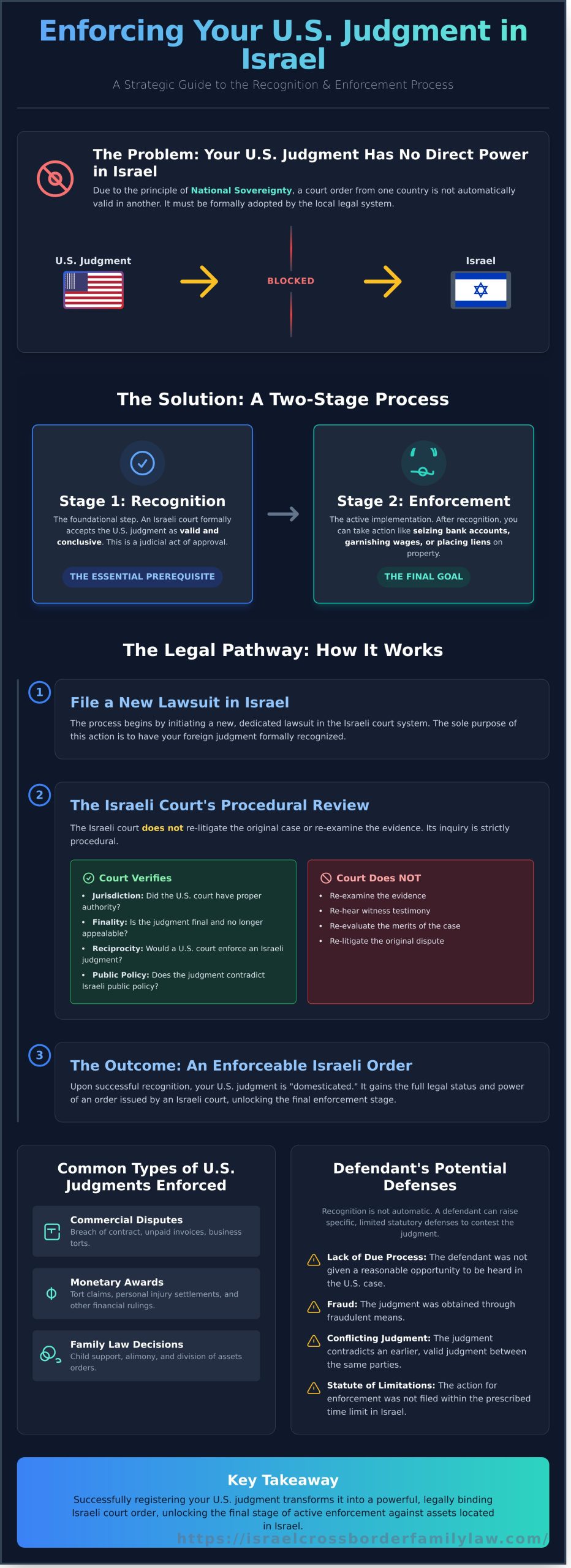
A final judgment secured in a United States court represents a significant legal victory. However, its authority is geographically confined by the fundamental principle of national sovereignty, meaning a US court order has no direct legal power within another country’s borders. For a US judgment to have effect in Israel, it must be adopted by the Israeli legal system. This is where the doctrine of comity becomes critical; it is the principle of mutual deference by which one nation’s courts will respect the judicial acts of another. This concept is supported by domestic legislation and evolving international legal frameworks that facilitate cross-border legal resolutions.
To better understand this foundational concept, this brief video provides a helpful overview:
Consequently, a US judgment must be formally domesticated before it can be acted upon within Israel’s jurisdiction. The Israeli legal system requires that the foreign judgment be presented to a local court, which then recognizes and converts it into a binding Israeli order. This crucial step is the core of the process for registering a US judgment, transforming a foreign decree into a locally potent and enforceable instrument.
The Difference Between Recognition and Enforcement
It is essential to distinguish between these two distinct but sequential stages. Recognition is the judicial act of an Israeli court formally accepting the US judgment as valid and conclusive. It is the foundational prerequisite. Enforcement is the subsequent, active implementation of that judgment-such as seizing bank accounts, garnishing wages, or placing liens on property-which is legally impossible without prior recognition by an Israeli court.
Common Misconceptions About International Judgments
A prevalent misconception is the existence of a single “international court” for civil claims; no such body exists for private commercial or personal judgments. Furthermore, simply arranging for a process server to serve US court documents on a defendant in Israel does not grant the judgment enforceability there. Engaging directly with the sophisticated Israeli legal framework is not an optional step but a mandatory requirement for any meaningful collection or compliance efforts.
The Legal Framework: Israel’s Foreign Judgments Enforcement Law
Navigating the enforcement of a foreign monetary award in Israel requires a sophisticated understanding of the governing statutory framework. The entire process for registering a US judgment is dictated by a single, pivotal piece of legislation: Israel’s Foreign Judgments Enforcement Law, 5718-1958. This law establishes the exclusive path for a foreign judgment to be declared enforceable within Israeli jurisdiction.
Crucially, this procedure is not a re-litigation of the original case. The Israeli court will not re-examine the merits or the evidence of the underlying US dispute. Instead, its inquiry is strictly procedural, focusing on whether the US judgment was rendered with proper authority and has achieved finality. Successfully demonstrating compliance with these statutory conditions is the cornerstone of an effective enforcement action.
Core Conditions for Recognition of a US Judgment
For an Israeli court to recognize and enforce a judgment from the United States, the petitioner must prove that several non-negotiable conditions, as stipulated by the Law, have been met. Failure to satisfy any one of these can result in the rejection of the enforcement application. The primary requirements include:
- Jurisdiction: The original US court must have possessed the authority to adjudicate the matter according to Israeli rules of private international law.
- Finality: The judgment must be final and no longer subject to appeal in the US jurisdiction where it was issued.
- Public Policy: The content and enforcement of the judgment must not contradict the laws, public security, or public policy of the State of Israel.
- Enforceability: The judgment must be considered a valid and enforceable order in the state where it was originally granted.
The Principle of Reciprocity
A fundamental pillar of the Israeli enforcement regime is the principle of reciprocity. The Foreign Judgments Enforcement Law requires that the country of origin-in this case, the United States-provides reciprocal treatment to judgments issued by Israeli courts. While no formal enforcement treaty exists between Israel and the United States, Israeli courts have consistently recognized a de facto reciprocity. This acceptance is based on the established and demonstrable practice of US courts enforcing valid Israeli judgments, thereby satisfying this critical requirement for the process for registering a US judgment.
The Step-by-Step Process for Registering Your US Judgment
Securing a judgment in the United States is a significant victory, but transforming it into an enforceable order in Israel requires navigating a distinct and formal legal framework. The process for registering a US judgment is not a mere administrative filing; it involves initiating a new, albeit specialized, lawsuit in an Israeli court. The sole purpose of this action is to request the recognition and declaration of enforceability for your foreign judgment. This multi-jurisdictional procedure demands meticulous attention to detail and strict adherence to Israeli civil procedure. Engaging experienced local counsel is therefore not just advisable but critical for successfully managing this complex undertaking. Our firm provides clear, strategic guidance on how it works for our clients, ensuring every requirement is met with precision.
Step 1: Gathering and Authenticating Documents
The foundation of your Israeli enforcement action is a complete and properly authenticated set of documents. Before a claim can even be drafted, you must collate the necessary paperwork, which serves as the primary evidence for the Israeli court. This initial phase is crucial, as any deficiencies can lead to significant delays or outright rejection of your claim. The core requirements include:
- A Certified Final Judgment: You must obtain a copy of the US judgment certified by the issuing court, confirming that it is final and no longer subject to appeal.
- Apostille Certification: The judgment must be authenticated with an Apostille seal pursuant to the Hague Convention, which validates its origin for use in Israel.
- Sworn Hebrew Translations: All non-Hebrew documents, including the judgment and Apostille, must be translated by a certified notary.
- Proof of Service: Evidence must be provided demonstrating that the defendant was properly served notice of the original US proceedings, satisfying due process requirements.
Step 2: Filing the Statement of Claim in Israel
With authenticated documents in hand, the next step is to draft and file a “Statement of Claim” with the appropriate Israeli court. This legal document must be expertly crafted to meet the specific statutory conditions outlined in Israel’s Foreign Judgments Enforcement Law. It formally petitions the court to recognize the US judgment. The claim, along with all supporting documentation, is then filed, and the requisite court fees, often calculated as a percentage of the judgment’s value and typically amounting to thousands of shekels (₪), must be paid to initiate the proceedings.
Step 3: Serving the Defendant and Court Proceedings
Once filed, the complete Statement of Claim must be properly served upon the defendant in Israel according to Israeli civil procedure rules. The defendant is then granted a specific period to file a “Statement of Defense,” outlining any legal arguments against the judgment’s recognition. While many enforcement actions are straightforward, the defendant may raise defenses, such as a lack of jurisdiction in the original US court or a violation of public policy. The Israeli court may schedule a hearing to consider these arguments before issuing its decision on whether to enforce the US judgment.
Common Types of US Judgments Enforced in Israel
The Israeli legal framework provides a well-defined pathway for the recognition and enforcement of a wide range of final and conclusive judgments originating from United States courts. While the core legal principles apply broadly, the process for registering a US judgment can vary in its practical application depending on the nature of the ruling. The enforcement mechanism is most frequently utilized in two primary domains: complex family law matters and significant civil or commercial disputes involving monetary awards.
Successfully domesticating a foreign order requires a sophisticated understanding of both the originating US legal context and the specific enforcement procedures available under Israeli law. Each case type presents unique nuances that demand specialized cross-border legal counsel to ensure a seamless and effective transition from a US court order to an enforceable Israeli judgment.
Enforcing Family Law Decrees
A significant portion of cross-border enforcement actions involves family law. Israeli courts regularly recognize and enforce final US decrees concerning divorce, the equitable division of marital assets, and detailed child custody or parenting time arrangements. This is a core issue for many international families facing separation, where giving legal effect to a US order in Israel is essential for providing stability and clarity for all parties involved.
Child Support and Alimony Orders
Judgments mandating child support or spousal support (alimony) are frequently registered in Israel to facilitate collection. Once a US support order is recognized by an Israeli court, it empowers the beneficiary to utilize local enforcement mechanisms, such as the Hotzaa L’Poal (Execution Office), to collect payments from a former spouse residing or holding assets in Israel. This is a critical step for ensuring the financial security of children and dependent ex-spouses. Learn more about our dedicated work in cross-border child support enforcement.
Monetary Judgments from Civil and Commercial Cases
The process for registering a US judgment extends robustly into the civil and commercial spheres. This allows creditors to enforce monetary awards stemming from a variety of disputes, including:
- Breach of contract litigation
- Complex business and shareholder disputes
- Personal injury awards and other civil torts
- Unpaid loans or other debt obligations
A crucial requirement for these cases is that the US judgment must be for a specific, determined sum of money. Israeli courts will not enforce judgments that are punitive in nature or that require actions other than the payment of a liquidated debt.
Potential Defenses and Reasons for Refusal
While the Israeli legal system respects the finality of foreign court decisions, the enforcement of a U.S. judgment is not an automatic administrative procedure. The defendant is entitled to raise a limited set of specific defenses as stipulated by Israel’s Foreign Judgments Enforcement Law, 1958. It is crucial to understand that an Israeli court will not re-examine the evidence or re-litigate the merits of the original U.S. case. The court’s inquiry is confined to whether certain procedural and policy-based conditions for enforcement have been met. Anticipating these potential hurdles is a critical component of the process for registering a us judgment.
Lack of Due Process in the Original Proceedings
A primary defense centers on the principle of fundamental fairness. A defendant can argue that the U.S. judgment should not be enforced because they were not afforded a reasonable opportunity to present their case and be heard by the original court. A common and potent example of this defense is improper service of process, where the defendant was not legally notified of the lawsuit and was therefore unable to participate in the proceedings. This defense ensures that only judgments obtained through a fundamentally fair judicial process are recognized in Israel.
Conflict with Israeli Public Policy
An Israeli court may refuse to enforce a foreign judgment if its content, or the obligation it imposes, is fundamentally contrary to the public policy of Israel. This is a high threshold, reserved for exceptional cases where the judgment is considered ‘repugnant’ to Israel’s core societal values and legal principles. Examples where this defense might be successfully invoked include attempts to enforce exorbitant punitive damages, which are not a standard feature of Israeli civil law, or judgments relating to obligations, such as certain gambling debts, that contradict public morals.
Judgment Procured by Extrinsic Fraud
A judgment can be challenged if it was obtained through extrinsic fraud-that is, fraud that was perpetrated upon the court itself, preventing a fair and just trial. This must be distinguished from intrinsic fraud, such as perjury during testimony, which the U.S. court was positioned to address. Proving extrinsic fraud involves demonstrating, for example, that the plaintiff concealed critical evidence or bribed a court official, thereby corrupting the integrity of the judicial process. This is a complex and difficult defense to successfully substantiate.
Successfully navigating these sophisticated legal arguments is essential for the process for registering a us judgment. Our firm possesses the cross-border expertise to advise on the viability of your judgment and represent your interests effectively in Israeli courts. For expert guidance on complex enforcement matters, contact our legal team.
After Recognition: The Final Step of Active Enforcement
Securing a recognition order from an Israeli court is a pivotal achievement in any cross-border legal action. At this stage, your foreign judgment is granted the full legal force and status of a domestic Israeli judgment. However, this judicial validation is only the penultimate step. If the judgment debtor fails to voluntarily comply with the court’s order, the final and most critical phase of the process for registering a us judgment begins: active enforcement.
This transition from legal recognition to tangible recovery is managed not by the courts, but by a distinct and powerful state authority dedicated to collections. It is this step that transforms a legal document into a practical financial reality, ensuring the creditor’s rights are ultimately satisfied.
Using the ‘Hotzaa Lapoal’ (Execution Office)
The enforcement of all civil judgments in Israel is exclusively handled by the Hotzaa Lapoal, the official state Execution and Collection Authority. To initiate enforcement, our legal team opens a formal collection file (tik hotzaa lapoal) on your behalf. This action triggers the issuance of an official warning to the debtor, formally notifying them of the debt and providing a limited period-typically 21 to 30 days-to settle the full amount owed.
Common Enforcement Mechanisms
Should the debtor disregard the formal warning, the Hotzaa Lapoal is empowered with a wide array of potent tools to compel payment. Successfully deploying these mechanisms requires sophisticated legal strategy and a deep understanding of the Israeli enforcement landscape. The most common and effective measures include:
- Garnishment of Assets: Placing immediate holds and subsequent seizures on the debtor’s Israeli bank accounts, wages, and other financial assets held by third parties.
- Property Liens (Ikul): Registering liens against the debtor’s real estate, vehicles, or other significant personal property, preventing their sale or transfer and paving the way for liquidation.
- Travel Restrictions: In certain circumstances, imposing a stay of exit order, which prevents the debtor from leaving the country until the debt is resolved.
Successfully navigating the complexities of the Hotzaa Lapoal is essential to finalizing the process for registering a us judgment. It demands precise execution and experienced counsel to ensure that your recognized judgment results in a successful collection. For comprehensive guidance through every stage of this sophisticated procedure, from initial court filing to final enforcement, contact our firm of cross-border legal experts.
Securing Your Judgment: From US Courtroom to Israeli Enforcement
Successfully enforcing a United States judgment within Israel is not an automatic right but a structured legal undertaking demanding sophisticated guidance. The Israeli Foreign Judgments Enforcement Law provides the critical framework, but navigating its procedural complexities and potential defenses is paramount to a successful outcome. Understanding the complete process for registering a us judgment is the foundational step toward transforming a foreign court order into a locally enforceable decree.
This multi-jurisdictional challenge requires a firm with a proven track record in cross-border judgment enforcement. Our bilingual attorneys possess deep expertise in multi-jurisdictional family law, offering a seamless bridge between the US and Israeli legal systems. We are committed to guiding you through every stage, from initial filing to active enforcement. To ensure your rights are protected and your judgment is effectively recognized, we invite you to request a confidential case review to discuss your US judgment. Take the decisive step toward making your judgment a reality in Israel.
Frequently Asked Questions
How long does the process for registering a US judgment in Israel typically take?
The timeline for enforcing a foreign judgment is contingent upon several factors, primarily whether the debtor contests the registration. An uncontested proceeding can often be concluded within three to six months. However, if the defendant raises substantive legal challenges, the matter will proceed to a full hearing, potentially extending the timeline to 12-18 months or more, subject to the court’s docket and the complexity of the arguments presented.
Do I need to travel to Israel to register my US judgment?
No, your physical presence in Israel is not required to initiate or conclude the registration of a US judgment. Our firm, acting as your local counsel, can manage the entire multi-jurisdictional process on your behalf. Through a duly executed power of attorney, we are authorized to file all necessary applications with the Israeli courts, represent your interests in any hearings, and navigate the procedural requirements, ensuring a seamless execution from abroad.
What are the estimated legal costs and court fees for this process?
The costs are comprised of court fees and legal fees. Court fees are statutorily set, typically calculated as a percentage of the judgment’s value, often around 1.25% for the initial filing. Legal fees vary based on the complexity of the case, with professional fees for a standard, uncontested registration potentially ranging from ₪20,000 to ₪40,000. Costs for sophisticated or contested matters will be significantly higher and are determined on a case-by-case basis.
Can a US default judgment (where the defendant never appeared) be enforced in Israel?
Yes, an American default judgment is generally enforceable in Israel, provided several critical conditions are met. The paramount condition is demonstrating to the Israeli court that the defendant received proper and timely notice of the original US legal proceedings, affording them a reasonable opportunity to defend themselves. The Israeli court will scrutinize the service of process to ensure it complied with both US law and principles of natural justice before recognizing the judgment.
What happens if there is already a conflicting Israeli judgment on the same matter?
The existence of a prior, conflicting Israeli judgment on the same subject matter between the same parties is a significant legal impediment. Under the principle of res judicata, Israeli courts will almost certainly decline to enforce a foreign judgment that contradicts a final ruling from its own jurisdiction. The domestic judgment will take precedence, effectively barring the registration and enforcement of the out-of-state order, which underscores the need for strategic, early legal counsel.
Is it possible to enforce non-monetary judgments, like an order to perform a specific action?
While the process for registering a US judgment is most commonly applied to monetary awards, enforcing non-monetary judgments, such as an order for specific performance or injunctive relief, is possible but more complex. The Israeli court will carefully evaluate whether the foreign order is enforceable “by its nature” and whether it conflicts with Israeli public policy. Enforcement is not automatic and requires a sophisticated legal argument demonstrating its compatibility with local law.

Article by
Gabriel Lior
A Personal Journey That Became a Mission
The advisory was founded by an American father Gabriel Lior, LLB, MBA , global entrepreneur, and cross-border advisor who spent more than a decade navigating the Israeli family court system firsthand and now lives in Singapore with his son.
As a divorced parent in a cross-border family, Gabriel faced nearly every legal challenge a foreign parent can encounter in Israel — including child custody disputes, child support proceedings, property matters in Israel and abroad, false accusations, and complex immigration and relocation proceedings.
Over the years, he learned the hard way how difficult it is for non-Israeli parents to understand the system, identify the right legal strategy, and choose the right legal representation — especially when language, culture, and jurisdictional differences are involved. He also witnessed how foreign parents and new immigrants are often disadvantaged or taken advantage of by service providers and institutions simply because they lack local knowledge or fluency.
From Client to Advisor
To truly understand — and survive — the system, Gabriel pursued formal legal education in Israel, completing two Israeli law degrees, alongside a BA and MBA earned in the United States. This was never about becoming a practicing attorney, but about gaining a deep, structural understanding of how the system works — and where it breaks down for foreign parents.
This rare combination of:
Firsthand client experience
Israeli legal and US business education
International business and negotiation training
Decades of commercial execution
created a unique perspective – one that understands both sides of the table.
After years of litigation, persistence, and at times self-representation, he ultimately succeeded in securing custody of his son and relocating abroad through a rare legal victory in the Israeli Supreme Court — becoming one of the first fathers in Israel to do so under these circumstances.
Disclaimer
Important Disclaimer:
The information provided on this website and in its content is for general informational and educational purposes only and does not constitute legal advice, legal opinion, or legal representation.
Gabriel Lior is not licensed to practice law in Israel (nor is he interested in doing so) and does not provide legal services, despite having completed 2 Law Degrees. The services offered are advisory in nature and are intended to provide general guidance, strategic insight, and information regarding cross-border family law considerations.
No attorney-client relationship is formed by accessing this website, reading its content, or communicating with us.
Any decisions made based on this information are at your own discretion and risk. For legal advice specific to your situation, you should consult a licensed attorney in the relevant jurisdiction.
Where appropriate, we may refer clients to independent, licensed attorneys or professionals. Such referrals do not constitute legal representation and no liability is assumed for services provided by third parties.