If you are a U.S. citizen planning for assets in Israel, or handling an inheritance involving both countries, start with the will, the known assets and any application already filed. This guide introduces Israeli inheritance law for US citizens and the questions to discuss with independent licensed lawyers. The applicable law and procedure depend on the estate and the countries involved.
Need help organizing your next step? Request a confidential review of your US–Israel inheritance situation. Share a brief outline of the countries involved, the assets and any deadline. ICBFL provides independent advisory and informational support; legal advice and representation are provided by independent licensed lawyers.
Core Principles of Israeli Inheritance Law for Foreign Residents
For United States citizens holding assets in Israel, navigating the complexities of cross-border estate administration requires a foundational understanding of the governing legal framework. The State of Israel maintains a distinct and sovereign legal system for succession, which dictates the transfer of any assets located within its territory upon an individual’s death. This system operates independently of the deceased’s nationality or country of residence, making it imperative for foreign nationals to comprehend its core tenets to ensure their estate plans are both valid and enforceable.
To better understand these complex, multi-jurisdictional issues, the following video provides a valuable overview:
Jurisdiction: Israeli Courts’ Authority Over Local Assets
The fundamental principle of jurisdiction is territorial. Any asset physically situated within Israel, including real estate, bank accounts, investment portfolios, and business interests, falls under the exclusive authority of Israeli courts for matters of inheritance. This legal precedent applies universally, regardless of whether the deceased was a citizen of the United States or any other foreign nation. Consequently, a U.S. court order or grant of probate concerning Israeli assets is not automatically enforceable and typically requires recognition and validation through a formal proceeding in an Israeli court.
The Two Paths of Inheritance: By Will or By Law
Israel’s Succession Law of 1965, the primary statute governing these matters, establishes two clear and distinct pathways for the devolution of an estate. Navigating global Inheritance laws requires understanding these local distinctions. The two paths in Israel are:
- Inheritance by Will (Testate Succession): Israel’s legal system places a high value on respecting the final wishes of the deceased. A legally valid will, whether drafted in Israel or abroad, serves as the primary instrument for directing the distribution of the estate’s assets.
- Inheritance by Law (Intestate Succession): In the absence of a valid will, the estate is distributed according to a statutory hierarchy of heirs defined in the Succession Law. This default mechanism designates spouses, children, parents, and other relatives as beneficiaries in a prescribed order.
Understanding Inheritance Tax: Israel vs. The United States
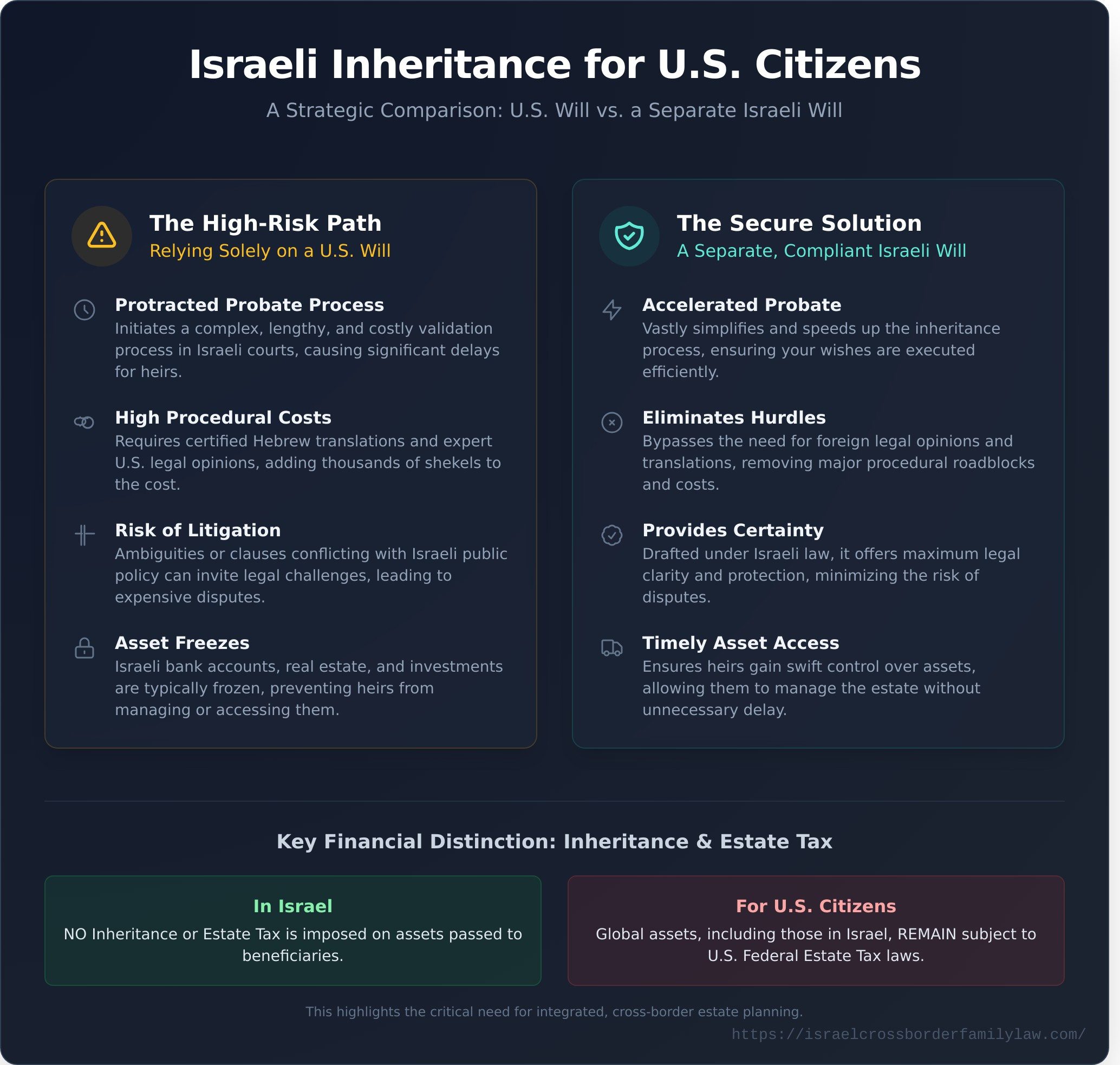
A significant point of divergence between the two legal systems concerns taxation. Israel does not currently impose an inheritance tax or an estate tax on assets passed to beneficiaries. This provides a considerable financial advantage compared to the U.S. federal estate tax regime. However, it is critical for U.S. citizens to recognize that their global assets, including those in Israel, remain subject to U.S. tax law. This dual-jurisdiction reality underscores the complexities of the israeli inheritance law for us citizens and the necessity for sophisticated, cross-border tax and estate planning.
The Critical Question: Is a US Will Valid for Assets in Israel?
A will made in the United States raises questions about its validity, the law applicable to the estate, and the documents required for an Israeli application. Have an independent licensed lawyer review the will and the estate facts before deciding whether another will is appropriate.
Legal Recognition of Foreign Wills in Israel
The validity of the will and the law governing distribution are questions to review separately. Give the lawyer the complete will, details of the deceased’s residence and citizenship, and a list of the assets and countries involved.
Practical Questions When Using a US Will
For the Israeli application, check the original will, the deceased’s identification and death records, and any foreign probate order already issued. The Inheritance Registrar’s document guidance describes a particular route where the original will is abroad and cannot be submitted and a properly authenticated foreign probate order exists. Ask the lawyer handling the file which route and supporting documents apply, including any translation or foreign-law opinion needed in your circumstances.
Considering a Separate Israeli Will
A separate will for Israeli assets may be an option to discuss, but do not assume that it eliminates foreign-law questions, guarantees faster probate, or prevents disputes. Review any proposed will alongside existing wills and beneficiary arrangements so that the documents work together. Request a confidential case review to discuss your estate-planning questions.
Managing an inheritance from outside Israel? Use our preparation checklist for non-resident heirs to organize the countries involved, available documents, assets and any deadlines before requesting a case review.
Inheritance By Law: What Happens Without a Will (Intestacy)
When an individual passes away without a legally valid will in Israel, their estate is considered “intestate.” The distribution of assets is then governed not by the deceased’s wishes, but by the rigid, default provisions of Israel’s Succession Law, 1965. For American citizens with assets in Israel, understanding these statutory rules is paramount, as they often diverge significantly from common law principles and personal intentions. Navigating the nuances of israeli inheritance law for us citizens is crucial to prevent unintended and often undesirable outcomes for your beneficiaries.
The Statutory Order of Succession in Israel
The Israeli Succession Law establishes a clear and inflexible hierarchy for distributing an intestate estate. The law identifies three primary “orders” or tiers of heirs, and the estate passes to the highest surviving tier. If there are heirs in a higher tier, the lower tiers are excluded entirely. This structured approach leaves no room for judicial discretion based on the deceased’s presumed wishes or the needs of the heirs.
- First Order Heirs: The deceased’s surviving spouse and children are the primary inheritors.
- Second Order Heirs: If the deceased has no children, the estate is divided between the surviving spouse and the deceased’s parents.
- Third Order Heirs: In the absence of children or parents, the law dictates succession by the deceased’s grandparents and their descendants.
How a Surviving Spouse’s Share is Determined
A surviving spouse is granted specific rights under Israeli intestacy law. The spouse is automatically entitled to the family automobile and all movable household property (furniture, appliances, etc.) that was part of the common household. After these items are allocated, the spouse inherits a share of the remaining estate. When inheriting alongside the deceased’s children or parents (First or Second Order Heirs), the spouse is entitled to exactly one-half of the estate. This share may increase if no other close relatives survive the deceased.
Distribution of Assets Among Children and Other Heirs
The portion of the estate not allocated to the surviving spouse is distributed among the other heirs in their respective tier. In the most common scenario, the deceased’s children inherit the remaining half of the estate, which they share equally among themselves. Should one of the deceased’s children have passed away prior, their share automatically passes down to their own children (the deceased’s grandchildren). The unyielding nature of this statutory division highlights the critical importance of drafting a will to ensure your assets are distributed according to your specific wishes, a vital step in managing the complexities of israeli inheritance law for us citizens.
The Israeli Probate Process for US Citizens (Tzav Yerusha)
Administering the Israeli assets of a US citizen decedent requires navigating a specific and often complex procedural framework. The ultimate goal is to obtain a legally binding order-either a Succession Order (Tzav Yerusha) for intestate estates or a Probate Order (Tzav Kiyum Tzavah) for testate estates-which grants the heirs legal title to the assets. This process is managed by a distinct administrative body and requires meticulous documentation, particularly in cross-border cases.
Initiating the Process: Filing for a Probate or Succession Order
The first practical step is for an heir, beneficiary, or other interested party to file a formal application with Israel’s Inheritance Registrar (HaRasham Le’Inyanei Yerusha). Upon receipt, the Registrar’s office publishes a notice of the application, opening a period for any party to file an objection. If the application is uncontested and all documentation is in order, the Registrar will issue the final order. However, should an objection be filed, the case is immediately transferred to the jurisdiction of the Family Court for adjudication.
Documents to Check for a US Citizen’s Estate
Prepare the documents you already have, then confirm the requirements for your particular application with the independent licensed lawyer handling the file. The Inheritance Registrar’s probate guidance is a starting point:
- The will: Locate the original. If it cannot be supplied, ask which additional application or foreign-probate documentation is appropriate.
- Identification and death records: Check whether the deceased had an Israeli ID number. The Registrar distinguishes updating an overseas death in the Israeli Population Registry from providing a duly verified death certificate when there is no Israeli ID number.
- Notice and representation: Check the required notices to beneficiaries and any power of attorney where a lawyer represents the applicant.
- Translations and foreign-law material: Ask which translations, authentication and legal opinions are needed for this estate. Do not assume every US document requires the same treatment.
- Application payments: Keep the relevant application-fee and publication-charge confirmations.
Navigating Common Delays and Complications
Cross-border estates frequently encounter specific hurdles that can delay the distribution of assets. Securing an Apostille from a US Secretary of State’s office can be a time-consuming bureaucratic process. Furthermore, effecting formal service of notice to heirs residing in multiple countries presents its own logistical and legal challenges. The potential for objections remains a significant complication, as a contested case will transition from an administrative process to full-scale litigation in the Family Court, adding considerable time and expense. Proactive management by experienced counsel is critical to mitigating these risks. For help organising your questions and identifying next steps, request an advisory case review.
Strategic Estate Planning for US Citizens with Israeli Assets
Understanding the legal framework is the first step; implementing a robust, forward-thinking strategy is what secures your legacy. For US citizens holding assets in Israel, a fragmented approach to estate planning can lead to jurisdictional conflicts, unnecessary tax burdens, and significant delays for beneficiaries. A successful strategy requires a holistic view that integrates both legal systems into a single, cohesive plan, providing clarity and protection for your multi-jurisdictional estate.
Coordinating Your US and Israeli Estate Plans
A common but critical error is creating separate wills that inadvertently conflict with or revoke one another. A US will often contains a standard clause revoking all prior wills, which can unintentionally nullify a carefully crafted Israeli will. To prevent such complications, your international estate plan must be meticulously coordinated. Key considerations include:
- Geographic Specificity: Each will must clearly define its geographic scope. For example, your US will should state it governs assets within the United States, while the Israeli will pertains exclusively to assets located in Israel.
- Clear Language: Utilize precise testamentary language to avoid ambiguity between the documents.
- Allocation of Liabilities: Explicitly detail how debts, administrative expenses, and potential taxes are to be allocated and paid from each jurisdiction’s assets.
Appointing an Executor (Estate Manager) in Israel
The practical administration of an Israeli estate is a significant component of effective planning. While you can appoint a US resident as your executor (known as an Estate Manager in Israel), it often creates logistical and bureaucratic hurdles. Appointing an Israeli resident-whether a trusted individual or a professional-is a strategic decision. A local executor can efficiently manage real estate, interact directly with Israeli banks, and navigate government offices without the challenges of time zones, language barriers, and international travel.
The Indispensable Role of a Cross-Border Attorney
Navigating the complexities of israeli inheritance law for us citizens demands more than just general legal knowledge; it requires sophisticated, dual-qualified counsel. A cross-border attorney with deep expertise in both US and Israeli inheritance and tax laws is essential to architecting a resilient plan. This specialist can anticipate and mitigate potential conflicts, ensuring that your estate is administered seamlessly and efficiently, thereby safeguarding your assets and relieving your loved ones of a complex legal burden. Protecting your global assets requires decisive action and expert guidance. Request a confidential case review about your cross-border estate.
Secure Your Transatlantic Legacy: Final Thoughts on Israeli Inheritance Law
Navigating the intersection of US and Israeli legal systems requires a sophisticated understanding of both jurisdictions. As this guide has detailed, the validity of a US will for Israeli assets is not guaranteed, and the default rules of intestacy can lead to unintended consequences. Proactive, strategic estate planning is therefore not merely advisable but essential for successfully managing israeli inheritance law for us citizens and ensuring your final wishes are honored.
ICBFL provides independent advisory and informational services to help you organise your cross-border questions and understand possible next steps. Where appropriate, we may introduce you to independent licensed attorneys. Legal advice and representation are provided by those attorneys through their own law firms.
Request a confidential case review for your US–Israel inheritance questions. Share the essentials so we can help you identify your next step.
Frequently Asked Questions: Navigating Israeli Inheritance Law for US Citizens
Do I have to travel to Israel to inherit property or go through probate?
No, it is not mandatory for a US citizen to be physically present in Israel to manage inheritance matters. You can grant a power of attorney to an experienced Israeli lawyer, which must be notarized and authenticated with an Apostille in the United States. This legal representative is empowered to handle the entire probate or succession process on your behalf, from filing petitions with the Inheritance Registrar to managing and registering the inherited assets with the relevant authorities.
How are US-based assets like a 401(k) or IRA treated under Israeli law?
Israeli succession law primarily governs assets physically located within Israel. US-domiciled assets, such as a 401(k), IRA, or US bank accounts, fall under the jurisdiction of United States law and are typically distributed according to their specific beneficiary designations. An Israeli probate order will not control these assets. It is critical to coordinate between US and Israeli counsel to ensure a cohesive, multi-jurisdictional estate administration strategy is properly implemented for all assets.
What happens to jointly owned Israeli property when one US citizen owner dies?
Unlike the automatic right of survivorship common in the US, Israeli law treats the deceased’s share of jointly owned property as part of their estate. This interest does not automatically pass to the surviving co-owner. Instead, it is distributed according to the stipulations of the deceased’s will or, in the absence of a will, according to the Israeli Law of Succession. The surviving owner must initiate probate proceedings to legally transfer the deceased’s share to the designated heirs.
How long does the probate process typically take in Israel for a foreigner?
Timing depends on the application, whether the required documents have been supplied, any requests for clarification or objections, and the work needed to administer the assets after an order is issued. The Inheritance Registrar provides general processing guidance, but it is not a guaranteed date for completing a cross-border estate. Ask the independent lawyer handling the matter for an estimate based on your file.
Can a US citizen challenge a will in an Israeli court?
Yes, a US citizen who has legal standing as an interested party (e.g., an heir under law) can contest a will in the Israeli Family Court. Grounds for such a challenge may include lack of testamentary capacity, undue influence, fraud, or errors in the will’s formal execution. This complex litigation requires filing a formal objection with the Inheritance Registrar. Successfully navigating israeli inheritance law for us citizens in a contentious proceeding demands sophisticated and experienced legal representation.
Are there specific rules for inheriting Israeli real estate as a non-citizen?
Generally, US citizens face no prohibitive restrictions when inheriting private real estate in Israel. However, complexities can arise if the property is on land administered by the Israel Land Authority (ILA), which may have specific regulations governing the transfer of lease rights to foreign nationals. It is essential to conduct thorough due diligence to confirm the property’s legal status and title. A comprehensive legal review ensures all regulatory compliance for a seamless transfer of ownership.

Article by
Gabriel Lior
A Personal Journey That Became a Mission
The advisory was founded by an American father Gabriel Lior, LLB, MBA , global entrepreneur, and cross-border advisor who spent more than a decade navigating the Israeli family court system firsthand and now lives in Singapore with his son.
As a divorced parent in a cross-border family, Gabriel faced nearly every legal challenge a foreign parent can encounter in Israel — including child custody disputes, child support proceedings, property matters in Israel and abroad, false accusations, and complex immigration and relocation proceedings.
Over the years, he learned the hard way how difficult it is for non-Israeli parents to understand the system, identify the right legal strategy, and choose the right legal representation — especially when language, culture, and jurisdictional differences are involved. He also witnessed how foreign parents and new immigrants are often disadvantaged or taken advantage of by service providers and institutions simply because they lack local knowledge or fluency.
From Client to Advisor
To truly understand — and survive — the system, Gabriel pursued formal legal education in Israel, completing two Israeli law degrees, alongside a BA and MBA earned in the United States. This was never about becoming a practicing attorney, but about gaining a deep, structural understanding of how the system works — and where it breaks down for foreign parents.
This rare combination of:
Firsthand client experience
Israeli legal and US business education
International business and negotiation training
Decades of commercial execution
created a unique perspective – one that understands both sides of the table.
After years of litigation, persistence, and at times self-representation, he ultimately succeeded in securing custody of his son and relocating abroad through a rare legal victory in the Israeli Supreme Court — becoming one of the first fathers in Israel to do so under these circumstances.
Disclaimer
Important Disclaimer:
The information provided on this website and in its content is for general informational and educational purposes only and does not constitute legal advice, legal opinion, or legal representation.
Gabriel Lior is not licensed to practice law in Israel (nor is he interested in doing so) and does not provide legal services, despite having completed 2 Law Degrees. The services offered are advisory in nature and are intended to provide general guidance, strategic insight, and information regarding cross-border family law considerations.
No attorney-client relationship is formed by accessing this website, reading its content, or communicating with us.
Any decisions made based on this information are at your own discretion and risk. For legal advice specific to your situation, you should consult a licensed attorney in the relevant jurisdiction.
Where appropriate, we may refer clients to independent, licensed attorneys or professionals. Such referrals do not constitute legal representation and no liability is assumed for services provided by third parties.