
This article is published on an independent advisory platform (not a law firm) and does not constitute an attorney-client relationship. Legal services are only provided by licensed attorneys under a separate engagement.
What if your status as a “married” spouse in your home country doesn’t automatically grant you 100% of your late partner’s assets in Israel? Many international families assume that joint ownership or simple marriage certificates bypass local probate, but the reality is often more complex. Understanding the israeli inheritance rights of a surviving spouse is critical because, under the Succession Law of 1965, you may find yourself sharing an estate with children or even in-laws if a proactive strategy isn’t in place. This can be especially jarring for those used to different jurisdictional rules where the spouse typically inherits everything by default.
It’s natural to feel anxious about assets being “locked” in a foreign system or to worry about the influence of the Rabbinical courts. we recognize that you need security and clarity during a difficult transition. This guide provides a clear roadmap of the current rules, including why you might only receive 50% of the estate and how common-law status is treated in Israel. You’ll learn how to navigate jurisdictional risks and the strategic steps needed to secure your inheritance without unnecessary burdens. Get clarity before you commit. Request a confidential consultation.
This article is published on an independent advisory platform (not a law firm) and does not constitute an attorney-client relationship. Legal services are only provided by licensed attorneys under a separate engagement.
Key Takeaways
- Understand how the Succession Law of 1965 governs asset distribution when no will is present, specifically regarding the shares allocated to children and parents.
- Gain clarity on the israeli inheritance rights of a surviving spouse, including the default 50% split and the ownership of movable household property.
- Learn the legal criteria for common-law status and the specific evidence required to establish inheritance rights for unmarried partners in the Israeli system.
- Explore the jurisdictional differences between Family and Rabbinical courts to understand how the first filing can dictate the legal framework of your case.
- Discover strategic steps for coordinating cross-border assets to ensure a seamless transition between international probate and Israeli succession systems.
This article is published on an independent advisory platform (not a law firm) and does not constitute an attorney-client relationship. Legal services are only provided by licensed attorneys under a separate engagement.
Surviving Spouse Rights Under the Israeli Succession Law of 1965
The Succession Law of 1965 serves as the primary legal framework for all inheritance matters in Israel. It dictates how assets are distributed when an individual passes away without a valid will. For international families, understanding the israeli inheritance rights of a surviving spouse is essential because local regulations often differ significantly from those in the US or UK. While many assume that a spouse automatically inherits the entire estate, the law in Israel creates a specific hierarchy that includes children and parents of the deceased.
The Ministry of Justice oversees the Registrar of Inheritance, which applies these rules to both residents and non-residents with assets in Israel. Under the default intestacy rules, the surviving spouse is entitled to a specific portion of the estate, but the exact percentage depends on which other relatives are alive. This system aims to balance the needs of the spouse with the rights of the broader family. It’s important to remember that these rules apply strictly to assets located in IL, regardless of the deceased’s citizenship or the laws of their home country.
What Constitutes a Valid Marriage in Israel?
Determining marital status is the first step in any probate proceeding. Israel generally recognizes civil marriages performed abroad, such as those in the US or Europe, for the purpose of inheritance. This is a vital distinction for expats and foreign nationals who may not have had a religious ceremony. A spouse remains an heir even if the couple was “separated” at the time of death, provided no final divorce decree was issued. This legal reality often surprises families where partners have lived apart for years. Clarity on this status is required before the Registrar will issue an Inheritance Order.
Movable Property vs. The Rest of the Estate
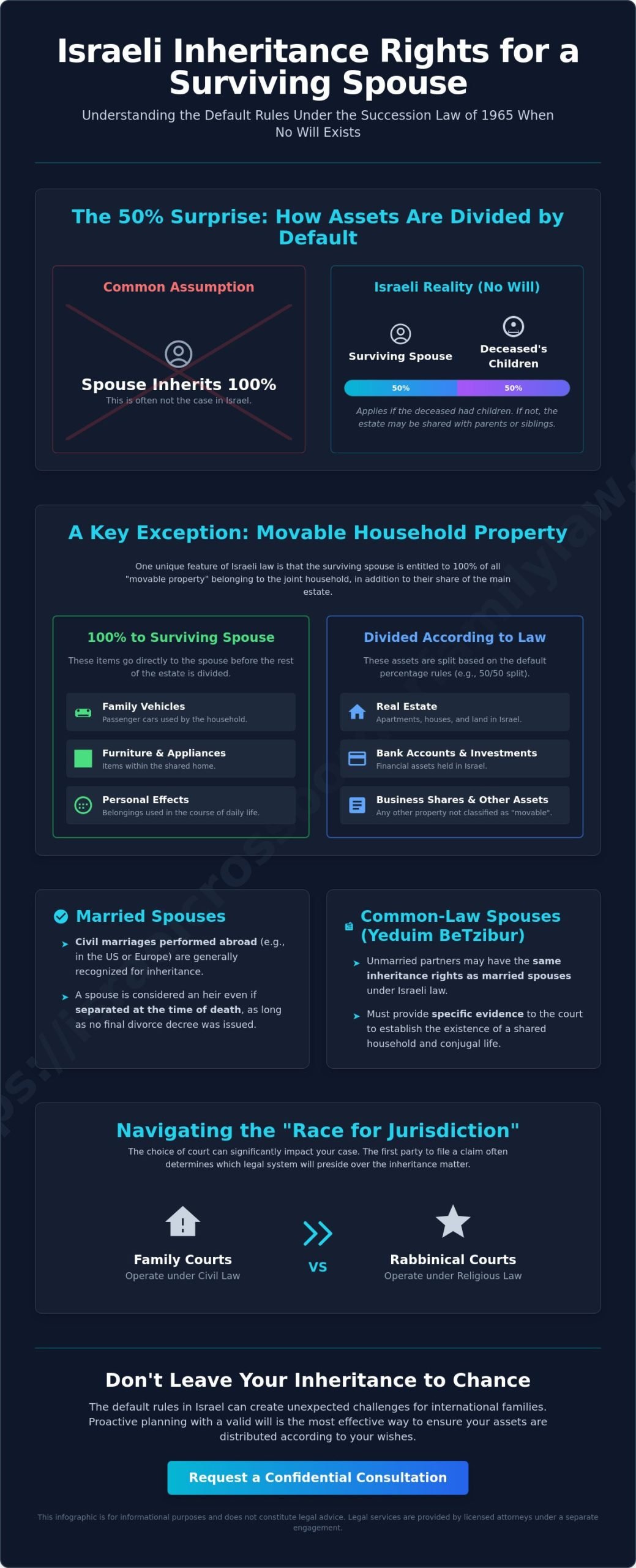
One unique feature of Israeli law is the treatment of movable property. The surviving spouse is entitled to 100% of all “movable property” that belongs to the joint household. This typically includes:
- Passenger cars and other family vehicles
- Furniture and household appliances
- Personal effects used within the home
The rest of the estate, including real estate, bank accounts, and investments, is then divided according to the percentage rules. Because movable property often carries significant sentimental or practical value, it can become a point of contention with other heirs. Managing these expectations early is a key part of an effective cross-border strategy. Understanding the israeli inheritance rights of a surviving spouse regarding these specific assets can prevent long disputes between family members.
Get clarity before you commit. Request a confidential consultation.
This article is published on an independent advisory platform (not a law firm) and does not constitute an attorney-client relationship. Legal services are only provided by licensed attorneys under a separate engagement.
The Distribution of Assets: Who Gets What Share?
Israeli law does not follow a “survivor takes all” principle by default. For expats and foreigners, this often creates unexpected hurdles during the probate process. If a person dies without a valid Israeli will, the estate is divided through a rigid, percentage-based system. The israeli inheritance rights of a surviving spouse are defined by which other relatives are alive at the time of the passing. This structure can lead to situations where a spouse must share ownership of bank accounts or real estate with the deceased’s children or even their siblings.
The distribution typically follows two primary scenarios:
- Scenario A: Spouse vs. Children: When the deceased is survived by children, the spouse receives 50% of the estate. The remaining 50% is divided equally among the children.
- Scenario B: Spouse vs. Parents or Siblings: If there are no children, but the deceased’s parents or siblings are still alive, the spouse’s share increases to two-thirds (66.6%). The final third is distributed to the parents or siblings.
A common risk for cross-border families involves the interaction between US wills and Israeli probate. If a US will isn’t properly validated in IL or fails to meet specific formal requirements, the Registrar of Inheritance may default to these percentage splits. This can “lock” assets in shared ownership between a widow and her in-laws, making it difficult to manage or sell property without unanimous consent. You should seek to understand these risks before assets become tied up in the local system.
The ‘Apartment Rule’: Protecting the Family Home
The law provides additional protection for the surviving spouse regarding the primary residence. The ‘Apartment Rule’ stipulates that a surviving spouse may inherit the deceased’s entire share in the family home if they resided together in that property for a minimum of three years leading up to the passing. This rule prevents the spouse from being forced out of their home by other heirs who might want to liquidate their share of the estate. However, this only applies if certain conditions are met, such as the apartment being the couple’s actual primary residence rather than a vacation property.
Inheritance Rights vs. Ketubah Claims
Religious marriage contracts, known as a Ketubah, can influence civil inheritance shares in Israel. A widow may technically have a claim for the amount promised in her Ketubah, but the law generally prevents “double dipping.” In the Rabbinical court, a spouse often has to choose between the Ketubah payment or their share of the inheritance. Pursuing both simultaneously can lead to significant strategic risks and may result in the civil court deducting the Ketubah amount from the final inheritance share. Get clarity before you commit. Request a confidential consultation.
This article is published on an independent advisory platform (not a law firm) and does not constitute an attorney-client relationship. Legal services are only provided by licensed attorneys under a separate engagement.
The ‘Common-Law’ Spouse: Rights of Unmarried Partners (Yeduim BeTzibur)
Israel possesses a progressive legal framework that recognizes the rights of unmarried couples, known as Yeduim BeTzibur (Known in Public). Under the Succession Law of 1965, a common-law partner may be entitled to the same israeli inheritance rights of a surviving spouse as a legally married person. However, these rights are not automatic. While a marriage certificate provides immediate proof of status, an unmarried partner must satisfy a rigorous two-pronged test in the Israeli Family Court. The court requires evidence of an intimate relationship similar to a marriage and the maintenance of a shared household.
For expats and international families, this burden of proof can be exceptionally high. Many cross-border couples maintain separate bank accounts or keep property in different countries for tax or personal reasons. In the eyes of the Israeli Ministry of Justice, these separate financial lives can undermine a claim of being “common-law.” A significant risk also exists regarding “competing spouses.” If a partner is still legally married to someone else abroad but living with a new partner in IL, the estate may become the subject of a multi-year legal battle between the legal spouse and the common-law partner.
Proving the Relationship to the Israeli Family Court
Proving a shared life requires concrete documentation. The court typically looks for joint lease agreements, shared utility bills, or evidence of joint bank accounts. Witness testimony from friends and neighbors is also common. A major pitfall for international residents involves maintaining separate residences for “tax purposes” or “residency requirements” in another country. If you have officially declared separate households to tax authorities, the Israeli Family Court may use those declarations to deny your inheritance claim. Seeking clarity on your status before a partner passes is vital for long-term security.
Common Pitfalls for International Couples
It’s important to understand that “Common-law” status in certain US states or European countries is often narrower than the Israeli concept of Yeduim BeTzibur. Conversely, some couples assume their foreign domestic partnership is automatically recognized in IL. The most effective way to solidify the israeli inheritance rights of a surviving spouse in an unmarried relationship is through a Heskem Mamon (Financial Agreement). This document, when approved by a court, acts as the “gold standard” for defining rights. For more information on this topic, you can view the guide on Common Law Rights in Israel. Get clarity before you commit. Request a confidential consultation.
This article is published on an independent advisory platform (not a law firm) and does not constitute an attorney-client relationship. Legal services are only provided by licensed attorneys under a separate engagement.
Navigating the Race for Jurisdiction: Civil vs. Rabbinical Courts
Israel’s legal landscape features a dual-court system that can significantly impact the israeli inheritance rights of a surviving spouse. While the civil Registrar of Inheritance handles most cases under the Succession Law of 1965, the Rabbinical courts also hold authority over inheritance matters. This parallel system creates a “race for jurisdiction” where the first party to file an application often determines which legal framework will govern the estate’s distribution. Understanding how our cross-border advisory works can help you identify these jurisdictional risks before a conflict arises.
For a Rabbinical court to take jurisdiction, all legal heirs must provide their written consent. However, international families often find themselves in these courts unintentionally. If one heir applies to the Rabbinical court and the surviving spouse fails to object or inadvertently signs a consent form, they may be bound by religious law. This is a critical strategic point because Rabbinical courts may interpret spousal support and estate division through the lens of Halacha (Jewish law), which can differ from the civil court’s 50/50 or 2/3 splits discussed in previous sections.
Strategic Filing: Why Speed and Geography Matter
The choice of where to file is not merely administrative; it is a tactical decision that can dictate the outcome of the entire probate process. The ‘first to file’ rule can fundamentally change the outcome of the estate distribution by locking the case into a specific court’s ideology. If a spouse wishes to ensure the protections of the civil Succession Law, they must act quickly to file with the Registrar of Inheritance. Delaying this step allows other heirs, who might benefit from a different legal interpretation, to seize the initiative in a religious forum.
The Role of the Israeli Administrator General
In cases involving foreign heirs or assets located abroad, the Israeli Administrator General (HaApotropos HaKlali) frequently intervenes. This government body acts as a supervisor to ensure that the rights of all heirs, especially those not present in IL, are protected. While this provides a layer of security, it also adds complexity. The Administrator General will review every probate application and issue a formal “Response” to the court. Preparing for this state-level scrutiny is essential for any surviving spouse seeking to release “locked” assets. To ensure your strategy accounts for these government interactions, request a confidential case review.
This article is published on an independent advisory platform (not a law firm) and does not constitute an attorney-client relationship. Legal services are only provided by licensed attorneys under a separate engagement.
Strategic Steps for Spouses with Assets in Israel and the US
Securing your future requires a proactive approach that looks beyond domestic borders. While a standard US will is a vital component of estate planning, it may not be sufficient to protect the israeli inheritance rights of a surviving spouse without significant administrative hurdles. Validating a foreign will in Israel often requires an “Expert Opinion on Foreign Law,” a document that can cost between ₪5,000 and ₪15,000 as of early 2026. To bypass these costs and the complexities of the Israeli probate system, many international families choose to execute an Israeli-specific will that deals exclusively with assets located in IL.
The first 30 days following the loss of a partner are often the most critical for legal standing. This period is when the “race for jurisdiction” typically begins, and early decisions can dictate whether the estate is handled by the civil Family Court or the Rabbinical system. Protecting your israeli inheritance rights of a surviving spouse involves navigating the interplay between US probate and Israeli succession rules before assets become “locked” by government intervention or competing claims from other heirs.
The Probate Process for US Residents
For those residing in the US, the process begins with filing for a Succession Order (Tzav Yerusha) through the Registrar of Inheritance. You’ll need to provide original documents, such as marriage and death certificates, which must be apostilled and translated into Hebrew by a certified professional. Common delays in the Israeli system often stem from incomplete documentation or a lack of response to the Administrator General. Mitigating these delays requires a clear understanding of the Ministry of Justice’s requirements for foreign residents, ensuring that your application is robust from the moment of filing.
Mitigating Conflict with Other Heirs
Cross-border inheritance frequently involves managing the expectations of children or siblings who may have legal claims to 50% or 1/3 of the estate. Clear communication is essential to avoid multi-year litigation that can deplete the estate’s value. Many families find success through a “Settlement of Estate” agreement, which allows heirs to redistribute assets in a way that honors the deceased’s wishes while providing immediate security for the spouse. This advisory approach focuses on maintaining family relationships through strategy rather than emotional reaction. Success in these matters depends on making informed, risk-based decisions early in the process. Get clarity before you commit. Request a confidential consultation.
This article is published on an independent advisory platform (not a law firm) and does not constitute an attorney-client relationship. Legal services are only provided by licensed attorneys under a separate engagement.
Securing Your Legacy Across Borders
Understanding the israeli inheritance rights of a surviving spouse requires a strategic shift from assuming automatic succession to mastering local statutory shares. You now recognize how the Succession Law of 1965 divides estates and how the “race for jurisdiction” can fundamentally alter your legal standing. Early intervention is key. Whether you are seeking common-law recognition or managing assets from abroad, proactive planning mitigates conflict. Our advisory provides specialized expertise in US-Israel cross-border family law, drawing on decades of experience navigating both the Family and Rabbinical court systems. We offer authoritative guidance tailored for the international Anglo community. Get clarity before you commit. Request a confidential consultation to begin your risk-based strategy. Taking these steps today ensures your family’s interests remain protected within the complex Israeli legal landscape.
This article is published on an independent advisory platform (not a law firm) and does not constitute an attorney-client relationship. Legal services are only provided by licensed attorneys under a separate engagement.
Frequently Asked Questions
Does a surviving spouse in Israel automatically inherit the entire estate?
No, a spouse does not automatically inherit everything under the Succession Law of 1965. If the deceased is survived by children or parents, the spouse typically receives 50% of the estate plus movable household property. The remaining half is distributed among the children or parents. A spouse only inherits 100% of the assets if there are no children, grandchildren, parents, or siblings of the deceased.
Can my children claim my house in Israel after my spouse passes away?
Children are legal heirs and are entitled to their portion of the estate, which may include a share of the family home. However, the law provides a specific “Apartment Rule” that protects the surviving spouse. If the couple lived together in the residence for at least three years prior to the death, the spouse may be entitled to the deceased’s entire share of that specific property to ensure housing stability.
Is a US marriage certificate recognized for inheritance rights in Israel?
Yes, Israel recognizes foreign civil marriages for the purpose of defining the israeli inheritance rights of a surviving spouse. You must provide an original certificate that has been apostilled in the US and translated into Hebrew by a certified Israeli notary. This documentation is essential for the Registrar of Inheritance to issue a Succession Order for an international family.
What is the difference between the Family Court and the Rabbinical Court for inheritance?
The Family Court applies civil statutes while the Rabbinical Court operates under religious law. While the Succession Law of 1965 is the default, the Rabbinical Court can only handle the case if every single heir provides written consent. This is a vital strategic distinction because religious courts may interpret spousal support and asset distribution differently than the civil system.
Do common-law partners have the same inheritance rights as married spouses in Israel?
Yes, common-law partners, known as Yeduim BeTzibur, have equal rights to married spouses provided they meet specific criteria. They must prove they maintained a joint household and an intimate relationship at the time of death. Additionally, neither partner can be legally married to another person for these rights to be recognized by the Israeli Family Court.
How long does the probate process take for a surviving spouse in Israel?
The process generally takes between three and nine months to complete. For cross-border families, the timeline is often longer because the court may require an “Expert Opinion on Foreign Law.” This opinion, which can cost between ₪5,000 and ₪15,000, is necessary to verify how the law of the deceased’s home country impacts the Israeli assets.
What happens to Israeli bank accounts if a spouse dies without a will?
Local bank accounts are typically frozen immediately upon the bank receiving notice of the death. These funds cannot be accessed or transferred until a formal Succession Order is issued by the Registrar of Inheritance. Once the order is granted, the bank will distribute the balances according to the legal percentages, such as the 50/50 split between a spouse and children.
Are there inheritance taxes for a surviving spouse in Israel?
There is no inheritance or estate tax in Israel. This tax was abolished on April 1, 1981, and there are no active legislative plans to reintroduce it as of May 2026. However, heirs should be aware of a 25% capital gains tax on the real profit if they choose to sell an inherited property later. Get clarity before you commit. Request a confidential consultation.

Article by
Gabriel Lior
A Personal Journey That Became a Mission
The advisory was founded by an American father Gabriel Lior, LLB, MBA , global entrepreneur, and cross-border advisor who spent more than a decade navigating the Israeli family court system firsthand and now lives in Singapore with his son.
As a divorced parent in a cross-border family, Gabriel faced nearly every legal challenge a foreign parent can encounter in Israel — including child custody disputes, child support proceedings, property matters in Israel and abroad, false accusations, and complex immigration and relocation proceedings.
Over the years, he learned the hard way how difficult it is for non-Israeli parents to understand the system, identify the right legal strategy, and choose the right legal representation — especially when language, culture, and jurisdictional differences are involved. He also witnessed how foreign parents and new immigrants are often disadvantaged or taken advantage of by service providers and institutions simply because they lack local knowledge or fluency.
From Client to Advisor
To truly understand — and survive — the system, Gabriel pursued formal legal education in Israel, completing two Israeli law degrees, alongside a BA and MBA earned in the United States. This was never about becoming a practicing attorney, but about gaining a deep, structural understanding of how the system works — and where it breaks down for foreign parents.
This rare combination of:
Firsthand client experience
Israeli legal and US business education
International business and negotiation training
Decades of commercial execution
created a unique perspective – one that understands both sides of the table.
After years of litigation, persistence, and at times self-representation, he ultimately succeeded in securing custody of his son and relocating abroad through a rare legal victory in the Israeli Supreme Court — becoming one of the first fathers in Israel to do so under these circumstances.
Disclaimer
Important Disclaimer:
The information provided on this website and in its content is for general informational and educational purposes only and does not constitute legal advice, legal opinion, or legal representation.
Gabriel Lior is not licensed to practice law in Israel (nor is he interested in doing so) and does not provide legal services, despite having completed 2 Law Degrees. The services offered are advisory in nature and are intended to provide general guidance, strategic insight, and information regarding cross-border family law considerations.
No attorney-client relationship is formed by accessing this website, reading its content, or communicating with us.
Any decisions made based on this information are at your own discretion and risk. For legal advice specific to your situation, you should consult a licensed attorney in the relevant jurisdiction.
Where appropriate, we may refer clients to independent, licensed attorneys or professionals. Such referrals do not constitute legal representation and no liability is assumed for services provided by third parties.
Related Insights & Resources

US Paternity in Israel: Cross-Border Legal Guide (2026)
Birth registration, parentage evidence and U.S. consular documents for U.S.–Israeli families: what to clarify before...Read More →
Disagree with Your Israel Lawyer’s Strategy? Here is What to Do
This article is published on an independent advisory platform, not a law firm. The content...Read More →
Understanding Segal Simchauve: A Guide to US-Israel Cross-Border Family Law
This content is published on an independent advisory platform and is intended for informational purposes...Read More →