Could a single signature in a Modi’in law office unintentionally jeopardize your US retirement accounts? Many international couples assume a standard Israeli financial agreement covers all bases, but cross-border assets like 401(k)s and US-based real estate require a more sophisticated approach. Finding a US-Israel prenuptial agreement lawyer Modi’in families can rely on is about more than just translation. It’s about ensuring your agreement stands up to scrutiny in both the Israeli Family Court and American jurisdictions.
You likely feel the weight of these decisions, especially with the 2026 updates to Israeli tax reporting for new immigrants and the shifting jurisdiction of Rabbinical Courts. It’s understandable to worry about the “Race to the Court” or whether your local agreement will be recognized abroad. This guide, compiled by the Israel Cross Border Law Firm, explains how to select a professional who understands the interplay between the Spouses’ Property Relations Law and US state laws. We’ll walk you through essential 2026 filing requirements, the importance of court ratification, and how to protect your global interests. Please note that this content is published on an independent advisory platform and does not constitute formal legal representation.
Key Takeaways
- Identify why a standard Israeli “Heskem Mamon” may not be sufficient to protect your US-based retirement accounts or real estate.
- Review the essential qualifications for a US-Israel prenuptial agreement lawyer Modi’in to ensure your document is enforceable in both countries.
- Understand the critical differences between Israeli court ratification and US legal standards regarding asset disclosure.
- Learn how a harmonized drafting process in both English and Hebrew creates a strategic bridge between two legal cultures.
- Discover how a custom advisory approach helps you navigate the inherent complexity of multi-jurisdictional asset division.
Why Cross-Border Expertise is Non-Negotiable for Modi’in Expats
Families in Modi’in often hold a blend of assets, from local apartments to US-based brokerage accounts. A Prenuptial agreement serves as a foundational tool for these couples, but a standard Israeli template rarely suffices for those with ties to the United States. A cross-border prenup is a specialized document that satisfies the unique disclosure laws of US states while meeting Israeli court approval. This dual-layered approach is essential in 2026, as new reporting requirements for immigrants mean that foreign assets must be disclosed to the Israel Tax Authority, making financial transparency more critical than ever.
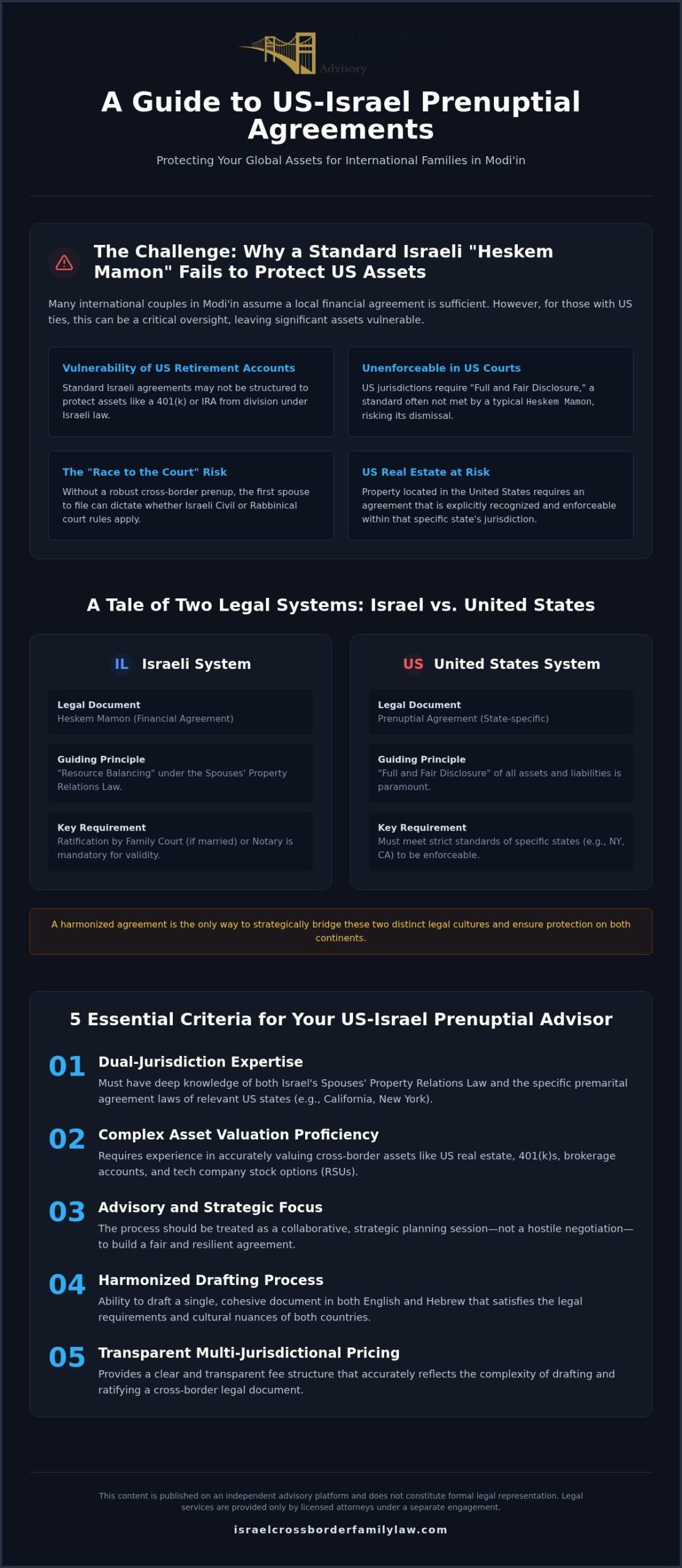
In Israel, the “Race to the Court” creates a strategic urgency that many expats don’t fully realize until it’s too late. The first party to file for divorce in either the civil Family Court or the Rabbinical Court can dictate which legal system governs the division of assets. Without a robust agreement, your US 401(k) or an inheritance could be subject to “Resource Balancing” under the 1973 Spouses’ Property Relations Law. A qualified US-Israel prenuptial agreement lawyer Modi’in can help draft a document that overrides these default rules in both jurisdictions, providing a level of security that spans continents. This content is published on an independent advisory platform and does not constitute formal legal representation; legal services are provided only by licensed attorneys under a separate engagement with Israel Cross Border Law Firm.
To better understand how these agreements function within the Israeli system, watch this helpful video:
The Risk of Local-Only Legal Counsel
Local-only counsel often relies on the Heskem Mamon, which is a standard Israeli financial agreement. While this is valid within IL, it’s frequently dismissed by US courts if it lacks “Full and Fair Disclosure.” US jurisdictions often require a detailed listing of all assets and liabilities to ensure the agreement wasn’t signed under duress. If your agreement doesn’t meet these specific American standards, your US-based assets remain vulnerable during litigation. Cultural nuances also play a role; what an Israeli judge considers a “fair” division might differ significantly from the expectations of a US court.
Modi’in: A Hub for International Families
Modi’in-Maccabim-Re’ut has become a primary hub for Anglo expats who maintain strong financial ties to North America. Its proximity to the Central District Family Court makes it a convenient base for legal proceedings, but the process requires precision. Local notaries can approve agreements for couples who aren’t yet married, but for those already wed, court ratification is mandatory. Navigating these nuances requires an advisory focus that bridges the gap between systems. For those navigating these hurdles, understanding how the advisory process works can provide much-needed clarity before making any long-term commitments.
5 Criteria for Selecting a US-Israel Prenuptial Lawyer
Selecting a US-Israel prenuptial agreement lawyer Modi’in families can trust involves looking beyond a simple law license. You need a professional who understands that an agreement must satisfy the strict requirements of US law on premarital agreements while remaining valid under the Israeli Spouses’ Property Relations Law. This dual focus ensures that your document isn’t just a piece of paper, but a strategic shield for your global interests. Learn more about our cross-border advisory approach for these complex scenarios.
A qualified practitioner should meet the following five benchmarks:
- Dual-Jurisdiction Expertise: They must know why specific disclosure standards in states like New York or California might impact an agreement signed in Modi’in.
- Asset Valuation Proficiency: Experience valuing tech stock options (RSUs) and US real estate is essential, as these require different actuarial approaches than local Israeli assets.
- Advisory Focus: Prioritize a professional who views the process as a collaborative strategy rather than a hostile negotiation.
- Transparent Multi-Jurisdictional Pricing: Seek clear fee structures that account for the complexity of drafting and reviewing documents in both English and Hebrew.
- Strategic Coordination: The practitioner should be able to work alongside your existing US tax or estate planners to ensure total alignment.
Verifying Cross-Border Credentials
Ask prospective lawyers about their specific experience with US state courts. There’s a vast difference between a lawyer who simply speaks English and one who understands the nuances of US legal concepts like “unconscionability” or “commingled assets.” A multi-qualified practitioner provides a bridge between divergent business cultures, ensuring your Modi’in-signed document carries weight in an American courtroom. It’s often helpful to discuss your specific situation to see if their experience matches your asset profile.
Evaluating Communication and Process
Drafting a pre-marriage agreement is a sensitive time. You should avoid lawyers who adopt an aggressive, litigation-first stance. Instead, look for a firm that can explain complex Israeli legal terms in plain English. The goal is to reach a fair consensus that protects both parties without creating unnecessary friction. This content is published on an independent advisory platform and does not constitute formal legal representation; legal services are provided only by licensed attorneys under a separate engagement.
Comparing Israeli ‘Financial Agreements’ with US Prenuptial Standards
In Israel, a prenuptial agreement, known as a Heskem Mamon, requires formal ratification by a Family Court judge or a notary to be legally binding. This process ensures both parties understand the document’s consequences. Without this official approval, the agreement is often treated as a mere draft. Conversely, US jurisdictions place heavy emphasis on the transparency and “voluntariness” of the process. If a spouse didn’t receive a detailed list of assets before signing, a US judge might discard the agreement as unconscionable. A skilled US-Israel prenuptial agreement lawyer Modi’in ensures the signing process meets both the Israeli court’s procedural requirements and the American standard for full financial disclosure.
Harmonizing these two systems into a single, cohesive document requires more than just a translation. It involves drafting clauses that acknowledge the Spouses’ Property Relations Law of 1973 while explicitly waiving certain rights under US state laws. This dual-layered approach prevents a scenario where an agreement is upheld in Israel but struck down in the US, leaving your foreign assets vulnerable. For those seeking deeper guidance for expats and foreign nationals in Israel, understanding these procedural differences is the first step toward a secure future.
Key Differences in Enforcement
The choice between the Israeli Family Court and the Rabbinical Court is a significant decision for international families in Modi’in. Following the November 2025 legal shift, Rabbinical Courts now have expanded authority to hear child support matters when they are included in a divorce claim. This makes it vital for your agreement to address jurisdictional preferences clearly to avoid “the race to the court.” Additionally, cross-border documents should incorporate provisions regarding the “Gett” (religious divorce) to prevent legal stalemates that civil courts in the US aren’t equipped to handle. It’s about creating a bridge between religious tradition and civil law.
Managing Multi-Jurisdictional Assets
Modi’in is home to many professionals with high-tech equity, such as RSUs and stock options, alongside US-based family businesses. These assets require precise handling. Israeli law’s “Resource Balancing” principle usually splits assets 50/50, but a custom agreement can protect pre-marital wealth or future inheritances originating from the US. If you’re managing complex corporate interests, you might also find value in our guide on Navigating US-Israel M&A and Business Protection. By harmonizing these standards, you create a single document that remains robust whether it’s reviewed in Jerusalem or New York. This content is provided by an independent advisory platform and is not legal advice; always consult a licensed attorney for your specific case.
The Drafting and Execution Process in Modi’in
The execution of a cross-border agreement follows a structured timeline to ensure international enforceability. It’s not a single meeting, but a multi-phase process designed to meet the high standards of both Israeli and US courts. This journey begins with a strategic discovery phase, where all global assets are identified. Under the 2026 reporting updates for new immigrants, disclosing foreign income and assets to the Israel Tax Authority is now mandatory. This transparency aligns perfectly with US legal requirements for “full and fair disclosure.” During this initial stage, it’s helpful to request a review of your specific asset profile to identify potential jurisdictional conflicts early.
Once the discovery phase is complete, the drafting begins. A US-Israel prenuptial agreement lawyer Modi’in will prepare a harmonized document in both English and Hebrew. This isn’t a simple translation; it’s a legal bridge that uses specific terminology recognized by the Israeli Family Court while incorporating the “voluntariness” clauses required by US state laws. After the draft is finalized, it moves to an independent review. Each party must have their own legal counsel to examine the document. This step is non-negotiable for US validity, as it proves that neither spouse was pressured into signing the agreement.
The final phase is the signing ceremony and official ratification. In Israel, a prenuptial agreement signed before marriage can be approved by a notary or a judge. However, for couples who are already married, the document must be ratified by the Family Court. As of July 1, 2026, the Israeli Judicial Authority has set the fee for court approval of a financial agreement at 541 NIS. This ratification gives the agreement the same legal weight as a court judgment, making it much harder to challenge in the future. For more details on the financial aspects of these filings, you can view our overview of cross-border legal costs.
The Importance of Independent Counsel
To satisfy US “due process” requirements, both parties must be represented by separate lawyers. If one lawyer drafts the agreement for both individuals, a US court may later view this as a conflict of interest and throw the document out. Finding a second cross-border lawyer in the Central District ensures that both parties receive unbiased advice. This dual-representation model protects the integrity of the agreement and provides peace of mind that the document will stand up to scrutiny in an American courtroom. It’s a critical step in avoiding “unconscionability” claims years down the line.
Local Logistics in Modi’in
Modi’in residents typically use the Central District Family Court in Lod for their ratification hearings. While the court operates in Hebrew, English-speaking expats can request an interpreter to ensure they fully understand the judge’s questions. In 2026, the timeline for completing a cross-border prenup usually ranges from four to eight weeks, depending on the complexity of the assets involved. This content is published on an independent advisory platform and does not constitute formal legal representation. If you’re ready to begin the process, speak with a professional about your timeline.
Strategic Asset Protection with Israel Cross Border Law Firm
Navigating the intersection of two legal systems requires more than a standard document; it demands a comprehensive strategy. While many local offices focus purely on the technical drafting of a Heskem Mamon, the professionals at Israel Cross Border Law Firm prioritize the strategic bridge between Israeli and US jurisdictions. This distinction is critical for high-net-worth individuals who own complex assets like tech stock options, US-based real estate, or family trusts. A US-Israel prenuptial agreement lawyer Modi’in families engage should be part of this wider strategic conversation. By understanding how our strategic advisory works, you can gain total clarity before you commit to a legally binding document.
Templates often fail international families because they don’t account for the unique enforcement standards of US state courts. A custom strategy ensures that every clause is built to withstand scrutiny in both Jerusalem and an American courtroom. We act as a calm guide, walking you through the inherent complexity of dual-system assets and helping you make informed decisions about your future. This guide is published on an independent advisory platform, not a law firm, and focuses on strategy rather than an attorney-client relationship. Legal services are only provided by licensed attorneys under a separate engagement with Israel Cross Border Law Firm.
A Focus on Long-Term Stability
Protecting your future self involves looking beyond the wedding day. A well-crafted agreement should provide financial and emotional stability for decades. This often includes mediation-style drafting, which prioritizes consensus and family harmony over aggressive negotiation. We also help clients consider postnuptial considerations if their asset profile changes significantly after moving to IL. This forward-thinking approach ensures that your agreement evolves alongside your life, maintaining its protective value as your portfolio grows and your residency status changes.
Next Steps: Getting Clarity
Timing is a vital factor in the validity of a cross-border agreement. We recommend starting the process at least three months before your wedding date. This lead time allows for the necessary independent reviews and court ratification without the pressure of a looming deadline. To prepare for an initial consultation, you should compile a comprehensive list of all global assets, including account balances, property valuations, and business interests. This organized approach allows a US-Israel prenuptial agreement lawyer Modi’in to provide the most accurate guidance. When you’re ready to move forward, you can request a confidential case review to discuss your unique situation.
Securing Your International Future in Modi’in
Protecting a multi-jurisdictional legacy requires a proactive approach that bridges the gap between the Israeli legal system and US state laws. A standard local agreement often fails the full disclosure tests required by American jurisdictions, leaving assets like 401(k)s or US real estate vulnerable. By prioritizing a dual-qualified approach and ensuring both parties have independent counsel, you create a robust legal framework that remains enforceable in both countries. This strategic alignment is essential for maintaining family harmony and financial security across borders.
Finding a US-Israel prenuptial agreement lawyer Modi’in families can rely on is the first step in this strategic journey. Our advisory focuses on providing the clarity needed to navigate these complex systems with confidence. Please note that this content is published on an independent advisory platform and provides strategic guidance rather than formal legal representation; legal services are only provided by licensed attorneys under a separate engagement.
Get clarity before you commit. Request a confidential consultation. Taking the time to harmonize your global assets today ensures a stable and secure foundation for your family’s future in Israel.
Frequently Asked Questions
Is a US prenuptial agreement enforceable in Israel?
A US agreement is generally enforceable, but it must be ratified to carry full weight under the Spouses’ Property Relations Law. If you move to Israel, a court or notary should review the document to ensure it meets local standards. Without this step, you might face complications during a “race to the court” if a dispute arises. It’s often safer to have a professional harmonize the existing document with Israeli requirements.
Do I need two separate prenups for the US and Israel?
You don’t need two separate documents, but you do need a single harmonized agreement that addresses both legal systems. A US-Israel prenuptial agreement lawyer Modi’in can draft a bilingual document that satisfies US disclosure standards and Israeli ratification rules. Having two separate agreements often leads to conflicting clauses. This creates significant legal chaos if the documents are ever contested in different jurisdictions simultaneously.
How much does a US-Israel prenuptial agreement lawyer in Modi’in cost?
The total investment depends on the complexity of your global asset profile and the depth of the required strategy. You should account for drafting fees, independent review costs for both parties, and the mandatory court filing fee of 541 NIS, which was updated in July 2026. High-net-worth individuals with US tech stock options or multi-state real estate typically require more detailed advisory work, which influences the final professional fees.
Can we sign a prenup after we are already married in Israel?
Yes, this is known as a postnuptial agreement or a Heskem Mamon. In Israel, once you are married, the agreement must be approved by the Family Court or a Rabbinical Court to be legally valid. You cannot use a notary for a postnuptial agreement like you can before the wedding. It’s a common solution for couples who didn’t address cross-border assets earlier but now wish to protect US-based business interests.
What happens to my US 401(k) if I don’t have a prenup in Israel?
Without an agreement, your 401(k) may be subject to “Resource Balancing” under Israeli law. This principle generally mandates an equal split of all assets accumulated during the marriage. Even if the account is located in the US, an Israeli court can order an actuarial valuation and include it in the marital pool. Proper planning with a US-Israel prenuptial agreement lawyer Modi’in ensures these retirement funds are explicitly protected as separate property.
Does an Israeli ‘Financial Agreement’ cover US real estate?
An Israeli Heskem Mamon can include US real estate, but it might not be recognized by an American court without “full and fair disclosure.” US jurisdictions often require a detailed schedule of assets to be attached to the document. If your Israeli agreement lacks this level of detail or wasn’t signed with independent counsel, you risk a US judge throwing out the provisions regarding your American property during a dispute.
How long does the court approval process take in Modi’in?
The timeline for ratification at the Central District Family Court typically ranges from a few weeks to two months. This depends on the court’s current docket and whether the judge requires additional clarifications. In 2026, the process remains relatively streamlined for couples who present a clear, bilingual agreement. You should factor in this time well before any significant financial transaction to ensure your legal protections are fully active and recognized.
What is the role of an independent advisory platform vs. a law firm?
An independent advisory platform focuses on strategy and cross-border risk management rather than direct litigation. We help you gain clarity on how different legal systems interact before you commit to a document. While we provide the strategic framework and guidance, formal legal services and representation are only provided by licensed attorneys under a separate engagement. This approach ensures your plan is strategically sound before the formal legal drafting begins.

Article by
Gabriel Lior
A Personal Journey That Became a Mission
The advisory was founded by an American father Gabriel Lior, LLB, MBA , global entrepreneur, and cross-border advisor who spent more than a decade navigating the Israeli family court system firsthand and now lives in Singapore with his son.
As a divorced parent in a cross-border family, Gabriel faced nearly every legal challenge a foreign parent can encounter in Israel — including child custody disputes, child support proceedings, property matters in Israel and abroad, false accusations, and complex immigration and relocation proceedings.
Over the years, he learned the hard way how difficult it is for non-Israeli parents to understand the system, identify the right legal strategy, and choose the right legal representation — especially when language, culture, and jurisdictional differences are involved. He also witnessed how foreign parents and new immigrants are often disadvantaged or taken advantage of by service providers and institutions simply because they lack local knowledge or fluency.
From Client to Advisor
To truly understand — and survive — the system, Gabriel pursued formal legal education in Israel, completing two Israeli law degrees, alongside a BA and MBA earned in the United States. This was never about becoming a practicing attorney, but about gaining a deep, structural understanding of how the system works — and where it breaks down for foreign parents.
This rare combination of:
Firsthand client experience
Israeli legal and US business education
International business and negotiation training
Decades of commercial execution
created a unique perspective – one that understands both sides of the table.
After years of litigation, persistence, and at times self-representation, he ultimately succeeded in securing custody of his son and relocating abroad through a rare legal victory in the Israeli Supreme Court — becoming one of the first fathers in Israel to do so under these circumstances.
Disclaimer
Important Disclaimer:
The information provided on this website and in its content is for general informational and educational purposes only and does not constitute legal advice, legal opinion, or legal representation.
Gabriel Lior is not licensed to practice law in Israel (nor is he interested in doing so) and does not provide legal services, despite having completed 2 Law Degrees. The services offered are advisory in nature and are intended to provide general guidance, strategic insight, and information regarding cross-border family law considerations.
No attorney-client relationship is formed by accessing this website, reading its content, or communicating with us.
Any decisions made based on this information are at your own discretion and risk. For legal advice specific to your situation, you should consult a licensed attorney in the relevant jurisdiction.
Where appropriate, we may refer clients to independent, licensed attorneys or professionals. Such referrals do not constitute legal representation and no liability is assumed for services provided by third parties.