This article is published on an independent advisory platform and is not a law firm. The content provided is for informational and advisory purposes only and does not constitute legal representation or legal advice. An attorney-client relationship is only established through a separate engagement with a licensed attorney.
What if you discovered that your US estate planning strategy actually creates a 25% tax liability for your heirs in Israel? For many international families, the shock of a significant capital gains bill often comes too late because they expected a US-style step-up in basis that doesn’t exist under Israeli law. It’s natural to feel overwhelmed when you’re managing an estate from abroad while trying to decode a foreign legal system. Partnering with a qualified israeli succession law firm provides the transnational expertise needed to manage this multi-jurisdictional complexity and protect your family’s legacy.
We understand the confusion that comes with cross-border inheritance. This guide explains the Succession Law 1965 and provides a roadmap for obtaining a probate order through the mandatory digital portal used in 2026. You’ll gain a clear understanding of how to manage assets between Israel and the US while avoiding common pitfalls that lead to high taxes or lost time. For more visual guidance on these procedures, you can also explore the Israel Family Law YouTube channel. Get clarity before you commit. Request a confidential consultation.
This article is published on an independent advisory platform and is not a law firm. The content provided is for informational and advisory purposes only and does not constitute legal representation or legal advice. An attorney-client relationship is only established through a separate engagement with a licensed attorney.
Key Takeaways
- Understand how the Succession Law 1965 governs all assets located in IL, ensuring you follow the correct legal framework for your specific situation.
- Learn how the 2026 mandatory digital portal for foreign residents simplifies the probate process while requiring strict compliance with electronic filing standards.
- Identify why an israeli succession law firm is essential for managing the conflict between US state probate laws and Israeli national inheritance requirements.
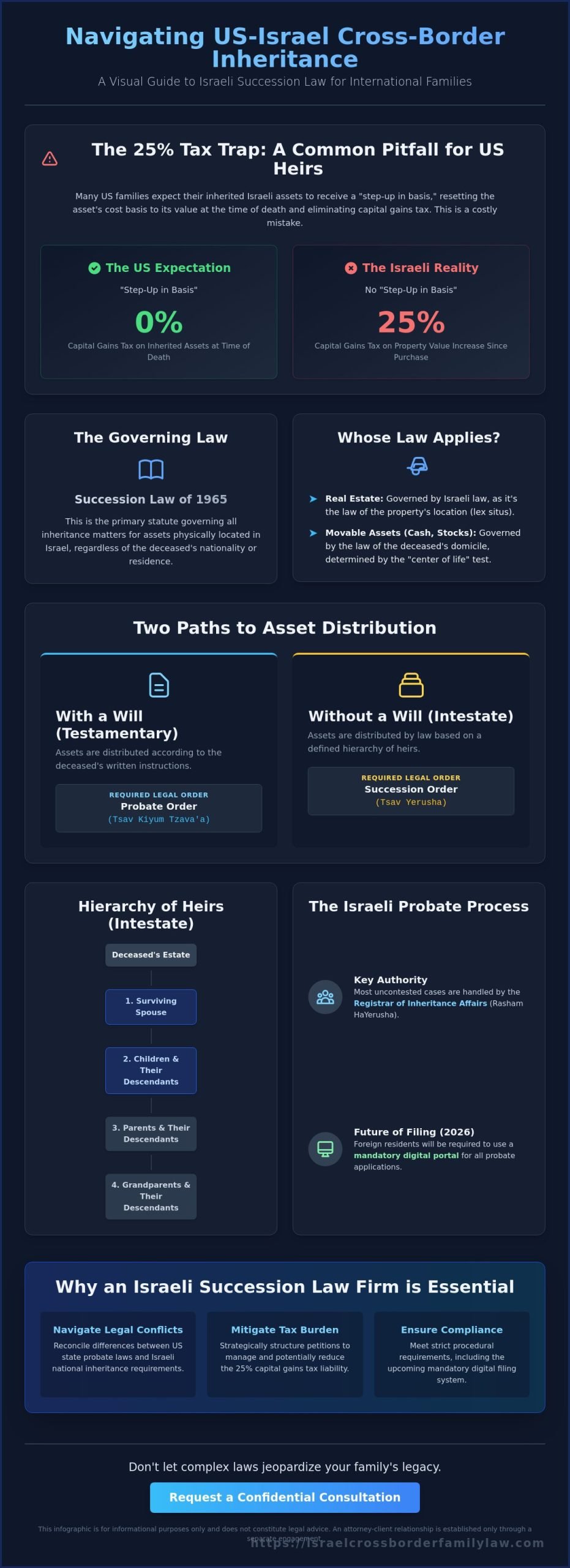
- Recognize the financial impact of the 25% capital gains tax on inherited property, as Israel doesn’t offer the “step-up in basis” common in the US.
- Explore the hierarchy of heirs under intestate succession to see how assets are divided between spouses and children if a valid will isn’t present.
This article is published on an independent advisory platform and is not a law firm. The content provided is for informational and advisory purposes only and does not constitute legal representation or legal advice. An attorney-client relationship is only established through a separate engagement with a licensed attorney.
Understanding the Framework of Israeli Succession Law (1965)
The primary legal pillar governing inheritance in Israel is the Succession Law of 1965. This comprehensive statute serves as the foundation for how estates are managed, providing a structured approach to asset distribution that differs significantly from many Western jurisdictions. Understanding the framework of Israeli law is essential because it applies to any assets physically located in IL, regardless of where the deceased person lived at the time of their passing. If a family member owned a property in Tel Aviv or held a bank account in Jerusalem, the Israeli legal system claims jurisdiction over those specific assets.
The central authority in this process is the Registrar of Inheritance Affairs, known in Hebrew as Rasham Hayerusha. Most uncontested inheritance cases begin here rather than in a courtroom. However, the complexity of cross-border estates means that early decisions often carry permanent financial consequences. For instance, choosing how to structure a petition can impact the eventual 25% capital gains tax heirs might face when selling inherited property. Working with an israeli succession law firm ensures that these strategic nuances are addressed before the legal process is set in motion, preventing costly errors that are difficult to reverse later.
The Scope of Israeli Inheritance Jurisdiction
Israeli law distinguishes between different types of assets. Real estate is typically governed by the law of the place where the property is located, while movable assets like cash or stocks are often influenced by the law of the deceased’s domicile. The “center of life” test is a critical factor here; it determines which country’s laws have the strongest claim to the estate. For expats and foreign nationals, this creates a multi-layered legal environment where international treaties and local succession rules must be reconciled to ensure a smooth transfer of ownership.
Plain English: Key Terms You Will Encounter
You’ll likely hear several Hebrew terms during this process. A “Probate Order” (Tsav Kiyum Tzava) is used when there’s a valid will to be enforced. If no will exists, you’ll need a “Succession Order” (Tsav Yerusha) to distribute assets according to the law. In some complex cases, an “Estate Administrator” is appointed to manage the assets, pay debts, and oversee the distribution. While the civil Registrar handles most cases, families sometimes have the option to use religious courts, though this requires the explicit consent of all heirs. Understanding these distinctions is the first step toward making an informed choice. For more detailed explanations of these terms, you can view educational videos on the Israel Family Law YouTube channel. Get clarity before you commit. Request a confidential consultation.
This article is published on an independent advisory platform and is not a law firm. The content provided is for informational and advisory purposes only and does not constitute legal representation or legal advice. An attorney-client relationship is only established through a separate engagement with a licensed attorney.
Intestate vs. Testamentary: How Assets Are Distributed
When an individual passes away without a will, the estate is governed by intestate succession. This means the state determines who inherits your assets based on a fixed legal hierarchy. Under the Israeli Succession Law (1965), the distribution isn’t always what international families expect. Generally, the surviving spouse receives all movable property, such as cars and household items, plus half of the remaining estate. The other half is divided equally among the children. If there are no children, the distribution shifts to include parents or siblings, which often complicates the transfer of family homes or business interests. Engaging an israeli succession law firm allows you to navigate these choices strategically before the law makes them for you.
Testamentary succession, or having a valid will, allows you to override these default rules. It provides the freedom to distribute assets according to your specific wishes, which is particularly vital in cross-border scenarios. However, Israeli courts maintain strict standards for what constitutes a valid will. Even a minor technical error can lead to a document being disqualified, forcing the estate back into the default intestate system. You can learn more about these risks by visiting the Israel Family Law YouTube channel. To better understand your specific situation, you may want to speak with an advisor regarding your options.
When There is No Will: The Legal Default
Israel’s “Order of Distribution” differs significantly from common US state laws. In many US jurisdictions, the surviving spouse might inherit the entire estate if all children are from the same marriage. In Israel, the children become immediate co-owners of the estate alongside the spouse. This can create significant challenges if the primary asset is a family home in Tel Aviv or Jerusalem. The law does provide specific protections for the spouse to continue living in the family residence, but the shared ownership with minor children often requires oversight from the Ministry of Justice to ensure the minors’ interests are protected. This added layer of bureaucracy can delay the management of assets for months.
The Importance of a Valid Israeli Will
For expats and foreign nationals, relying on a US-based will for Israeli assets is a high-risk strategy. Israeli courts often struggle with foreign wills that don’t meet local formal requirements, such as specific witness protocols or language clarity. A “Dual Country Will” strategy is frequently the most effective way to ensure your wishes are honored in both jurisdictions. By having a separate document specifically for Israeli assets, you avoid the 8 to 12-month delay typically required to validate a foreign will. This proactive approach reduces the likelihood of family conflict and ensures that your heirs don’t face unnecessary legal hurdles during an already stressful time. Get clarity before you commit. Request a confidential consultation.
This article is published on an independent advisory platform and is not a law firm. The content provided is for informational and advisory purposes only and does not constitute legal representation or legal advice. An attorney-client relationship is only established through a separate engagement with a licensed attorney.
The Cross-Border Challenge: US Assets and Israeli Law
Managing an estate that spans both the United States and Israel involves reconciling two fundamentally different legal systems. US probate is typically handled at the state level, while Israeli inheritance follows a national code. This discrepancy often leads to “Situs” asset conflicts, where property located in one country is subject to the residency laws of another. For example, a US citizen owning an apartment in Tel Aviv may assume their US will automatically governs that property. However, Israeli authorities require a local validation process that doesn’t always align with US court orders. Without a coordinated strategy, these jurisdictional overlaps can lead to legal deadlocks that stall asset distribution for years.
The US-Israel Tax Treaty is another area where many families face unexpected hurdles. While the treaty provides relief for income and corporate taxes, it doesn’t cover estate or inheritance taxes. This gap creates a strategic vacuum that an israeli succession law firm must help heirs bridge. Heirs often find that decisions made in the US have unintended consequences in Israel, particularly regarding the timing of asset sales. Professional guidance is essential to ensure that the transition of assets across borders remains compliant with both nations’ regulatory frameworks while protecting the family’s long-term financial interests.
Tax Implications for US Beneficiaries
Israel doesn’t have an inheritance or estate tax; this was abolished in 1981. However, heirs must plan for the 25% capital gains tax (Mas Shevach) when selling inherited property. Unlike the US system, Israel doesn’t offer a “step-up in basis.” The tax is calculated from the original purchase price paid by the deceased, not the value at the time of death. Additionally, US citizens inheriting foreign assets must comply with federal reporting requirements. This includes filing an FBAR (Report of Foreign Bank and Financial Accounts) and potentially FATCA forms if the value of the Israeli accounts exceeds specific thresholds. For US citizens, the 2026 federal estate tax exemption is approximately $13.99 million per individual, but values exceeding this amount are taxed at 40%.
Dual Country Wills and Jurisdictional Conflicts
The most effective way to manage these complexities is through proactive cross-border planning. Drafting a “Dual Country Will” ensures that your documents satisfy the formal requirements of both the US state and the Israeli Registrar. This is especially important for managing digital assets or international business interests that don’t have a single physical location. While trusts are a staple of US estate planning, they are treated differently under the Israeli Succession Law. Using a trust to bridge these systems requires a nuanced understanding of how Israeli courts view fiduciary duties and asset ownership. You can find more information on these strategies on the Israel Family Law YouTube channel. Get clarity before you commit. Request a confidential consultation.
This article is published on an independent advisory platform and is not a law firm. The content provided is for informational and advisory purposes only and does not constitute legal representation or legal advice. An attorney-client relationship is only established through a separate engagement with a licensed attorney.
The Probate Process: From Application to Distribution
Moving from the strategic planning phase to the actual administration of an estate requires a disciplined adherence to Israeli procedural rules. The process is highly structured, beginning with the collection of vital records. You’ll need original death certificates and wills, which must be authenticated with an Apostille if they originated in the US. This authentication confirms the document’s validity for use in a foreign jurisdiction. Once these are ready, the petition is submitted through the mandatory digital portal to the Registrar of Inheritance Affairs. In 2026, all petitions involving foreign residents must use this digital system, which allows for efficient remote management.
After filing, a mandatory notice of the petition is published in an Israeli daily newspaper, costing 215 NIS as of May 2026. This public announcement triggers a 14-day window where any interested party can submit an objection. If no challenges arise, the Registrar issues the final Order. This document is then used to update ownership at the Land Registry (Tabu) for real estate or to release funds from Israeli bank accounts. Partnering with an israeli succession law firm ensures that each of these steps is completed accurately, preventing administrative delays that often plague cross-border cases. If you’re ready to begin this process, you can request a review of your case to determine the best path forward.
Filing for a Succession or Probate Order
Most families apply through the Registrar of Inheritance Affairs, which handles uncontested administrative filings. However, if there’s a dispute or a complex legal question, the file may be transferred to the Family Court. For US-based heirs, managing this remotely is now the standard. The digital portal eliminates the need to travel to Israel for routine filings. You’ll need professionally translated documents and an expert opinion on foreign law if you’re validating a US will. This expert opinion typically costs between 3,000 and 7,000 ILS in 2026 and explains how the foreign will complies with its home jurisdiction’s laws.
Managing Objections and Will Contests
Objections are often based on claims of undue influence or a lack of mental capacity at the time the will was signed. In 2026, there’s been a 15% increase in disputes specifically regarding the validity of digital signatures on electronic wills. The Administrator General reviews all international files to ensure the interests of all heirs, especially minors or those living abroad, are protected. While a local Israeli will can be processed in four to nine months, a foreign will typically takes eight to 12 months to validate due to these extra layers of scrutiny. You can find more detail on avoiding these delays on the Israel Family Law YouTube channel. Get clarity before you commit. Request a confidential consultation.
This article is published on an independent advisory platform and is not a law firm. The content provided is for informational and advisory purposes only and does not constitute legal representation or legal advice. An attorney-client relationship is only established through a separate engagement with a licensed attorney.
Strategic Planning with an Israeli Succession Law Firm
Succession planning for international families isn’t just about filing paperwork; it’s a strategic bridge between two distinct legal systems. While the technical steps of probate are necessary, the underlying strategy determines how quickly your family can access assets and how much of the estate is preserved. A strategy-first approach helps you identify potential conflicts before they become expensive courtroom battles. Choosing a path based solely on the lowest initial cost often leads to significant delays, especially when dealing with the 15% increase in disputes regarding digital signatures observed in 2026. Understanding how the process works from a strategic perspective allows you to make informed decisions that protect your heirs.
An israeli succession law firm provides the necessary transnational expertise to navigate these complexities. Early intervention is the most effective way to prevent asset freezes and ensure that the transition between US and Israeli jurisdictions is seamless. By reviewing the specific details of your estate early on, you can avoid the reactive legal maneuvers that often complicate cross-border inheritance. This proactive clarity is the most reliable way to safeguard your family’s financial future. You can explore our transparent pricing framework to understand the investment required for professional advisory.
Bridging the Gap Between Legal Cultures
US expats often find the Israeli system surprising because of its Civil Law roots. Unlike the US system, which relies heavily on judicial precedent, the Israeli framework is built on specific statutes like the Succession Law 1965. This cultural difference impacts everything from how witnesses are viewed to how trusts are interpreted. Working with practitioners who are licensed in both regions ensures that nothing is lost in translation. For ongoing education on these cultural nuances, you can visit the Israel Family Law YouTube channel. These resources help you understand the strategic landscape before you commit to a specific legal path.
Moving Forward: Your Next Steps
Your first step toward clarity is organizing a comprehensive list of international assets, including real estate, bank accounts, and digital holdings. This preparation allows for a more productive confidential case review. During this initial phase, the goal is to identify risks such as potential tax liabilities or jurisdictional deadlocks. Early legal strategy prevents the stress of managing a foreign process from abroad under pressure. Clarity is the best protection for your family’s legacy. Get clarity before you commit. Request a confidential consultation.
This article is published on an independent advisory platform and is not a law firm. The content provided is for informational and advisory purposes only and does not constitute legal representation or legal advice. An attorney-client relationship is only established through a separate engagement with a licensed attorney.
Securing Your Cross-Border Legacy
Managing an estate between Israel and the US requires more than just administrative filing; it demands a strategic bridge between two distinct legal cultures. We’ve explored how the Succession Law 1965 governs local assets and how the 2026 digital portal has changed the timeline for foreign beneficiaries. By addressing potential capital gains tax issues early and ensuring your will satisfies both jurisdictions, you protect your heirs from unnecessary delays and financial loss. These early decisions are the most critical factors in preventing asset freezes and family conflict.
Our advisory platform specializes in these transnational complexities, offering a calm and steady approach for international families. Working with practitioners who understand the nuances of being licensed in both regions ensures that your strategy is robust and compliant. Partnering with an expert israeli succession law firm allows you to move forward with confidence, knowing that your cross-border interests are being managed with authoritative expertise. Your family’s future depends on the clarity you establish today. You can also find additional guidance on the Israel Family Law YouTube channel.
Get clarity before you commit. Request a confidential consultation.
This article is published on an independent advisory platform and is not a law firm. The content provided is for informational and advisory purposes only and does not constitute legal representation or legal advice. An attorney-client relationship is only established through a separate engagement with a licensed attorney.
Frequently Asked Questions
Does Israel have an inheritance or estate tax in 2026?
Israel does not have an inheritance or estate tax; it was abolished in 1981 and no plans exist to reintroduce it as of May 2026. While the transfer of assets is tax-free, heirs should prepare for a 25% capital gains tax when selling inherited property. This is because Israel doesn’t offer a “step-up in basis,” meaning the tax is calculated from the deceased’s original purchase price.
Can a US will be used to inherit property in Israel?
Yes, a US will can be used, but it must undergo a local “absorption” process to be validated by the Israeli Registrar. This requires a professional translation and an expert legal opinion from a US attorney proving the will is valid in its home jurisdiction. Partnering with an israeli succession law firm ensures that these foreign documents meet the specific procedural standards required in IL.
How long does the probate process take in Israel for foreigners?
The process to validate a foreign will typically takes between 8 and 12 months in 2026. If the deceased left a specific Israeli will for their local assets, the timeline is generally shorter, often concluding within four to nine months. These estimates include the mandatory 14-day window for public objections and the time required for the Administrator General to review the international file.
Do I need to travel to Israel to manage my inheritance?
You don’t need to travel to Israel to manage the inheritance process. Since May 2026, all petitions involving foreign residents must be submitted through a mandatory digital portal to the Registrar of Inheritance Affairs. This allows your legal representatives to handle document filings, newspaper publications, and communications with the authorities remotely while you remain in your home country.
What is the role of the Israeli Registrar of Inheritance Affairs?
The Registrar of Inheritance Affairs, or Rasham Hayerusha, is the administrative body responsible for overseeing the inheritance process. They review petitions, manage the public notice period, and issue the final Probate or Succession Orders. Most inheritance matters are resolved through this office; files are only transferred to the Family Court if a formal objection or a complex legal dispute arises.
Can I contest an Israeli will from the United States?
You can contest an Israeli will from abroad by filing a formal objection through the digital portal. Common grounds for a contest include claims of undue influence or lack of testamentary capacity. In 2026, there’s been a 15% increase in disputes regarding digital signatures on electronic wills, making it essential to work with an israeli succession law firm to manage these cross-border challenges.
How are Israeli bank accounts handled after the owner passes away?
Israeli banks typically freeze accounts as soon as they are notified of the owner’s death to protect the estate’s assets. Heirs cannot access or transfer funds until they present a certified Probate or Succession Order from the Registrar. It’s important to coordinate with the bank’s compliance department early, as transferring funds to foreign accounts involves specific regulatory checks and documentation.
What is an apostille and why is it required for my US documents?
An apostille is an international certification that confirms the authenticity of a public document, such as a death certificate or a notarized will. Israeli authorities require an apostille for all US-originated documents to ensure they are legally valid under international treaties. Without this certification, the Registrar will not accept your documents, which can lead to significant delays in the probate process.
Get clarity before you commit. Request a confidential consultation.

Article by
Gabriel Lior
A Personal Journey That Became a Mission
The advisory was founded by an American father Gabriel Lior, LLB, MBA , global entrepreneur, and cross-border advisor who spent more than a decade navigating the Israeli family court system firsthand and now lives in Singapore with his son.
As a divorced parent in a cross-border family, Gabriel faced nearly every legal challenge a foreign parent can encounter in Israel — including child custody disputes, child support proceedings, property matters in Israel and abroad, false accusations, and complex immigration and relocation proceedings.
Over the years, he learned the hard way how difficult it is for non-Israeli parents to understand the system, identify the right legal strategy, and choose the right legal representation — especially when language, culture, and jurisdictional differences are involved. He also witnessed how foreign parents and new immigrants are often disadvantaged or taken advantage of by service providers and institutions simply because they lack local knowledge or fluency.
From Client to Advisor
To truly understand — and survive — the system, Gabriel pursued formal legal education in Israel, completing two Israeli law degrees, alongside a BA and MBA earned in the United States. This was never about becoming a practicing attorney, but about gaining a deep, structural understanding of how the system works — and where it breaks down for foreign parents.
This rare combination of:
Firsthand client experience
Israeli legal and US business education
International business and negotiation training
Decades of commercial execution
created a unique perspective – one that understands both sides of the table.
After years of litigation, persistence, and at times self-representation, he ultimately succeeded in securing custody of his son and relocating abroad through a rare legal victory in the Israeli Supreme Court — becoming one of the first fathers in Israel to do so under these circumstances.
Disclaimer
Important Disclaimer:
The information provided on this website and in its content is for general informational and educational purposes only and does not constitute legal advice, legal opinion, or legal representation.
Gabriel Lior is not licensed to practice law in Israel (nor is he interested in doing so) and does not provide legal services, despite having completed 2 Law Degrees. The services offered are advisory in nature and are intended to provide general guidance, strategic insight, and information regarding cross-border family law considerations.
No attorney-client relationship is formed by accessing this website, reading its content, or communicating with us.
Any decisions made based on this information are at your own discretion and risk. For legal advice specific to your situation, you should consult a licensed attorney in the relevant jurisdiction.
Where appropriate, we may refer clients to independent, licensed attorneys or professionals. Such referrals do not constitute legal representation and no liability is assumed for services provided by third parties.