The dissolution of a marriage for an expatriate in Israel presents a complex and often daunting legal landscape, where personal challenges are magnified by unfamiliar legal systems and cross-border intricacies. The uncertainty over jurisdiction between religious and civil courts, the fear of unfavorable child custody rulings that could prevent international relocation, and the complexity of dividing a global asset portfolio can be overwhelming. This demanding situation requires sophisticated and precise legal advice for expats divorcing in Israel, guidance specifically structured to navigate these multi-jurisdictional challenges. This comprehensive guide is engineered to provide that critical clarity and strategic direction. We will meticulously unpack the Israeli divorce process for foreign nationals, from establishing the correct legal venue to the equitable division of assets held both within Israel and abroad. By exploring the nuances of child custody, alimony, and the enforcement of foreign judgments, our objective is to equip you with the foundational knowledge required to protect your rights, secure your financial future, and confidently engage expert legal representation to achieve a fair and structured resolution.
Key Takeaways
- Determining the appropriate legal venue-either the Rabbinical Courts or the Family Courts-is the foundational first step for any expatriate initiating divorce proceedings in Israel.
- Navigate the required divorce process, from mandatory mediation sessions to the strategic management of complex cross-border child custody and international relocation matters.
- Understand how Israeli courts exercise broad jurisdiction to divide marital property and financial assets, even when they are located in different countries.
- Securing specialized legal advice for expats divorcing in Israel is essential for managing the intricate intersection of Israeli and international family law.
First Steps for Expats: Understanding Jurisdiction in Israeli Divorce
For expatriates contemplating divorce in Israel, the initial and most critical step is determining which legal authority has the jurisdiction to hear the case. This is not a simple matter of geography; it is a complex determination based on the intersection of your nationality, your spouse’s nationality, and your respective religious affiliations. Securing sound legal advice for expats divorcing in israel at this early stage is paramount to navigating the country’s unique legal framework. To better understand these foundational concepts, our firm has prepared the following overview:
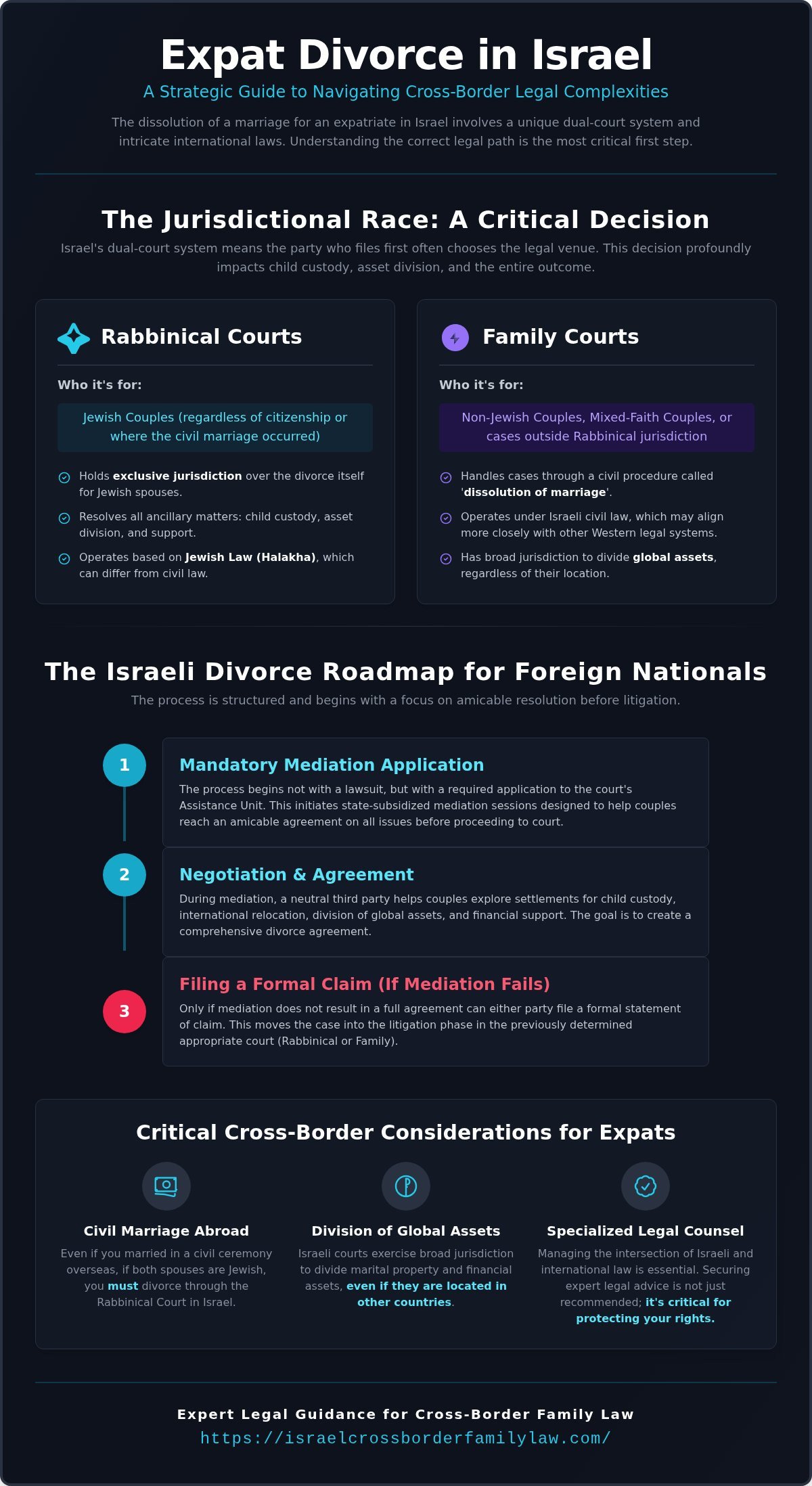
One of the most significant strategic considerations in Israeli family law is the “jurisdictional race.” Because Israel operates a dual court system for divorce, the party who files first can often secure the legal venue that is more advantageous to their position. Acting decisively and with informed counsel can therefore have a profound impact on the entire outcome of the proceedings, from property division to child custody.
The Rabbinical Court vs. The Family Court
Israel’s legal system delegates matters of marriage and divorce based on religious community. The Rabbinical Courts hold exclusive jurisdiction over the divorce of Jewish couples, irrespective of their citizenship status. Conversely, the Family Courts are empowered to handle divorce proceedings for non-Jewish couples, mixed-faith couples, and matters where the Rabbinical Court lacks jurisdiction. Both courts also rule on ancillary issues like child custody and asset division, making the initial choice of venue critically important. You can explore our dedicated resources for expats and foreign nationals to learn more.
What if You Had a Civil Marriage Abroad?
A common point of confusion for expats is the status of civil marriages performed overseas. While the State of Israel recognizes these marriages for registration and administrative purposes, this recognition does not alter the jurisdictional rules for divorce. According to the complex Marriage and divorce laws in Israel, if both spouses are Jewish, they must dissolve their union through the Rabbinical Court, even if they were married in a civil ceremony in another country.
Mixed-Faith and Non-Jewish Couples
For couples of different religious backgrounds or those where neither party is Jewish, the Family Court is the appropriate jurisdiction. These cases are not processed as a traditional divorce but through a specific legal procedure known as ‘dissolution of marriage.’ This process involves its own distinct procedural requirements and legal standards. Navigating this path requires sophisticated legal counsel to ensure your rights are fully protected throughout this multi-jurisdictional process.
The Israeli Divorce Process: A Roadmap for Foreign Nationals
Navigating the dissolution of a marriage in Israel requires a methodical approach, particularly for foreign nationals who must contend with a legal system that may be fundamentally different from their country of origin. Understanding the structured, multi-stage process is the first step in managing expectations and preparing an effective strategy. Securing professional legal advice for expats divorcing in Israel is critical to ensure your rights are protected at every juncture, from initial filings to the final decree.
Mandatory Mediation and Filing the Claim
The Israeli divorce process formally commences not with litigation, but with a mandatory application to the court’s Assistance Unit. This prerequisite step is designed to encourage amicable resolution outside the courtroom. During a series of state-subsidized meetings, a neutral mediator helps couples explore potential agreements on all pertinent issues. Only if these negotiations fail to produce a comprehensive settlement can either party proceed with filing a formal statement of claim in the appropriate court-either the Family Court or, for Jewish couples, the Rabbinical Court.
Key Components of a Divorce Agreement
Whether achieved through mediation or court proceedings, the ultimate goal is a comprehensive divorce agreement that governs all facets of the separation. A robust agreement provides clarity and is instrumental in preventing future conflict. The complexities of cross-border asset division and international custody arrangements underscore the unique legal considerations for expat divorce. Key components that must be meticulously addressed include:
- Child Custody and Visitation: Detailed plans for guardianship, residency, and visitation schedules, including provisions for international travel.
- Financial Support: Calculations for child support and, where applicable, spousal support (alimony), conforming to Israeli law.
- Division of Assets: An equitable distribution of all marital property, including real estate, bank accounts, pensions, and business interests located both in Israel and abroad.
Our firm has extensive experience in structuring these sophisticated agreements. Learn about our approach to divorce for international families.
The ‘Get’: The Final Step for Jewish Couples
For Jewish nationals, the civil divorce process is paralleled by a religious one. The final, indispensable step is obtaining a ‘Get’, a formal bill of divorcement, through a ceremony at the Rabbinical Court (Beit Din). Without this document, the parties are not considered divorced under Jewish law (Halakha). This has profound implications, particularly for the woman, who would be unable to remarry within the Jewish faith. Ensuring the ‘Get’ is properly administered is a critical aspect of the legal advice for expats divorcing in Israel who are subject to Rabbinical Court jurisdiction.
Critical Cross-Border Issues: Child Custody and Relocation
For expatriate families, divorce proceedings in Israel introduce multi-jurisdictional complexities, particularly concerning children. The issues of child custody and international relocation are frequently the most contentious and emotionally charged aspects of the dissolution. Israeli family law is unequivocally centered on one guiding principle: the ‘best interests of the child’ (tovat hayeled). This standard governs all judicial decisions, from determining living arrangements to approving a parent’s request to move abroad.
Determining Child Custody in Israel
Israeli courts increasingly favor joint custody arrangements, provided they are feasible and serve the child’s welfare. When making a determination, the court conducts a thorough assessment of several key factors, including:
- The child’s age and wishes (if of appropriate maturity).
- The quality and nature of each parent’s relationship with the child.
- Each parent’s capacity to provide a stable, supportive, and nurturing environment.
The ability to guarantee the child’s physical, educational, and emotional needs is paramount in the court’s evaluation.
The Hague Convention on Child Abduction
Israel is a signatory to the Hague Convention on the Civil Aspects of International Child Abduction. This international treaty provides a robust legal framework for the prompt return of a child wrongfully removed from or retained outside their country of habitual residence. Understanding your rights and obligations under the Convention is a vital component of receiving effective legal advice for expats divorcing in israel, as it serves as a powerful deterrent against unilateral parental action.
Legal Strategy for International Relocation
A parent wishing to relocate internationally with a child must either secure the explicit written consent of the other parent or obtain permission from the court. This requires presenting a comprehensive and convincing relocation plan that demonstrates the move is in the child’s best interest. The plan must detail the child’s future living arrangements, schooling, healthcare, and a concrete proposal for maintaining a meaningful relationship with the left-behind parent. Navigating these complex petitions demands sophisticated legal guidance. Read more on our approach to international custody and relocation.
Dividing International Assets and Financial Support
Divorces involving expatriates inherently feature complex, multi-jurisdictional financial landscapes. A critical point to understand is that Israeli family courts possess the jurisdiction to adjudicate and divide all marital assets, irrespective of their physical location. This global reach is comprehensive, encompassing a wide array of holdings acquired during the marriage, including:
- Real estate properties in foreign countries
- International bank accounts and investment portfolios
- Pensions, 401(k)s, and other retirement funds held abroad
- Interests in businesses operating outside of Israel
Navigating these financial intricacies is a primary reason why obtaining specialized legal advice for expats divorcing in israel is not merely beneficial, but essential for protecting your interests.
Valuation and Division of Global Property
Under Israeli law, the guiding principle is the equal division of all assets and debts accumulated during the marital union. This process is contingent upon complete and transparent financial disclosure from both spouses. For international assets, this often requires engaging specialists, such as forensic accountants or certified valuators in the relevant country, to accurately assess the value of foreign real estate, complex business interests, or sophisticated investment vehicles.
Spousal Support (Alimony) for Expats
The determination of spousal support, or alimony, in Israel depends heavily on the judicial venue. In the Family Court, decisions are grounded in secular legal principles, considering factors like the recipient’s needs, each party’s earning capacity, the standard of living during the marriage, and the duration of the marriage. Conversely, in the Rabbinical Court, a husband’s obligation to pay alimony is directly tied to his duties as stipulated by Jewish Law (Halakha).
Enforcing Child Support Orders Across Borders
Ensuring the consistent payment of child support across international borders presents a unique set of challenges. Fortunately, Israel is a signatory to international treaties, such as the Hague Convention on the International Recovery of Child Support, which facilitate the recognition and enforcement of support orders in other member countries, including the United States and most of Europe. Successfully enforcing an Israeli court order abroad, or a foreign order in Israel, is a sophisticated legal process requiring experienced counsel. Effectively managing the cross-border financial aspects of a divorce demands a strategic and knowledgeable approach. For guidance on your specific circumstances, we recommend seeking a consultation with legal professionals experienced in international family law.
Why Expats Need Specialized Cross-Border Legal Counsel
Navigating the Israeli family court system is a formidable challenge. For an expatriate, this complexity is magnified exponentially by the overlay of international laws, treaties, and financial regulations from a home country. A divorce proceeding is no longer a single-jurisdiction matter; it becomes a multi-jurisdictional puzzle involving property, pensions, and child custody arrangements that span continents. The single most important decision you will make is selecting legal counsel equipped to manage this intricate legal landscape. Choosing a specialist is not a luxury-it is a fundamental necessity for protecting your assets and parental rights.
The Dangers of Inexperienced Representation
Retaining a lawyer with exclusively local experience for a cross-border divorce can be a catastrophic error. Such counsel may overlook the critical implications of foreign-held assets, misinterpret international tax treaties, or fail to properly enforce a foreign judgment in Israel. In cases involving children, a lack of expertise in Hague Convention protocols on international child abduction or relocation petitions can have devastating, permanent consequences for your family.
Qualities of an Effective International Divorce Lawyer
When seeking the right legal advice for expats divorcing in israel, your evaluation must be rigorous. The ideal legal partner possesses a unique combination of skills and credentials tailored to sophisticated international disputes. Look for a professional with:
- Dual Qualification or Equivalent Experience: Verifiable expertise and licensure in both Israeli law and the legal system of your home country (e.g., the U.S. or U.K.).
- Legal and Cultural Fluency: Complete command of both English and Hebrew is essential for precise negotiation, drafting of agreements, and effective representation in court.
- A Proven Track Record: A history of successfully managing complex, high-value international family law cases, including those with intricate corporate structures and trusts.
Developing a Cohesive Legal Strategy
An effective international divorce lawyer does not work in a vacuum. They serve as the strategic architect of your case, coordinating with a global network of financial advisors, forensic accountants, and legal professionals in other relevant jurisdictions. This ensures the development of a cohesive, multi-faceted strategy that protects your interests on all fronts, from property division in Tel Aviv to pension rights in New York. This proactive and integrated approach is the key to achieving a secure and favorable outcome. For a confidential consultation to discuss your unique situation, our team is prepared to guide you.
Secure Your Future with Specialized Cross-Border Legal Guidance
Divorcing as an expat in Israel introduces a labyrinth of legal complexities, from establishing jurisdiction to navigating the intricate nuances of international child custody and multi-jurisdictional asset division. The critical takeaway is that these sophisticated cross-border matters demand a specialized strategic approach to protect your rights and assets. Securing the right legal advice for expats divorcing in Israel is not merely a procedural step-it is the foundational element for achieving a successful and equitable outcome. Our firm provides precisely this level of dedicated expertise. With extensive experience in high-stakes US-Israel divorce cases, a deep understanding of complex asset division across multiple jurisdictions, and proven success in sensitive international child custody and relocation matters, we are uniquely positioned to guide you. We invite you to Request a Confidential Case Review to discuss your specific situation and understand how our strategic counsel can serve your interests. Taking this decisive step allows you to navigate this challenging period with confidence and move toward a secure and stable future.
Frequently Asked Questions
How long does the divorce process typically take for an expat in Israel?
The timeline for a cross-border divorce in Israel is highly variable, contingent upon the complexity of the case and the level of cooperation between spouses. An amicable, uncontested divorce may be finalized within several months. However, sophisticated, multi-jurisdictional disputes involving contested child custody or significant international assets can extend the process to over a year. Our firm is experienced in navigating these complexities to achieve an efficient resolution for our clients.
Is my prenuptial agreement from the United States enforceable in Israel?
A prenuptial agreement validly executed in the United States is generally recognized and enforceable by Israeli courts. However, its enforcement is subject to review to ensure it does not contravene Israeli public policy and was properly authorized by a competent legal authority. It is imperative that such international agreements are reviewed by counsel with deep expertise in both Israeli and U.S. family law to confirm their viability within the Israeli legal framework.
What happens if my spouse is not an Israeli citizen?
The Israeli courts can maintain jurisdiction even if one spouse is a foreign national, provided the couple’s “center of life” was established in Israel or one spouse is an Israeli citizen. The non-citizen spouse is afforded full rights under Israeli law concerning marital property division, child custody, and support. Navigating these matters requires sophisticated counsel to address the complex interplay between Israeli domestic law and relevant international treaties governing such cross-border family disputes.
Can I file for divorce in Israel if I am not a citizen but a legal resident?
Yes, Israeli citizenship is not a prerequisite for filing for divorce in Israel. The Family Courts can establish jurisdiction if you are a legal resident and Israel has been the primary center of your family’s life. This is a frequent scenario for the expatriate community. Obtaining tailored legal advice for expats divorcing in Israel is critical in these situations to properly establish jurisdiction and protect your rights regarding property division, support, and child custody arrangements.
How are debts acquired during the marriage divided in an Israeli divorce?
Under the Spouses’ Property Relations Law, assets and debts accumulated during the marriage are presumed to be joint and are typically divided equally. This includes mortgages, loans, and credit card debts incurred for the benefit of the family unit. Debts that are strictly personal and did not contribute to the couple’s shared life may be assigned to the individual spouse. A comprehensive financial assessment is essential to ensure an equitable and legally sound division.
Do I need to be physically present in Israel for the entire divorce process?
While your presence is mandatory for certain critical court hearings, particularly the final divorce decree (Get) proceeding in the Rabbinical Court, you are not required to be in Israel for the entire process. Through a legally executed power of attorney, your counsel can represent you at numerous procedural hearings and manage filings on your behalf. We strategically guide our international clients to manage their presence efficiently, minimizing disruption to their professional and personal lives abroad.

Article by
Gabriel Lior
A Personal Journey That Became a Mission The advisory was founded by an American father Gabriel Lior, LLB, MBA , global entrepreneur, and cross-border advisor who spent more than a decade navigating the Israeli family court system firsthand and now lives in Singapore with his son.
As a divorced parent in a cross-border family, Gabriel faced nearly every legal challenge a foreign parent can encounter in Israel — including child custody disputes, child support proceedings, property matters in Israel and abroad, false accusations, and complex immigration and relocation proceedings. Over the years, he learned the hard way how difficult it is for non-Israeli parents to understand the system, identify the right legal strategy, and choose the right legal representation — especially when language, culture, and jurisdictional differences are involved. He also witnessed how foreign parents and new immigrants are often disadvantaged or taken advantage of by service providers and institutions simply because they lack local knowledge or fluency. From Client to Advisor To truly understand — and survive — the system, Gabriel pursued formal legal education in Israel, completing two Israeli law degrees, alongside a BA and MBA earned in the United States. This was never about becoming a practicing attorney, but about gaining a deep, structural understanding of how the system works — and where it breaks down for foreign parents. This rare combination of: Firsthand client experience Israeli legal and US business education International business and negotiation training Decades of commercial execution created a unique perspective – one that understands both sides of the table. After years of litigation, persistence, and at times self-representation, he ultimately succeeded in securing custody of his son and relocating abroad through a rare legal victory in the Israeli Supreme Court — becoming one of the first fathers in Israel to do so under these circumstances.
Disclaimer
Important Disclaimer: The information provided on this website and in its content is for general informational and educational purposes only and does not constitute legal advice, legal opinion, or legal representation. Gabriel Lior is not licensed to practice law in Israel (nor is he interested in doing so) and does not provide legal services, despite having completed 2 Law Degrees. The services offered are advisory in nature and are intended to provide general guidance, strategic insight, and information regarding cross-border family law considerations. No attorney-client relationship is formed by accessing this website, reading its content, or communicating with us. Any decisions made based on this information are at your own discretion and risk. For legal advice specific to your situation, you should consult a licensed attorney in the relevant jurisdiction. Where appropriate, we may refer clients to independent, licensed attorneys or professionals. Such referrals do not constitute legal representation and no liability is assumed for services provided by third parties.