This article is published on an independent advisory platform and is for informational purposes only. It does not constitute legal representation or an attorney-client relationship. Legal services are only provided by licensed attorneys under a separate engagement.
What if the most important conversation of your life happened in a language you didn’t fully understand? For many parents involved in cross-border cases, a custody evaluation in Israel can feel like a high-stakes test where the questions are slightly blurred. You might worry that a Hebrew-speaking evaluator will miss the nuances of your words or that a translated psychological test will misinterpret your personality. These language considerations for custody evaluations are not just technical hurdles; they are filters that can significantly impact how an evaluator views your bond with your child.
It is natural to feel anxious that cultural differences in your parenting style might be labeled as instability simply because of a linguistic gap. We agree that your parenting philosophy should be captured accurately, without the distortion of bias or poor translation. This guide explains the specific risks of cross-border evaluations in IL and provides a roadmap for ensuring your voice is heard. You will learn how to navigate the Hebrew-centric court system and manage the complexities of the “best interests of the child” standard to protect your parental rights.
Key Takeaways
- Understand the “Language Gap” and how discrepancies between your intent and an evaluator’s interpretation can influence custody recommendations.
- Learn about the psychological strain of standardized testing in a second language and how to address the risks of misinterpretation during parent interviews.
- Discover essential language considerations for custody evaluations when navigating the Israeli “Machon” system to ensure your parenting philosophy remains clear.
- Identify strategic steps to advocate for a bilingual evaluator and the importance of providing formal statements in both Hebrew and English from the start.
- Recognize how early linguistic clarity impacts long-term outcomes for child support and relocation rights in complex cross-border cases.
Why Language Precision Matters in Cross-Border Custody Evaluations
This article is published on an independent advisory platform and does not imply an attorney-client relationship. Legal services are only provided by licensed attorneys under a separate engagement.
In the Israeli legal system, the custody evaluator’s report serves as the primary roadmap for the judge’s final decision. For international families, language considerations for custody evaluations are not just minor details; they are the foundation of a successful case strategy. We define the “Language Gap” as the critical discrepancy between a parent’s intended meaning and the evaluator’s professional interpretation. When you are describing your relationship with your child, every word carries weight. If those words are filtered through a language barrier, your parenting philosophy can easily be lost or mischaracterized.
Even parents who are fluent in “plain English” often find that their words are misunderstood in formal Hebrew legal contexts. The complexities of legal translation mean that concepts common in the US or UK legal systems don’t always have a direct equivalent in IL. Because the court relies so heavily on the forensic evaluator’s written report, a single linguistic error can influence the judge’s perception of your stability or cooperation for years to come. You aren’t just fighting for custody; you’re fighting to ensure your story is told accurately in a language that isn’t your own.
To better understand how to navigate these challenges, watch this helpful video on preparing for the evaluation process:
The Risk of Linguistic Misinterpretation
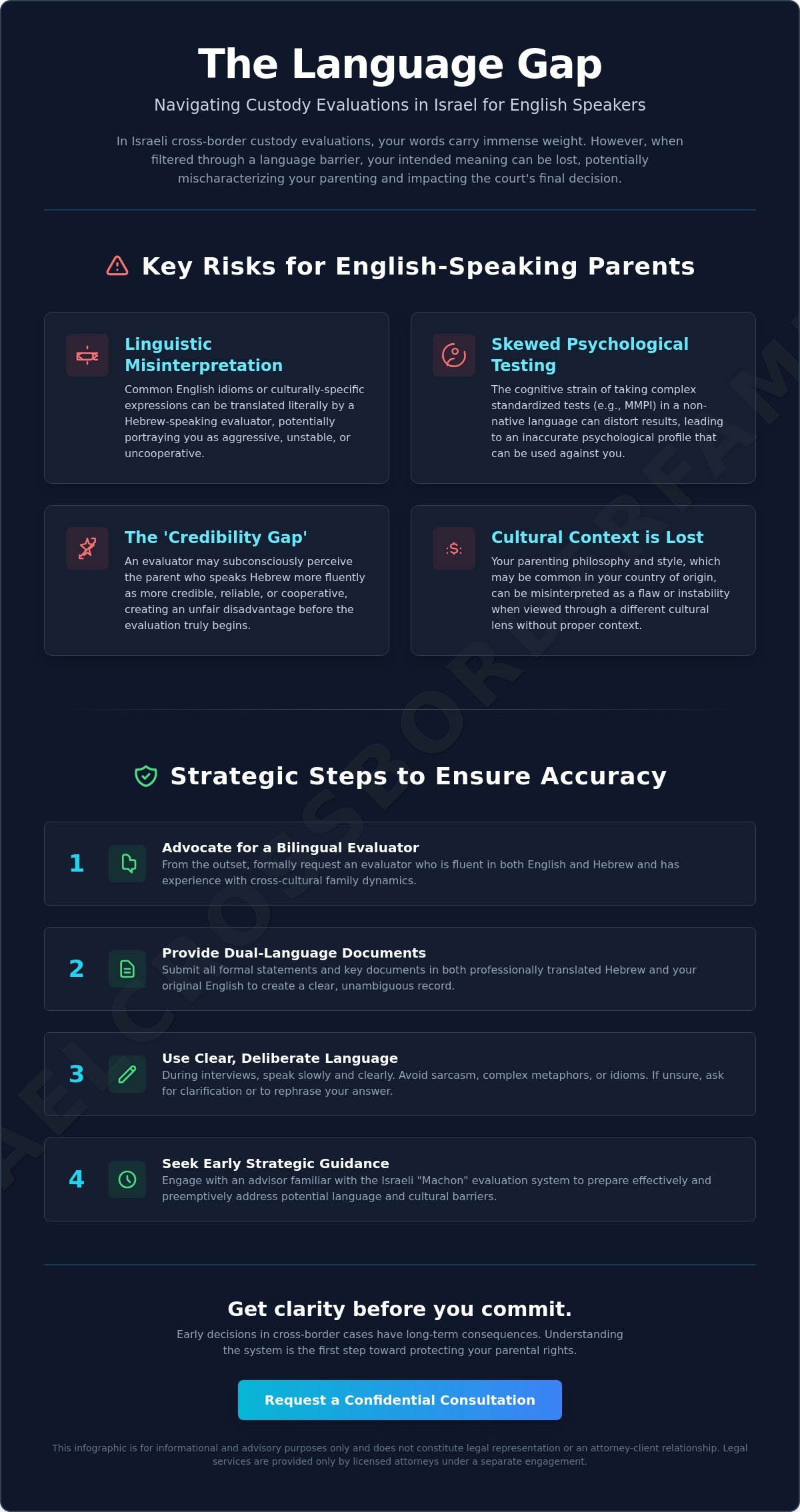
Common idioms and cultural expressions can be a major liability during a high-stress interview. If you use a phrase that suggests frustration or intensity, a literal Hebrew translation might make you appear aggressive or emotionally unstable. These “lost in translation” moments are particularly dangerous during psychological assessments where the evaluator is looking for subtle behavioral cues. Simple translation isn’t enough for the psychological depth required in these cases. You need an evaluator who understands the cultural context behind your English vocabulary to avoid being wrongly flagged by the court.
Linguistic Bias in Forensic Assessments
Evaluators are human, and their own level of English proficiency can subconsciously affect how they perceive you. If an evaluator finds it difficult to follow your narrative, they might view you as evasive or defensive rather than simply someone struggling with a second language. This leads to a “Credibility Gap” where the parent who speaks better Hebrew is seen as more reliable or grounded. In IL family law, linguistic bias is the subconscious tendency of an evaluator to favor the narrative of the parent who communicates more fluently in the court’s primary language. Recognizing this risk is the first step toward building a strategy that protects your parental rights.
This article is published on an independent advisory platform and does not imply an attorney-client relationship. Legal services are only provided by licensed attorneys under a separate engagement.
Impact of Language on Psychological Testing and Parent Interviews
Israeli family courts rely heavily on the MMPI and other diagnostic instruments during the forensic phase of a case. For an English speaker in IL, these tests represent a significant cognitive hurdle. The psychological strain of undergoing an evaluation in a non-primary language can skew results, as the mental energy required to interpret complex Hebrew questions often leaves less room for authentic emotional expression. Because these findings form the backbone of the evaluator’s report, any linguistic confusion during testing can have long-term consequences for your parental standing.
The Standardized Testing Trap
Standardized tools are frequently normed for native Hebrew speakers and local cultural expectations. Taking these assessments in a second language can trigger “false positives” for personality traits like defensiveness or paranoia. It’s essential to follow the APA guidelines on cultural competence, which mandate that evaluators account for a parent’s linguistic and national background. When discussing language considerations for custody evaluations, you should verify if the institute provides validated English versions of these diagnostic tools to ensure the data is accurate and culturally relevant.
The Nuance of Emotional Expression
Clinical “affect,” which refers to the outward display of emotion, is judged differently across cultures. A calm, measured English response might be interpreted as “detachment” by an evaluator accustomed to the more direct and assertive Hebrew communication style. Conversely, your natural stress may be misread as instability if the evaluator misses the subtle nuances of your tone. These language considerations for custody evaluations extend to the parent interviews, where cadence and word choice are just as important as the facts provided. If the evaluator doesn’t understand the cultural context of your emotional expression, the report may present an inaccurate picture of your bond with your child.
This complexity also impacts “Collateral Interviews” with your English-speaking references, such as teachers or therapists. If the evaluator cannot capture the full depth of their testimony, your character assessment may be incomplete or distorted. Strategic preparation helps bridge this gap by ensuring your emotional and psychological profile is presented clearly and without linguistic bias. To discuss how these factors apply to your specific case, you can request a strategy session to review your needs.
This article is published on an independent advisory platform and does not imply an attorney-client relationship. Legal services are only provided by licensed attorneys under a separate engagement.
Hebrew vs. English: Cultural Context in the Israeli Legal Landscape
In IL, the family court typically delegates the task of evaluating parental fitness to a “Machon” (an institute). These institutes are staffed by psychologists and social workers who act as the primary experts for the judge. For those navigating divorce and separation for international families, it’s vital to understand that these institutes operate primarily within a Hebrew-speaking, Israeli cultural framework. The way you describe your child’s needs or your future plans may be filtered through local expectations that don’t always align with Anglo parenting norms.
Israeli family courts often prioritize specific cultural markers, such as the child’s “routine” (shigra) and their integration into the local community. If you’re an expat, your desire to maintain international connections or follow a specific educational path might be misinterpreted as a lack of commitment to the child’s life in Israel. These language considerations for custody evaluations are deeply tied to cultural perception. A parent’s intent can easily be lost if the evaluator doesn’t have a background in cross-border family dynamics or the nuances of your primary language.
Dealing with Court-Appointed Evaluators in Israel
The typical profile of a court-appointed evaluator in IL is a professional with extensive experience in the local welfare system. While many evaluators claim to be fluent in English, you shouldn’t assume their proficiency is high enough for a complex forensic report. A report is a technical document that requires a high level of precision. If an evaluator misses the nuance in your explanation, the final report might reflect a version of your parenting that feels unfamiliar or inaccurate. The impact of early decisions is significant here. Once the court appoints a specific institute, it’s very difficult to change that decision later, making the initial selection process a critical strategic step for international families.
Translators vs. Culturally Competent Professionals
Relying on a court-appointed translator during a psychological interview is often a mistake. A third-party translator can disrupt the emotional connection between you and the evaluator, making the session feel clinical and distant. A bilingual professional is always a better choice because they can understand your responses directly without a middleman. While linguistic translation is the literal conversion of words from English to Hebrew, cultural mediation is the process of explaining a parent’s values so they make sense within the Israeli legal context. Ensuring your evaluator can provide this level of mediation is essential for a fair and accurate assessment of your bond with your child.
This article is published on an independent advisory platform and does not imply an attorney-client relationship. Legal services are only provided by licensed attorneys under a separate engagement.
Strategy: Ensuring Accuracy when English is Your Primary Language
Taking a proactive approach to the evaluation process is the most effective way to mitigate linguistic risks. You should advocate for a bilingual evaluator at the very beginning of your case. Waiting until the evaluation has started to raise concerns about a language barrier is often too late. When the court issues an order for an evaluation, it should ideally specify that the professional must be fluent in English. This ensures that the language considerations for custody evaluations are addressed before any interviews take place.
One practical strategy is to provide all your written statements in both Hebrew and English. By submitting a professionally translated version alongside your original English text, you maintain control over your narrative. This prevents the evaluator from relying on a potentially flawed, ad-hoc translation of your thoughts. This level of precision is particularly important in cases involving international custody and relocation, where the specific wording of your future plans can determine the outcome of the case.
Requesting Specific Evaluator Qualifications
Your legal strategy should include a formal request for an evaluator with “Anglo-cultural competence.” This goes beyond simple language skills; it requires an understanding of the social and educational values common in English-speaking countries. If the court denies a request for a specific professional, you may still be able to request that the chosen institute assigns their most proficient English speaker to your file. Shaping the evaluation order early on is much more effective than trying to challenge a finished report later. If you are unsure how to frame these requests, you can reach out for a strategy session to review your options.
Reviewing the Draft Report for Linguistic Errors
The “Home Visit” presents a unique challenge when the household language is English. The evaluator needs to observe natural interactions between you and your child. If they don’t understand the dialogue, they might miss the warmth or educational value of your communication. Once the evaluation is complete, there is often a critical window to review a draft or summary. Use this time to identify mistranslated quotes or terminology that changes the meaning of your testimony. Look for “red flag” words in Hebrew that might imply a lack of cooperation or stability when you were actually expressing a different sentiment. Correcting these errors before the report is finalized and submitted to the judge is a vital step in protecting your parental rights in IL.
This article is published on an independent advisory platform and does not imply an attorney-client relationship. Legal services are only provided by licensed attorneys under a separate engagement.
Strategic Preparation for International Families
“Clarity before commitment” is the most important rule for any parent involved in a US-Israel case. In the Israeli legal system, the custody evaluation is often the single most influential factor in a judge’s final ruling. If you enter this process without a clear strategy, you’re essentially leaving your parental narrative to chance. These language considerations for custody evaluations are foundational because the evaluation report becomes a permanent part of your legal record in IL. Once a professional has labeled your communication style or emotional state in a certain way, it’s very difficult to undo that impression in later hearings.
The cumulative effect of language issues extends far beyond the immediate custody arrangement. A flawed evaluation report can negatively impact your child support outcomes and your future relocation rights. If an evaluator misinterprets your parenting philosophy as “unstable” or “uncooperative” due to a linguistic gap, the court may use those findings to restrict your travel or limit your financial claims. To better understand how these systemic differences work, you can explore the educational videos on the Israel Family Law YouTube channel. Success in these cases depends on strategy rather than simply “showing up” and hoping the evaluator understands your intent.
Moving from Confusion to Clarity
Ignoring the risks of a language barrier can lead to a negative report that follows you for years. Early advisory is the best way to prevent these misunderstandings before they are documented in a formal forensic report. In a localized Israeli court, having a cross-border perspective is essential for bridging the gap between your Anglo-cultural values and the expectations of the local welfare system. This preparation ensures that the evaluator captures your genuine bond with your child rather than a version of you that has been “lost in translation.”
Next Steps for Your Custody Case
We encourage you to review the specific details of your case and identify where linguistic or cultural gaps might exist. Every international family faces a unique set of challenges, and your strategy should reflect the specific dynamics of your move or your divorce. Seeking a confidential review of your situation can help you identify red flags in your current evaluation process. Don’t let a language barrier dictate the future of your family life. Get clarity before you commit. Request a confidential consultation.
Protecting Your Parental Narrative in the Israeli Legal System
This article is published on an independent advisory platform and does not imply an attorney-client relationship. Legal services are only provided by licensed attorneys under a separate engagement.
Navigating the Israeli legal landscape requires more than just showing up for interviews. It demands a deep understanding of how linguistic nuances and cultural differences can shape an evaluator’s final report. We’ve explored how standardized tests can produce skewed results and why the role of a “Machon” is so pivotal in IL family courts. By addressing language considerations for custody evaluations early, you protect your story from the risks of linguistic bias and cultural misinterpretation.
Our focus remains on strategy and risk mitigation for international families. We bring extensive expertise in US-Israel cross-border family law to help you bridge the gap between two very different systems. Early decisions regarding your evaluator can define the trajectory of your case for years. Ensuring your voice is captured with precision is the best way to safeguard your relationship with your children and maintain your parental rights.
Get clarity before you commit. Request a confidential consultation via WhatsApp or our secure form. You don’t have to navigate these complexities alone. We are here to help you move forward with confidence.
This article is published on an independent advisory platform and does not imply an attorney-client relationship. Legal services are only provided by licensed attorneys under a separate engagement.
Frequently Asked Questions
Can I request that my custody evaluation in Israel be conducted in English?
Yes, you can request an English-speaking evaluator through a formal court application. While the official language of the court is Hebrew, judges often accommodate English speakers to ensure the report’s accuracy. It’s best to raise these language considerations for custody evaluations during the initial hearing to avoid being assigned to a Hebrew-only institute. This early request helps ensure the professional assigned to your case can communicate with you directly.
Will using a translator during the evaluation make me look less integrated into Israeli society?
No, seeking linguistic clarity is viewed as a sign of responsible parenting rather than a lack of integration. Evaluators prioritize the “best interests of the child” over your level of cultural assimilation. Being misunderstood because you tried to speak Hebrew can cause more damage than using a professional translator. Accuracy is the priority; a professional ensures your intent is captured correctly, which is vital for a fair assessment.
Are psychological tests like the MMPI-2 available in English in Israel?
Yes, validated English versions of standard psychological tests are available in IL. You should explicitly ask the evaluating institute if they provide the English MMPI-2 before the testing begins. Taking these tests in a second language can lead to “false positives” for personality issues or defensiveness. Ensuring the test matches your primary language is a key part of managing language considerations for custody evaluations effectively.
What happens if the evaluator’s report contains mistranslated quotes of what I said?
You have a limited window to address errors before the report is finalized and submitted to the judge. If you spot mistranslated quotes, your strategy should involve submitting a formal clarification to the court. Since these reports are the primary evidence judges use, correcting linguistic errors is a high priority. Acting early prevents a flawed narrative from becoming a permanent part of your legal file.
How much does a bilingual custody evaluation cost compared to a standard one?
Bilingual evaluations generally involve higher costs due to the specialized nature of the service and the additional time required. You may need to pay for certified translations of documents or the higher hourly fees of a professional who is fluent in both languages. While standard evaluations in IL have set rates, adding a linguistic component increases the complexity and the resources needed for the evaluator to complete a precise report.
Can my US-based therapist provide input to the Israeli custody evaluator?
Yes, your US-based therapist can provide valuable context to the Israeli evaluator through a collateral interview or written documentation. This input helps the Israeli professional understand your parenting history and emotional health within your native cultural context. Providing this background ensures the evaluator has a balanced view of your fitness, especially if you have only lived in Israel for a short period.
Is it better to speak broken Hebrew or use a professional translator during the interview?
It’s almost always better to use a professional translator if you aren’t fully fluent in Hebrew. Speaking broken Hebrew during a high-stress forensic interview increases the risk of being mischaracterized as unstable, evasive, or defensive. Precision is much more important than appearing fluent. A professional translator allows you to express complex emotions and nuanced parenting philosophies without the risk of significant linguistic errors.
How do cultural differences in ‘discipline’ affect evaluations between the US and Israel?
Significant cultural gaps exist in how discipline is viewed in the US versus IL. Israeli parenting norms often lean toward a more communal and direct style; whereas Anglo parents might prioritize structure and individual boundaries. An evaluator who isn’t familiar with these differences might label your discipline style as “detached” or “overly strict.” Explaining the cultural context behind your parenting choices is essential to avoid negative labels.
Get clarity before you commit. Request a confidential consultation.

Article by
Gabriel Lior
A Personal Journey That Became a Mission
The advisory was founded by an American father Gabriel Lior, LLB, MBA , global entrepreneur, and cross-border advisor who spent more than a decade navigating the Israeli family court system firsthand and now lives in Singapore with his son.
As a divorced parent in a cross-border family, Gabriel faced nearly every legal challenge a foreign parent can encounter in Israel — including child custody disputes, child support proceedings, property matters in Israel and abroad, false accusations, and complex immigration and relocation proceedings.
Over the years, he learned the hard way how difficult it is for non-Israeli parents to understand the system, identify the right legal strategy, and choose the right legal representation — especially when language, culture, and jurisdictional differences are involved. He also witnessed how foreign parents and new immigrants are often disadvantaged or taken advantage of by service providers and institutions simply because they lack local knowledge or fluency.
From Client to Advisor
To truly understand — and survive — the system, Gabriel pursued formal legal education in Israel, completing two Israeli law degrees, alongside a BA and MBA earned in the United States. This was never about becoming a practicing attorney, but about gaining a deep, structural understanding of how the system works — and where it breaks down for foreign parents.
This rare combination of:
Firsthand client experience
Israeli legal and US business education
International business and negotiation training
Decades of commercial execution
created a unique perspective – one that understands both sides of the table.
After years of litigation, persistence, and at times self-representation, he ultimately succeeded in securing custody of his son and relocating abroad through a rare legal victory in the Israeli Supreme Court — becoming one of the first fathers in Israel to do so under these circumstances.
Disclaimer
Important Disclaimer:
The information provided on this website and in its content is for general informational and educational purposes only and does not constitute legal advice, legal opinion, or legal representation.
Gabriel Lior is not licensed to practice law in Israel (nor is he interested in doing so) and does not provide legal services, despite having completed 2 Law Degrees. The services offered are advisory in nature and are intended to provide general guidance, strategic insight, and information regarding cross-border family law considerations.
No attorney-client relationship is formed by accessing this website, reading its content, or communicating with us.
Any decisions made based on this information are at your own discretion and risk. For legal advice specific to your situation, you should consult a licensed attorney in the relevant jurisdiction.
Where appropriate, we may refer clients to independent, licensed attorneys or professionals. Such referrals do not constitute legal representation and no liability is assumed for services provided by third parties.