A custody order from a U.S. court doesn’t automatically cross the Atlantic just because you or your child does. If you’ve discovered that your existing agreement is being ignored once a parent reaches Israel, the feeling of powerlessness can be overwhelming. You likely feel the weight of every decision, fearing that one wrong move could lead to a permanent loss of contact or a complex jurisdictional battle. It’s natural to feel confused about whether your American rights hold any weight in a system that operates in a different language and culture.
This article outlines your legal options for enforcing custody agreement terms between the U.S. and Israel, providing a strategic roadmap to restore your rights. You’ll learn how to navigate the complexities of the Hague Convention and the specific requirements of the Israeli Foreign Judgments Enforcement Law of 1958. We will preview the critical timelines you must meet, the role of the Israeli Family Court, and how to avoid the common procedural traps that can delay the return of your child or the restoration of your visitation schedule.
Key Takeaways
- Understand how jurisdictional frameworks like the UCCJEA determine which court has the authority to hear your case in a cross-border dispute.
- Evaluate the most effective legal options for enforcing custody agreement terms, from domesticating foreign orders in Israel to filing for contempt in the United States.
- Identify the specific types of documentation, such as visitation journals and digital communication logs, required to prove violations to a judge.
- Debunk dangerous misconceptions regarding the automatic validity of foreign orders and the legal risks of withholding visitation due to unpaid child support.
- Learn why seeking professional clarity before initiating litigation is essential for minimizing emotional stress and protecting your long-term parental rights.
Understanding the Framework: US-Israel Custody Jurisdictions
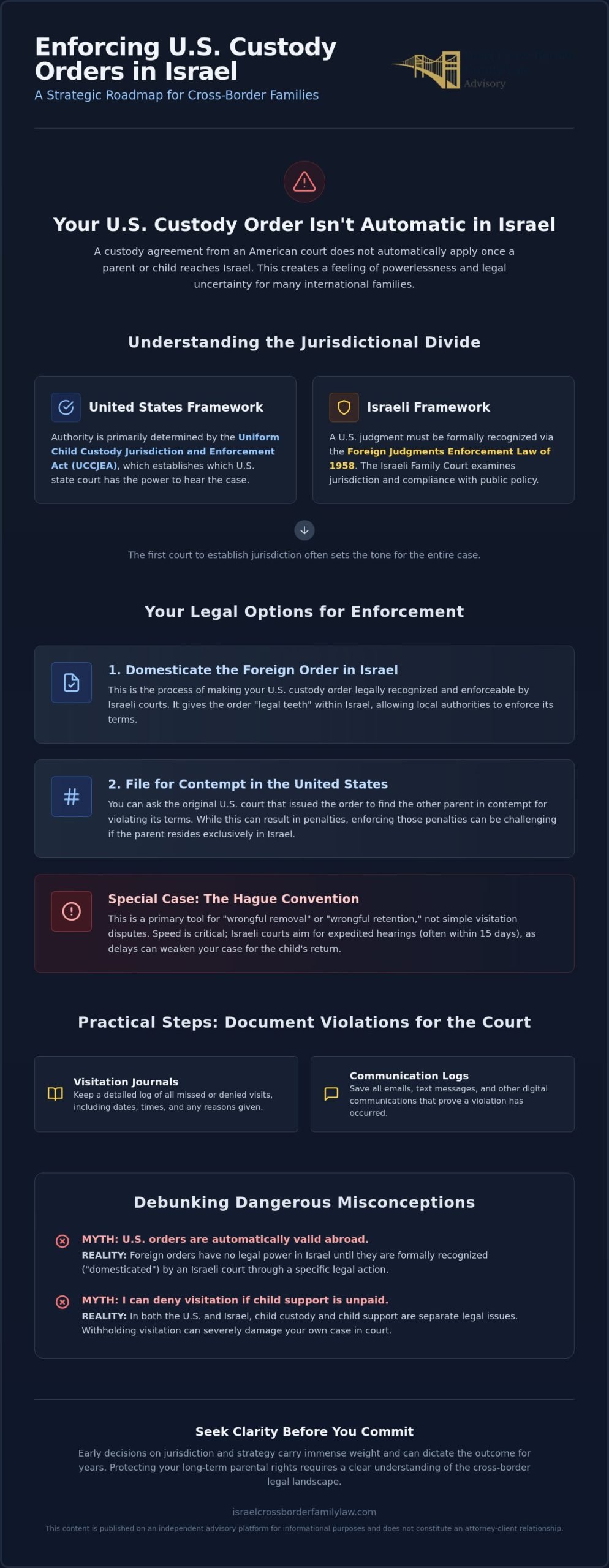
The 2026 legal landscape for international families is more interconnected than ever, yet the friction between different legal systems remains a significant hurdle. When a child moves between the United States and Israel, parents often assume their existing court orders travel with them. This is a misconception. Understanding your legal options for enforcing custody agreement terms requires a clear grasp of how two distinct nations determine which court has the authority to make decisions. In the U.S., this is governed by the Uniform Child Custody Jurisdiction and Enforcement Act (UCCJEA), while in Israel, the Family Court (Beit Mishpat Le’inyanei Mishpacha) applies domestic statutes to foreign rulings.
To better understand the general principles of enforcement, watch this helpful video:
In Israel, the court doesn’t automatically recognize a U.S. judgment. Instead, a specific legal action must be initiated under the Foreign Judgments Enforcement Law of 1958. The Israeli court will examine whether the U.S. court had proper jurisdiction and if the order aligns with Israeli public policy. A critical factor is the “jurisdictional race.” The first court to issue a ruling or “speak” on the matter often sets the tone for the entire case. If a parent files in Israel before the U.S. court has solidified its stance, it can create a situation where two courts are simultaneously considering the same dispute, leading to conflicting orders and high emotional stress.
The Role of the Hague Convention
The Hague Convention on the Civil Aspects of International Child Abduction is the primary tool for cases involving “wrongful removal” or “wrongful retention.” It’s vital to distinguish these from simple visitation disputes. If a parent keeps a child in Israel beyond the agreed date, it may trigger a Hague claim. Speed is essential here. Israeli courts generally aim for an expedited process, often setting initial hearings within 15 days. Delays can lead a court to decide the child has “settled” into their new environment, making a return more difficult. For more detailed guidance, you can read about the Hague Convention child abduction process.
US vs. Israeli Legal Cultures
Both systems use the “best interests of the child” standard, but they interpret it through different cultural lenses. Israel’s dual legal system includes Rabbinical Courts, which may have concurrent jurisdiction with civil Family Courts if a divorce is already in progress. Additionally, “standard” U.S. legal language regarding visitation may not translate directly into the Israeli enforcement framework. Specificity is required to ensure that an Israeli judge understands exactly what rights are being denied. Early decisions on which court to approach first carry immense weight and can dictate the outcome for years to come.
Disclaimer: This content is published on an independent advisory platform and does not constitute a law firm or an attorney-client relationship. It is intended for informational purposes regarding strategy and decision-making. Legal services are only provided by licensed attorneys under a separate engagement.
Legal Options for Enforcing Visitation and Custody
When an existing agreement is breached across borders, parents must choose a strategy that fits their specific circumstances. There isn’t a one-size-fits-all solution. Instead, several legal options for enforcing custody agreement terms exist, ranging from formal court recognition to administrative assistance from national authorities. Selecting the right path early on is vital, as your choice of legal options for enforcing custody agreement terms can determine how quickly visitation or custody is restored. Each method carries its own set of procedural requirements and potential risks that must be weighed carefully before any filings are made.
Domesticating a Foreign Judgment in Israel
For a U.S. custody order to have any legal teeth in Israel, it must undergo “domestication.” This is a formal process where the Israeli Family Court reviews the foreign order and grants it the same status as a local decree. To succeed, the order must be final and the U.S. court must have had the proper jurisdiction. One significant risk is that the Israeli court may choose to review the child’s current welfare. If the court believes the circumstances have changed significantly since the U.S. order was issued, they might “re-open” aspects of the case rather than simply enforcing the existing terms. Once domesticated, the order allows you to use Israeli enforcement tools, such as police assistance or financial sanctions, to ensure compliance.
The Contempt of Court Process
Another route involves returning to the U.S. court that issued the original order to file a Motion for Enforcement or Contempt. Contempt occurs when a parent willfully violates a court-ordered schedule. If a judge finds a parent in contempt, they may issue penalties such as fines, “makeup” visitation time, or even a change in primary custody. However, enforcing these penalties is difficult if the violating parent remains in Israel. A U.S. judge cannot easily force an individual in another country to pay a fine or return a child without the cooperation of the Israeli authorities. This is why many parents choose to pursue domestication in Israel alongside U.S. proceedings.
For cases involving the wrongful removal of a child, parents can utilize the Central Authority within the Israeli Ministry of Justice. This office facilitates cooperation under Israel’s implementation of the Hague Convention. This administrative path is often faster than standard litigation but is strictly limited to abduction and retention cases. Alternatively, mediation offers a way for families to reach an out-of-court settlement that respects both legal systems. A mediated agreement can be confirmed by an Israeli court, giving it the full force of law without the high emotional cost of a trial. If you aren’t sure which path fits your situation, it may be helpful to speak with an advisor to weigh the risks and benefits of each approach.
Disclaimer: This content is published on an independent advisory platform and does not constitute a law firm or an attorney-client relationship. It is intended for informational purposes regarding strategy and decision-making. Legal services are only provided by licensed attorneys under a separate engagement.
Practical Steps: Documenting Violations for the Court
Success in any enforcement action depends heavily on the quality of the evidence presented. When considering your legal options for enforcing custody agreement terms, you must transition from emotional reactions to objective data collection. Israeli Family Courts require a clear, chronological record of every violation to justify judicial intervention. A “Visitation Journal” is an essential tool for this purpose. It should track specific dates, arrival times, and the content of communications regarding the child. Vague claims of “frequent lateness” carry little weight compared to a log showing ten specific instances of a parent being more than 30 minutes late over a three-month period.
Digital evidence provides a modern foundation for these records. In Israel, WhatsApp is the standard for daily communication; courts frequently accept these logs as evidence of a parent’s intent or refusal to comply. You should preserve all emails, text messages, and call logs without editing or deleting them. Sometimes, a single sentence from a school official or a child’s pediatrician can be a “fact-dense” piece of evidence. For example, a teacher’s email noting a child’s repeated absence on your scheduled visitation days provides powerful third-party verification that the court can trust.
Preparing these documents for cross-border use requires attention to technical detail. American records must often be authenticated with an Apostille to be recognized by Israeli authorities. Similarly, any English documentation must be translated into Hebrew by a certified translator. These procedural steps are not optional; they are the bridge that allows your evidence to cross from one legal system to another.
Communication Best Practices
Your tone in every message matters. You should maintain a calm, non-confrontational style in all written exchanges, regardless of the other parent’s behavior. Aggressive or emotional responses can be used against you in a 2026 court hearing to argue that you are the source of conflict. Using specialized co-parenting apps is often a wise strategy. These platforms provide a neutral environment where all communication is logged and cannot be altered, making it much easier to document compliance for a judge.
Third-Party Verification
Involving professionals can strengthen your case significantly. School officials or medical providers can provide objective accounts of when a child was or was not present. In Israel, the court may involve a Guardian ad Litem or social workers from the “Siyua” (Assistance) unit to provide an independent perspective. Careful logging also helps you avoid the common pitfall of “parental alienation” accusations. By documenting only the facts of missed visitation, you demonstrate that your goal is the restoration of rights rather than an attack on the other parent’s character.
Disclaimer: This content is published on an independent advisory platform and does not constitute a law firm or an attorney-client relationship. It is intended for informational purposes regarding strategy and decision-making. Legal services are only provided by licensed attorneys under a separate engagement.
Common Misconceptions in Cross-Border Enforcement
One of the most dangerous assumptions a parent can make is that a U.S. court order is automatically enforceable in Israel. In reality, a foreign judgment lacks legal standing until it has been formally domesticated by an Israeli Family Court. This process acts as a necessary bridge between two distinct sovereign systems. Without this step, attempting to use local police or social services to enforce your rights will likely fail. Understanding your legal options for enforcing custody agreement terms means recognizing that your American decree is the starting point, not the finish line.
The concept of “habitual residence” is another area where misconceptions lead to legal setbacks. This status can shift faster than many parents realize. If a child lives in Israel for a significant period, the Israeli courts may eventually claim primary jurisdiction based on the child’s new “center of life.” Taking “self-help” measures, such as refusing to return a child after a scheduled summer visit, often accelerates this jurisdictional shift in a way that harms your case. Such actions are frequently viewed by judges as a sign of parental unfitness rather than a legitimate enforcement tactic. It’s much safer to rely on formal legal channels to protect your relationship with your child.
The “Support vs. Visitation” Trap
Parents often believe they can withhold visitation if the other parent falls behind on financial obligations. This is a significant error. Courts in both the U.S. and Israel view child support and custody as entirely separate legal issues. Denying visitation over support can lead to a judge finding you in contempt, which undermines your credibility in future hearings. If you are struggling with unpaid obligations, it’s more effective to explore specific strategies for Enforcing US Child Support Orders in Israel rather than risking your custody rights through unilateral actions.
Jurisdictional “Limbo”
When both parents file for custody in different countries simultaneously, the situation enters a state of jurisdictional limbo. This often triggers the “First in Time” rule, where the court that first establishes jurisdiction may become the permanent venue for the dispute. While there are exceptions, waiting too long to enforce an agreement can result in a loss of jurisdiction as the child becomes settled in their new environment. If you find yourself in this complex situation, it’s wise to consult with an advisor to determine which court should take the lead and how to protect your standing in both jurisdictions.
Disclaimer: This content is published on an independent advisory platform and does not constitute a law firm or an attorney-client relationship. It is intended for informational purposes regarding strategy and decision-making. Legal services are only provided by licensed attorneys under a separate engagement.
Strategy and Next Steps: Getting Clarity
When you are faced with a breach of a court order across international borders, the impulse to litigate immediately is often strong. However, a strategy-first approach is almost always more effective than rushing into a courtroom. Navigating the legal options for enforcing custody agreement terms requires a high-level view of how two sovereign legal systems will interact over the coming months. Rushing into a filing without a clear roadmap can trigger the very jurisdictional traps and “limbo” scenarios discussed earlier. Taking the time to build a comprehensive plan allows you to manage the timeline and the significant emotional stress that accompanies these high-stakes family matters.
Before committing to a specific course of action, it’s vital to undergo a Confidential Case Review. This initial step focuses on the strategic landscape, helping you identify which jurisdiction is most likely to provide a favorable and enforceable outcome. An independent advisory platform differs from a traditional law firm by prioritizing strategy, risk assessment, and decision-making guidance. This bird’s-eye view ensures that when you do engage a licensed attorney for representation, you are doing so with a clear understanding of the obstacles and the most efficient path toward the restoration of your parental rights.
Choosing Your Legal Team
Selecting the right practitioners is a critical component of your strategy. You should evaluate a lawyer’s specific experience with the Hague Convention and the nuances of International Custody and Relocation. The most effective teams often include practitioners who are licensed in multiple jurisdictions, as they possess a nuanced understanding of divergent legal cultures. This cross-cultural proficiency is a critical differentiator. It allows your team to act as a bridge between the U.S. and Israeli systems, ensuring that your U.S. order is translated and domesticated correctly without losing its original intent.
Seeking Advisory Before Commitment
Understanding the inherent costs and risks involved in cross-border enforcement is the only way to make an informed decision. Every case is unique, and what worked for one family may not be appropriate for yours. For further education on these complex topics, you can utilize the resources available on the Israel Family Law YouTube channel. These videos offer a calm, expert perspective on the Israeli legal system for those who are unfamiliar with its inner workings. Remember that gaining clarity is always the first step toward a sustainable resolution. Once you understand the framework, the road ahead becomes much less daunting.
Disclaimer: This content is published on an independent advisory platform and does not constitute a law firm or an attorney-client relationship. It is intended for informational purposes regarding strategy and decision-making. Legal services are only provided by licensed attorneys under a separate engagement.
Get clarity before you commit. Request a confidential consultation.
Securing Your Parental Rights Across Borders
Resolving a cross-border dispute requires more than just a valid U.S. court order. It demands a sophisticated understanding of how the Israeli Family Court recognizes foreign judgments and the specific procedural speed required for Hague Convention claims. You now understand that your legal options for enforcing custody agreement terms involve a strategic mix of formal domestication, administrative assistance, and precise documentation. By avoiding “self-help” measures and prioritizing a strategy-first approach, you protect your long-term standing in both legal systems.
Our advisory platform brings decades of experience to these complex matters, with a specialized focus on international relocation. We work with practitioners licensed in multiple jurisdictions to ensure your strategy is sound before you commit to the costs of litigation. This high-level guidance helps you manage the emotional and financial risks inherent in transnational family law. Gaining clarity is the most important step you can take toward a stable resolution for your family.
Disclaimer: This content is published on an independent advisory platform and does not constitute a law firm or an attorney-client relationship. Legal services are only provided by licensed attorneys under a separate engagement.
Get clarity before you commit. Request a confidential consultation.
Frequently Asked Questions
Is a US custody order valid in Israel without a new court case?
No, a U.S. custody order isn’t automatically valid and requires formal domestication by an Israeli Family Court. This process involves a legal action under the Foreign Judgments Enforcement Law of 1958 to ensure the order doesn’t conflict with local public policy or the child’s welfare. Without this recognition, Israeli authorities like the police cannot enforce the terms of your American decree.
Can I use the Hague Convention if the other parent is just late returning the child?
The Hague Convention is generally reserved for “wrongful removal” or “wrongful retention” rather than minor lateness. If the other parent is a few hours or days late, this is typically handled as a visitation dispute in the court that holds jurisdiction. However, if the lateness becomes an indefinite refusal to return the child, it may then trigger the Convention’s protections. It’s important to evaluate the intent behind the delay before filing.
What happens if the other parent hides the child in Israel?
If a parent hides a child, you can seek emergency “Stay of Exit” orders to prevent them from leaving the country. You should also contact the Central Authority at the Ministry of Justice to initiate recovery efforts under international treaties. In these high-stakes scenarios, the court can authorize police assistance and search orders to locate the child and ensure their safety while the case proceeds.
How much does it cost to enforce a cross-border custody agreement?
While total costs depend on the complexity of the dispute, the court filing fee for a family claim in Israel is ₪568 as of early 2026. You should also account for expenses related to certified translations and Apostilles required for your U.S. documents. Understanding your legal options for enforcing custody agreement terms early can help you avoid the financial drain of making incorrect or unnecessary legal filings.
Can I change the custody agreement during an enforcement proceeding?
Enforcement proceedings are strictly focused on following the existing order, not changing it. If you wish to modify the custody arrangement, you must file a separate motion based on a material change in circumstances. Attempting to change terms during an enforcement hearing often confuses the court and can delay the restoration of your current rights. It’s usually better to restore the status quo before seeking a modification.
How long does the Israeli Family Court take to recognize a foreign order?
The timeline for recognition depends on whether the case is contested, but Hague Convention cases are prioritized. Initial hearings are often set within 15 days of filing, with a goal of a final decision within six weeks. In practice, many cases take between 45 and 90 days to reach a conclusion. Standard domestication of a non-emergency order may take several months depending on the court’s schedule.
What is the “Central Authority” and how do they help with custody?
The Central Authority is a specialized department within the Israeli Ministry of Justice that manages international child abduction and access cases. They act as the primary liaison between the U.S. Department of State and the Israeli court system. Their role is to facilitate the administrative aspects of international treaties, ensuring that communications and legal requests between the two nations remain clear and efficient.
Do I need to travel to Israel to enforce my custody rights?
You don’t always need to be physically present in Israel for every stage of the enforcement process. Many preliminary hearings and administrative steps can be handled by your legal team while you remain in the U.S. However, if the case goes to a full evidentiary hearing, the judge may require you to provide testimony. Israeli courts have become increasingly open to allowing testimony via secure video link in international cases.
Disclaimer: This content is published on an independent advisory platform and does not constitute a law firm or an attorney-client relationship. It is intended for informational purposes regarding strategy and decision-making. Legal services are only provided by licensed attorneys under a separate engagement.
Get clarity before you commit. Request a confidential consultation.

Article by
Gabriel Lior
A Personal Journey That Became a Mission
The advisory was founded by an American father Gabriel Lior, LLB, MBA , global entrepreneur, and cross-border advisor who spent more than a decade navigating the Israeli family court system firsthand and now lives in Singapore with his son.
As a divorced parent in a cross-border family, Gabriel faced nearly every legal challenge a foreign parent can encounter in Israel — including child custody disputes, child support proceedings, property matters in Israel and abroad, false accusations, and complex immigration and relocation proceedings.
Over the years, he learned the hard way how difficult it is for non-Israeli parents to understand the system, identify the right legal strategy, and choose the right legal representation — especially when language, culture, and jurisdictional differences are involved. He also witnessed how foreign parents and new immigrants are often disadvantaged or taken advantage of by service providers and institutions simply because they lack local knowledge or fluency.
From Client to Advisor
To truly understand — and survive — the system, Gabriel pursued formal legal education in Israel, completing two Israeli law degrees, alongside a BA and MBA earned in the United States. This was never about becoming a practicing attorney, but about gaining a deep, structural understanding of how the system works — and where it breaks down for foreign parents.
This rare combination of:
Firsthand client experience
Israeli legal and US business education
International business and negotiation training
Decades of commercial execution
created a unique perspective – one that understands both sides of the table.
After years of litigation, persistence, and at times self-representation, he ultimately succeeded in securing custody of his son and relocating abroad through a rare legal victory in the Israeli Supreme Court — becoming one of the first fathers in Israel to do so under these circumstances.
Disclaimer
Important Disclaimer:
The information provided on this website and in its content is for general informational and educational purposes only and does not constitute legal advice, legal opinion, or legal representation.
Gabriel Lior is not licensed to practice law in Israel (nor is he interested in doing so) and does not provide legal services, despite having completed 2 Law Degrees. The services offered are advisory in nature and are intended to provide general guidance, strategic insight, and information regarding cross-border family law considerations.
No attorney-client relationship is formed by accessing this website, reading its content, or communicating with us.
Any decisions made based on this information are at your own discretion and risk. For legal advice specific to your situation, you should consult a licensed attorney in the relevant jurisdiction.
Where appropriate, we may refer clients to independent, licensed attorneys or professionals. Such referrals do not constitute legal representation and no liability is assumed for services provided by third parties.