In Israel, filing for a “legal separation” doesn’t actually exist as a formal court-decreed status, even though many expats assume it works exactly like it does in the United States. Instead, couples who wish to live apart without ending their marriage must rely on a contract known as a separation agreement. Understanding the nuances of legal separation vs divorce israel is vital because your initial strategy often dictates whether the Rabbinical or Civil court will ultimately control your financial future. This article is published on an independent advisory platform and provides informational guidance rather than formal legal representation.
You may feel overwhelmed by the pressure to choose between an uncomfortable living situation and a full divorce filing that could jeopardize your US-based assets. It is common to worry that a single mistake in the Israeli court system will cause you to lose your jurisdictional footing. This guide offers the clarity you need to determine if a separation agreement is a safer alternative to a divorce filing. We will explore how to protect your cross-border property, manage the “race to file,” and establish a roadmap for living apart legally while maintaining your long-term interests.
Key Takeaways
- Understand why Israel utilizes private contracts instead of court decrees and how the choice of legal separation vs divorce israel affects your jurisdictional standing in the US.
- Discover how a Heskem Peruda functions as a binding separation agreement to secure alimony and child support while living apart.
- Learn how to protect your assets from appreciation and manage cross-border property division before a final divorce is filed.
- Identify the specific risks to your residency status and international custody rights under the Hague Convention when separating in Israel.
- Evaluate the strategic benefits of a financial agreement to navigate the complex differences between the Rabbinical and Civil court systems.
Understanding Legal Separation vs. Divorce in the Israeli Context
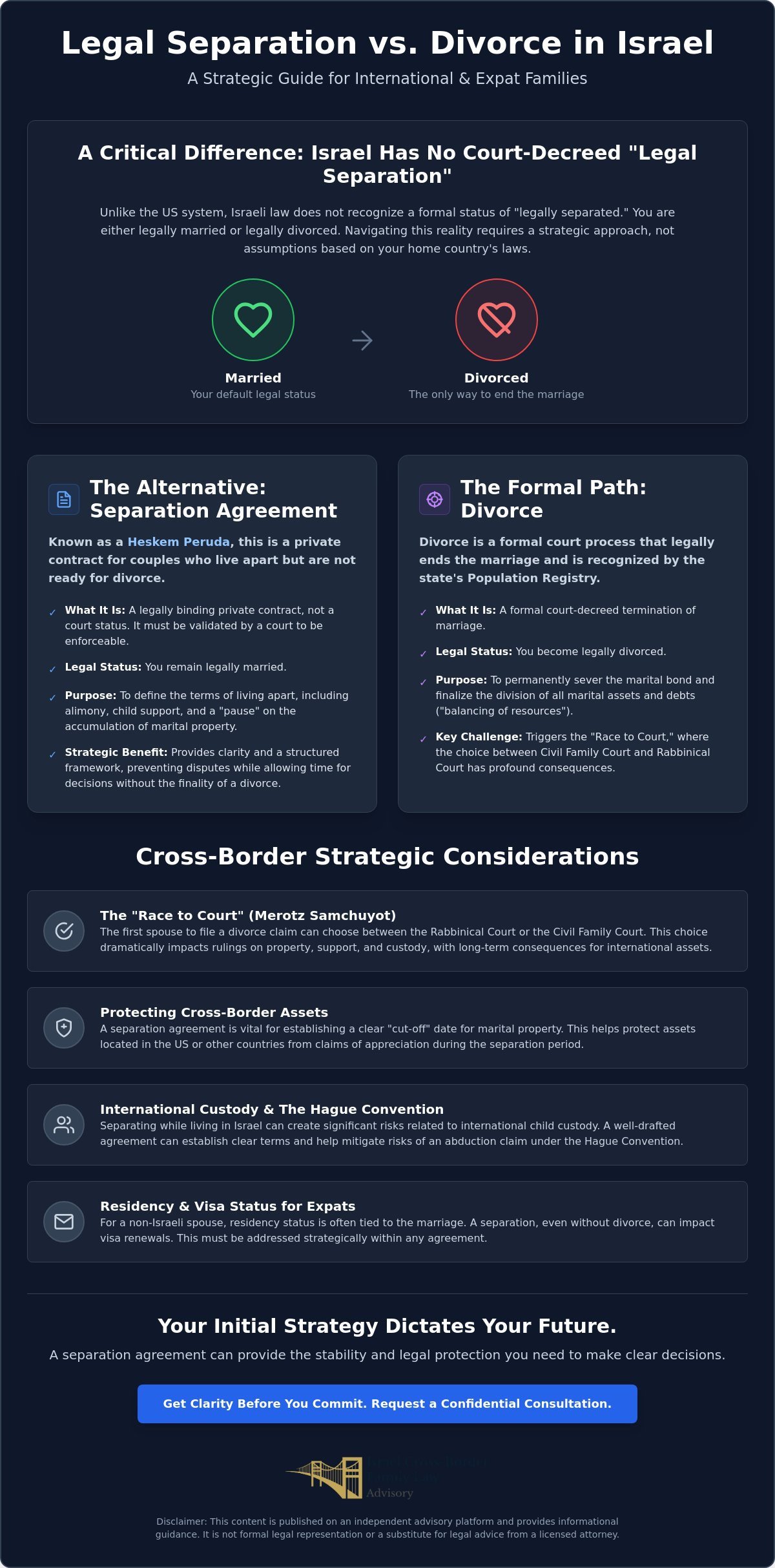
For many American families relocating to Israel, the concept of a “legal separation” is a familiar middle ground. In several US states, you can obtain a formal court decree that recognizes you as legally separated while remaining married. However, the framework of legal separation vs divorce israel operates on an entirely different premise. Israel does not have a statutory status of “legal separation.” You are either married or you are divorced; there is no official third category recognized by the state’s Population Registry. This section is published on an independent advisory platform and provides informational guidance rather than formal legal representation.
This distinction is critical because Israeli marriage and divorce laws are governed by a dual system of civil and religious courts. While you can physically live apart, your legal obligations don’t change until you take specific action. This often leads to the “Race to Court” (Merotz Samchuyot), where the spouse who files first in either the Family Court or the Rabbinical Court can significantly influence which laws apply to property and custody. For cross-border families, this race is even more high-stakes, as the choice of court in Israel can affect whether a US court will later defer to an Israeli ruling on international assets.
To better understand the fundamental differences in how these terms are applied, watch this helpful video:
The Myth of Legal Separation Status
Expats often assume they can file for a separation decree to protect their interests while they decide whether to end the marriage. In reality, “separation” in Israel is a factual state rather than a legal one. Simply moving out doesn’t automatically trigger a division of assets or stop the clock on marital debts. Because the state doesn’t issue separation decrees, families must rely on private contracts to create a roadmap for living apart. This is particularly complex for expats and foreign nationals who may have assets in multiple countries and must ensure their Israeli agreements are enforceable in their home jurisdictions.
When Separation Becomes a Strategy
While it isn’t a formal status, separation is frequently used as a strategic tool. Documenting the exact date you stopped sharing a household is essential for the future “balancing of resources.” This date determines which assets are considered marital property and which are private. You should also be aware of how the Rabbinical courts view separation. If a spouse leaves the home without a “justified cause,” they might be labeled a “rebellious spouse,” which can impact their right to alimony. Balancing these religious risks with civil protections requires a clear understanding of the local landscape before any physical move occurs.
The Separation Agreement (Heskem Peruda): A Practical Alternative
Since Israel doesn’t recognize an official status for legal separation, the Heskem Peruda (Separation Agreement) serves as the primary legal tool for couples who aren’t ready for a full divorce. It’s a private contract that outlines how you’ll manage your lives while living apart. Unlike a verbal “gentleman’s agreement,” which carries no weight in the Israeli legal system, a written and validated Heskem Peruda provides a clear, enforceable framework. This is especially helpful given the statistical trends in Israeli divorce, which suggest that many families benefit from a structured transition period rather than jumping into immediate litigation. This content is published on an independent advisory platform and provides informational guidance rather than formal legal representation.
When weighing the pros and cons of legal separation vs divorce israel, you must consider the stability of your daily life. A separation agreement can specify who remains in the family home and who is responsible for the mortgage or rent. This prevents a situation where one spouse is suddenly left without a place to live while the legal process unfolds. If you are unsure which path fits your specific assets, you can request a confidential case review to gain clarity.
Financial Protections in a Separation Agreement
The financial details are often the most complex part of any cross-border separation. A Heskem Peruda allows you to define “temporary” spousal support, known in Israel as Mezonot Isha. This ensures the economically weaker spouse can maintain their standard of living in a separate residence. You can also specify how joint bank accounts will be managed and how debts incurred during the separation period will be assigned. For parents, establishing clear terms for understanding child support in cross-border cases is essential to prevent future disputes over international payments or school fees.
One tool often overlooked by competitors is the Heskem Mamon (Financial Agreement). While usually seen as a prenuptial or postnuptial agreement, it can be drafted during a separation to “lock in” property rights. This protects your assets from further appreciation and ensures that business interests or inheritances remain private while you are living apart.
The Court Validation Process
An agreement is just a piece of paper until an Israeli judge validates it. Whether you choose the Family Court or the Rabbinical Court, the judge must perform a “Fairness and Understanding” test. They’ll ask if you’ve signed the contract of your own free will and if you fully grasp the consequences of every clause. Once validated, the agreement has the same legal weight as a court ruling. This is a critical step in the legal separation vs divorce israel journey, as a validated agreement can eventually be converted into a final divorce decree, saving you from a long and expensive court battle later on.
Key Strategic Differences: Financial, Religious, and Jurisdictional
Choosing between legal separation vs divorce israel involves more than just emotional readiness; it requires a calculated assessment of your financial and jurisdictional standing. In a separation, assets like pensions, real estate, and business interests often continue to be viewed as joint property. This means any appreciation in value during the separation period may still be subject to equal division unless a formal agreement specifies a “cut-off” date. For US citizens, this decision also carries tax implications. Until a final divorce decree is issued, you generally remain “married” for IRS purposes, which may limit your filing options to Married Filing Jointly or Married Filing Separately. This content is published on an independent advisory platform and provides informational guidance rather than formal legal representation.
Religious vs. Civil Jurisdiction
For Jewish couples, the religious aspect adds a layer of complexity that doesn’t exist in the US civil system. A separation agreement doesn’t end your religious marriage obligations. The Rabbinical Court maintains authority over the “Get” (religious divorce) and may even order “Shlom Bayit” (restoration of marital harmony) if one spouse resists the split. However, a well-drafted separation contract can include clauses that prevent “Get” refusal, known as Sarginut, by setting financial penalties for non-compliance. Non-Jewish or interfaith couples typically bypass these religious hurdles, focusing instead on the civil Family Court system.
The Jurisdictional Race for US-Israel Families
One of the most significant risks for cross-border families is losing the “Home Court” advantage. In international law, the principle of “First in Time, First in Right” often determines which country’s courts will handle the case. If you choose to live in a state of separation in Israel without filing formal papers, your spouse could potentially file for divorce in a US state. This could force you to litigate property division or alimony under American laws that might be less favorable to your specific situation. This is why obtaining information for expats and foreign nationals is vital before deciding to wait.
Custody matters are equally high-stakes during a separation. Without a court-validated agreement, moving a child across borders can trigger severe legal consequences. Understanding Cross-Border Challenges: Custody and the Hague Convention is essential for any parent considering a move. Israeli courts take international child abduction very seriously. A separation agreement must explicitly address travel rights and residency to ensure both parents remain compliant with international treaties. Establishing these rules early prevents the confusion that often leads to accidental legal violations.
Cross-Border Challenges: Custody and Property
The choice between legal separation vs divorce israel often hinges on how each status is perceived by foreign jurisdictions. For families with ties to the United States, an Israeli separation agreement is a strategic document that can either bridge the gap or create a jurisdictional vacuum. If you sign an agreement in Israel but one spouse later relocates to the US, a local American court may still claim jurisdiction over the marriage if no final divorce was filed in Israel. This content is published on an independent advisory platform and provides informational guidance rather than formal legal representation.
Maintaining your “Center of Life” (Merkaz Chaim) is another critical factor. Israeli authorities look at where your daily life is centered to determine tax liability and residency benefits. A separation where both parties stay in Israel reinforces this status. Conversely, a separation that involves one party moving abroad can complicate your standing with the National Insurance Institute (Bituach Leumi) and affect your long-term rights to Israeli social services. Managing US-based real estate while living under an Israeli separation agreement also requires careful drafting to ensure that US title companies and lenders recognize the validity of the Israeli contract.
International Custody and Relocation
Trial separations that involve crossing international borders are legally dangerous. Without a court-validated agreement that explicitly permits relocation, taking a child out of Israel for an extended period can be classified as international child abduction under the Hague Convention. Even if the other parent verbally agrees, the lack of a formal document leaves you vulnerable to legal action. You must understand the international custody and relocation risks before making any travel plans. Preventing the unauthorized removal of children requires proactive legal steps, such as a “Stay of Exit” order, which can be integrated into your separation strategy to protect your parental rights during this transitional phase.
Dividing Transnational Assets
Israeli courts apply the principle of “Balance of Resources” (Izun Mashabim), which generally mandates an equal split of assets accumulated during the marriage. However, managing US-based retirement accounts like 401(k)s and IRAs under an Israeli separation agreement requires specialized handling. US financial institutions often require specific domestic relations orders that an Israeli court cannot issue directly. While the Israeli agreement can establish the right to these funds, additional steps are usually needed in the US to execute the transfer.
Discovery in Israeli family law is also significantly narrower than the broad “fishing expeditions” common in US litigation. While you can request financial disclosures, the process is often faster and less invasive than American discovery. If you have significant US-based assets, you should consult with a professional who understands both systems to ensure your separation agreement is recognized by US financial entities and correctly addresses the nuances of transnational property division.
Strategic Decision Making: Protecting Your Future
The final determination between legal separation vs divorce israel often rests on whether a couple seeks a temporary pause or a permanent dissolution. In the Israeli system, you can file for “Restoration of Marital Harmony” (Shlom Bayit) in the Rabbinical Court, which officially signals an intent to reconcile. However, this filing is frequently used as a strategic maneuver to delay divorce proceedings or to secure a specific jurisdictional advantage. You must evaluate these options carefully, as the path you choose today creates a legal precedent that is difficult to reverse later. This content is published on an independent advisory platform and provides informational guidance rather than formal legal representation.
A highly effective but underutilized tool in these scenarios is the Heskem Mamon (Financial Agreement). While many view it as a prenuptial contract, it can be drafted as a preemptive measure during a period of marital strain. It allows you to ring-fence specific assets and establish clear financial boundaries before a formal divorce is even on the horizon. This approach addresses the common fear of losing assets during a long process by locking in the valuation of property and businesses early. Securing early legal counsel is critical before you make any physical moves, such as leaving the family residence, as these actions carry significant weight in both civil and religious courts.
The Weight of Early Decisions
The “Date of Separation” is a pivotal data point that determines the pool of marital assets subject to division. If you move out without a validated agreement in place, the court may view your departure as “abandonment,” which can negatively impact your claims to the family home or spousal support. You can find more detailed explanations on these dynamics by watching the Israel Family Law Videos. Establishing a clear, documented separation date through a contract protects your interests and prevents your spouse from claiming a share of assets you acquire after you’ve stopped living as a couple. This clarity is essential for cross-border families who must manage assets across multiple time zones and legal systems.
Next Steps for US Citizens in Israel
For US citizens, the complexity of cross-border law requires a preparation-heavy approach. You should begin by compiling a comprehensive “Separation File” that includes documentation for all global assets, including US-based retirement accounts, Israeli real estate, and transnational debts. If possible, consult with practitioners who understand the interplay between both legal systems. This ensures that any agreement reached in Israel won’t inadvertently trigger negative tax consequences or jurisdictional conflicts in the United States. Protecting your future requires a roadmap that accounts for both the Israeli Family Court and the requirements of US financial institutions. Get clarity before you commit. Request a confidential case review.
Navigating Your Cross-Border Future with Confidence
Choosing between legal separation vs divorce israel is a high-stakes decision that requires more than just emotional readiness. It demands a strategic understanding of how Israeli contracts interact with US legal systems. We’ve explored how the Heskem Peruda provides a practical roadmap for living apart and why the “Race to Court” determines which jurisdiction governs your financial future. Whether you’re managing US-based real estate or navigating the complexities of the Hague Convention, the weight of your early decisions can’t be overstated.
This advisory platform focuses on the unique challenges of cross-border US-Israel family law. With a physical presence in both Tel Aviv and New York, we offer specialized expertise in international custody and transnational asset division. Navigating these divergent legal frameworks is inherently complex, but seeking clarity before making commitments helps protect your interests in both countries. Get clarity before you commit. Request a confidential consultation.
Every family’s situation is unique. Taking the time to understand your options ensures you move forward with confidence and security.
Frequently Asked Questions
Is legal separation recognized in Israel?
Israel does not recognize “legal separation” as a formal, court-decreed status like many US states do. While you can live apart (Peruda), you remain legally married in the eyes of the state until a final divorce decree is issued. To protect your financial and parental interests during this time, you must draft a private separation agreement and have it validated by either the Family Court or the Rabbinical Court.
Can I be forced to leave my home during a separation in Israel?
You cannot generally be forced to leave your family home during a separation without a specific court order. In the Israeli system, both spouses typically have a right to reside in the marital home regardless of whose name is on the property deed. Eviction orders are rare and are usually reserved for cases involving domestic violence. It’s vital to establish specific residency terms within a validated agreement to avoid future disputes.
How does a separation agreement affect my US taxes?
A separation agreement does not change your US tax filing status because the IRS recognizes you as married until a final divorce decree is issued. This means you must continue to file as Married Filing Jointly or Married Filing Separately. Understanding the nuances of legal separation vs divorce israel is essential here, as the lack of a final decree prevents you from filing as Single or Head of Household in most cross-border scenarios.
What happens to my US assets if I separate in Israel?
Your US assets remain part of the joint marital pool until a formal “cut-off” date is established by a court or a validated agreement. Israeli law follows the “Balance of Resources” principle, which typically splits assets accumulated during the marriage equally. Without a validated document, any appreciation in your US 401(k), IRA, or real estate during the separation period could still be subject to equal division in an Israeli court.
Can I take my children to the US during a trial separation?
You should never take children to the US during a trial separation without explicit written consent from the other parent or a court order. Doing so can trigger international child abduction proceedings under the Hague Convention. Even if the move feels temporary, Israeli courts view the unauthorized removal of children as a serious violation. Always secure a validated travel schedule or relocation agreement before crossing borders with minors.
Is a US separation agreement enforceable in an Israeli court?
A US separation agreement is not automatically enforceable in Israel and must undergo a formal recognition process. Israeli courts must review and validate the document to ensure it doesn’t contradict local public policy or religious laws. This is a complex cross-border issue where the specific wording of the US order determines whether an Israeli judge will grant it legal standing. Often, a mirror agreement must be drafted locally.
Do I need a “Get” if we are only legally separated?
You do not need a “Get” (religious divorce) if you are only living apart under a separation agreement. The “Get” is the final step required to dissolve a Jewish marriage and allow both parties to remarry. However, as long as you are only separated, you remain religiously married. This means you still have certain marital obligations under religious law and cannot enter into a new religious marriage in Israel or abroad.
How long does it take to validate a separation agreement in Israel?
Validating a separation agreement in Israel typically takes between three to six months if both parties are in full agreement. The process involves submitting the contract to the Family Court or Rabbinical Court for a judge’s review and approval. This timeline can extend significantly if the court identifies “unfair” clauses or if the parties begin to contest the terms during the validation hearing. Early preparation of the “Separation File” can help expedite this process.

Article by
Gabriel Lior
A Personal Journey That Became a Mission
The advisory was founded by an American father Gabriel Lior, LLB, MBA , global entrepreneur, and cross-border advisor who spent more than a decade navigating the Israeli family court system firsthand and now lives in Singapore with his son.
As a divorced parent in a cross-border family, Gabriel faced nearly every legal challenge a foreign parent can encounter in Israel — including child custody disputes, child support proceedings, property matters in Israel and abroad, false accusations, and complex immigration and relocation proceedings.
Over the years, he learned the hard way how difficult it is for non-Israeli parents to understand the system, identify the right legal strategy, and choose the right legal representation — especially when language, culture, and jurisdictional differences are involved. He also witnessed how foreign parents and new immigrants are often disadvantaged or taken advantage of by service providers and institutions simply because they lack local knowledge or fluency.
From Client to Advisor
To truly understand — and survive — the system, Gabriel pursued formal legal education in Israel, completing two Israeli law degrees, alongside a BA and MBA earned in the United States. This was never about becoming a practicing attorney, but about gaining a deep, structural understanding of how the system works — and where it breaks down for foreign parents.
This rare combination of:
Firsthand client experience
Israeli legal and US business education
International business and negotiation training
Decades of commercial execution
created a unique perspective – one that understands both sides of the table.
After years of litigation, persistence, and at times self-representation, he ultimately succeeded in securing custody of his son and relocating abroad through a rare legal victory in the Israeli Supreme Court — becoming one of the first fathers in Israel to do so under these circumstances.
Disclaimer
Important Disclaimer:
The information provided on this website and in its content is for general informational and educational purposes only and does not constitute legal advice, legal opinion, or legal representation.
Gabriel Lior is not licensed to practice law in Israel (nor is he interested in doing so) and does not provide legal services, despite having completed 2 Law Degrees. The services offered are advisory in nature and are intended to provide general guidance, strategic insight, and information regarding cross-border family law considerations.
No attorney-client relationship is formed by accessing this website, reading its content, or communicating with us.
Any decisions made based on this information are at your own discretion and risk. For legal advice specific to your situation, you should consult a licensed attorney in the relevant jurisdiction.
Where appropriate, we may refer clients to independent, licensed attorneys or professionals. Such referrals do not constitute legal representation and no liability is assumed for services provided by third parties.