This article is published on an independent advisory platform and does not constitute legal representation or an attorney-client relationship.
What if the most effective way to protect your child from emotional manipulation isn’t through aggressive confrontation, but through a calculated, risk-based approach in the Israeli court system? Many parents facing cross-border disputes feel a paralyzing fear that their child is being coached to reject them, especially when international relocation is a looming threat. You’re right to be concerned about the long-term psychological impact on your child. It’s a heavy burden to carry when you’re also trying to understand the differences between Israeli Family courts and Rabbinical tribunals. This guide explores specific legal strategies to combat parental alienation by showing you how to identify and document these behaviors within the US-Israel legal framework.
You’ll discover how to present clear evidence to a judge and implement safeguards to prevent your child from being moved out of the jurisdiction. We’ll examine the importance of early strategic decisions and how to leverage local Israeli remedies alongside international treaties. By the end of this article, you’ll have a clearer roadmap for navigating these multi-jurisdictional complexities and restoring a healthy, stable relationship with your child. Get clarity before you commit. Request a confidential consultation.
Key Takeaways
- Learn how to transform daily frustrations into admissible evidence by maintaining contemporaneous logs and utilizing digital records from platforms like WhatsApp in Israeli courts.
- Gain clarity on the distinct roles of the Family Court (Beit Mishpat LeInyaney Mishpacha) and the Rabbinical Court when determining the “Best Interests of the Child.”
- Identify effective legal strategies to combat parental alienation by shifting from emotional reactions to a risk-based approach that prioritizes your child’s psychological stability.
- Understand the critical link between alienation and cross-border relocation (Hagira) applications, including the legal safeguards provided by the Hague Convention.
- Develop a multi-layered strategy that balances assertive legal pressure with the sensitivity required to restore a healthy parent-child bond.
This article is published on an independent advisory platform (not a law firm) and does not constitute legal representation or an attorney-client relationship. Legal services are only provided by licensed attorneys under a separate engagement.
Understanding Parental Alienation in the US-Israel Context
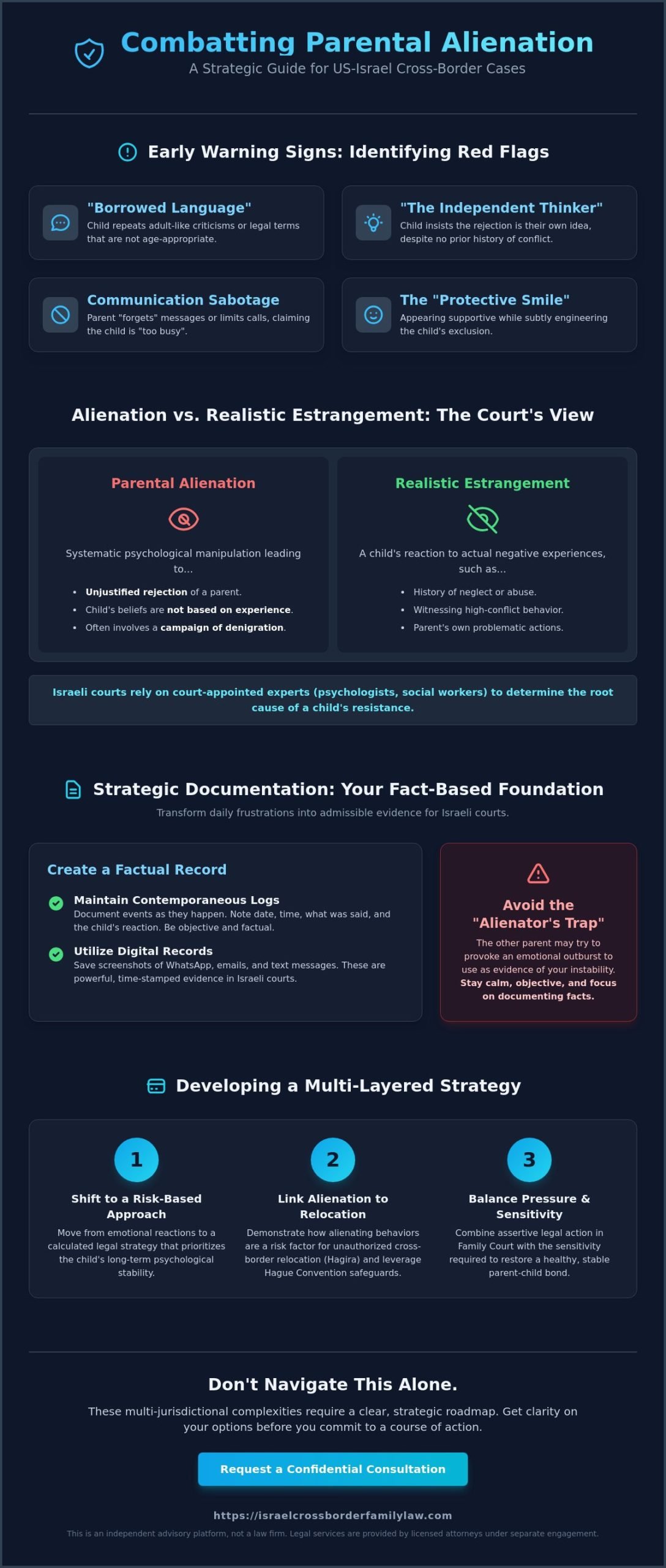
Parental alienation is the systematic psychological manipulation of a child by one parent, designed to foster an unjustified rejection of the other parent. In the complex environment of US-Israel family law, these dynamics often become entangled with the stress of relocation, language barriers, and cultural differences. It’s common for cross-border stressors to exacerbate alienating behaviors. A parent residing in Israel might use the physical distance from the United States or the child’s integration into Israeli society to isolate the other parent. Identifying these patterns early is the first step in developing effective legal strategies to combat parental alienation.
One of the most difficult aspects to identify is the “protective smile” of the alienating parent. This occurs when a parent presents themselves as a supportive gatekeeper while subtly engineering the child’s exclusion. They may claim to encourage communication while simultaneously scheduling the child’s social activities during the only windows available for international calls. This passive-aggressive exclusion is often harder to prove in court than overt hostility, yet it is equally damaging to the parent-child bond. Recognizing that these behaviors are part of a strategy, rather than accidental, allows for a more proactive legal response.
Identifying Alienating Behaviors Early
Children affected by alienation often display specific red flags that parents should document. You might notice your child using “borrowed language,” where they repeat adult-like criticisms or legal terminology that doesn’t fit their age. Another common sign is the “independent thinker” phenomenon. This happens when a child insists their rejection of a parent is entirely their own idea, despite having no history of conflict with that parent. In many cases, the alienating parent will “forget” to pass on messages or limit digital communication under the guise of the child being “too busy” with their new life in Israel.
Alienation vs. Realistic Estrangement
It’s vital to distinguish between alienation and realistic estrangement. While alienation involves an unjustified rejection, estrangement is a child’s reaction to actual experience, such as a history of neglect or high-conflict behavior. Israeli Family Courts are increasingly sophisticated in making this distinction before ordering sanctions. Judges frequently rely on court-appointed experts, such as psychologists or social workers from the Welfare Ministry (Revacha), to determine the root cause of a child’s resistance. Understanding this difference is a cornerstone of legal strategies to combat parental alienation, as it dictates whether the court focuses on reconciliation or protective measures. If you are concerned about your child being moved permanently, you should review our guide on international custody and relocation. Get clarity before you commit. Request a confidential consultation.
This article is published on an independent advisory platform (not a law firm) and does not constitute legal representation or an attorney-client relationship. Legal services are only provided by licensed attorneys under a separate engagement.
Strategic Documentation: Building a Fact-Based Foundation
Documentation is the bridge between your personal experience and the legal facts presented to an Israeli judge. In high-conflict cross-border cases, the court relies heavily on objective data rather than emotional testimony. One of the most effective legal strategies to combat parental alienation is the creation of a factual record that demonstrates a pattern of behavior over time. This approach moves the conversation away from “he said, she said” narratives and toward a verifiable timeline of events.
It’s essential to avoid the “alienator’s trap,” where the other parent provokes an emotional outburst to use as evidence of your supposed instability. Israeli Family Courts often view high-conflict communication through a lens of parental fitness. If you respond to a blocked call with a barrage of angry texts, those messages may be presented in court to justify the alienation. Maintaining a calm, professional demeanor in all digital interactions is a tactical necessity. You must remain the “healthier” parent in the eyes of the court, regardless of the provocation.
Maintaining a Communication Log
A neutral, fact-based log is significantly more persuasive to an Israeli judge than a journal filled with emotional venting. When tracking interference, consistency is your greatest asset. Your log should include:
- Date and Time: Record exactly when the call or visitation was scheduled and the exact moment it was missed or blocked.
- The Specific Excuse: Document the reason provided by the other parent, such as “the child is sleeping” or “we are at a family event,” without adding your own commentary.
- Observations of the Child: Note any specific behaviors or “borrowed language” observed during successful interactions, such as a child repeating adult legal concerns.
- Communication Channel: Save screenshots of WhatsApp messages and emails; these are the primary forms of evidence in the Israeli legal system.
Avoid engaging in arguments within these channels. Your goal is to document the interference, not to win a debate that could later be used against you.
The Role of Third-Party Evidence
External records provide a layer of objectivity that personal logs cannot match. In Israel, you can request records from schools (Mishrad HaChinuch) or health maintenance organizations (Kupat Holim) to demonstrate if you are being excluded from your child’s life. If the other parent fails to list you as an emergency contact or ignores your requests for medical updates, these records provide concrete proof of a gatekeeping strategy.
Social media also plays an increasing role in these cases. Posts that denigrate your relationship with the child or celebrate the child’s “rejection” of you can be powerful evidence of an alienating environment. Beyond digital footprints, your consistent, calm presence at school events or doctor appointments serves as a silent but effective legal strategy. It demonstrates your commitment and counters any narrative that you are an “absent” parent. If you need help organizing your evidence, you may want to request a confidential case review. Get clarity before you commit. Request a confidential consultation.
This article is published on an independent advisory platform (not a law firm) and does not constitute legal representation or an attorney-client relationship. Legal services are only provided by licensed attorneys under a separate engagement.
Legal Remedies within the Israeli Family Court System
Navigating the Israeli legal landscape requires an understanding of the parallel court systems. The Family Court (Beit Mishpat LeInyaney Mishpacha) and the Rabbinical Court (Beit Din Rabbany) both have jurisdiction over custody matters, but their procedural approaches to conflict can differ significantly. While the Family Court is a civil entity, the Rabbinical Court operates under religious law. Both are bound by the “Best Interests of the Child” standard, yet how they interpret alienating behavior often depends on the specific recommendations of the Pkidat Sa’ad, or court-appointed social worker. This professional acts as the “eyes and ears” of the judge, and their report frequently forms the basis of the final ruling. For those navigating these complexities, understanding divorce and separation for international families provides essential context for how these courts interact in cross-border scenarios.
The Pkidat Sa’ad’s role is pivotal because judges rarely meet with children directly. Instead, they rely on the social worker’s assessment of the family dynamic. If the social worker identifies a pattern of psychological manipulation, they may recommend specific legal strategies to combat parental alienation, such as supervised visitation or mandatory counseling. It’s vital to cooperate fully and transparently with these professionals, as their perception of your parental fitness is the most influential factor in the court’s decision-making process.
Court-Ordered Therapy and Parental Coordination
The court often attempts to resolve conflict through Parental Coordination, known in Israel as Teum Hory. This involves a professional who manages day-to-day disputes, such as scheduling or holiday pick-ups, to prevent constant litigation. When alienation is suspected, the court may also mandate reunification therapy. However, therapy has its limits. In severe cases, legal strategies to combat parental alienation must move beyond therapeutic intervention. Without “legal teeth,” such as the threat of sanctions, therapy alone often fails because the alienating parent may subtly undermine the process.
Enforcement of Visitation and Contempt
If a parent continues to block access, the targeted parent can file for the enforcement of a visitation order (Akiufa). Israeli judges have the authority to impose financial sanctions for every missed visit. These fines, often starting at several hundred or even thousands of Israeli Shekels (₪) per incident, serve as a concrete deterrent. While the “nuclear option” of changing primary custody is rare, it remains a possibility in extreme cases where the child’s psychological health is at risk. Implementing these strategies requires a disciplined approach to documentation and a clear understanding of the court’s enforcement powers. Get clarity before you commit. Request a confidential consultation.
This article is published on an independent advisory platform (not a law firm) and does not constitute legal representation or an attorney-client relationship. Legal services are only provided by licensed attorneys under a separate engagement.
Combating Alienation in Cross-Border Relocation Cases
In the context of US-Israel family law, parental alienation is frequently more than just a domestic dispute; it’s often the tactical precursor to a formal relocation application, known in Israel as Hagira. The alienating parent may systematically weaken the child’s bond with the parent in the United States to argue that the child has no meaningful connection left to their country of origin. This strategy is designed to make a permanent move to Israel appear to be in the child’s best interests. Recognizing this early is one of the most critical legal strategies to combat parental alienation. If you suspect your child is being prepared for a move, understanding the nuances of international custody and relocation is paramount.
The concept of forum shopping is a significant risk in these cases. A parent might attempt to initiate proceedings in the jurisdiction they perceive as more favorable to their goals. For example, a parent who has already moved the child to Israel might rush to file in an Israeli Family Court to establish habitual residence before a US court can intervene. Conversely, a parent in the US must act quickly to secure orders that can be registered and enforced abroad. The timing of these filings often dictates which country’s laws will govern the family’s future for years to come.
The Hague Convention and International Risks
The 1980 Hague Convention on the Civil Aspects of International Child Abduction is the primary treaty used to return children who have been wrongfully removed or retained across borders. However, alienating parents often use the “grave risk” defense to fight a return order. They may coach the child to express a strong objection to returning to the US, claiming that the targeted parent is abusive or neglectful. Effective legal strategies to combat parental alienation in Hague cases involve providing the court with psychological evidence that counters these coached objections. For more detailed information on these defenses, see our analysis of Hague Convention child abduction cases.
Jurisdictional Challenges: US vs. Israel
A common misconception is that a US custody order is automatically enforceable in Israel. In reality, foreign orders must often be formally registered and recognized by the Israeli court system to have legal weight. This is especially complex when families have lived in multiple countries, making the determination of habitual residence a central legal battleground. If you’re concerned that an upcoming overseas trip might be used to alienate your child permanently, you need a proactive strategy. This might include seeking stay-away orders or requiring the deposit of a financial bond in an Israeli bank account, often in Israeli Shekels (₪), as security for the child’s return. To discuss your specific situation, you can speak with a cross-border advisor. Get clarity before you commit. Request a confidential consultation.
This article is published on an independent advisory platform (not a law firm) and does not constitute legal representation or an attorney-client relationship. Legal services are only provided by licensed attorneys under a separate engagement.
Developing a Multi-Layered Strategy for Reconciliation
The most successful outcomes in cross-border disputes don’t happen by accident; they’re the result of a “Strategy First” approach that prioritizes planning over emotional reaction. When you’re facing the possibility of a severed relationship with your child, it’s natural to want to fight back immediately. However, impulsive legal moves can often backfire in the Israeli court system. You need a plan that balances assertive legal pressure with a deep sensitivity to your child’s psychological state. For visual guides on how to structure this approach, the YouTube channel “IsraelFamilyLaw” provides several helpful walkthroughs on navigating these specific hurdles. Early intervention is often the only way to prevent a difficult situation from turning into total, long-term estrangement.
Effective legal strategies to combat parental alienation require you to look beyond the next court date. While the legal system can enforce visitation, it cannot force a child to feel a genuine emotional connection. Your strategy must include a path for reconciliation that the court can support. This often involves proposing a graduated “reunification plan” that moves from supervised or short visits to full overnight stays. By presenting a structured, reasonable solution to the judge, you position yourself as the parent focused on the child’s health rather than just winning a legal battle.
Advisory vs. Litigation-First Approaches
Choosing between “soft” strategies, like mediation or parental coordination, and “hard” strategies, such as filing for contempt or financial sanctions, is a pivotal decision. Soft strategies are often more effective in the early stages when the alienating behavior is subtle. These methods allow for a less adversarial environment which can be better for the child. However, if the other parent is actively blocking all contact, hard strategies become a necessity to protect your parental rights. Seeking clarity before you commit to a specific path is the most important step for an expat or international family. Early decisions on which court to use or how to frame your initial filings will dictate the trajectory of your case for years.
The Long Game: Staying Present
Maintaining a consistent presence in your child’s life is a legal strategy in itself. Even when visits are blocked or calls are ignored, you must continue to “leave the door open.” This means sending regular, non-confrontational messages, emails, or gifts that document your ongoing desire for a relationship. Psychologically, this provides the child with a different narrative than the one they may be hearing from the alienating parent. Legally, it creates a paper trail showing that you’ve never abandoned your child. If you’re unsure how to begin this process, you may want to learn more about our advisory process. Legal strategies to combat parental alienation are most effective when they’re part of a calm, persistent, and well-documented effort. Get clarity before you commit. Request a confidential consultation.
This article is published on an independent advisory platform and does not constitute legal representation or an attorney-client relationship.
Securing Your Child’s Future Across Borders
Navigating the intersection of US and Israeli family law requires a shift from emotional reaction to disciplined, strategic planning. Success depends on your ability to build a fact-based foundation through meticulous documentation and a sophisticated understanding of how the Family and Rabbinical courts interpret the “best interests of the child.” By identifying alienating behaviors early and leveraging professional observations from Israeli institutions, you can present a compelling case to the court. These legal strategies to combat parental alienation are most effective when they’re part of a broader, multi-layered approach that prioritizes your child’s psychological stability over short-term legal wins.
Our advisory platform specializes in the nuances of US-Israel cross-border family law, offering bilingual and bicultural guidance tailored for international families. With decades of experience navigating the complexities of the Israeli legal marketplace, we provide the steady hand needed to guide you through these challenging landscapes. Don’t let jurisdictional confusion or cultural barriers jeopardize your parental bond. Get clarity before you commit. Request a confidential consultation. You have the power to restore a healthy relationship with your child through informed decision-making and a clear legal roadmap.
Frequently Asked Questions
What is the first thing I should do if I suspect parental alienation?
The first step is to begin keeping a neutral, contemporaneous log of all missed visitations and blocked communications. It’s critical to consult with a professional who understands the specific legal strategies to combat parental alienation in a cross-border context. Early decisions regarding which court to file in can impact the case for years. This proactive approach ensures you have a factual foundation before entering the litigation phase.
Can an Israeli court force my child to see me if they refuse?
Israeli courts generally don’t use physical force to compel a child’s attendance; however, they utilize indirect enforcement mechanisms. Judges frequently impose financial fines, often starting at ₪500 per missed visit, against the alienating parent. They may also mandate reunification therapy or appoint a parental coordinator. If the resistance is severe, the court relies on psychological experts to determine if the child’s refusal is genuine or coached.
Does the Rabbinical Court handle parental alienation differently than the Family Court?
The Rabbinical Court (Beit Din Rabbany) and Family Court (Beit Mishpat LeInyaney Mishpacha) have different procedural focuses. Rabbinical courts may emphasize the religious duty of a child to honor their parents, while Family courts prioritize clinical psychological assessments. Both systems are bound by the “Best Interests of the Child” standard, but the Rabbinical court’s interpretation may be influenced by traditional family structures and Halakhic principles.
How long does a parental alienation case usually take in Israel?
A parental alienation case in Israel typically requires 12 to 18 months for a comprehensive resolution. This timeline accounts for the mandatory cooling-off periods and the time needed for a court-appointed social worker (Pkidat Sa’ad) to conduct a thorough investigation. Because these cases involve psychological evaluations and multiple hearings, parents should prepare for a deliberate and structured legal process rather than a quick fix.
Can I stop my child from traveling to the US if I fear they won’t return?
You can request a Stay of Exit order (Tzav Ikur Yetzia Min HaAretz) to prevent your child from being removed from Israel. This is a common precaution when there’s a documented risk of international child abduction or permanent relocation. The court may require a financial bond, often several thousand Israeli Shekels (₪), to be deposited as a guarantee for the child’s return if travel is eventually permitted.
What evidence is most convincing to an Israeli judge in alienation cases?
Israeli judges find objective, third-party reports from school officials, doctors, and social workers most convincing. Digital evidence, particularly WhatsApp message histories and email transcripts, provides a verifiable timeline of interference. When you implement legal strategies to combat parental alienation, these documents serve as the primary proof that the rejection is unjustified and orchestrated by the other parent rather than a result of your own actions.
Will the court appoint a lawyer for my child?
Yes, the court often appoints an independent legal representative for the child, known as a Guardian ad Litem, in high-conflict disputes. This professional’s role is to represent the child’s specific interests and rights separately from both parents. They provide the judge with a neutral perspective on the child’s psychological state and help determine if the child’s expressed wishes are a product of alienating influence.
Is parental alienation considered a crime in Israel?
Parental alienation isn’t a criminal offense in Israel; it’s a civil matter adjudicated in the family court system. While it’s not a crime, the court treats it as a serious violation of the child’s rights and parental obligations. Extreme cases involving the violation of court orders or international child abduction can, however, trigger criminal investigations under separate statutes related to the Hague Convention or domestic kidnapping laws.

Article by
Gabriel Lior
A Personal Journey That Became a Mission
The advisory was founded by an American father Gabriel Lior, LLB, MBA , global entrepreneur, and cross-border advisor who spent more than a decade navigating the Israeli family court system firsthand and now lives in Singapore with his son.
As a divorced parent in a cross-border family, Gabriel faced nearly every legal challenge a foreign parent can encounter in Israel — including child custody disputes, child support proceedings, property matters in Israel and abroad, false accusations, and complex immigration and relocation proceedings.
Over the years, he learned the hard way how difficult it is for non-Israeli parents to understand the system, identify the right legal strategy, and choose the right legal representation — especially when language, culture, and jurisdictional differences are involved. He also witnessed how foreign parents and new immigrants are often disadvantaged or taken advantage of by service providers and institutions simply because they lack local knowledge or fluency.
From Client to Advisor
To truly understand — and survive — the system, Gabriel pursued formal legal education in Israel, completing two Israeli law degrees, alongside a BA and MBA earned in the United States. This was never about becoming a practicing attorney, but about gaining a deep, structural understanding of how the system works — and where it breaks down for foreign parents.
This rare combination of:
Firsthand client experience
Israeli legal and US business education
International business and negotiation training
Decades of commercial execution
created a unique perspective – one that understands both sides of the table.
After years of litigation, persistence, and at times self-representation, he ultimately succeeded in securing custody of his son and relocating abroad through a rare legal victory in the Israeli Supreme Court — becoming one of the first fathers in Israel to do so under these circumstances.
Disclaimer
Important Disclaimer:
The information provided on this website and in its content is for general informational and educational purposes only and does not constitute legal advice, legal opinion, or legal representation.
Gabriel Lior is not licensed to practice law in Israel (nor is he interested in doing so) and does not provide legal services, despite having completed 2 Law Degrees. The services offered are advisory in nature and are intended to provide general guidance, strategic insight, and information regarding cross-border family law considerations.
No attorney-client relationship is formed by accessing this website, reading its content, or communicating with us.
Any decisions made based on this information are at your own discretion and risk. For legal advice specific to your situation, you should consult a licensed attorney in the relevant jurisdiction.
Where appropriate, we may refer clients to independent, licensed attorneys or professionals. Such referrals do not constitute legal representation and no liability is assumed for services provided by third parties.