What if the final divorce decree from your home country leaves you legally married in the eyes of the Jewish state? For many international families, a civil settlement is only half the battle, especially when facing the strategic challenge of gett refusal. You might feel chained to a marriage that’s effectively over, fearing that your religious status could be used as leverage in negotiations over assets or child custody. It’s a heavy burden to carry, especially when you’re also trying to manage the significant differences between Western legal cultures and the Israeli system.
We understand the confusion caused by the overlapping roles of the Israeli Rabbinical and Civil courts, particularly with recent 2026 legislative shifts that expanded religious court authority. This article provides strategic guidance tailored for expats and international families in IL to help you gain clarity on your legal rights. We’ll explore how to protect your interests during negotiations, the reality of sanctions for refusal, and how to bridge the gap between two very different legal systems to achieve a complete resolution. This content is published on an independent advisory platform and is intended for informational purposes; it doesn’t constitute legal representation or formal legal advice. For additional perspectives on these complex matters, you can view relevant insights on the @IsraelFamilyLaw YouTube channel.
Key Takeaways
- Understand the legal mechanisms of gett refusal and the specific risks of remaining “chained” under IL law after a civil divorce is finalized.
- Learn about the exclusive jurisdiction of the Rabbinical Courts and the mandatory requirement for halakhic grounds to dissolve a Jewish marriage.
- Identify the strategic challenges of “limping marriages,” where couples are legally divorced in one jurisdiction but remain married in another.
- Discover the legal recourse available through the Israeli system, ranging from Rabbinical sanctions to civil tort claims for financial damages.
- Establish a framework for strategic decision-making that prioritizes clarity and the protection of assets during complex multi-jurisdictional negotiations.
What is Gett Refusal and Why Does it Occur?
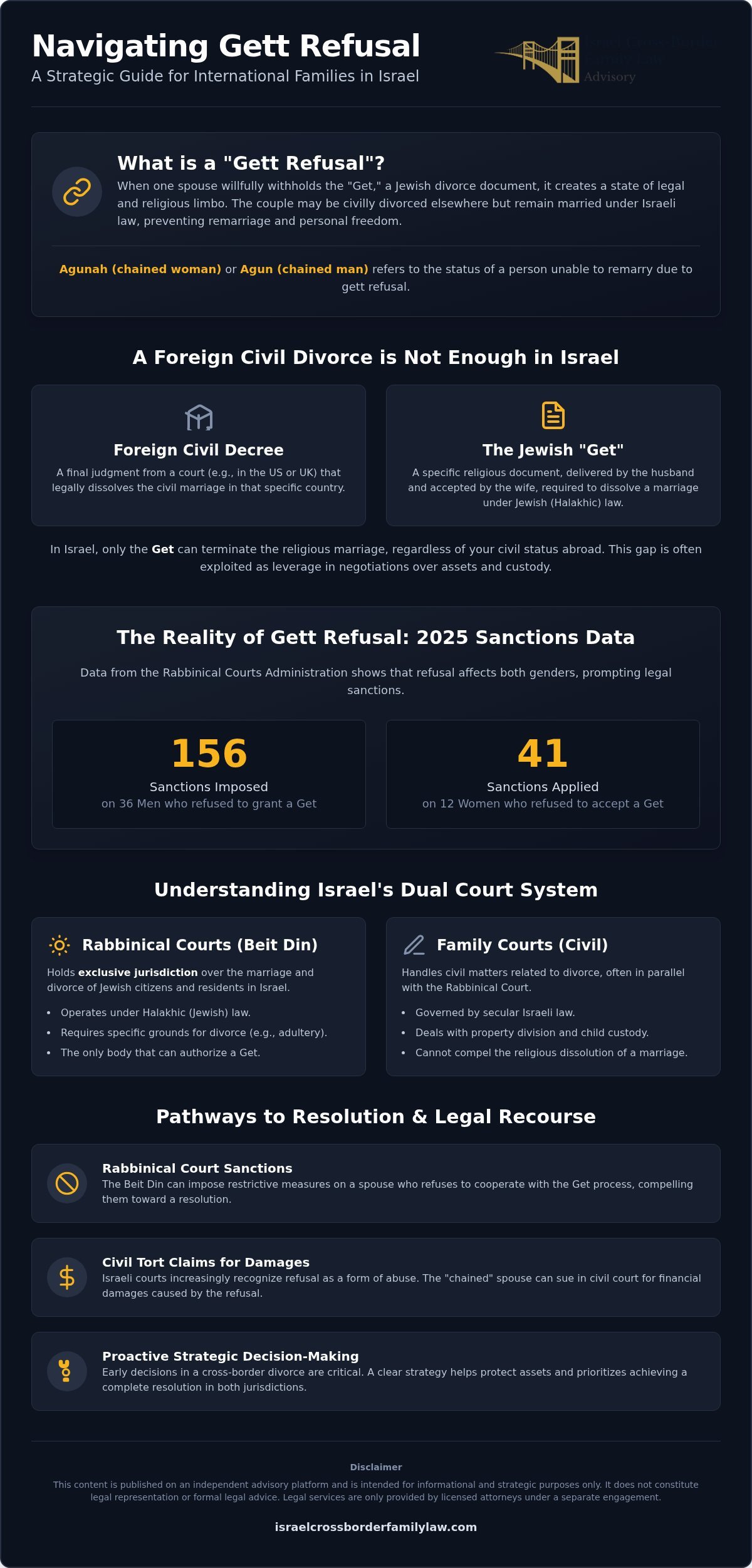
In the context of Jewish law, a marriage isn’t dissolved by a court decree alone. It requires a specific religious document, known as a Get, to be delivered by the husband and accepted by the wife. When one party willfully withholds this document, it results in gett refusal. This creates a state of legal and religious limbo where the couple may be civilly divorced but remains married under halakhic (Jewish) law. For the spouse seeking to move on, this situation is more than a formality; it’s a barrier to remarriage and personal freedom.
This status leads to the concepts of the Agunah (chained woman) or Agun (chained man). While historically associated with missing husbands, modern IL law recognizes that active refusal is just as restrictive. According to data from the Rabbinical Courts Administration, in 2025 alone, 156 sanctions were imposed on 36 men who refused to grant a Get, while 41 sanctions were applied to 12 women who refused to accept one. These figures highlight that while the issue is often framed around women, it affects both genders across the religious and secular spectrum.
The Difference Between Civil and Religious Divorce
Many expats and international families in Israel mistakenly believe a US “decree absolute” or a final judgment from a state court satisfies all requirements. It doesn’t. Under Jewish law, a divorce is a voluntary act between spouses. A US court cannot force the religious dissolution of a marriage. Because of this, gett refusal is frequently used as a strategic bargaining chip. One spouse might withhold the Get to demand a larger share of assets, lower child support payments, or specific custody arrangements. Understanding What is a gett is the first step in recognizing why a civil paper from New York or California won’t prevent you from being considered “married” in Israel.
Spiritual Abuse and Legal Recognition
Israeli authorities and international legal bodies are increasingly viewing persistent refusal as a form of spiritual or domestic abuse. It’s an exercise of power that prevents an individual from fulfilling their religious and social rights. The psychological impact is profound, often involving social stigma and the inability to have children who will be recognized as legitimate within the Jewish community. IL courts have begun to allow civil tort claims, where the “chained” spouse can sue for financial damages caused by the refusal. This shift emphasizes why early strategic planning is vital. Decisions made at the start of a cross-border divorce can determine whether you achieve a clean break or remain tethered to a former spouse for years.
Disclaimer: This content is published on an independent advisory platform and is intended for informational and strategic purposes only. It does not constitute legal representation or formal legal advice. Legal services are only provided by licensed attorneys under a separate engagement.
The Role of the Israeli Rabbinical Courts (Beit Din)
In IL, the Rabbinical Court holds exclusive jurisdiction over the marriage and divorce of Jewish citizens and residents. This authority means that even if a couple is secular or was married in a civil ceremony abroad, the religious dissolution of the marriage must occur through this specific institution. The Beit Din operates under halakhic law, which differs significantly from the “no-fault” systems common in many US states. To move forward, the court requires specific grounds for divorce, such as adultery or the refusal of marital obligations. When these grounds aren’t met or proven, the process can stall, creating an environment where gett refusal becomes a tangible risk.
The interaction between the Rabbinical Court and the secular Family Court is complex. While the Rabbinical Court has sole authority over the Get itself, both court systems can handle civil matters like property division and custody. This dual system often leads to procedural confusion for those accustomed to a unified court structure. As of January 2026, the mandatory first step for any divorce in IL is filing a “Settlement of Dispute” application, which carries a fee of 119 NIS. This filing is a critical moment that determines which court will eventually oversee the broader civil aspects of the separation.
Jurisdiction and the ‘Race to the Court’
The “race for jurisdiction” is a pivotal strategic element in IL divorce. The court where a claim is first filed often secures the right to decide related civil issues. For example, if a husband files for divorce in the Rabbinical Court and includes property division in his claim, that court may take authority over those assets. Conversely, a wife might prefer the secular Family Court for these matters. This choice impacts everything from asset distribution to understanding child support enforcement. Decisions made in these early hours have long-term weight, especially in cross-border cases where assets are held in multiple countries.
Navigating the Beit Din as a Foreign National
For expats and foreign nationals, the Beit Din can be an intimidating environment. Hearings are conducted in Hebrew, and the procedural rhythm is rooted in religious tradition rather than Western litigation styles. It’s essential to have a strategy that accounts for these cultural and linguistic gaps. Recent legislative changes in March 2026 now allow Rabbinical Courts to act as arbitrators in certain civil or commercial disputes if both parties provide consent, further expanding their influence. Gaining a strategic overview before your first filing is essential. You might consider a confidential case review to map out your jurisdictional options and protect your rights from the outset.
Disclaimer: This content is published on an independent advisory platform and is intended for informational and strategic purposes only. It does not constitute legal representation or formal legal advice. Legal services are only provided by licensed attorneys under a separate engagement.
Cross-Border Complications: When US and Israeli Laws Conflict
For international couples, a divorce is rarely contained within a single border. A common and distressing scenario is the “limping marriage,” where a couple is civilly divorced in the US but remains religiously married in Israel. This occurs because Israeli authorities do not automatically recognize foreign civil decrees as a dissolution of a Jewish marriage. Without a synchronized legal strategy, you may find yourself legally single in New York but trapped in a marriage in Jerusalem. This discrepancy often leads to gett refusal, where one party uses their religious status as a tool to influence civil outcomes across the Atlantic.
One significant risk for expats and US citizens in IL is the “Stay of Exit” order. In Israel, a spouse can request a court order to prevent the other party from leaving the country while divorce proceedings are active. This is often used to ensure the party remains present for the delivery of the Get. Being detained in a foreign country while trying to manage a life or career in the US is a reality that requires careful, early-stage planning. The complexity increases when considering the 2026 Supreme Court decision, which strengthened the presumption of shared ownership for pre-marital assets and inheritances in long-term marriages. This ruling makes it harder to protect US-based assets if the case is handled exclusively under Israeli jurisdiction without proper cross-border coordination.
Enforceability of International Agreements
US prenuptial and financial agreements face unique challenges in the Israeli Rabbinical Court. While a US court might attempt to compel a spouse to give a Get under statutes like the “New York Gett Law,” these orders carry little weight within the Israeli religious system. The Beit Din views the Get as a voluntary act; any hint of civil coercion can actually invalidate the religious divorce. Conversely, financial agreements signed in the US often require formal “validation” by an Israeli court to be enforceable in IL. Without this step, your carefully drafted US agreement may be set aside during the division of local assets.
International Custody and Relocation Risks
The threat of gett refusal is frequently intertwined with disputes over international custody and relocation. A spouse might withhold the Get specifically to block the other parent from moving back to the US with their children. While the Hague Convention governs the return of abducted children, it does not resolve the underlying religious status. This creates a situation where a parent might win a custody battle in a civil court but remain “chained” religiously, preventing them from truly starting over in their home country. Navigating these overlapping layers of international treaty law and religious mandates requires a bridge between both legal cultures.
Disclaimer: This content is published on an independent advisory platform and is intended for informational and strategic purposes only. It does not constitute legal representation or formal legal advice. Legal services are only provided by licensed attorneys under a separate engagement.
Strategic Options for Resolving Gett Refusal
While gett refusal presents a significant hurdle, the Israeli legal system has developed robust mechanisms to address it. These options range from religious pressure to civil financial penalties, allowing for a strategic approach that doesn’t rely solely on the voluntary cooperation of a recalcitrant spouse. Moving from a state of conflict to a state of resolution requires understanding how these tools can be applied in a cross-border context.
Sanctions and Legal Pressure
The Rabbinical Court has the authority to issue specific orders to compel compliance when a Get is being withheld. Harchakot refers to the specific set of social and legal distancing measures used by the Beit Din to pressure a recalcitrant spouse into granting or accepting a Get. These measures are not merely symbolic; they carry significant real-world weight. The court can order the revocation of driver’s licenses, impose professional bans, or even authorize imprisonment in extreme cases. As noted previously, the proactive application of these sanctions helped resolve nearly 200 cases of “chained” individuals in 2025.
Beyond religious sanctions, the IL Family Court provides a civil path for relief through tort claims. A spouse can sue for financial damages based on a “breach of autonomy.” These lawsuits recognize that the refusal of a religious divorce is a violation of an individual’s personal freedom and right to remarry. The financial pressure of a civil judgment often serves as a powerful motivator for the refusing party to finalize the Get and move forward with the civil settlement.
Preventative Measures for Future Clarity
Strategic planning is the most effective way to manage these risks. Agreements like the “Agreement for Mutual Respect” are designed to outline the divorce process clearly before conflict arises. For those already in a marriage, a postnuptial agreement can include a “Gett Clause.” This clause stipulates financial penalties if one party refuses to cooperate with the religious divorce, providing a clear roadmap for dissolution. This is particularly useful for expats and foreign nationals who need to ensure their US and Israeli legal statuses remain synchronized.
Mediation offers a less adversarial path to resolution. By working with a neutral third party, couples can often reach a settlement that includes the delivery of the Get as part of a broader financial and custody package. This approach avoids the high-stakes environment of the Beit Din and keeps decision-making power in the hands of the family. If you are facing these hurdles, you can reach out for a confidential consultation to explore which path best fits your specific cross-border needs.
Disclaimer: This content is published on an independent advisory platform and is intended for informational and strategic purposes only. It does not constitute legal representation or formal legal advice. Legal services are only provided by licensed attorneys under a separate engagement.
Navigating Your Path to Clarity and Resolution
The resolution of a cross-border divorce requires more than just reacting to court dates; it demands a bird’s-eye view of how decisions in one jurisdiction echo in another. When facing gett refusal, the natural instinct is often to increase legal pressure immediately. However, without a neutral, strategic assessment, aggressive moves in a US civil court might unintentionally complicate proceedings in the Israeli Rabbinical Court. Achieving a complete religious and civil divorce is a process of synchronization. It is about ensuring that your assets, custody rights, and religious status are all addressed in a single, cohesive roadmap that respects the nuances of both systems.
Emotional escalation is one of the greatest risks in international disputes. It often leads to a “race to the court” that can drain financial resources and leave families in a state of legal limbo for years. In the IL system, where the weight of early decisions is significant, taking a moment to seek clarity before making a formal commitment to a specific litigation path is essential. This strategic pause allows you to evaluate the inherent complexity of your case and the significant differences between Western legal expectations and Israeli religious mandates.
Seeking Strategy Over Conflict
In the sensitive environment of the Beit Din, aggressive tactics can sometimes backfire. Because the religious divorce must be given of “free will,” a spouse who feels cornered by civil litigation may dig in their heels, prolonging the status of being “chained.” An advisory platform serves as a critical bridge in these moments. By providing a roadmap for resolution before you enter the adversarial court system, you can identify which levers to pull and when. This allows you to engage specialized cross-border practitioners at the right time, armed with a clear understanding of the 2026 legislative landscape and your specific rights.
Next Steps for International Families
Your path forward begins with a thorough review of your current standing in both IL and the US. You must determine if your US agreements are properly validated in Israel and how the 2026 Supreme Court decision on pre-marital assets might impact your specific holdings. For further visual guidance on these complex topics, you can consult the Israel Family Law YouTube channel at @IsraelFamilyLaw. Gaining this knowledge is the most effective way to lower the temperature of a dispute and move toward a final, binding resolution.
Understanding the how it works of cross-border strategy is the best defense against a prolonged conflict. While gett refusal is a complex challenge, it is not insurmountable. You can gain the clarity needed to protect your assets and your personal freedom by requesting a confidential case review to map out your specific situation.
Disclaimer: This content is published on an independent advisory platform and is intended for informational and strategic purposes only. It does not constitute legal representation or formal legal advice. Legal services are only provided by licensed attorneys under a separate engagement.
Get clarity before you commit. Request a confidential consultation.
Securing Your Future Across Borders
Achieving a successful resolution in a US-Israel divorce requires a steady hand and a deep understanding of how religious and civil laws intersect. The risks associated with gett refusal are significant, yet they can be managed effectively through early strategic planning and a nuanced approach to jurisdiction. By prioritizing resolution over conflict and ensuring your international agreements are validated within the IL system, you protect both your financial assets and your personal freedom. It’s essential to remember that the decisions you make in the earliest stages of this process will carry the most weight in the years to come.
Our advisory platform serves as a vital bridge between these complex legal systems, offering the specialized expertise required to manage multi-jurisdictional risks. We’re dedicated to providing international families and expats with the authoritative guidance needed to navigate this landscape with confidence. This content is published on an independent advisory platform and is intended for informational and strategic purposes; it doesn’t constitute legal representation or formal legal advice. Legal services are only provided by licensed attorneys under a separate engagement.
Get clarity before you commit. Request a confidential consultation. You can move forward with the assurance that a structured, strategic roadmap is your most powerful tool for reaching a complete and lasting resolution.
Frequently Asked Questions
Can an Israeli court force my husband to give me a Gett if we were married in the US?
The Israeli Rabbinical Court has exclusive jurisdiction over the divorce of Jewish residents, regardless of where the wedding ceremony took place. While the court doesn’t physically force a husband to deliver the document, it can apply significant legal and social sanctions to compel his compliance. This authority extends to couples who were married in US civil ceremonies but are now living in IL.
What happens if I have a civil divorce but my spouse refuses the religious one?
You will remain religiously married under Israeli law, creating a “limping marriage” where your civil and religious statuses don’t match. This state of gett refusal prevents you from remarrying within the Jewish community and can lead to serious legal complications regarding the status of future children. It effectively keeps you tethered to a spouse even after your civil life has moved forward.
Is Gett refusal considered domestic abuse in Israel?
Persistent gett refusal is increasingly recognized as a form of spiritual and domestic abuse by the Israeli legal system. Victims have the right to file civil tort claims in the Family Court to seek financial damages for the harm caused by being “chained.” These lawsuits treat the refusal as a violation of personal autonomy and a breach of human dignity.
Can I be prevented from leaving Israel if my spouse opens a case in the Rabbinical Court?
A “Stay of Exit” order can be issued against a spouse to ensure they remain in the country while divorce proceedings are active. This is a common procedural tool used to prevent one party from leaving the jurisdiction before the religious divorce is finalized. It’s a significant risk for expats who may have professional or family commitments back in the US.
Do I need a separate lawyer for the Rabbinical Court and the Family Court?
You don’t necessarily need two different attorneys, but you must have a representative who is experienced in both secular and religious jurisdictions. The rules of evidence and the procedural language used in the Beit Din are entirely different from those in the Family Court. A multi-qualified practitioner can ensure your strategy is consistent across both systems.
How long does the process of resolving a Gett refusal typically take?
The timeline for resolution depends on the specific strategy employed and the level of cooperation from the other party. While some cases are resolved through strategic mediation in a few months, others that require court-ordered sanctions or civil lawsuits can take much longer. Early intervention and a clear roadmap are the best ways to expedite the process.
Are there civil financial penalties for refusing to grant a religious divorce?
Civil courts in IL can impose heavy financial judgments against a spouse who refuses to grant or accept a Get. These penalties are awarded through tort claims and are designed to compensate the victim for emotional distress and the loss of the right to remarry. Financial pressure often serves as a powerful motivator to resolve the religious deadlock.
Can a prenuptial agreement from the US help me in an Israeli religious court?
A standard US prenuptial agreement is often insufficient to address religious divorce requirements in IL. To be effective in the Beit Din, the document must include specific halakhic clauses and should ideally be validated by an Israeli court. Without these local adjustments, the Rabbinical Court may not recognize the financial penalties intended to prevent refusal.

Article by
Gabriel Lior
A Personal Journey That Became a Mission
The advisory was founded by an American father Gabriel Lior, LLB, MBA , global entrepreneur, and cross-border advisor who spent more than a decade navigating the Israeli family court system firsthand and now lives in Singapore with his son.
As a divorced parent in a cross-border family, Gabriel faced nearly every legal challenge a foreign parent can encounter in Israel — including child custody disputes, child support proceedings, property matters in Israel and abroad, false accusations, and complex immigration and relocation proceedings.
Over the years, he learned the hard way how difficult it is for non-Israeli parents to understand the system, identify the right legal strategy, and choose the right legal representation — especially when language, culture, and jurisdictional differences are involved. He also witnessed how foreign parents and new immigrants are often disadvantaged or taken advantage of by service providers and institutions simply because they lack local knowledge or fluency.
From Client to Advisor
To truly understand — and survive — the system, Gabriel pursued formal legal education in Israel, completing two Israeli law degrees, alongside a BA and MBA earned in the United States. This was never about becoming a practicing attorney, but about gaining a deep, structural understanding of how the system works — and where it breaks down for foreign parents.
This rare combination of:
Firsthand client experience
Israeli legal and US business education
International business and negotiation training
Decades of commercial execution
created a unique perspective – one that understands both sides of the table.
After years of litigation, persistence, and at times self-representation, he ultimately succeeded in securing custody of his son and relocating abroad through a rare legal victory in the Israeli Supreme Court — becoming one of the first fathers in Israel to do so under these circumstances.
Disclaimer
Important Disclaimer:
The information provided on this website and in its content is for general informational and educational purposes only and does not constitute legal advice, legal opinion, or legal representation.
Gabriel Lior is not licensed to practice law in Israel (nor is he interested in doing so) and does not provide legal services, despite having completed 2 Law Degrees. The services offered are advisory in nature and are intended to provide general guidance, strategic insight, and information regarding cross-border family law considerations.
No attorney-client relationship is formed by accessing this website, reading its content, or communicating with us.
Any decisions made based on this information are at your own discretion and risk. For legal advice specific to your situation, you should consult a licensed attorney in the relevant jurisdiction.
Where appropriate, we may refer clients to independent, licensed attorneys or professionals. Such referrals do not constitute legal representation and no liability is assumed for services provided by third parties.