When family matters transcend national borders, the resulting legal landscape can become profoundly complex and fraught with uncertainty. Questions of jurisdiction-which country’s laws will govern your divorce, child custody arrangements, or the division of international assets-are central to the sophisticated field of cross-border family law Israel. For individuals and families facing these multi-jurisdictional challenges, the fear of an international child relocation dispute or ambiguity over how a global property portfolio will be handled can be paralyzing without expert guidance. This comprehensive guide is designed to provide clarity amidst this complexity. We will navigate the critical legal challenges inherent in international divorce, custody battles, and asset division involving Israel. Our objective is to equip you with the foundational knowledge required to protect your rights, understand your obligations across different legal systems, and develop a clear, strategic path toward resolution. By understanding the process, you can move forward to select the right legal representation with confidence and secure a favorable outcome for your family’s future.
What is Cross-Border Family Law and Who Does It Affect in Israel?
Cross-border family law governs complex legal disputes involving individuals, children, or assets located in more than one country. In an increasingly globalized world, matters of marriage, divorce, and child custody frequently transcend national borders, creating multi-jurisdictional challenges. For families connected to Israel, these issues require a sophisticated understanding of both Israeli and international legal frameworks. Navigating the intricacies of cross-border family law Israel demands specialized expertise to protect your rights and achieve a favourable resolution. To better understand these complex concepts, watch this overview of the Hague Convention and cross-border divorce in Israel:
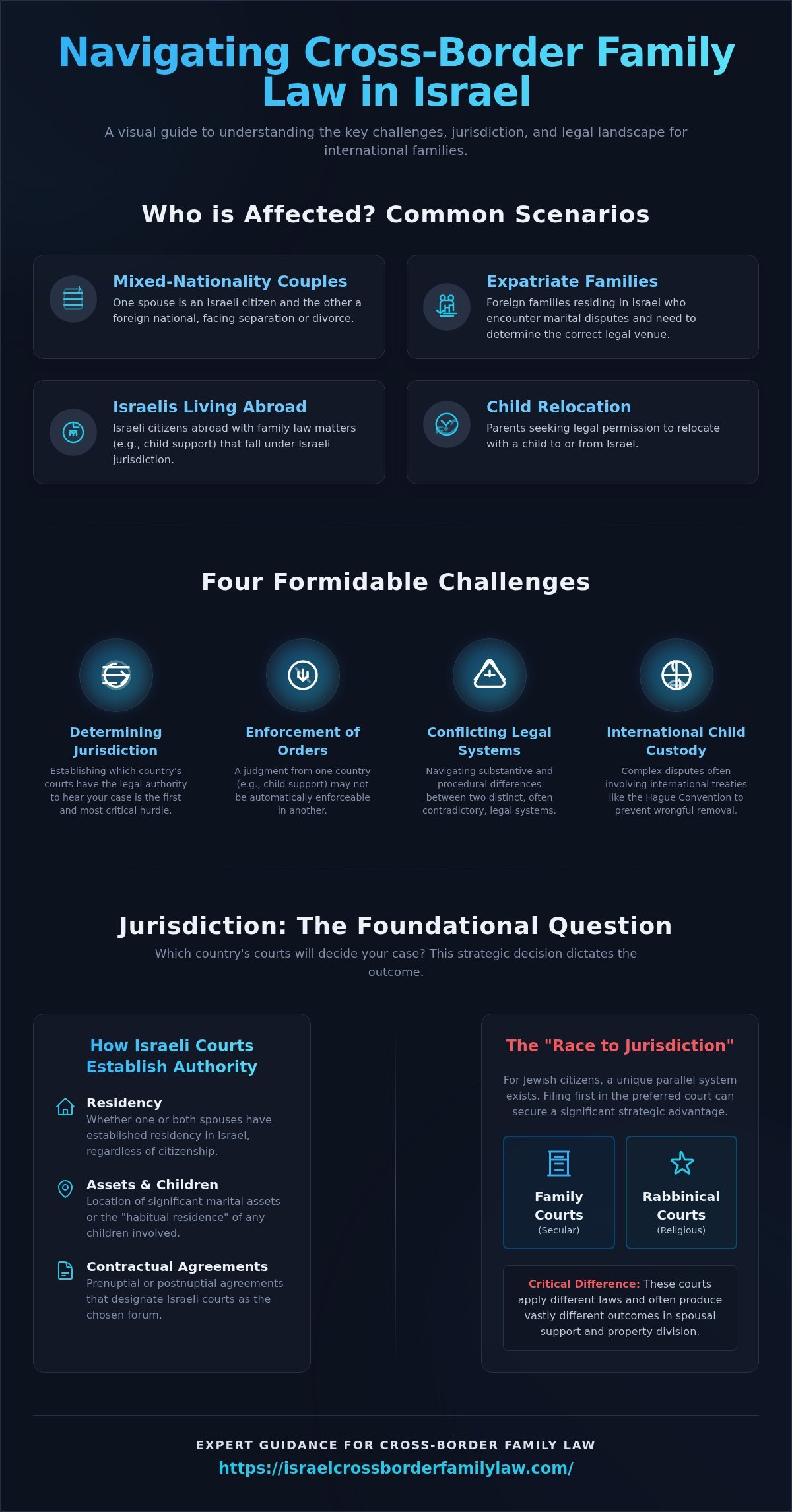
Common Scenarios for International Families
The need for experienced international legal counsel arises in numerous situations. Individuals and families are frequently affected in the following circumstances:
- Mixed-nationality couples, where one spouse is an Israeli citizen and the other is a foreign national, facing divorce or separation.
- Expatriate families residing in Israel who encounter marital disputes and must determine the appropriate legal venue for their case.
- Israeli citizens living abroad who have ongoing family law matters, such as child support or property division, that fall under Israeli jurisdiction.
- Parents seeking legal permission to relocate with a child either from Israel to another country or to Israel from abroad.
Key Challenges You Will Face
International family law cases present unique and formidable obstacles that are not present in domestic disputes. Successfully managing these matters requires overcoming several key challenges:
- Determining Jurisdiction: Establishing which country’s courts have the legal authority to hear your case is often the first and most critical hurdle.
- Enforcement of Orders: A judgment for child support or property division issued in one country may not be automatically enforceable in another, requiring complex legal procedures.
- Conflicting Legal Systems: You must navigate the substantive and procedural differences between two distinct legal systems, which may have contradictory approaches to family law.
- International Child Custody: Resolving international custody disputes can be particularly challenging, often involving international treaties like the Hague Convention on International Child Abduction to prevent wrongful removal.
This guide provides essential information and strategic guidance for expats & foreign nationals facing these multi-jurisdictional issues.
Jurisdiction: The First and Most Critical Question in Your Case
In the complex arena of international family disputes, jurisdiction is the foundational question of which country’s courts have the legal authority to hear and decide your case. Before any substantive matters such as child custody, asset division, or spousal support can be addressed, it must be unequivocally established where the legal proceedings will take place. This initial determination is not a mere formality; it is a profoundly strategic decision that can dictate the entire outcome of your case, as the laws governing family matters vary dramatically between countries. Failing to properly address jurisdiction from the outset can lead to costly, protracted, and ultimately unfavorable results in any matter of cross-border family law Israel. This early phase often involves a tactical consideration known as ‘forum shopping,’ where one party may attempt to initiate proceedings in the jurisdiction whose laws are most advantageous to their position. An experienced legal team will guide you in assessing the most favorable forum and taking swift, decisive action to secure it.
How Israeli Courts Establish Jurisdiction
The Israeli judicial system assesses several key factors to determine if it has the authority to adjudicate a multi-jurisdictional family law case. These factors are critical and require sophisticated analysis. They include:
- Residency: The court will examine whether one or both spouses have established residency in Israel, even if they are not Israeli citizens.
- Assets and Children: The location of significant marital assets or, crucially, the ‘habitual residence’ of any children involved. This concept is a cornerstone of international child custody law, governed by treaties like the Hague Convention on the Civil Aspects of International Child Abduction, which is authoritatively detailed by The Hague Conference on Private International Law.
- Contractual Agreements: The existence of a prenuptial or postnuptial agreement that explicitly designates Israeli courts as the chosen jurisdiction for resolving any future disputes.
The Dual Legal System: Family Courts vs. Rabbinical Courts
For Jewish citizens, Israel presents a unique jurisdictional challenge due to its parallel legal system. Both the secular Family Courts and the religious Rabbinical Courts (Batei Din) have the authority to hear divorce cases. This can initiate a “race to jurisdiction,” where the party who files first in their preferred court may secure that forum. As these courts apply different laws and often produce vastly different outcomes, especially regarding spousal support and property division, obtaining immediate and strategic legal advice is paramount to protecting your interests.
Core Practice Areas in Israel-International Family Law
Navigating family disputes that span multiple jurisdictions demands a sophisticated understanding of both Israeli and international legal frameworks. The intersection of different legal systems, cultures, and regulations creates unique challenges that require specialized counsel. Effective representation in cross-border family law Israel matters is built upon deep expertise in several core practice areas, each presenting its own distinct complexities.
International Divorce and Separation
Dissolving a marriage with international ties involves far more than a standard domestic procedure. A primary concern is the recognition of foreign civil divorces in Israel, which is not always straightforward, particularly for Jewish couples who must also obtain a religious divorce, or ‘Get’, from the Rabbinical Court to be considered divorced under Jewish law and remarry. Furthermore, the equitable division of marital assets, including real estate, investments, and business interests located in multiple countries, requires meticulous multi-jurisdictional coordination. Navigating this process requires a deep understanding of the unique challenges involved in divorce for international families.
Cross-Border Child Custody and Relocation
When children are involved, Israeli courts are guided by the principle of the “best interests of the child” (tovat ha’yeled). Obtaining permission from an Israeli court for a parent to relocate internationally with a child (hagira) is a complex and highly scrutinized process. International custody disputes are often governed by treaties, most notably The Hague Convention on the Civil Aspects of International Child Abduction, which Israel is a signatory to. Crafting viable parenting plans across different time zones and continents presents significant logistical and legal hurdles. Expert guidance is essential to address the complexities of international custody & relocation and protect parental rights.
Financial Disputes: Alimony and Child Support
Determining and enforcing financial obligations across borders is a critical component of cross-border family law Israel. In Israel, child support (mezonot yeladim) and spousal support (mezonot isha) calculations are often influenced by the personal status law of the parties (e.g., Jewish, Muslim, Christian), adding a layer of complexity not found in many Western countries. A significant challenge is the enforcement of foreign support orders, such as those issued by a US court, within Israel. This process is governed by specific bilateral and multilateral treaties, which facilitate the recognition and execution of financial judgments between nations.
The Hague Convention and Preventing International Child Abduction
In the complex arena of multi-jurisdictional family disputes, the Hague Convention on the Civil Aspects of International Child Abduction stands as the critical international treaty designed to protect children from the devastating impact of parental abduction. The Convention provides a legal framework for the prompt return of children who have been wrongfully removed from their country of habitual residence or wrongfully retained in another country. A ‘wrongful removal’ or ‘retention’ occurs when it is in breach of custody rights that were being actively exercised by a parent or guardian under the law of the state in which the child was habitually resident immediately before the removal. If you fear your child is at risk of being taken to or from Israel, or has already been abducted, immediate action is paramount. The initial hours and days are crucial for establishing a successful legal strategy to secure their return.
How the Hague Convention Works in Israel
As a signatory to the Convention, Israel is fully committed to its principles and has established a robust, expedited legal process to handle these sensitive cases. The central tenet of a Hague Convention application is the swift return of the child to their country of habitual residence. It is imperative to understand that the Israeli Family Court hearing the application does not delve into the merits of custody or visitation rights. Its jurisdiction is narrowly focused on the single issue of whether the child should be returned, leaving substantive custodial decisions to the courts of the child’s home country.
Defenses and Exceptions to a Hague Application
While the Convention presumes the child’s return is in their best interest, it provides for a limited set of defenses. An abducting parent may argue, for example, that returning the child would create a “grave risk of physical or psychological harm” or that the child (of sufficient age and maturity) objects to being returned. However, Israeli courts, consistent with global judicial interpretation, construe these defenses very narrowly. The burden of proof is exceptionally high, as courts are mandated to prevent these exceptions from undermining the Convention’s core purpose. This legal reality underscores a vital truth in cross-border family law Israel: prevention is profoundly better than litigation. Proactive legal measures to prevent abduction are far more effective than relying on the slim chances of a successful defense after the fact. Effectively navigating these urgent and complex proceedings requires deep, specialized knowledge. Engaging experienced legal counsel at the first sign of risk is the most decisive step a parent can take to protect their child and their parental rights. For expert guidance, contact our firm to discuss your case.
Why a Specialized Cross-Border Lawyer is Non-Negotiable
Navigating an international family dispute requires a level of expertise far beyond the scope of standard domestic law. While a local lawyer possesses a deep understanding of Israeli statutes, complex multi-jurisdictional cases demand a professional who can strategically manage the interplay between different legal systems, international treaties, and divergent cultural norms. Choosing the right counsel is not merely a preference; it is a fundamental necessity for protecting your rights and assets across borders. The difference lies in a unique combination of skills and global perspective that a domestic practitioner cannot offer. A specialist in cross-border family law Israel transforms your legal strategy from a local defense into a coordinated international plan.
Unique Skills of an International Family Lawyer
An international specialist provides a distinct and decisive advantage by bringing a sophisticated, multi-faceted skill set to your case. This expertise is crucial for anticipating challenges and leveraging opportunities that arise when multiple legal systems are involved. Key capabilities include:
- Expertise in Private International Law: Mastery of complex jurisdictional rules, choice of law provisions, and the Hague Conventions governing child abduction and service of process.
- Multi-Jurisdictional Litigation Experience: A proven track record of litigating effectively within both the Israeli court system and foreign legal contexts, understanding the procedural and evidentiary differences.
- Global Legal Network: The ability to seamlessly coordinate with pre-vetted legal counsel and financial experts in other countries to enforce orders, trace assets, or gather evidence.
- Bicultural and Bilingual Fluency: Deep cultural understanding and fluency in English, ensuring that legal arguments are not only technically precise but also culturally resonant and persuasive.
Your Next Step: Developing a Legal Strategy
The path to a successful resolution begins with a comprehensive analysis of your unique circumstances. An international specialist can identify critical risks and strategic opportunities-such as the most favorable jurisdiction for your case-that are often invisible to those without multi-jurisdictional experience. This proactive planning is the cornerstone of achieving a favorable outcome, preventing costly errors, and securing your family’s future. The initial decisions made in a cross-border case are often the most critical. We invite you to take the essential first step towards clarity and control by requesting a Confidential Case Review. Our team is prepared to help you navigate the complexities of your case with the authority and expertise you deserve.
Your Strategic Path Forward in Israeli International Family Law
The landscape of international family disputes is inherently complex, defined by critical jurisdictional questions and the protective framework of international treaties like The Hague Convention. As we have explored, determining which court holds authority is the foundational step that dictates the trajectory of your case, while understanding the mechanisms to prevent parental child abduction is paramount for protecting your family’s most vital interests. These high-stakes matters underscore a non-negotiable reality: specialized legal counsel is essential for a successful resolution. Navigating these multi-jurisdictional challenges requires more than just legal knowledge; it demands focused, strategic guidance. For matters of cross-border family law Israel, engaging a firm with profound expertise is a necessity for a favorable outcome. Our firm provides clear, English-speaking legal counsel for expats and foreign nationals, leveraging deep expertise in Israeli, US, and International law to protect your rights. Take the decisive next step to secure your family’s future. Request a Confidential Case Review to Develop Your Legal Strategy and gain the clarity you need to move forward with confidence.
Frequently Asked Questions About Cross-Border Family Law in Israel
Can a US court order for divorce or custody be enforced in Israel?
While Israel has not ratified all international treaties on the recognition of foreign divorces, a US divorce decree can often be recognized under principles of international comity. For custody, Israel is a signatory to the Hague Convention on Child Abduction, which provides a robust framework for the return of children. However, direct enforcement of a US custody order requires a separate recognition process in an Israeli Family Court, which will assess jurisdiction and public policy considerations before granting enforcement.
What happens to our property and assets located in both the US and Israel during a divorce?
The division of marital assets in multiple countries presents a complex, multi-jurisdictional challenge. Typically, an Israeli court has jurisdiction over assets within Israel, while a US court presides over US-based assets. A comprehensive legal strategy is essential to ensure both courts work in concert to achieve an equitable global division. Without a coordinated approach, parallel proceedings can result in conflicting rulings, requiring sophisticated legal counsel to harmonize the outcomes and protect your financial interests across borders.
My spouse is threatening to take our children to Israel and not return. What should I do?
This situation requires immediate and decisive action. You must promptly seek an emergency court order in your US jurisdiction to prevent the children’s removal, which can include seizing their passports. If the children have already been taken, you can initiate proceedings under the Hague Convention on the Civil Aspects of International Child Abduction for their swift return to their country of habitual residence. Engaging experienced counsel with expertise in both US and Israeli law is critical for a rapid and effective response.
Do I need to be physically present in Israel to handle a family law case there?
While your presence may be necessary for critical hearings, such as providing testimony, a significant portion of the legal process can be managed remotely by your Israeli counsel. Through a valid power of attorney, your legal representatives can file motions, attend procedural hearings, and conduct negotiations on your behalf. Modern court systems increasingly accommodate international clients, but strategic decisions regarding your presence should be made in close consultation with your attorney to advance your case effectively.
How are prenuptial agreements from another country treated by Israeli courts?
A foreign prenuptial agreement is generally enforceable in Israel, provided it meets specific legal standards. Israeli courts will verify that the agreement was entered into voluntarily, with full financial disclosure and independent legal advice for both parties, and that its terms do not violate Israeli public policy. To maximize its authority in matters of cross-border family law Israel, it is highly advisable to have a foreign agreement reviewed and formally ratified by the Israeli Family Court upon relocating.
What is the difference between an Israeli Family Court and a Rabbinical Court?
Israel operates a dual-jurisdiction system for family matters. The Family Court is a civil institution with broad authority over all family disputes, including custody, property division, and support, applying secular state law. In contrast, the Rabbinical Court (Beit Din) is a religious tribunal with exclusive jurisdiction over marriage and divorce for Jewish citizens. It may also rule on ancillary matters if both parties consent, in which case it applies Jewish Law (Halakha) to its decisions.

Article by
Gabriel Lior
A Personal Journey That Became a Mission The advisory was founded by an American father Gabriel Lior, LLB, MBA , global entrepreneur, and cross-border advisor who spent more than a decade navigating the Israeli family court system firsthand and now lives in Singapore with his son.
As a divorced parent in a cross-border family, Gabriel faced nearly every legal challenge a foreign parent can encounter in Israel — including child custody disputes, child support proceedings, property matters in Israel and abroad, false accusations, and complex immigration and relocation proceedings. Over the years, he learned the hard way how difficult it is for non-Israeli parents to understand the system, identify the right legal strategy, and choose the right legal representation — especially when language, culture, and jurisdictional differences are involved. He also witnessed how foreign parents and new immigrants are often disadvantaged or taken advantage of by service providers and institutions simply because they lack local knowledge or fluency. From Client to Advisor To truly understand — and survive — the system, Gabriel pursued formal legal education in Israel, completing two Israeli law degrees, alongside a BA and MBA earned in the United States. This was never about becoming a practicing attorney, but about gaining a deep, structural understanding of how the system works — and where it breaks down for foreign parents. This rare combination of: Firsthand client experience Israeli legal and US business education International business and negotiation training Decades of commercial execution created a unique perspective – one that understands both sides of the table. After years of litigation, persistence, and at times self-representation, he ultimately succeeded in securing custody of his son and relocating abroad through a rare legal victory in the Israeli Supreme Court — becoming one of the first fathers in Israel to do so under these circumstances.
Disclaimer
Important Disclaimer: The information provided on this website and in its content is for general informational and educational purposes only and does not constitute legal advice, legal opinion, or legal representation. Gabriel Lior is not licensed to practice law in Israel (nor is he interested in doing so) and does not provide legal services, despite having completed 2 Law Degrees. The services offered are advisory in nature and are intended to provide general guidance, strategic insight, and information regarding cross-border family law considerations. No attorney-client relationship is formed by accessing this website, reading its content, or communicating with us. Any decisions made based on this information are at your own discretion and risk. For legal advice specific to your situation, you should consult a licensed attorney in the relevant jurisdiction. Where appropriate, we may refer clients to independent, licensed attorneys or professionals. Such referrals do not constitute legal representation and no liability is assumed for services provided by third parties.