For international couples embarking on marriage, the convergence of personal commitment and multi-jurisdictional assets presents a sophisticated legal challenge. The uncertainty surrounding how foreign-held property, inherited wealth, or complex business interests will be treated under Israeli law can create significant apprehension. Navigating this landscape requires foresight and strategic planning, making a meticulously drafted prenuptial agreement in Israel a critical instrument for achieving financial clarity and security. It is not merely a contingency plan for dissolution but a foundational document that provides a clear framework for managing assets throughout your cross-border relationship. This comprehensive guide is designed to advise international couples on the pivotal role of a prenuptial agreement under the Israeli legal system. We will navigate the essential requirements, explore how to effectively safeguard personal and business assets across borders, and demonstrate how this proactive measure can streamline potential disputes. Our goal is to provide you with the knowledge to secure your financial future, ensuring the confidence and predictability essential for your international marriage.
Key Takeaways
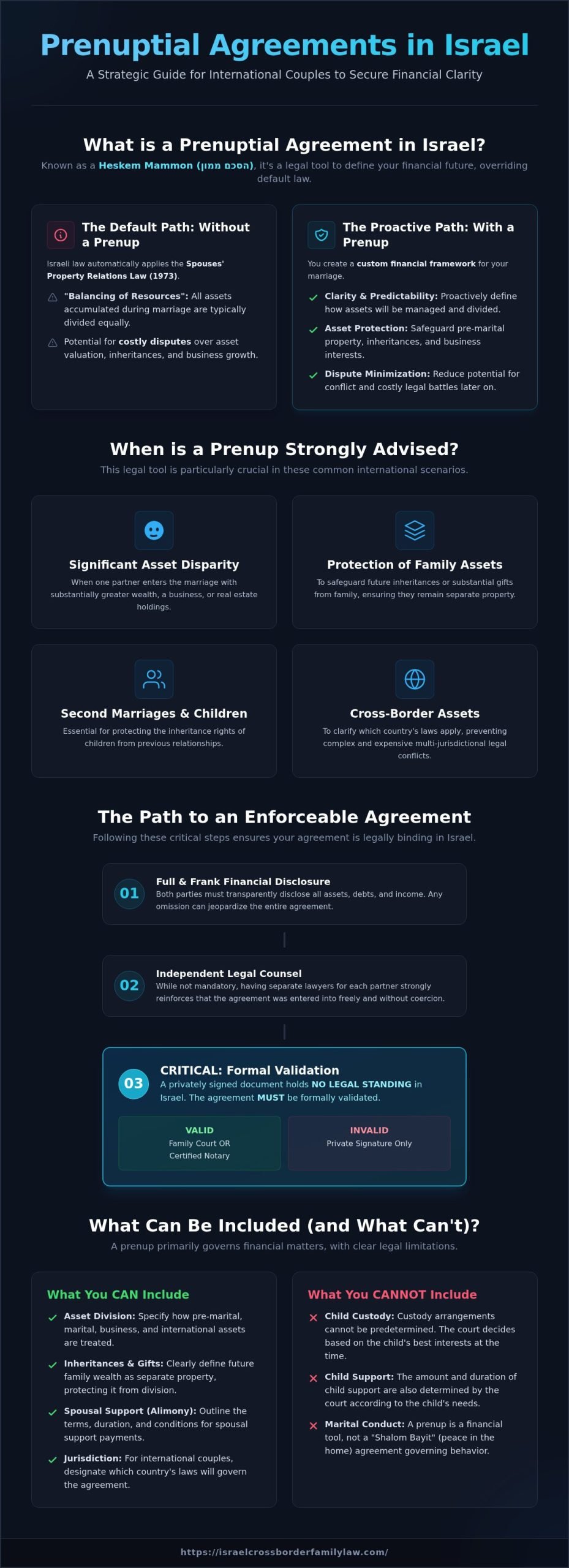
- Understand that an Israeli prenuptial agreement (‘Heskem Mammon’) is a critical legal instrument that allows you to proactively define financial outcomes, supplanting the default provisions of Israeli law.
- Recognize that for a prenuptial agreement israel to be enforceable, it requires formal validation by either a family court or a certified notary, as a privately signed document holds no legal standing.
- Navigate the complexities of cross-border marriage by structuring your agreement to address multi-jurisdictional asset management and resolve potential conflicts between Israeli and foreign legal systems.
- Ensure the long-term validity of your agreement by avoiding critical procedural errors, beginning with the foundational requirement of full and transparent financial disclosure from both parties.
What is a Prenuptial Agreement in Israel and Why Should You Consider One?
In Israel, a prenuptial agreement, known legally as a Heskem Mammon (הסכם ממון), is a sophisticated legal instrument that allows couples to define their financial relationship and asset division framework, deviating from the state’s default legal regime. Far from being a sign of distrust, it is a strategic tool for promoting financial transparency and clarity from the outset of a marriage. Its primary function is to establish a clear, mutually agreed-upon plan for the separation of assets in the event of divorce or death, thereby minimizing the potential for protracted and costly legal disputes. To better understand the strategic benefits of this financial tool, we invite you to watch the following overview:
By proactively addressing complex financial matters, a prenuptial agreement serves as a vital ‘insurance policy’ for the marriage’s economic health. It provides both partners with security and predictability, allowing them to enter the union with a shared understanding and a solid foundation, free from future ambiguity concerning significant financial assets.
The Legal Framework: Israel’s Spouses’ Property Relations Law
In the absence of a prenuptial agreement, the Spouses’ Property Relations Law, 1973, governs the division of assets for couples married after January 1, 1974. The law mandates a “balancing of resources,” where all assets accumulated during the marriage are generally divided equally upon divorce. However, the law excludes pre-marital assets, inheritances, gifts, and certain pension rights. Relying solely on this framework can lead to complex disputes over asset valuation, commingling of funds, and the appreciation of separate property.
Key Scenarios Where a Prenup is Advisable
Executing a comprehensive prenuptial agreement in Israel is particularly prudent in several complex situations. We strongly advise clients to consider this instrument under the following circumstances:
- Significant Asset Disparity: When one partner enters the marriage with substantially greater wealth, a business, or significant real estate holdings.
- Protection of Family Assets: To safeguard future inheritances or substantial gifts from family members, ensuring they remain separate property.
- Second Marriages: For individuals with children from previous relationships, a prenup is essential for protecting their children’s inheritance rights.
- International and Cross-Border Couples: When partners have assets in multiple jurisdictions, a prenup can clarify which country’s laws will apply, preventing multi-jurisdictional legal conflicts.
Beyond Finances: Addressing Non-Monetary Issues
While primarily a financial tool, a Heskem Mammon can also address ancillary matters such as the terms of spousal support (alimony). It is distinct from a “Shalom Bayit” (peace in the home) agreement, which focuses on marital conduct. It is important to note that Israeli law prohibits predetermining matters of child custody and support within a prenup, as these are decided based on the child’s best interests at the time of separation. This distinction is crucial, as a civil agreement operates alongside, but separately from, the considerations found in a traditional Jewish prenuptial agreement, which may address religious obligations.
Key Components of an Enforceable Israeli Prenuptial Agreement
To be legally binding in Israel, a prenuptial agreement must be meticulously drafted with unambiguous language, leaving no room for future misinterpretation. The foundational pillar of any such agreement is the full and frank financial disclosure by both parties; any omission or misrepresentation can jeopardize its enforceability. While these agreements are highly tailored, they are built upon several critical components. Crucially, the validity of a prenuptial agreement Israel is significantly reinforced when both parties have been advised by independent legal counsel, ensuring that the terms were entered into freely, knowingly, and without coercion.
Defining Separate vs. Marital Property
A primary function of the agreement is to precisely delineate between separate and marital property. This involves creating a comprehensive schedule of each party’s pre-marital assets, such as real estate holdings, investment portfolios valued in ILS (₪), or family businesses. The agreement must then establish clear rules for assets acquired during the marriage, either affirming or modifying the default presumptions under Israeli law. A sophisticated agreement will also proactively address how any appreciation in the value of separate property will be treated-a frequent source of complex litigation.
Addressing Future Assets, Debts, and Business Interests
A forward-looking agreement extends beyond current assets to govern future financial complexities. This includes clauses addressing the division of future income, career-related assets, and retirement accounts such as a keren hishtalmut or pension funds. The agreement provides a clear framework for liability, ensuring pre-marital debts remain the responsibility of the original debtor. For entrepreneurs and executives, it is essential to include provisions that protect business ownership, intellectual property rights, and unvested stock options, safeguarding these complex assets from future claims.
Provisions for Inheritance and Spousal Support (Alimony)
The agreement should explicitly state that any future inheritances or substantial gifts received by one party will remain their separate property, thereby preventing them from being commingled with marital assets. Furthermore, it can provide definitive terms for spousal support (mezonot), allowing couples to waive it entirely or set specific amounts and durations. This level of specificity provides certainty, a principle embraced by both bespoke legal documents and religiously-attuned frameworks like Tzohar’s prenuptial agreement, which seeks to prevent future disputes under both civil and Jewish law.
The Legal Process: How to Validate a Prenuptial Agreement in Israel
In Israeli family law, the mere act of drafting and signing a prenuptial agreement is insufficient to render it legally binding. To be enforceable, the agreement must undergo a formal validation process before an authorized legal body. This critical step, mandated by the Spouses’ Property Relations Law, 5733-1973, is designed to ensure that both parties have entered into the contract with full comprehension and free will. Without this official approval, the document holds no legal weight and will not be upheld by the courts in the event of a separation. Parties must navigate one of two primary paths to secure this essential validation.
Path 1: Validation by the Family Court or a Notary
The most common route for validation involves submitting the agreement to the Israeli Family Court or having it certified by a qualified notary. When presented to the court, a judge will personally meet with the couple to confirm that they understand the full scope and future implications of each clause. The judge’s primary role is to verify that the consent of both parties is genuine, informed, and free from any external pressure or duress. Alternatively, a notary with specific authorization for prenuptial agreements can provide certification, a process that is often more expeditious. This civil path is the standard for most secular, interfaith, and non-Jewish couples.
Path 2: Approval by the Rabbinical Court (Beit Din)
For Jewish couples who intend to marry and, if necessary, divorce according to Jewish law (Halakha), seeking validation from the Rabbinical Court, or Beit Din, is a strategic option. This ensures that the financial terms stipulated in the agreement are recognized and integrated within the religious divorce proceedings, including the granting of a Get (religious bill of divorce). The process mirrors that of the Family Court, with a rabbinical judge (Dayan) examining the agreement and confirming the couple’s voluntary and informed consent. Choosing this path provides a cohesive legal framework for couples navigating both the civil and religious aspects of Israeli family law.
The Critical Importance of Independent Legal Counsel
While the court or notary provides the final validation, a foundational element in creating a robust prenuptial agreement in Israel is the engagement of independent legal counsel for each party. This practice is paramount for safeguarding the integrity of the agreement. By having separate attorneys, each party can receive unbiased advice tailored to their specific interests, which preemptively counters any future claims of coercion, misunderstanding, or unequal bargaining power. This proactive measure significantly fortifies the agreement against legal challenges, ensuring it stands as a clear and defensible reflection of the couple’s mutual intentions.
Special Considerations for US-Israeli and International Couples
For couples with diverse nationalities and assets spread across multiple countries, the financial planning process is inherently more complex. A standard domestic agreement often fails to address the sophisticated challenges of cross-border life, where families must navigate the intersection of Israeli, US, and other international laws. A multi-jurisdictional approach is essential to protect assets and ensure clarity for the future.
Enforceability of Foreign Prenups in Israel
A common misconception is that a prenuptial agreement drafted and signed in the United States is automatically enforceable in Israel. While Israeli courts may recognize foreign agreements under the principle of ‘comity’ (judicial respect for another jurisdiction’s laws), enforcement is not guaranteed. To ensure legal validity, it is highly advisable to have the foreign agreement reviewed by Israeli counsel and formally ratified by an Israeli Family Court. This ‘domestication’ process provides an essential layer of legal certainty.
Managing Assets Located in the US and Israel
International couples frequently hold a diverse portfolio of assets, including real estate in Tel Aviv, retirement accounts like a 401(k) in the US, and global investment portfolios. A robust agreement must address potential conflicts between differing legal systems, such as US community property laws versus Israeli marital property regulations. Effective planning also involves coordinating the prenuptial agreement with multi-jurisdictional estate planning to create a seamless and comprehensive financial strategy that protects wealth on a global scale.
Jurisdictional Clauses: Deciding Where a Divorce is Heard
One of the most powerful tools for an international couple is the inclusion of a ‘choice of law’ or ‘forum selection’ clause. This provision pre-determines which country’s laws will govern the agreement and where any potential divorce proceedings will be heard. Establishing jurisdiction in advance provides critical predictability and control for international families facing divorce or separation, preventing costly and protracted legal battles over which court has authority. Crafting a durable prenuptial agreement israel for a US-Israeli or international family demands sophisticated legal counsel with deep expertise in both jurisdictions. A properly structured cross-border agreement provides the security and clarity necessary to build a future with confidence. For guidance on navigating these complex international matters, consult with a firm experienced in cross-border family law.
Common Pitfalls to Avoid When Drafting Your Agreement
A financial agreement is only as strong as the legal process used to create it. In Israel, family courts meticulously scrutinize not only the final terms but also the circumstances under which the agreement was drafted and signed. Procedural mistakes, even seemingly minor ones, can render an entire agreement void, leading to complex and costly litigation-the very outcome you sought to prevent. Proactively navigating these common pitfalls with experienced counsel is essential to ensuring your agreement’s validity and long-term enforceability.
The Risk of Inadequate or Incomplete Financial Disclosure
The most direct path to invalidating a financial agreement is through concealment of assets. Full, transparent, and documented financial disclosure is not a mere formality; it is the foundational requirement upon which the entire agreement rests. Both parties must provide a comprehensive and honest schedule of all assets, liabilities, and income, both in Israel and abroad. Any attempt to hide property, undervalue business interests, or omit sources of income demonstrates a lack of good faith and provides clear grounds for a court to set the agreement aside.
Avoiding Claims of Coercion, Duress, or Undue Influence
For an agreement to be valid, both parties must enter into it freely, voluntarily, and with a full understanding of its implications. A subsequent claim that one party was subjected to coercion or duress can unravel the entire document. Legal duress can include situations where one party is presented with the agreement on the eve of the wedding with an ultimatum. The best defense against these claims is a robust and deliberate process, which includes drafting the agreement well in advance of the marriage and, most importantly, ensuring each party is represented by their own independent legal counsel.
Ensuring the Agreement is Fair and Not ‘Unconscionable’
While a prenuptial agreement in Israel does not need to be perfectly equal, it cannot be “unconscionable”-a legal term for an agreement so grossly one-sided and oppressive that it shocks the conscience of the court. An agreement that waives all rights to marital property and provides no spousal support, potentially leaving one party destitute after a long-term marriage, will face intense judicial scrutiny. The courts retain the authority to invalidate provisions deemed fundamentally unfair. If you are navigating a complex financial situation and are unsure whether your proposed terms meet the standard of fairness under Israeli law, we recommend you request a confidential case review to understand your options. Navigating these procedural and substantive requirements, especially in a cross-border context, demands sophisticated legal guidance. Engaging experienced counsel is the most effective strategy to safeguard your assets and ensure your financial agreement is structured to withstand future legal challenges.
Navigating Your Cross-Border Union with Confidence
For international couples, a prenuptial agreement is not merely a contractual document; it is a foundational instrument for financial clarity and mutual understanding. As we have explored, the enforceability of such an agreement hinges on meticulous drafting that addresses the nuances of Israeli law and its required validation through the Family Court or a notary. Navigating the specific considerations for US-Israeli unions and avoiding common procedural pitfalls is paramount to ensuring your assets and your future are protected. The complexities of a cross-border marriage demand sophisticated legal counsel. A properly executed prenuptial agreement israel is critical for safeguarding your interests across jurisdictions. Our firm brings decades of experience in multi-jurisdictional US-Israel family law, offering unparalleled expertise in protecting complex, cross-border assets. Our attorneys, licensed to practice in both the US and Israel, provide the nuanced, bicultural guidance necessary to navigate this intricate process. We invite you to schedule a confidential consultation to discuss your international prenuptial agreement. Take the definitive step today to secure a future built on clarity and confidence.
Frequently Asked Questions: Prenuptial Agreements in Israel
What happens if we don’t have a prenuptial agreement in Israel?
In the absence of a prenuptial agreement, Israel’s Spouses’ Property Relations Law (1973) dictates that all assets, properties, and rights accumulated by either spouse during the marriage are subject to an equal 50/50 division upon divorce or death. This default legal framework, known as the “balancing of resources,” applies to most assets regardless of whose name they are registered in. Excluded are pre-marital assets, inheritances, and certain pension rights.
Is a prenuptial agreement signed abroad valid in Israel?
Israeli courts generally recognize the validity of prenuptial agreements executed in foreign jurisdictions, provided the agreement was validly created according to the laws of that country and its terms do not contravene Israeli public policy. When presented in a legal proceeding, an Israeli court will review the foreign agreement’s authenticity and the circumstances of its signing. For multi-jurisdictional families, ensuring the agreement is drafted to be enforceable in both Israel and abroad is a critical strategic consideration.
Can we change or cancel our prenuptial agreement after we are married?
Yes, a prenuptial agreement can be modified or cancelled after marriage, but any such changes require the mutual consent of both spouses. The modification or cancellation is not legally effective until it is formally approved by the same authority that validated the original agreement. This means the couple must return to either the Family Court or a notary to have the new terms reviewed and certified, ensuring both parties understand and agree to the revised arrangement.
How much does it cost to draft and validate a prenuptial agreement in Israel?
The cost of drafting and validating a prenuptial agreement in Israel typically ranges from ₪3,000 to over ₪10,000. The final fee is contingent upon the complexity of the couple’s financial portfolio, the extent of negotiations required between legal counsel, and whether the agreement is validated by a notary or the Family Court. Simple agreements are at the lower end of the scale, while those involving complex international assets, trusts, or business holdings will incur higher legal fees.
Does an Israeli prenuptial agreement cover child custody or child support?
A prenuptial agreement in Israel cannot definitively determine matters of child custody or child support. While couples may include clauses expressing their intentions on these matters, Israeli Family Courts are not bound by them. The court retains ultimate jurisdiction to decide on all issues concerning minors, with the child’s best interests serving as the paramount consideration. Any such provisions in an agreement are viewed as declarative and are subject to the court’s final, binding ruling.
What is the difference between a prenuptial agreement and a ‘peaceful home’ agreement?
A prenuptial agreement (heskem mamon) is a financial instrument focused exclusively on the division of assets in the event of separation or divorce. Its primary purpose is to pre-determine property distribution. In contrast, a ‘peaceful home’ agreement (heskem shalom bayit) is designed to facilitate marital reconciliation. It outlines behavioral and financial obligations to maintain the marriage, often stipulating financial consequences should one party initiate divorce proceedings, thereby serving as both a reconciliation tool and a postnuptial financial arrangement.

Article by
Gabriel Lior
A Personal Journey That Became a Mission The advisory was founded by an American father Gabriel Lior, LLB, MBA , global entrepreneur, and cross-border advisor who spent more than a decade navigating the Israeli family court system firsthand and now lives in Singapore with his son.
As a divorced parent in a cross-border family, Gabriel faced nearly every legal challenge a foreign parent can encounter in Israel — including child custody disputes, child support proceedings, property matters in Israel and abroad, false accusations, and complex immigration and relocation proceedings. Over the years, he learned the hard way how difficult it is for non-Israeli parents to understand the system, identify the right legal strategy, and choose the right legal representation — especially when language, culture, and jurisdictional differences are involved. He also witnessed how foreign parents and new immigrants are often disadvantaged or taken advantage of by service providers and institutions simply because they lack local knowledge or fluency. From Client to Advisor To truly understand — and survive — the system, Gabriel pursued formal legal education in Israel, completing two Israeli law degrees, alongside a BA and MBA earned in the United States. This was never about becoming a practicing attorney, but about gaining a deep, structural understanding of how the system works — and where it breaks down for foreign parents. This rare combination of: Firsthand client experience Israeli legal and US business education International business and negotiation training Decades of commercial execution created a unique perspective – one that understands both sides of the table. After years of litigation, persistence, and at times self-representation, he ultimately succeeded in securing custody of his son and relocating abroad through a rare legal victory in the Israeli Supreme Court — becoming one of the first fathers in Israel to do so under these circumstances.
Disclaimer
Important Disclaimer: The information provided on this website and in its content is for general informational and educational purposes only and does not constitute legal advice, legal opinion, or legal representation. Gabriel Lior is not licensed to practice law in Israel (nor is he interested in doing so) and does not provide legal services, despite having completed 2 Law Degrees. The services offered are advisory in nature and are intended to provide general guidance, strategic insight, and information regarding cross-border family law considerations. No attorney-client relationship is formed by accessing this website, reading its content, or communicating with us. Any decisions made based on this information are at your own discretion and risk. For legal advice specific to your situation, you should consult a licensed attorney in the relevant jurisdiction. Where appropriate, we may refer clients to independent, licensed attorneys or professionals. Such referrals do not constitute legal representation and no liability is assumed for services provided by third parties.