This article is published on an independent advisory platform (not a law firm). Do NOT use language that implies attorney-client relationship, legal representation, or giving legal advice. Focus on strategy, risks, and decision-making guidance. Soft CTA to advisory call / WhatsApp.
What if the enterprise you built from the ground up in the Herzliya Pituach tech hub was suddenly treated like a simple shared bank account by the Israeli courts? For many entrepreneurs and international families, the realization that a private company is subject to the "Balancing of Resources" principle often comes as a significant shock. You’ve likely spent years managing cross-border complexities, only to find that a personal life change threatens your operational control. The anxiety surrounding the "Race for Jurisdiction" and the confusion over how local courts value business interests are common concerns for those protecting a family business from a divorce in Herzliya.
It’s understandable to feel protective of the commercial goals you’ve worked so hard to achieve. This article provides a clear roadmap for safeguarding your assets and navigating the nuances of Israeli family law. We’ll examine strategic decision-making regarding court selection, the impact of 2026 legal precedents on pre-marital property, and how to ensure a valuation doesn’t cripple your company’s future. By understanding these system differences early, you can maintain continuity and focus on a fair resolution.
Key Takeaways
- Understand how the Israeli Spousal Property Relations Law (1973) defaults to an equal division of business assets accumulated during the marriage, even if they’re registered to only one spouse.
- Learn how the strategic choice between the Herzliya Family Court and the Rabbinical Court can fundamentally alter the legal principles and valuation frameworks applied to your company.
- Identify the critical distinction between personal and enterprise goodwill and the role court-appointed actuaries play in determining a company’s fair market value during property division.
- Discover actionable strategies for protecting a family business from a divorce in Herzliya by implementing tailored financial agreements and protective corporate bylaws that restrict share transfers.
- Recognize why early strategic planning and a cross-border perspective are essential for maintaining operational control and avoiding court-mandated business liquidation or crippling payouts.
This article is published on an independent advisory platform (not a law firm). Do NOT use language that implies attorney-client relationship, legal representation, or giving legal advice. Focus on strategy, risks, and decision-making guidance. Soft CTA to advisory call / WhatsApp.
The Vulnerability of a Family Business in an Israeli Divorce
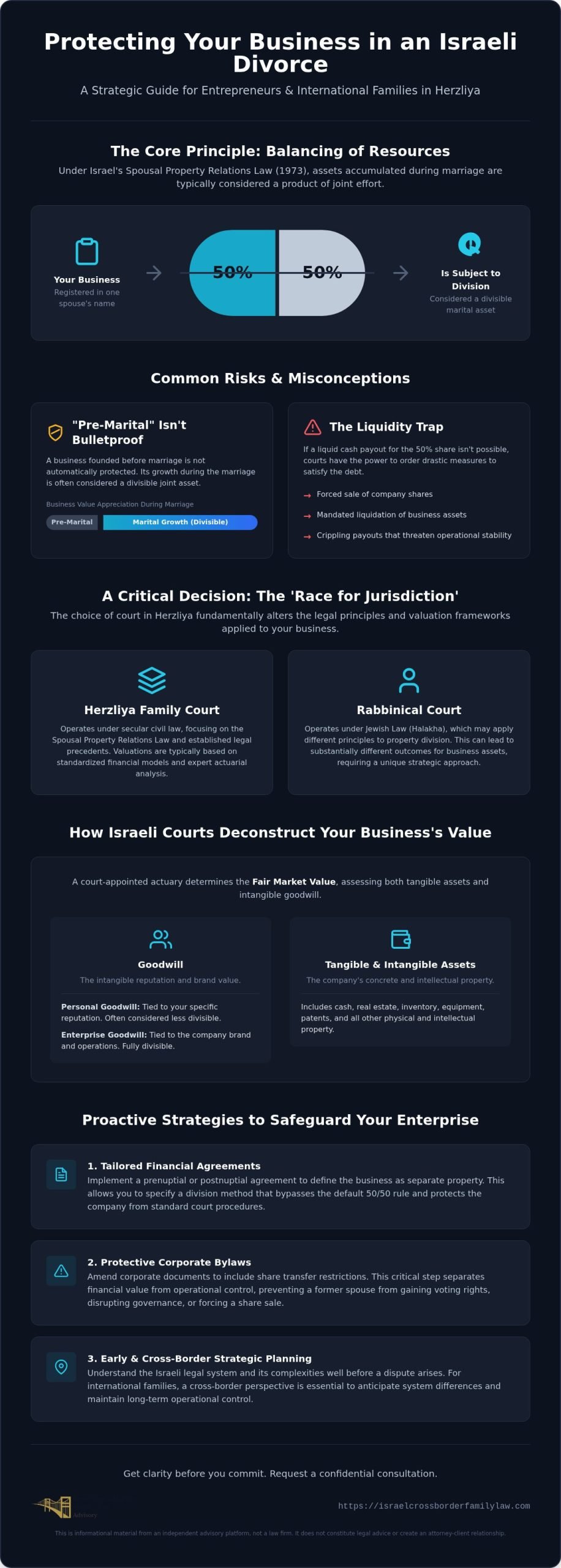
The Spousal Property Relations Law (1973) serves as the primary legal framework for asset division for couples married after January 1, 1974. Under this statute, the Israeli legal system assumes that any wealth or economic value accumulated during the marriage is the result of joint effort. Even if a business is registered solely in one spouse’s name, it is frequently classified as a marital asset subject to division. This concept shares similarities with Community Property Laws found in various international jurisdictions, where the focus is on the economic partnership of the marriage rather than the formal title of the asset.
If a business owner cannot provide a liquid payout to cover the spouse’s 50% share of the company’s appraised value, the situation becomes precarious. In some instances, the court might consider the liquidation of business assets or the forced sale of shares to satisfy the debt. Balance of Resources is the mechanism for equalizing asset values upon divorce in Israel.
To better understand how these principles apply to your specific situation, watch this helpful video:
Pre-marital vs. Marital Assets
Many entrepreneurs in the Herzliya tech sector believe that founding a company before the marriage provides absolute protection. This is often a misconception. A 2026 Supreme Court decision has reinforced the trend that pre-marital assets can be included in the property division, especially in long-term marriages where a "sharing intention" is evident. If the business grew in value during the years of the marriage, that appreciation is typically viewed as a joint asset. Furthermore, if business dividends were used to pay for a family residence or shared expenses, the lines between separate and marital property become blurred. This commingling makes protecting a family business from a divorce in Herzliya significantly more complex without a clear strategy.
Operational Control vs. Financial Value
Israeli courts generally attempt to distinguish between the financial value of a company and its day-to-day management. The judicial system typically prefers to keep a functional business intact rather than granting a non-owning spouse voting rights or management authority. However, the risk remains that a former spouse could be awarded a significant equity stake, effectively becoming a "silent partner" with the power to disrupt corporate governance. Strategic decisions regarding corporate bylaws and share transfer restrictions are essential to maintain operational continuity. By separating the right to the asset’s value from the right to control the entity, you can protect the company’s professional environment from personal disputes.
This article is published on an independent advisory platform (not a law firm). Soft CTA to advisory call / WhatsApp.
The Herzliya ‘Race for Jurisdiction’ and Your Business
In Israel, the specific venue where you initiate divorce proceedings often dictates the financial trajectory for your company. This phenomenon is known as the "Race for Jurisdiction." The court that receives the first valid application typically gains the authority to decide property matters, including the division of business interests. For those focused on protecting a family business from a divorce in Herzliya, this initial step is the most critical strategic decision in the entire process. The choice isn’t merely administrative; it defines which judicial philosophy will govern your life’s work.
The choice lies between the civil Family Court and the religious Rabbinical Court. While both systems must technically operate under the Spouses (Property Relations) Law, their interpretation of business value and "equitable balancing" can diverge significantly. Business owners in Herzliya Pituach, particularly those with complex tech assets, intellectual property, or international equity, often lean toward the Family Court. This preference stems from the civil system’s procedural predictability and its familiarity with corporate standards. You can discuss your strategic options to better understand the risks involved in each jurisdiction before taking action.
In the Rabbinical system, the granting of the "Get" (the religious divorce decree) can sometimes be used as leverage in financial negotiations. This creates a high-pressure environment where business interests might be traded for personal resolution. Understanding these cultural and systemic differences is vital before any papers are filed. Even the mandatory "Settlement of Dispute" application, which costs 119 NIS in 2026, triggers a temporary stay that prevents the other party from filing elsewhere, making early decisions paramount.
The Herzliya Family Court Approach
The Family Court in the Tel Aviv District follows a highly structured process for business valuation. It typically appoints an independent actuary or forensic accountant to determine the fair market value of the entity. This system favors a "clean break" settlement. The goal is usually for one spouse to retain the business while compensating the other with liquid assets or other property. This approach is generally preferred by those managing multi-jurisdictional operations who require clear financial boundaries and corporate stability.
The Rabbinical Court Alternative
The Rabbinical Court occasionally considers elements of marital conduct when reviewing property division, which is a departure from the purely economic focus of civil courts. While they’re bound by the 1973 law, the weight given to the "Ketubah" (marriage contract) versus the business’s market value can vary. Litigation in this system can become prolonged if the parties don’t reach a mutual agreement. This uncertainty can impact a company’s stability, especially if the court seeks to maintain a link between the spouses’ financial futures.
This article is published on an independent advisory platform (not a law firm). Soft CTA to advisory call / WhatsApp.
Valuing a Business in Herzliya: Goodwill and Tangible Assets
The valuation process often begins with the court appointing an independent actuary or forensic accountant to determine the company’s worth. This professional serves as a neutral expert, translating complex corporate structures, balance sheets, and market trends into a single figure for the "Balance of Resources." Israeli courts increasingly recognize ‘Career Assets’ as part of the marital estate. This means the valuation is not limited to physical property or cash reserves; it encompasses the intangible value of professional reputation and future earning potential. For those protecting a family business from a divorce in Herzliya, understanding how these experts calculate "Goodwill" is the most important step in preventing an inflated appraisal that could cripple the company’s cash flow.
A primary battleground in service-based businesses is the distinction between personal and enterprise goodwill. Enterprise goodwill belongs to the company and is transferable to a new owner, whereas personal goodwill is tied directly to the founder’s unique skills and reputation. If the business’s value would vanish if the owner left, that portion of the value is often argued to be separate from the marital pot. A comprehensive forensic accounting report for a business with multi-jurisdictional assets typically ranges from ₪18,000 to ₪50,000 in 2026. This investment is often necessary to ensure the court-appointed expert’s assumptions align with commercial reality.
Valuation Methods for Tech Startups
Herzliya’s high-tech ecosystem presents unique challenges for standard valuation models. Pre-revenue startups or firms in high-growth phases do not fit easily into traditional EBITDA-based calculations. In these cases, actuaries may use "Exit" potential or recent funding rounds as benchmarks for the settlement. Intellectual Property (IP) is treated as a major asset, and its future licensing potential or the probability of a secondary market sale is often factored into the total marital estate. This requires a nuanced strategy that accounts for the volatility of the tech sector and the specific risks associated with early-stage ventures.
Protecting the ‘Personal’ in your Business
Strategic planning is the most effective tool for protecting a family business from a divorce in Herzliya. While previous sections detailed the vulnerabilities of the "Balancing of Resources" principle, this phase focuses on proactive measures that establish clear boundaries between personal relationships and professional assets. Relying on general corporate standards is often insufficient in the Israeli context; specific legal instruments must be validated by the local judiciary to be enforceable. Without these protections, the default legal framework will likely view your business as a shared economic partnership.
For US-Israeli dual citizens, the complexity increases significantly. A financial agreement that is enforceable in Herzliya must also be drafted with an eye toward international standards to prevent a spouse from seeking a different outcome in a foreign court. This cross-border perspective ensures that your business interests are shielded regardless of which legal system is engaged. Learn more about our approach to cross-border cases to see how integrated strategies address these multi-jurisdictional risks.
The Postnuptial Agreement as a Business Shield
It’s a common misconception among the Anglo community in Herzliya that financial protections must be established before the wedding. In Israel, couples can enter into a binding "Financial Agreement" at any point during their marriage. For business owners, this document serves as a specialized contract that overrides the default 50/50 split of the 1973 law. To be valid, these agreements require formal approval from a Family Court or a Rabbinical Court. A judge must verify that both parties entered the agreement willingly and understand its consequences. An unvalidated agreement, even if signed by both parties, carries little weight in an Israeli divorce proceeding.
Corporate Governance as Defense
Corporate structures provide another layer of security. Shareholders’ agreements and company bylaws can be drafted to include restrictive covenants regarding share transfers. These clauses can prevent a spouse from becoming an active shareholder or gaining voting rights. Instead, the agreement might mandate a "Buy-Sell" arrangement where the owning spouse or the company itself has the first right to purchase any shares at a predetermined, fair valuation. This keeps the management of the firm in professional hands while addressing the financial claims of the spouse.
Maintaining a strict separation between business and personal finances is equally vital. When business dividends are used for family vacations or home renovations, the argument for "commingling" of assets becomes harder to defend. Utilizing trusts for business succession can also provide a protective barrier, ensuring that the enterprise remains a separate entity from the marital estate. These structures are particularly useful for international families who need to align their Israeli operations with global estate planning goals.
Get clarity before you commit. Request a confidential consultation.
This article is published on an independent advisory platform (not a law firm). Soft CTA to advisory call / WhatsApp.
Navigating the Path Forward: Advisory and Strategy
The pre-filing phase is the most influential period for any business owner facing a potential marital split. In Herzliya, where innovation and equity-heavy compensation are standard, decisions made before a formal application is submitted often determine the final outcome. Protecting a family business from a divorce in Herzliya requires a measured approach that balances a robust defense of corporate interests with the practical need for a collaborative resolution. While litigation can be aggressive, a strategic settlement often prevents the court-mandated liquidation risks discussed in previous sections.
Herzliya’s international community operates in a multi-jurisdictional reality. A cross-border perspective is essential because your business likely involves foreign investors, intellectual property registered abroad, or equity structures that don’t translate easily into the Israeli "Balance of Resources" framework. Failing to account for these differences can lead to valuations that ignore the reality of your corporate obligations. You can request a confidential case review to assess how these specific complexities might impact your company’s valuation and operational stability.
Choosing the Right Advisory Team
Business owners need a team that speaks the language of both high-stakes corporate finance and Israeli family law. For Anglo expats, this means finding practitioners who can bridge the cultural divide between Western business expectations and the local judicial system. A successful strategy focuses on risk mitigation and commercial objectives rather than just legal maneuvers. This collaborative approach ensures that your professional team works in harmony with your existing corporate advisors to maintain a unified front. This ensures that your legal strategy remains commercially aware, protecting the long-term viability of the business while navigating personal complexities.
Next Steps for Herzliya Business Owners
If you suspect a divorce is imminent, your first priority is business continuity. Begin gathering critical financial documentation in a discreet manner to allow for an accurate internal assessment before a court-appointed expert is involved. This includes:
- Shareholder agreements and corporate bylaws
- Historical tax filings and recent profit-and-loss statements
- Capitalization tables and intellectual property registrations
- Records of pre-marital investments and separate property
Avoid making sudden, large-scale changes to business operations or ownership structures, as these can be viewed with suspicion by the courts. Instead, focus on building a clear roadmap that prioritizes the health of the enterprise while addressing the eventual financial balancing required by law. Early strategic decisions often save months of costly litigation and prevent the destabilization of your company’s daily operations.
Get clarity before you commit. Request a confidential consultation.
This article is published on an independent advisory platform (not a law firm). Soft CTA to advisory call / WhatsApp.
Strategic Continuity for the Herzliya Entrepreneur
Managing a business within the Israeli legal system requires a nuanced understanding of how local courts view the economic partnership of marriage. We’ve explored the critical nature of the "Race for Jurisdiction," the complexities of "Goodwill" valuations, and the importance of validated financial agreements. Protecting a family business from a divorce in Herzliya is not just about defending shares; it’s about ensuring that your operational control and long-term commercial goals remain intact despite personal transitions.
Our advisory focuses on providing a bridge between Western corporate standards and the specific requirements of the Israeli judiciary. With expertise in US-Israel cross-border family law and a confidential, professional approach, we help high-net-worth business owners navigate these multi-jurisdictional challenges with clarity. Early strategic decisions are the most effective way to avoid court-mandated liquidations and achieve a fair resolution. You can move forward with confidence when your corporate interests are aligned with a clear legal roadmap.
Get clarity before you commit. Request a confidential consultation.
This article is published on an independent advisory platform (not a law firm). Soft CTA to advisory call / WhatsApp.
Frequently Asked Questions
Is my business considered marital property if I started it before the marriage in Israel?
A business established before the marriage is not automatically exempt from property division. While the initial entity may be separate property, any increase in value during the marriage is typically viewed as a shared asset. Under a 2026 Supreme Court decision, courts are more likely to include pre-marital assets in the division if a "sharing intention" is proven, especially in long-term marriages where business income supported the family home.
Can the court force me to sell my company to pay my spouse in a divorce?
Israeli courts generally prioritize business continuity and prefer a "clean break" financial settlement over a forced liquidation. However, if you lack the liquid assets to pay your spouse their 50% share of the appraised value, the court could theoretically order the sale of business assets. Strategically protecting a family business from a divorce in Herzliya often involves identifying alternative assets to satisfy this balancing debt without disrupting operations.
What is the ‘Race for Jurisdiction’ and how does it affect my business assets?
The "Race for Jurisdiction" occurs when spouses rush to file first in either the civil Family Court or the religious Rabbinical Court. The court that receives the filing first typically handles the property division. This choice is critical because the systems may apply different weights to business valuations or the "Ketubah" contract. Early strategic filing is often the most decisive factor in determining which legal principles will govern your company’s future.
How does the Herzliya Family Court value a high-tech startup with no profits?
For pre-revenue firms in Herzliya Pituach, court-appointed actuaries move beyond traditional profit-based models. They often use recent funding rounds, "Exit" potential, or the market value of intellectual property as benchmarks. The valuation factors in the probability of future success and the specific risks of the tech sector. This ensures the non-owning spouse receives a share of the company’s perceived market value, even if the entity is currently cash-poor.
Will a US prenuptial agreement protect my Israeli business?
A US prenuptial agreement is a helpful strategic tool, but it’s not automatically binding in Israel. To be fully enforceable, the agreement should be validated by an Israeli court to ensure it meets the requirements of the Spouses (Property Relations) Law. Without this local approval, a spouse might challenge the document’s validity. It’s often necessary to draft a complementary Israeli financial agreement that specifically addresses your local business interests and cross-border assets.
Can I use corporate bylaws to prevent my spouse from getting shares?
You can structure shareholder agreements and corporate bylaws to include restrictive covenants that prevent the transfer of shares to non-active spouses. These clauses often mandate that any awarded "value" must be paid in cash rather than equity. This maintains operational control within the professional team. Implementing these corporate governance defenses early is a standard method for protecting a family business from a divorce in Herzliya and ensuring long-term stability.
What happens if my business has partners—are their interests at risk too?
Your partners’ specific shares are not subject to division in your divorce, but the company’s financial health could be impacted. If the court awards your spouse a significant payout, the business might face a liquidity crisis. Furthermore, a lack of clear bylaws could lead to your spouse attempting to gain information rights or voting power. Buy-sell agreements are essential to ensure that your divorce does not destabilize the interests of your co-founders.
How is ‘Goodwill’ calculated for a professional practice in Herzliya?
Forensic actuaries calculate goodwill by distinguishing between the reputation of the entity and the personal reputation of the owner. In service-based practices, "Personal Goodwill" is often argued as a separate asset that shouldn’t be divided. The calculation typically involves analyzing the firm’s excess earning power above its tangible assets. In 2026, Tel Aviv district courts have shown a nuanced approach to these appraisals, requiring detailed forensic reports to achieve a fair valuation.
Get clarity before you commit. Request a confidential consultation.

Article by
Gabriel Lior
A Personal Journey That Became a Mission
The advisory was founded by an American father Gabriel Lior, LLB, MBA , global entrepreneur, and cross-border advisor who spent more than a decade navigating the Israeli family court system firsthand and now lives in Singapore with his son.
As a divorced parent in a cross-border family, Gabriel faced nearly every legal challenge a foreign parent can encounter in Israel — including child custody disputes, child support proceedings, property matters in Israel and abroad, false accusations, and complex immigration and relocation proceedings.
Over the years, he learned the hard way how difficult it is for non-Israeli parents to understand the system, identify the right legal strategy, and choose the right legal representation — especially when language, culture, and jurisdictional differences are involved. He also witnessed how foreign parents and new immigrants are often disadvantaged or taken advantage of by service providers and institutions simply because they lack local knowledge or fluency.
From Client to Advisor
To truly understand — and survive — the system, Gabriel pursued formal legal education in Israel, completing two Israeli law degrees, alongside a BA and MBA earned in the United States. This was never about becoming a practicing attorney, but about gaining a deep, structural understanding of how the system works — and where it breaks down for foreign parents.
This rare combination of:
Firsthand client experience
Israeli legal and US business education
International business and negotiation training
Decades of commercial execution
created a unique perspective – one that understands both sides of the table.
After years of litigation, persistence, and at times self-representation, he ultimately succeeded in securing custody of his son and relocating abroad through a rare legal victory in the Israeli Supreme Court — becoming one of the first fathers in Israel to do so under these circumstances.
Disclaimer
Important Disclaimer:
The information provided on this website and in its content is for general informational and educational purposes only and does not constitute legal advice, legal opinion, or legal representation.
Gabriel Lior is not licensed to practice law in Israel (nor is he interested in doing so) and does not provide legal services, despite having completed 2 Law Degrees. The services offered are advisory in nature and are intended to provide general guidance, strategic insight, and information regarding cross-border family law considerations.
No attorney-client relationship is formed by accessing this website, reading its content, or communicating with us.
Any decisions made based on this information are at your own discretion and risk. For legal advice specific to your situation, you should consult a licensed attorney in the relevant jurisdiction.
Where appropriate, we may refer clients to independent, licensed attorneys or professionals. Such referrals do not constitute legal representation and no liability is assumed for services provided by third parties.