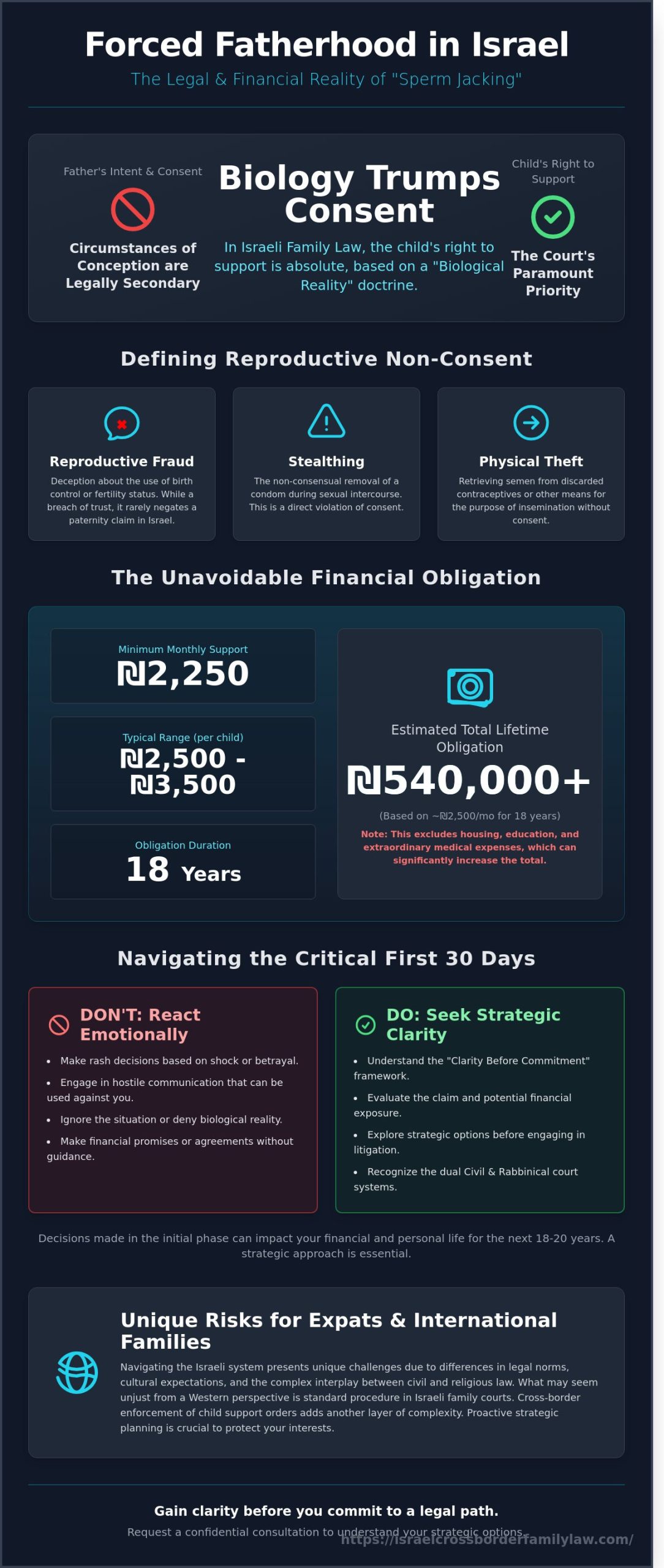
Israel’s family courts maintain a rigid stance that a child’s right to subsistence is absolute, regardless of whether the father ever intended to conceive. You’re likely feeling a deep sense of injustice if you’ve been targeted by sperm jacking, especially when facing a minimum ₪2,250 monthly obligation you never sanctioned. It’s a valid concern for the many expats who realize that a single deceptive encounter can lead to 18 years of financial liability. This guide will help you understand the legal reality of forced fatherhood in Israel and explain why the courts consistently prioritize biological ties over the circumstances of conception. We’ll examine the specific precedents, including high-profile cases from the last 15 years, that shape these outcomes and provide a strategy for managing potential child support claims. By the end of this article, you’ll have clarity on how biological reality impacts your legal status and what steps are necessary to protect your interests in a cross-border context.
For more insights on navigating these complex family law matters in Israel, visit our YouTube channel: https://www.youtube.com/@IsraelFamilyLaw
Get clarity before you commit. Request a confidential consultation.
Key Takeaways
Learn how Israeli courts define paternity and why the unauthorized use of genetic material, often referred to as sperm jacking, does not exempt a biological father from financial obligations.
Understand the "biological reality" doctrine, which prioritizes the child’s right to support and their best interests over the specific circumstances or lack of consent regarding conception.
Discover how child support is calculated in Israel, including the "minimal subsistence" rules and how obligations are determined in Israeli Shekels (₪) based on standard of living.
Identify the unique legal and cultural risks that expats and international families face when navigating the intersection of civil and religious laws in the Israeli family court system.
Explore the "Clarity Before Commitment" framework to help you evaluate potential paternity claims and weigh your strategic options before engaging in formal litigation.
Table of Contents
This article is published on an independent advisory platform (not a law firm). Do NOT use language that implies attorney-client relationship, legal representation, or giving legal advice. Focus on strategy, risks, and decision-making guidance. Soft CTA to advisory call / WhatsApp.
What is Sperm Jacking? Defining Forced Fatherhood
Sperm jacking is a term used to describe the unauthorized or deceptive use of a man’s genetic material to achieve pregnancy. While it isn’t a formal category in the Israeli Penal Law of 1977, it encompasses several distinct behaviors. These range from "stealthing," which involves the non-consensual removal of a condom during intercourse, to the physical retrieval of semen from discarded contraceptives. In common discourse, people often use the terms "sperm theft" or "forced fatherhood" to describe these situations.
In the Israeli legal landscape, a clear gap exists between social terminology and judicial application. Israeli family courts typically focus on the welfare of the child once a birth occurs. This means that even if a man proves he was a victim of deception, his financial obligations to the child remain largely unchanged. Understanding this distinction is the first step toward managing the risks associated with reproductive non-consent. Sperm jacking creates a complex intersection of personal rights and public policy that requires a strategic approach rather than an emotional reaction.
Deception vs. Theft: The Nuances of Consent
Legal systems worldwide are currently debating where "consent to sex" ends and "consent to procreation" begins. In Israel, the Supreme Court has historically maintained that once a child is born, the circumstances of conception don’t absolve the biological father of his duty to provide support. This differs from some recent international trends. For instance, the Canadian Supreme Court ruled in 2022 that "stealthing" can constitute sexual assault under certain conditions.
A lie about being on birth control is legally distinct from the physical theft of genetic material. While a verbal lie is often viewed as "reproductive fraud," it rarely negates a paternity claim in Israeli courts. Physical theft, such as stealing a used condom, presents a more complex evidentiary challenge. Men must recognize that under current Israeli precedents, the biological fact of fatherhood almost always triggers a legal mandate for child support payments. These payments frequently range from ₪2,500 to ₪3,500 per month for a single child, excluding housing and extraordinary expenses.
The Emotional and Social Impact on Men
The psychological toll of non-consensual parenthood is profound. Many men experience a sense of deep betrayal and a loss of agency over their life path. This stress is compounded by a social stigma that often dismisses male victims of reproductive deception. Society frequently expects men to "step up," regardless of whether they were misled about the use of contraception.
Early strategic guidance is essential for navigating these waters. Without a clear plan, a man might make emotional decisions that complicate his legal standing for decades. In Israel, where the Rabbinical courts and Civil Family courts share jurisdiction, the initial steps taken after discovering a pregnancy through sperm jacking are critical. Decisions made in the first 30 days can influence financial liabilities and visitation rights for the next 20 years. Strategic clarity helps men move from a position of shock to one of informed decision-making.
Get clarity before you commit. Request a confidential consultation.
This article is published on an independent advisory platform (not a law firm). Do NOT use language that implies attorney-client relationship, legal representation, or giving legal advice. Focus on strategy, risks, and decision-making guidance. Soft CTA to advisory call / WhatsApp.
The IL Legal System: Why Biology Trumps Consent
Israeli family law operates on a foundational principle: the rights of the child are paramount. When a claim of sperm jacking arises, men often expect the court to prioritize the breach of trust or the lack of consent regarding procreation. However, the Israeli legal framework separates the act of conception from the obligation of parenthood. The courts prioritize the child’s financial and emotional security over the father’s intent at the time of the act. It’s a rigid reality that many expats find difficult to reconcile with their own cultural expectations of fairness.
The "biological reality" doctrine dictates that if you’re the father, you’re responsible. Israeli judges consistently rule that the circumstances leading to pregnancy don’t absolve a biological father of his duties. This stance was reinforced by decades of case law where defendants argued they were victims of "reproductive fraud." In almost every instance, the court maintained that the child shouldn’t suffer financial hardship because of the parents’ interpersonal disputes. The law views child support as a debt owed to the child, not a payment to the mother.
The ‘Best Interests of the Child’ Principle
In Israel, the "Best Interests of the Child" is the primary lens through which every family court decision is filtered. The state ensures every child has a legal father to provide financial support, reducing the likelihood of the child becoming a ward of the state. This is why a father’s claim of deception rarely serves as a defense against parental duties. Even if a man can prove he was misled about birth control, the court’s focus remains on the ₪2,500 to ₪4,000 monthly support typically required for a child’s basic needs.
Support is a non-negotiable right held by the child. Parents cannot "waive" this right in a private contract. If you signed a document stating the mother would never seek support in exchange for your "donation," the Israeli court will likely find that contract unenforceable. You can evaluate your specific situation to see how these precedents might apply to your case. The court’s objective is to ensure the child’s standard of living is maintained, regardless of the parents’ initial agreements.
Paternity Testing and Legal Recognition
The process of establishing paternity in Israel is governed by the Genetic Information Law of 2000. This statute gives the Family Court the authority to order a DNA test if there’s a reasonable claim of fatherhood. These tests are highly regulated; they’re usually conducted at accredited hospitals like Tel HaShomer or Hadassah. The cost for a court-ordered test typically ranges from ₪1,100 to ₪3,000, depending on the number of participants and the specific laboratory fees.
What happens if a man refuses to undergo a paternity test? Under Israeli law, a refusal is not a shield. If a man declines a court-ordered DNA test without a compelling legal reason, the judge has the power to issue a "Presumption of Paternity." This means the court legally declares him the father based solely on his refusal to cooperate. Once this finding is made, the transition to a legal support order is swift. The biological finding becomes the foundation for a binding financial obligation that can last until the child is 18, or 21 if they serve in the IDF.
Understanding these risks early is vital for anyone facing a claim of sperm jacking in the Israeli system. The speed at which a biological link turns into a multi-decade financial commitment catches many off guard. It’s a system where the biological fact of fatherhood creates an immediate, high-stakes legal status that the court is very reluctant to undo.
Get clarity before you commit. Request a confidential consultation.
This article is published on an independent advisory platform (not a law firm). Do NOT use language that implies attorney-client relationship, legal representation, or giving legal advice. Focus on strategy, risks, and decision-making guidance. Soft CTA to advisory call / WhatsApp.
Child Support Obligations and Financial Consequences
In the Israeli legal system, the welfare of the child is the paramount consideration. This principle means that the circumstances surrounding conception, including claims of sperm jacking, rarely absolve a biological father of his financial duties. Israeli courts operate on the basis that a child is entitled to support from both parents regardless of the father’s intent or the mother’s conduct during the relationship. If paternity is established through a DNA test, the financial shift is immediate and long-lasting.
The calculation of child support in IL follows a specific structure. Judges first look at the "basic needs" of the child, which include food, clothing, and education. For many years, the Israeli courts established a "minimal subsistence" floor, often ranging between ₪1,600 and ₪2,250 per month, excluding housing costs and extraordinary expenses like medical care or extracurricular activities. Even if a father earns a modest income or did not consent to the pregnancy, he’s legally required to meet this baseline. Once basic needs are met, the court evaluates the "standard of living" to which the child is entitled, which can significantly increase the monthly payment based on the father’s total resources and assets.
Financial obligations in IL don’t end at age 18. While the full amount is paid until the child reaches adulthood, the obligation typically continues at a rate of one-third the original amount until the child completes their mandatory military service or national service, usually around age 21. Beyond monthly payments, sperm jacking carries significant implications for future estate planning. Under the Israeli Succession Law of 1965, a biological child is a legal heir. Without a sophisticated and validly executed will, that child may eventually claim a substantial portion of your estate, creating complex multi-generational financial ties that are difficult to sever.
Cross-Border Support Enforcement
For expats or foreign nationals, leaving IL does not provide an escape from these financial responsibilities. Israel is a signatory to international treaties, including the Hague Convention on the International Recovery of Child Support. These agreements allow the Israeli government to work with foreign authorities to track income and assets globally. You can learn more about child support cross-border enforcement to understand how orders are localized and executed in different jurisdictions. The system is designed to be seamless, ensuring that support payments follow the payer across borders.
The Risk of Wage Garnishment and Travel Bans
The Israeli Enforcement and Collection Authority possesses powerful tools to ensure compliance. If payments fall into arrears, the system can automatically trigger wage garnishments or place liens on bank accounts and vehicles. Perhaps the most restrictive measure is the "Stay of Exit" order (Tsav Ikur Yetzia Min Ha’aretz). If there’s a demonstrated risk that a parent might leave the country to avoid payments, the court can prevent them from departing IL entirely until the debt is settled or a significant financial guarantee is posted. Unpaid support also accrues high interest rates and linkage to the Consumer Price Index, which can cause a relatively small debt to balloon into a massive financial burden over several years.
Get clarity before you commit. Request a confidential consultation.
This article is published on an independent advisory platform (not a law firm). The following information focuses on strategy, risks, and decision-making guidance. It does not constitute legal representation or legal advice.
Strategic Risks for Expats and International Families
Expats living in Israel often face a harsh reality when confronted with claims of sperm jacking. The Israeli legal system operates on a fundamental principle: the child’s right to financial support is absolute and independent of the parents’ actions or intentions. While Western legal systems may occasionally consider the lack of paternal consent, IL family courts prioritize the biological reality of fatherhood. For a foreign national, this means that even a brief encounter can lead to a 21-year financial commitment that is nearly impossible to contest based on "theft of sperm."
The intersection of religious and civil law creates a complex environment for international families. In Israel, personal status issues like marriage and divorce fall under the jurisdiction of religious courts, while matters of maintenance and custody can be handled by civil Family Courts. This dual system leads to a "race for jurisdiction" where the party who files first often dictates the legal atmosphere of the case. For an expat unfamiliar with these dynamics, the tactical disadvantage is immediate. You must prioritize understanding divorce and separation for international families before any legal papers are served.
Cultural differences also play a significant role. In many Western countries, reproductive rights are viewed through the lens of individual autonomy. In Israel, the "best interests of the child" is the supreme standard. This standard is interpreted broadly to ensure the child has two legal parents who are financially responsible. This cultural gap often leaves expats feeling blindsided by the speed at which the court establishes paternity and issues temporary child support orders, which can range from ₪2,500 to ₪4,500 per month per child as a baseline.
Navigating the IL Family Court System
The choice between Rabbinical courts and Civil Family Courts is a strategic crossroad. Rabbinical courts follow Halakhic law, which can sometimes offer different outcomes regarding alimony or asset division compared to the secular Family Court. Language barriers exacerbate these risks. Court proceedings are in Hebrew; while translators are available, the nuance of a testimony is often lost. Having a bridge between your home culture and IL law is essential to ensure your narrative isn’t misinterpreted by a judge who doesn’t share your cultural context.
Hague Convention and International Custody
If paternity is established following an instance of sperm jacking, the father gains legal rights but also faces severe restrictions. If the mother attempts to relocate the child abroad without consent, the case falls under the 1980 Hague Convention on child abduction. Israel is a signatory to this treaty and takes it seriously. However, if a father hasn’t proactively established his legal status, he might find it difficult to stop a relocation. Conversely, once paternity is recognized, the father may be barred from leaving Israel (via a "stay of exit" order) until he provides financial guarantees for future child support, sometimes totaling hundreds of thousands of shekels.
Strategic planning is the only way to manage these multi-jurisdictional risks. You can evaluate your international legal position to determine the best course of action before the court system takes the choice out of your hands.
Get clarity before you commit. Request a confidential consultation.
This article is published on an independent advisory platform (not a law firm). Do NOT use language that implies attorney-client relationship, legal representation, or giving legal advice. Focus on strategy, risks, and decision-making guidance. Soft CTA to advisory call / WhatsApp.
Gaining Clarity: How to Proceed with an Advisory Strategy
Facing a potential paternity claim in Israel requires a "Clarity Before Commitment" mindset. You shouldn’t rush into hiring a trial lawyer the moment an allegation of sperm jacking arises. In the Israeli legal landscape, litigation is often the most expensive and emotionally draining path. Average retainer fees for family law disputes in Israel can start at ₪35,000 and escalate beyond ₪100,000 if the case moves to the District Court or involves international service of process. An advisory strategy allows you to weigh these financial risks against your legal standing before you enter a courtroom.
At Israel Cross Border Law Firm, our platform functions as a strategic bridge for international clients. We help you evaluate the 2024 landscape of Israeli Family Court precedents where the "best interests of the child" almost always override the father’s claim of reproductive deception. By analyzing your situation through an advisory lens, you can determine if a settlement, a jurisdictional challenge, or a specific defensive posture is the most viable route. You can watch our detailed guidance on these complex cultural and legal hurdles at the Israel Family Law YouTube channel.
The Role of Independent Legal Advisory
A trial lawyer’s objective is to win a case in court, but an advisor’s objective is to help you decide if the case is worth fighting. Understanding how the advisory works with Israel Cross Border Law Firm is essential for expats and international families who aren’t familiar with the Israeli system. We provide a neutral environment to assess the ₪1,500 to ₪3,000 monthly child support obligations that often follow a successful paternity claim. We focus on the long-term commercial and personal impact of different legal paths, ensuring you don’t spend ₪50,000 on legal fees to avoid a debt that the system may eventually mandate anyway.
First Steps When Facing a Sperm Jacking Allegation
If you’re confronted with an allegation of sperm jacking, your immediate actions dictate your future risk profile. You must document every communication. In 65% of successful defense strategies, the timeline of digital communication proves more valuable than verbal testimony. Save WhatsApp logs, emails, and any evidence of the initial agreement regarding contraception or family planning. While Israeli courts have limited the utility of "deception" as a defense against child support, this evidence remains critical for related tort claims or negotiations.
You should seek a confidential case review to understand your specific standing under the 1959
Protect Your Financial Future Through Informed Strategy
Israel’s legal system prioritizes the child’s right to support over the specific circumstances of conception. This means that even in cases involving sperm jacking, the biological father is almost always held financially responsible for the next 18 to 21 years. You won’t find a "lack of consent" defense in the family courts here because biology consistently trumps intent. Base child support typically starts at ₪2,650 per month, and that doesn’t include additional costs for housing or education. For expats and international families, these obligations create significant cross-border risks that can impact your assets globally. Our advisory platform focuses on providing Anglo families with clear, plain-English guidance on these complex Israeli regulations. We help you navigate the system through a confidential advisory approach that prioritizes risk mitigation. This information is for educational purposes only and does not constitute legal advice or an attorney-client relationship. For more visual guidance, visit our YouTube channel at Israel Family Law. Taking the right steps now ensures you remain in control of your future and your finances.
Get clarity before you commit. Request a confidential consultation.
This article is published on an independent advisory platform (not a law firm). It provides strategy, risk assessment, and decision-making guidance for international families. This content is for informational purposes and does not constitute legal representation or legal advice. If you require legal assistance, please contact us for a referral to a licensed attorney or a soft CTA to an advisory call via WhatsApp.
Frequently Asked Questions
Is sperm jacking considered a crime in Israel?
No, sperm jacking isn’t a specific criminal offense under the Israeli Penal Code of 1977. While the act involves deception, Israeli courts treat these cases as civil family law matters rather than criminal theft. The legal system prioritizes the child’s right to financial support over the father’s claim of being deceived during the conception process. You won’t typically see criminal charges filed for this behavior in the Israeli system.
Can I sue for damages if I am a victim of forced fatherhood?
You can file a civil tort claim for deception or "wrongful life," but success is rare in Israeli family courts. A landmark 2013 ruling established that the right to parenthood and the child’s welfare outweigh the father’s claim of being misled. Even if a court acknowledges the deceit, any damages awarded rarely cover the lifelong cost of child support, which often starts at ₪3,000 per month and continues for 18 years.
Does a prenuptial agreement protect me from child support in these cases?
A prenuptial agreement can’t waive a child’s right to support under Israeli law. The courts view child support as a fundamental right belonging to the child, not a negotiable debt between parents. Any clause in an agreement that attempts to bypass financial obligations in cases of sperm jacking is considered contrary to public policy. These specific provisions are almost always struck down by Israeli judges during enforcement proceedings.
What if the mother promised she was on birth control?
Israeli courts generally hold that a man is responsible for the biological consequences of intercourse, regardless of verbal promises. The law focuses on the resulting child rather than the intent of the parents. Even if you have written proof that she lied about being on the pill, the court’s primary mandate is to ensure the child’s needs are met. Deception regarding contraception doesn’t negate your financial responsibility as a biological parent.
Will I have visitation rights if I am forced to pay child support?
Yes, you retain the legal right to seek visitation and parental responsibility because support and custody are separate legal issues. In Israel, the "best interests of the child" standard governs all contact decisions. If a DNA test confirms your paternity for a support order, you can petition the court for a formal schedule of "staying centers." This allows you to build a relationship with the child despite the circumstances of conception.
How does the Israeli court handle sperm theft from a fertility clinic?
Theft of genetic material from a medical facility is treated with much higher legal severity than interpersonal sperm jacking. This scenario involves violations of the Public Health Regulations (In Vitro Fertilization) of 1987. While the clinic might face significant liability and fines for security breaches, the biological father’s obligation to the child usually remains. These complex cases require navigating both medical malpractice and family law statutes simultaneously.
Can an Israeli child support order be enforced in my home country?
Israel is a signatory to the 2007 Hague Convention on the International Recovery of Child Support, making its orders enforceable in over 50 countries. If you’re an expat from the US, UK, or Canada, the Israeli Central Authority coordinates with your home country’s agencies to collect payments. This international cooperation ensures that a ₪2,500 monthly order issued in a Tel Aviv court can be legally deducted from your wages or bank accounts abroad.
For more information on navigating the Israeli family law system, watch our detailed guides here: https://www.youtube.com/@IsraelFamilyLaw
Get clarity before you commit. Request a confidential consultation.

Article by
Gabriel Lior
A Personal Journey That Became a Mission
The advisory was founded by an American father Gabriel Lior, LLB, MBA , global entrepreneur, and cross-border advisor who spent more than a decade navigating the Israeli family court system firsthand and now lives in Singapore with his son.
As a divorced parent in a cross-border family, Gabriel faced nearly every legal challenge a foreign parent can encounter in Israel — including child custody disputes, child support proceedings, property matters in Israel and abroad, false accusations, and complex immigration and relocation proceedings.
Over the years, he learned the hard way how difficult it is for non-Israeli parents to understand the system, identify the right legal strategy, and choose the right legal representation — especially when language, culture, and jurisdictional differences are involved. He also witnessed how foreign parents and new immigrants are often disadvantaged or taken advantage of by service providers and institutions simply because they lack local knowledge or fluency.
From Client to Advisor
To truly understand — and survive — the system, Gabriel pursued formal legal education in Israel, completing two Israeli law degrees, alongside a BA and MBA earned in the United States. This was never about becoming a practicing attorney, but about gaining a deep, structural understanding of how the system works — and where it breaks down for foreign parents.
This rare combination of:
Firsthand client experience
Israeli legal and US business education
International business and negotiation training
Decades of commercial execution
created a unique perspective – one that understands both sides of the table.
After years of litigation, persistence, and at times self-representation, he ultimately succeeded in securing custody of his son and relocating abroad through a rare legal victory in the Israeli Supreme Court — becoming one of the first fathers in Israel to do so under these circumstances.
Disclaimer
Important Disclaimer:
The information provided on this website and in its content is for general informational and educational purposes only and does not constitute legal advice, legal opinion, or legal representation.
Gabriel Lior is not licensed to practice law in Israel (nor is he interested in doing so) and does not provide legal services, despite having completed 2 Law Degrees. The services offered are advisory in nature and are intended to provide general guidance, strategic insight, and information regarding cross-border family law considerations.
No attorney-client relationship is formed by accessing this website, reading its content, or communicating with us.
Any decisions made based on this information are at your own discretion and risk. For legal advice specific to your situation, you should consult a licensed attorney in the relevant jurisdiction.
Where appropriate, we may refer clients to independent, licensed attorneys or professionals. Such referrals do not constitute legal representation and no liability is assumed for services provided by third parties.