This article is published on an independent advisory platform and does not constitute a law firm or an attorney-client relationship. Legal services are only provided by licensed attorneys under a separate engagement.
A valid court order is only half the battle; the true success lies in ensuring that order is portable and registrable across both legal systems from day one. Many international families assume that a decree issued in one country will be seamlessly recognized in the other, but the reality of stepparent adoption across borders involves navigating a complex web of jurisdictional risks and residency requirements. It’s understandable to feel concerned about whether your child’s inheritance and residency rights are truly secure when moving between the US and Israel.
This guide provides the strategic clarity you need to move forward with confidence. You’ll gain a clear understanding of the procedural differences between these two legal systems, including the impact of the Hague Convention and the specific requirements of Israel’s Child Adoption Law of 1981. We’ll explore which jurisdiction offers the most favorable path for your specific situation and provide a clear roadmap for the mandatory home study process. Get clarity before you commit. Request a confidential consultation.
Key Takeaways
- Learn why choosing the correct jurisdiction based on your family’s habitual residence is the first step in a successful stepparent adoption across borders.
- Understand the structural differences between decentralized US state laws and Israel’s centralized Ministry of Welfare to avoid common procedural errors.
- Evaluate the strategic benefits of filing in the US versus the Israeli court system, focusing on the speed and cost of each unique process.
- Discover how to navigate mandatory requirements like home studies and the coordination of background checks between the FBI and Israeli police.
- Gain clarity on how a cross-border decree impacts your child’s future inheritance rights and citizenship status in both nations.
Understanding Cross-Border Stepparent Adoption: Why Jurisdiction Matters
In the context of US-Israel families, stepparent adoption across borders is the process where a spouse legally adopts their partner’s child while the family maintains ties to two different legal systems. This isn’t a simple administrative update. It’s a formal transfer of parental rights that must satisfy the strict requirements of both the Israeli Ministry of Welfare and the relevant US state court. Relying on local advice that only considers one side of the ocean often leads to significant procedural delays or total legal rejection.
To better understand the procedural steps involved in these cases, watch this helpful video:
Dual citizenship and the role of the Hague Convention on Intercountry Adoption create a layer of multi-jurisdictional complexity that local practitioners might overlook. Families often find that their residency status determines which court has the authority to hear the case. For those living as expats or foreign nationals in Israel, the intersection of US state laws and Israeli family law requires a strategic approach to ensure the adoption is valid in both nations.
The Concept of Habitual Residence
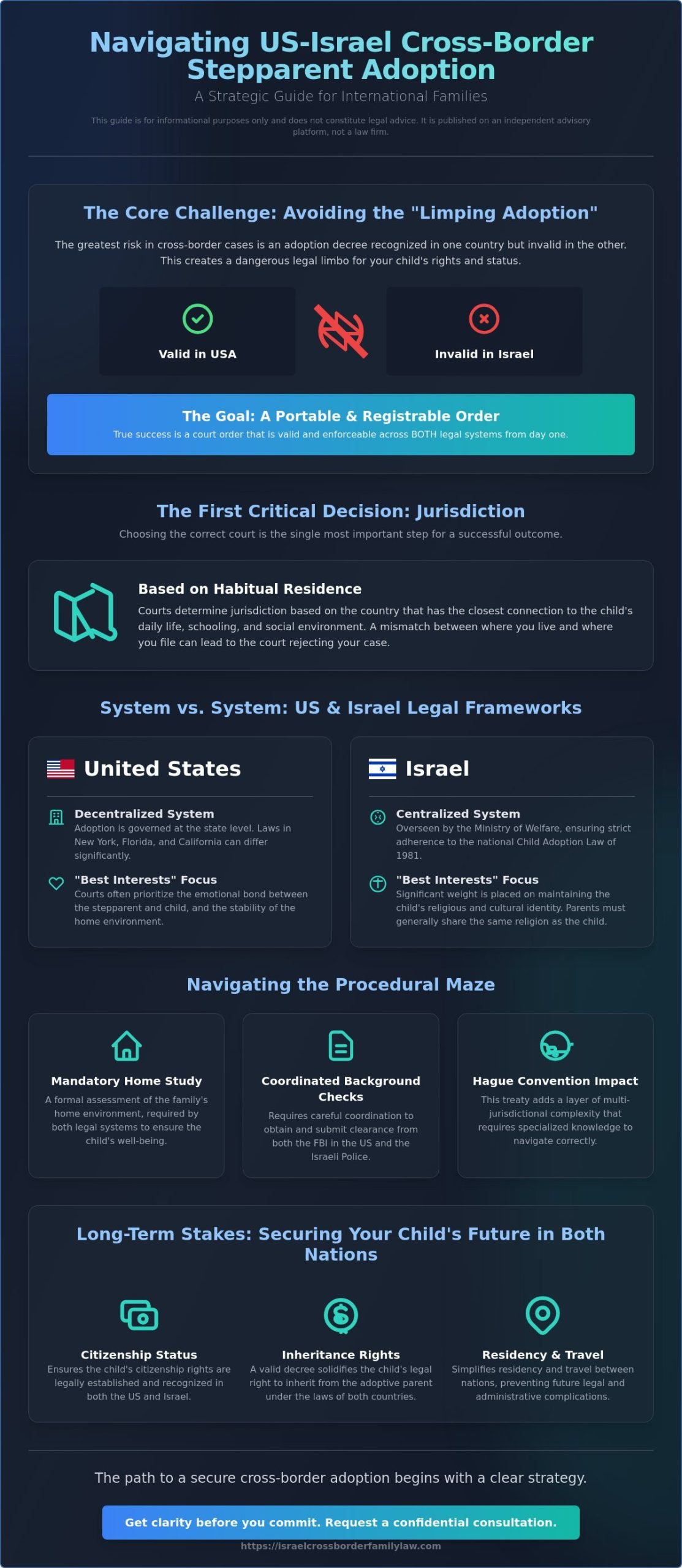
Courts use the concept of habitual residence to identify which country has the closest connection to the child’s daily life. If a family lives in Israel but attempts to file for adoption in a US state court, they may face jurisdictional challenges. This mismatch often results in a “limping adoption.” This is a dangerous situation where the adoption is legally recognized in the United States but remains invisible or invalid under Israeli law. Ensuring the court’s authority is recognized by both systems is essential for the child’s long-term security.
The Best Interests of the Child Standard
While both systems prioritize the child, US and Israeli courts interpret this standard through different cultural lenses. US courts often focus on the emotional bond and the stability of the home environment. In contrast, Israeli law places significant weight on maintaining the child’s religious and cultural identity. The “best interests of the child” standard serves as the universal anchor for all cross-border adoption decisions. Families must demonstrate how the adoption supports the child’s identity within their specific transnational context.
The Legal Framework: US State Laws vs. Israeli Family Law
Successfully managing stepparent adoption across borders requires an understanding of two fundamentally different legal architectures. In the United States, adoption is governed at the state level rather than by federal law. This means the specific requirements for a stepparent living in New York will differ significantly from those in Florida or Texas. Conversely, Israel maintains a highly centralized system where the Ministry of Welfare and Social Affairs oversees every case. This agency ensures strict adherence to the Child Adoption Law of 1981, regardless of where in the country the family resides.
For international families, the U.S. State Department adoption information for Israel clarifies that adoption by non-citizens is rare and heavily regulated. Israeli Family Courts typically handle these matters for expats, but they do so in close coordination with the Central Authority. A unique factor in the Israeli system is the intersection with religious identity. Under Israeli law, prospective adoptive parents must generally share the same religion as the child. This religious alignment is a critical component of the “suitability” assessment, a requirement that often surprises families accustomed to the more secular approach of many US state courts.
Consent and the Biological Parent
Securing legal consent is often the most sensitive stage of the process. When a biological parent resides in a different country, the court requires verifiable proof that they have been properly served and understand the permanent nature of the adoption. In the US, this often involves a formal “termination of parental rights.” Israeli standards are equally rigorous. If a biological parent refuses consent or cannot be located, the court sets a high evidentiary bar before it will dispense with the need for their signature. You must demonstrate a persistent failure to maintain a relationship or provide support, which is often difficult to prove across international lines.
The Role of the Israeli Ministry of Welfare
Every adoption in Israel involves a government-appointed social worker from the Ministry of Welfare (Misrad HaRevacha). This official conducts an in-depth study to produce a “suitability report” for the Family Court. For expats and foreign nationals, this process includes a review of your financial stability, criminal background, and the home environment. The social worker acts as an independent arm of the court, ensuring that the adoption serves the child’s long-term welfare within the Israeli social fabric. Understanding these expectations early can help you get clarity before you commit to a specific legal path.
Strategic Considerations: Choosing the Right Jurisdiction for Adoption
Choosing the correct jurisdiction is the most critical decision in stepparent adoption across borders. It requires a balance between your current residence and your long-term relocation plans. Families must consider whether a US state court or an Israeli Family Court offers the most secure path for their child’s future. This decision impacts not just the immediate legal status but also the long-term portability of the adoption decree. It’s often more effective to file where the child has the strongest legal and social ties to ensure the order is recognized without further litigation.
A US private adoption often moves faster than the Israeli government-led process. However, the financial commitment is different. While Israeli government administrative fees are minimal, the overall investment in legal and social work assessments varies based on the case complexity. In Israel, the process is court-led and involves the Ministry of Welfare, which ensures a high degree of local legal certainty. You must avoid “forum shopping” or choosing a jurisdiction solely for convenience. Courts in both countries look unfavorably on bad-faith jurisdictional claims. Such claims can lead to the decree being overturned years later if the other parent challenges the court’s original authority.
Filing in the United States
For US citizens living abroad, filing in their last state of residence can offer certain advantages regarding document recognition and Apostille requirements. However, bringing a US order back to Israel often requires a separate validation process before the Ministry of Interior will update the population registry. To ensure the order is registrable, you must complete a home study that meets international standards. This is a common requirement under the U.S. requirements for adopting from Israel. Without this compliance, you risk a “limping adoption” that neither country fully accepts.
Filing in Israel (IL)
Anglo expats living in Tel Aviv or Jerusalem often find it more practical to file within the Israeli system. This approach ensures that the child’s residency and inheritance rights are immediately secured under local law. While the Israeli decree is generally respected by US authorities, you must still navigate specific US immigration requirements to update the child’s status. For those managing the complexities of divorce and separation for international families, a stepparent adoption provides essential stability for a blended household. The Israeli court will carefully review the child’s connection to the country before asserting jurisdiction. This includes evaluating the child’s schooling, social ties, and the family’s intent to remain in the region.
Navigating the Procedural Maze: Home Studies and Background Checks
The procedural requirements for stepparent adoption across borders are often the most time-consuming part of the journey. These steps exist to ensure that the adoption is in the child’s best interests and that the new legal parent is fully prepared for their responsibilities. You will need to provide extensive documentation, including detailed financial statements and medical records. Israeli courts and the Ministry of Welfare require full transparency regarding your health and your ability to provide for the child’s needs over the long term.
Coordinating background checks is another critical layer of the process. If you are a US citizen living in Israel, you must obtain a clearance from the FBI. Simultaneously, you must provide records from the Israeli police. This dual-track verification can be complex because the two systems do not always communicate directly. You must ensure that every document is properly authenticated and translated to be accepted by the Israeli Family Court. Missing a single stamp or using an unapproved translator can result in the court rejecting the entire application.
Children also have a voice in this legal transition. Depending on their age and maturity, the court or a social worker will conduct an interview to gauge their understanding of the adoption. These conversations are handled with care to avoid creating stress for the child while ensuring their feelings are considered. The court looks for a genuine bond between the stepparent and the child that justifies the permanent termination of the other biological parent’s legal rights.
The Home Study Process for Expats
A home study is a comprehensive evaluation of the domestic environment and parental fitness. For international families, finding a social worker who understands both US and Israeli standards is essential. A common pitfall is submitting a report that lacks the specific details required by the Israeli Ministry of Welfare, which can lead to significant delays. You can find visual guides on these court procedures and what to expect during social worker visits on the Israel Family Law YouTube channel.
Post-Placement Supervision
Even after the initial paperwork is approved, the process continues with post-placement supervision. This involves a series of follow-up visits by a social worker to observe the family dynamic in person. These visits must occur before the court issues the final decree. If your family plans to move between the US and Israel during this period, you must coordinate with the court early. A change in residence can pause the process if supervision cannot be maintained by the authorized authorities. To ensure your paperwork meets all jurisdictional requirements, contact us to discuss your specific procedural roadmap.
Long-Term Implications and Risk Mitigation for International Families
A court order is not the end of the legal journey. Completing a stepparent adoption across borders is a significant milestone, but families must carefully manage the long-term implications for inheritance and citizenship. A successful decree establishes a permanent legal bond. This bond grants the child the same inheritance rights as a biological child in both the US and Israel. Such legal clarity is vital for estate planning. It ensures the child’s future is secure regardless of where the family eventually settles.
Citizenship and passport status also require immediate attention after the court issues its decree. While the adoption provides the legal foundation, it doesn’t automatically update a child’s nationality. You’ll need to follow specific consular or immigration procedures to secure the child’s status in both nations. This often involves a delicate balance of requirements from the US Department of State and the Israeli Ministry of Interior. Failing to finalize these administrative steps can lead to travel complications or residency issues later in the child’s life.
Cultural expectations regarding “open” or “closed” adoptions vary significantly between these two systems. In the US, many jurisdictions have moved toward open adoptions where some level of contact or information sharing remains with the biological family. Israel has traditionally maintained a more closed system, though legal practices are slowly evolving. Aligning these expectations with the reality of your family’s daily life is a key part of the transition. It helps ensure that the legal framework supports the emotional health of the blended family.
Registration and Recognition
Obtaining a court order is only the first step. You must ensure the order is recognized by the relevant government bodies in both countries. This requires an Apostille for all cross-border documents to verify their authenticity for foreign authorities. In Israel, you must register the foreign adoption order with the Population Authority. This step is essential to update the child’s Israeli ID (Teudat Zehut) and ensure their records are accurate. Similarly, you may need to apply for an amended US birth certificate. Managing these updates is as critical as managing international custody and relocation issues.
Strategic Risk Management
Early legal strategy is the best way to prevent the “limping adoption” trap. This occurs when one country recognizes the parent-child relationship while the other does not. To avoid this, you should coordinate with practitioners who understand the nuances of both systems simultaneously. This dual-track approach ensures that every decision made in one court will be registrable in the other without further litigation. Proactive planning helps you navigate the multi-jurisdictional complexity of stepparent adoption across borders without facing unexpected legal hurdles years later. Get clarity before you commit. Request a confidential consultation.
Securing Your Family’s Transnational Legal Future
Establishing permanent legal bonds for your child requires more than just standard local paperwork. Successfully navigating stepparent adoption across borders depends on a proactive strategy that addresses the specific, and often conflicting, requirements of both US state courts and the Israeli Ministry of Welfare. By identifying the correct jurisdiction early and ensuring all procedures strictly comply with Hague Convention protocols, you protect your child’s inheritance, residency, and citizenship rights in both nations. This foresight prevents the legal uncertainty that often arises when families move between different legal systems.
Our advisory platform offers access to bilingual and multi-jurisdictional practitioners with specialized expertise in US-Israel family law. We provide the steady, authoritative guidance needed to manage complex international requirements and ensure your adoption decree is portable and recognized globally. It’s essential to act with precision when multiple countries are involved to ensure your family’s status is never in doubt. Get clarity before you commit. Request a confidential consultation with a cross-border family law expert. Taking these strategic steps today provides the legal certainty your family deserves for the years ahead.
Frequently Asked Questions
Is a US stepparent adoption automatically recognized in Israel?
A US adoption decree is not automatically recognized in Israel. You must register the order with the Population Authority, which often requires an Apostille and a validation process through the Family Court. Without this formal registration, the child’s legal status remains unchanged in the Israeli registry, potentially affecting inheritance and residency rights.
Can an American stepparent adopt their spouse’s child while living in Israel?
An American stepparent can adopt their spouse’s child while living in Israel by filing through the Israeli Family Court. This process involves the Ministry of Welfare and a government-appointed social worker. Residency in Israel for at least six months is typically a prerequisite for the court to assert jurisdiction over the matter.
Do I need the biological parent’s consent for a cross-border adoption?
Consent from the biological parent is a mandatory requirement in almost all cases of stepparent adoption across borders. Courts in both the US and Israel protect biological parental rights fiercely. Dispensing with consent only happens in extreme cases of abandonment or proven unfitness, requiring a high evidentiary bar that is difficult to meet across international lines.
How long does the stepparent adoption process take between the US and IL?
The timeline for a cross-border adoption between the US and Israel generally spans 6 to 18 months. Factors like the social worker’s assessment speed, the court’s current docket, and the time needed to coordinate international background checks influence the total duration. Contested cases where a parent refuses consent can take significantly longer to resolve.
Will my child get a new birth certificate after an international adoption?
Your child will typically receive an amended birth certificate once the adoption is finalized and registered in the appropriate jurisdiction. In Israel, you must first update the Population Registry records. In the US, you apply to the Vital Records office in the state where the child was born or where the adoption was finalized to reflect the new parentage.
What is a Hague-compliant home study and do I need one?
A Hague-compliant home study is a specialized evaluation that meets the international standards set by the Hague Adoption Convention. Since both the US and Israel are signatories, you’ll need this type of study to ensure the stepparent adoption across borders is legally portable. It ensures that both governments recognize the adoption as valid and ethical.
Can a stepparent adoption affect the child’s US or Israeli citizenship?
Adoption can impact citizenship status, but it isn’t an automatic grant of a new nationality. After the decree is issued, you must file separate petitions with USCIS or the Israeli Ministry of Interior to update the child’s citizenship status. These administrative steps are necessary to secure the appropriate passports and long-term residency rights.
What happens if the biological parent lives in a third country?
If the biological parent resides in a third country, you must satisfy the legal requirements for notice and consent in that specific jurisdiction. This adds a third layer of legal complexity to the case. It requires precise coordination to ensure the service of process is valid under international treaties and will be accepted by the court hearing your case.

Article by
Gabriel Lior
A Personal Journey That Became a Mission
The advisory was founded by an American father Gabriel Lior, LLB, MBA , global entrepreneur, and cross-border advisor who spent more than a decade navigating the Israeli family court system firsthand and now lives in Singapore with his son.
As a divorced parent in a cross-border family, Gabriel faced nearly every legal challenge a foreign parent can encounter in Israel — including child custody disputes, child support proceedings, property matters in Israel and abroad, false accusations, and complex immigration and relocation proceedings.
Over the years, he learned the hard way how difficult it is for non-Israeli parents to understand the system, identify the right legal strategy, and choose the right legal representation — especially when language, culture, and jurisdictional differences are involved. He also witnessed how foreign parents and new immigrants are often disadvantaged or taken advantage of by service providers and institutions simply because they lack local knowledge or fluency.
From Client to Advisor
To truly understand — and survive — the system, Gabriel pursued formal legal education in Israel, completing two Israeli law degrees, alongside a BA and MBA earned in the United States. This was never about becoming a practicing attorney, but about gaining a deep, structural understanding of how the system works — and where it breaks down for foreign parents.
This rare combination of:
Firsthand client experience
Israeli legal and US business education
International business and negotiation training
Decades of commercial execution
created a unique perspective – one that understands both sides of the table.
After years of litigation, persistence, and at times self-representation, he ultimately succeeded in securing custody of his son and relocating abroad through a rare legal victory in the Israeli Supreme Court — becoming one of the first fathers in Israel to do so under these circumstances.
Disclaimer
Important Disclaimer:
The information provided on this website and in its content is for general informational and educational purposes only and does not constitute legal advice, legal opinion, or legal representation.
Gabriel Lior is not licensed to practice law in Israel (nor is he interested in doing so) and does not provide legal services, despite having completed 2 Law Degrees. The services offered are advisory in nature and are intended to provide general guidance, strategic insight, and information regarding cross-border family law considerations.
No attorney-client relationship is formed by accessing this website, reading its content, or communicating with us.
Any decisions made based on this information are at your own discretion and risk. For legal advice specific to your situation, you should consult a licensed attorney in the relevant jurisdiction.
Where appropriate, we may refer clients to independent, licensed attorneys or professionals. Such referrals do not constitute legal representation and no liability is assumed for services provided by third parties.