The feeling of helplessness is profound when your relationship with your child is systematically undermined from an ocean away. For parents caught in the complex web of parental alienation across borders us israel, this nightmare is a devastating reality. Navigating the disparate legal frameworks of the United States and Israel adds a formidable layer of complexity and significant financial strain to an already emotionally fraught situation, leaving many feeling isolated and without a clear path forward.
This comprehensive guide is designed to cut through that complexity. We provide targeted parents with a clear understanding of the multi-jurisdictional legal challenges they face, outlining actionable strategies to protect their child and their parental rights. Here, you will find a strategic framework for understanding your rights in both nations, the evidence required to build a robust case, and the crucial steps for re-establishing your relationship, ensuring you are equipped to navigate this sophisticated international matter with confidence and expert guidance.
Understanding Parental Alienation in the US-Israel Context
Parental alienation is a sophisticated and damaging pattern of behavior through which one parent systematically undermines and sabotages a child’s relationship with the other parent. This is not a matter of a child’s natural preference or a legitimate estrangement resulting from a parent’s own harmful actions; rather, it is a deliberate campaign of psychological manipulation. The profound impact on the child constitutes a significant form of emotional harm, with long-lasting consequences. For a more foundational overview, Understanding Parental Alienation provides a comprehensive background on its psychological and legal history.
To further contextualize this complex issue, the following discussion by leading international experts provides valuable insight:
Legal vs. Psychological Definitions
While the psychological community may discuss ‘Parental Alienation Syndrome’ (PAS), judicial bodies in both the United States and Israel tend to focus on the tangible, observable behaviors. Courts may not formally recognize the term ‘PAS’, but they will rigorously scrutinize the alienating parent’s pattern of conduct. This includes actions such as systematically interfering with scheduled phone calls and video chats, poisoning the child’s mind with false or negative information, and actively denigrating the targeted parent to the child.
How Borders Magnify the Alienation
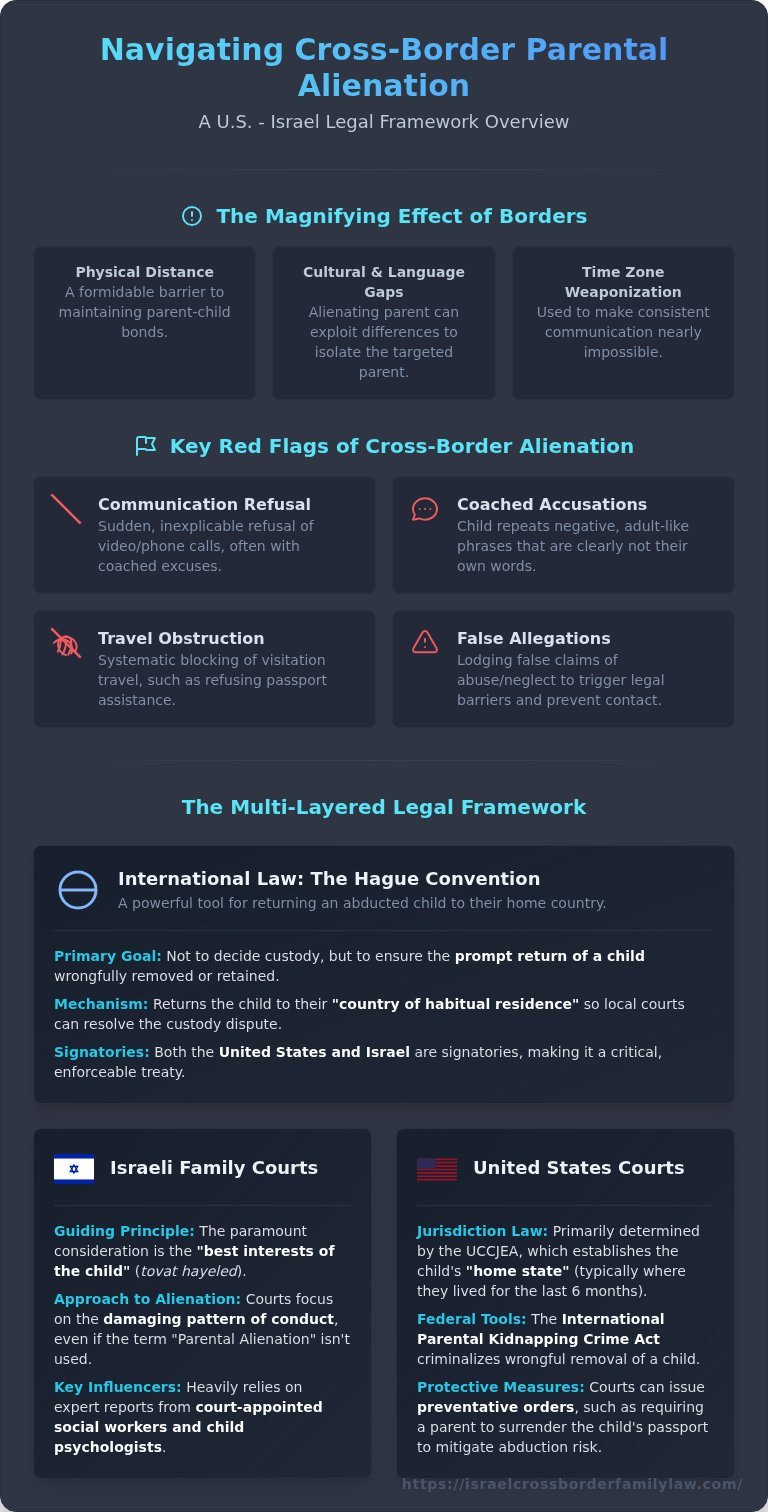
The complexities of parental alienation across borders US Israel are exponentially greater than in domestic cases. The vast physical distance creates a formidable barrier to maintaining a healthy parent-child bond. An alienating parent can exploit differences in language, cultural norms, and educational systems to create a world in which the targeted parent feels like a foreigner. Furthermore, the significant time zone difference can be weaponized to make consistent communication nearly impossible, further isolating the child and the targeted parent.
Common Signs of Cross-Border Alienation
Navigating these multi-jurisdictional challenges requires vigilance. Key indicators of international parental alienation include:
- A sudden and inexplicable refusal by the child to communicate via video calls or phone, often with coached excuses.
- The child repeating negative, adult-like phrases or accusations about the targeted parent that are clearly not their own.
- Systematic obstruction of travel plans for visitation, including refusing to assist with passports or creating last-minute conflicts.
- The lodging of false allegations of abuse or neglect, a tactic designed to trigger international legal barriers and delay or prevent contact.
The Legal Framework: Navigating US, Israeli, and International Law
Successfully resolving cases of parental alienation across borders us israel demands a sophisticated understanding of a multi-layered legal landscape. The primary challenge is establishing which country has the authority-or jurisdiction-to hear the case and make binding decisions. Without proper legal strategy, parents can find themselves with court orders that are unenforceable in the other country. The goal is to navigate a complex web of international treaties, national laws, and state statutes to secure a ruling that is recognized and respected in both the United States and Israel.
The Hague Convention on Child Abduction: A Critical Tool
The cornerstone of international child custody law is the Hague Convention on the Civil Aspects of International Child Abduction, to which both the US and Israel are signatories. Its central purpose is not to decide custody but to ensure the prompt return of a child wrongfully removed to or retained in another member country. For instance, if a parent takes a child to Israel for a vacation and then refuses to return to the US, the Convention can be invoked. It is a powerful mechanism for returning the child to their country of habitual residence so that the local courts there can resolve the underlying custody dispute.
Parental Alienation in Israeli Family Courts
Israeli Family Courts operate under the paramount principle of the “best interests of the child” (tovat hayeled). While the legal system may not always use the precise term “parental alienation,” courts are highly attuned to its damaging behaviors. Judges will act decisively when one parent’s conduct is found to be harming the child’s relationship with the other parent. To make these complex determinations, Israeli courts frequently rely on comprehensive reports and recommendations from court-appointed social workers (p’kidot sa’ad) and child psychologists, whose expert opinions carry significant weight in the final judgment.
How US Courts Address International Alienation
In the United States, jurisdiction is primarily determined by the Uniform Child Custody Jurisdiction and Enforcement Act (UCCJEA), a state law enacted nationwide. The UCCJEA establishes which state has jurisdiction, typically the child’s “home state” where they have lived for the six months prior to the court filing. Beyond jurisdiction, U.S. federal law provides additional layers of protection. The Hague Convention’s civil remedies are reinforced by criminal statutes, such as the International Parental Kidnapping Crime Act, which criminalizes the wrongful removal of a child. Furthermore, US courts can issue preventative orders, such as requiring a parent to surrender a child’s passport, to mitigate the risk of international abduction.
Building Your Case: A Strategic Approach for the Targeted Parent
When confronted with the complexities of parental alienation, the natural response is often emotional. However, in multi-jurisdictional legal disputes, a strategic, evidence-based approach is not merely beneficial-it is essential. The burden of proof in these sophisticated matters frequently rests with the targeted parent, who must present a clear and undeniable record of alienating behaviors. Successfully navigating the challenges of parental alienation across borders us israel requires moving beyond reaction and into proactive, meticulous case-building, regardless of your physical location.
Documentation: Your Most Powerful Weapon
Your most critical asset is a comprehensive and contemporaneous record. This evidentiary foundation serves to counter false narratives and demonstrate a consistent pattern of behavior to the courts in both the United States and Israel. Your documentation must be methodical and unwavering.
- Maintain a Detailed Log: Document every instance of interference with your parental rights. Note the date, time, and specific details of every missed video call, unanswered message, and broken promise regarding visitation.
- Preserve All Communications: Archive every email, text message, social media post, and voicemail from the alienating parent. These digital communications often provide direct evidence of manipulation or obstruction.
- Record Your Efforts: Systematically document your own consistent and reasonable attempts to communicate with your child. This record demonstrates your commitment and refutes any claims of parental abandonment.
The Role of Expert Witnesses and Evaluations
Allegations of parental alienation require more than anecdotal evidence; they demand professional assessment. A neutral, third-party psychological evaluation conducted by a qualified forensic psychologist is a cornerstone of a strong case. These experts are trained to identify the subtle and overt patterns of alienating conduct and can provide the court with a professional opinion on the psychological state of the child and the family dynamic. Crucially, their expert testimony and detailed reports can be submitted in either or both jurisdictions, providing the court with the impartial guidance needed to understand the complexities of the situation and recommend vital interventions, particularly in cases governed by international agreements like the Hague Convention in Israel.
Maintaining the Parent-Child Bond Across the Miles
While building your legal case, you must concurrently work to preserve your relationship with your child. This requires persistent, positive effort, even in the face of resistance that may be orchestrated by the other parent.
- Schedule regular, predictable video calls to create a stable point of contact.
- Send physical letters, cards, and age-appropriate gifts for birthdays and holidays to provide a tangible connection.
- Never speak negatively about the other parent to or in front of your child. Maintain your position as a source of stability and unconditional love.
Feeling overwhelmed? Our team can help you build a strategy.
[
Download
](https://getautoseo.com/screenshots/getautoseocom_1768609662_FH0yKf7a.jpg)
Feedback & Recreate
Delete

Legal Remedies and Court-Ordered Interventions
When informal attempts to resolve destructive gatekeeping fail, a targeted parent must turn to the Israeli Family Court for decisive action. The court possesses a broad mandate to intervene when a child’s welfare is compromised. It is critical to understand that the court’s primary objective is not to punish the alienating parent, but to protect the child’s fundamental right to a relationship with both parents. Successfully addressing parental alienation across borders us israel depends on presenting a meticulously documented case to the court with jurisdiction, demonstrating the harm being inflicted upon the child.
The remedies available range from therapeutic interventions to significant modifications of existing custodial arrangements, each tailored to the severity of the situation. Engaging experienced legal counsel is paramount to navigating this complex process and petitioning for the most effective relief.
Modifying Custody and Visitation Orders
A targeted parent can file a motion to modify existing court orders by demonstrating a “significant change in circumstances”-the alienation itself. This can involve requesting specific, enforceable orders to counteract obstruction, such as mandating daily, unimpeded video calls or ordering therapeutic visitation. In severe, well-documented cases, the court may even be petitioned to transfer the child’s primary physical residence to the targeted parent, a significant step that underscores the gravity with which the court views severe alienation.
Court-Ordered Reunification Therapy
Israeli courts can mandate participation in reunification therapy, a specialized intervention designed to methodically repair the damaged parent-child bond. This sophisticated therapeutic process is often conducted by a court-appointed expert. For international families, sessions can be structured virtually or during extended in-person visits to either Israel or the United States. Crucially, the court can compel the participation of not only the child but also the alienating parent, whose own behaviors must be addressed for the therapy to succeed.
Enforcement and Sanctions
When an alienating parent willfully violates a court order, the targeted parent can file a motion for contempt of court (biziun beit hamishpat). This action requests that the court enforce its own orders through powerful sanctions. These can include:
- Imposing significant daily or weekly fines, often amounting to thousands of shekels (₪), for each continued violation.
- Ordering the alienating parent to pay the targeted parent’s legal fees and associated costs (hotsa’ot mishpat).
- In extreme cases of repeated and flagrant non-compliance, the court retains the authority to order imprisonment.
Effectively pursuing these remedies requires a robust legal strategy. For expert guidance on navigating the complexities of parental alienation across borders us israel, our firm provides sophisticated cross-border representation.
Why a Unified US-Israel Legal Team is Essential
When facing the immense complexities of international child custody disputes, particularly those involving allegations of alienation, the structure of your legal representation is not merely a detail-it is the foundational element of your entire strategy. Engaging separate, uncoordinated lawyers in the United States and Israel creates significant, often insurmountable, risks. A fragmented approach can lead to contradictory legal actions, wasted resources, and a weakened position in both jurisdictions. The only effective path forward is a single, cohesive legal team with deep, multi-jurisdictional expertise.
A unified firm provides a singular, overarching strategy that anticipates legal maneuvers in both countries simultaneously. This integrated approach ensures that every filing, every communication, and every court appearance is a deliberate step in a coordinated plan, maximizing your chances for a successful resolution while minimizing the significant financial and emotional costs of a protracted international legal battle.
Avoiding Conflicting Legal Advice
When two independent lawyers operate in different legal systems, they often provide advice that is sound in their own jurisdiction but detrimental in the other. For instance, a tactical decision that strengthens your case in an Israeli family court could inadvertently violate a standing order from a U.S. court. Our unified team eliminates this risk by ensuring every action is vetted against the legal frameworks of both nations, preventing the opposing party from exploiting strategic inconsistencies.
Navigating Cultural and Procedural Nuances
The family court systems in Israel and the United States operate with distinct procedures, evidentiary standards, and cultural expectations. A legal team qualified in both jurisdictions understands how to frame arguments and present evidence effectively to judges and court-appointed professionals on both sides of the Atlantic. Fluent in both English and Hebrew, our attorneys communicate seamlessly with all parties, ensuring that critical nuances are never lost in translation and that your case is presented with authority and cultural sensitivity.
Our Firm’s Experience in Complex Alienation Cases
Our firm has a proven and extensive track record of successfully representing clients in the most challenging and high-conflict cases of parental alienation across borders us israel. Our attorneys are not just bilingual; they are dual-licensed, possessing the authority and experience to practice law effectively in both Israeli and American courts. We provide the sophisticated, reassuring guidance necessary to navigate these difficult circumstances, protecting your rights and your relationship with your child. For a comprehensive strategy tailored to your unique situation, we invite you to schedule a confidential consultation to discuss your case.
Securing Your Parental Rights: A Unified Approach to Cross-Border Parental Alienation
Confronting parental alienation across borders us israel is an exceptionally complex challenge, demanding a sophisticated understanding of multi-jurisdictional legal frameworks, including the Hague Convention and the UCCJEA. As we have explored, success hinges on a meticulously prepared case and the strategic application of legal remedies available in both nations. The most critical takeaway is the profound advantage of a unified legal strategy, one that seamlessly integrates Israeli and American legal perspectives to prevent critical gaps in representation and advocacy.
Our team of dual-qualified attorneys, licensed to practice in both the United States and Israel, possesses deep experience in these high-stakes international custody cases. We provide the unified, strategic approach necessary to navigate this complex litigation and vigorously defend your relationship with your child. Do not face this daunting process alone. Protect your parental rights. Schedule a confidential consultation with our US-Israel family law experts today.
With the right expert guidance, there is a clear path forward to restoring and protecting your most important family bonds.
Frequently Asked Questions
Is parental alienation considered a crime in Israel or the US?
Parental alienation is not classified as a standalone criminal offense in either Israel or the United States. However, it is a significant and recognized issue within the civil family court systems of both jurisdictions. Courts view such behavior as detrimental to a child’s welfare and will consider it a critical factor when determining custody, visitation rights, and the best interests of the child. Actions constituting alienation can lead to severe civil sanctions, including modification of custody orders.
How long does an international parental alienation case typically take to resolve?
Resolving a multi-jurisdictional parental alienation case between the US and Israel is a complex undertaking with a timeline that can extend from 18 months to several years. The duration is contingent upon numerous factors, including the specific courts involved, the need for cross-border evidence gathering, the appointment of psychological experts, and the potential invocation of international treaties like the Hague Convention. Navigating these sophisticated procedural layers requires experienced international legal counsel to manage the case efficiently.
What are the estimated legal costs for a cross-border custody battle between the US and Israel?
The legal expenditures for a complex international custody dispute are substantial. Clients should anticipate initial retainers with experienced Israeli counsel ranging from approximately ₪50,000 to ₪150,000. Total costs can escalate significantly, often reaching several hundred thousand shekels, depending on the duration and complexity of the litigation. These figures account for extensive legal work, court fees, expert witness testimony, and the necessity of coordinating legal strategies across two distinct legal systems.
Can my child be forced to testify in court against the other parent?
Both Israeli and US family courts are highly reluctant to compel a child to provide direct testimony against a parent in an open, adversarial setting. To protect the child’s psychological well-being, courts prefer alternative methods. A judge may appoint a guardian ad litem (Apoptropos L’Din) or a child psychologist to interview the child and report their findings, or the judge may speak with the child privately in chambers to ascertain their wishes and perspective.
What happens if the alienating parent refuses to comply with a court order for reunification therapy?
A parent’s refusal to comply with a court-mandated order for reunification therapy constitutes contempt of court and carries serious consequences. The presiding judge has the authority to impose a range of sanctions, which may include substantial monetary fines, ordering the non-compliant parent to cover the other party’s legal fees, or modifying the existing custody and visitation agreement. In cases of persistent defiance, a court may even transfer primary physical custody to the targeted parent.
How can I prove my case when all communication is controlled by the other parent in another country?
Proving a case of parental alienation across borders us israel demands a meticulous and strategic approach to evidence gathering. Our firm guides clients in compiling comprehensive documentation, including saved emails, text messages, and detailed logs of thwarted communication attempts. We also leverage the legal discovery process to obtain records and engage neutral third-party witnesses. Crucially, we retain forensic psychologists whose expert evaluations can provide the court with an authoritative analysis of the alienating dynamics.

Article by
Gabriel Lior
A Personal Journey That Became a Mission
The advisory was founded by an American father Gabriel Lior, LLB, MBA , global entrepreneur, and cross-border advisor who spent more than a decade navigating the Israeli family court system firsthand and now lives in Singapore with his son.
As a divorced parent in a cross-border family, Gabriel faced nearly every legal challenge a foreign parent can encounter in Israel — including child custody disputes, child support proceedings, property matters in Israel and abroad, false accusations, and complex immigration and relocation proceedings.
Over the years, he learned the hard way how difficult it is for non-Israeli parents to understand the system, identify the right legal strategy, and choose the right legal representation — especially when language, culture, and jurisdictional differences are involved. He also witnessed how foreign parents and new immigrants are often disadvantaged or taken advantage of by service providers and institutions simply because they lack local knowledge or fluency.
From Client to Advisor
To truly understand — and survive — the system, Gabriel pursued formal legal education in Israel, completing two Israeli law degrees, alongside a BA and MBA earned in the United States. This was never about becoming a practicing attorney, but about gaining a deep, structural understanding of how the system works — and where it breaks down for foreign parents.
This rare combination of:
Firsthand client experience
Israeli legal and US business education
International business and negotiation training
Decades of commercial execution
created a unique perspective – one that understands both sides of the table.
After years of litigation, persistence, and at times self-representation, he ultimately succeeded in securing custody of his son and relocating abroad through a rare legal victory in the Israeli Supreme Court — becoming one of the first fathers in Israel to do so under these circumstances.
Disclaimer
Important Disclaimer:
The information provided on this website and in its content is for general informational and educational purposes only and does not constitute legal advice, legal opinion, or legal representation.
Gabriel Lior is not licensed to practice law in Israel (nor is he interested in doing so) and does not provide legal services, despite having completed 2 Law Degrees. The services offered are advisory in nature and are intended to provide general guidance, strategic insight, and information regarding cross-border family law considerations.
No attorney-client relationship is formed by accessing this website, reading its content, or communicating with us.
Any decisions made based on this information are at your own discretion and risk. For legal advice specific to your situation, you should consult a licensed attorney in the relevant jurisdiction.
Where appropriate, we may refer clients to independent, licensed attorneys or professionals. Such referrals do not constitute legal representation and no liability is assumed for services provided by third parties.