This article is published on an independent advisory platform, providing general information and not constituting an attorney-client relationship. Israel Cross Border Law Firm offers legal services exclusively through licensed attorneys under a separate engagement.
What if the trajectory of your international divorce was determined entirely by which spouse reached a specific courthouse first? In the world of US-Israel family law, this ‘race to court’ often creates a climate of fear and rushed decisions that can lead to costly mistakes. At Israel Cross Border Law Firm, we recognize that you’re likely concerned about the authority of religious courts or the language barriers inherent in complex litigation. It’s natural to feel that the system is stacked against you when you don’t speak the language or understand the jurisdictional nuances. We promise to show you how a strategic, advisory-led approach can provide the clarity you need to protect your assets and parental rights. This guide previews the essential steps for navigating multi-jurisdictional disputes, from understanding the March 2026 expansion of religious court authority to utilizing the 1980 Hague Convention for child protection. You can move forward with confidence by focusing on risk-based decision-making rather than conflict. For more insights, visit our channel at https://www.youtube.com/@IsraelFamilyLaw. Get clarity before you commit. Request a confidential consultation.
Key Takeaways
- Understand why the “Race to Court” in Israel makes early jurisdictional planning essential for protecting your interests in a cross-border divorce.
- Learn how the advisory-led model at israelcrossborderfamilylaw.com prioritizes comprehensive strategy before you commit to local litigation in either Israel or the US.
- Review the 1980 Hague Convention and Israeli relocation standards to safeguard your parental rights and manage international custody disputes.
- Identify the essential documentation and assessment steps required to manage multi-jurisdictional assets and legal requirements with confidence.
- Develop a strategic roadmap to minimize conflict through risk-based decision-making specifically designed for the Anglo community in Israel.
This article is published on an independent advisory platform and does not constitute a law firm or an attorney-client relationship. Legal services are only provided by licensed attorneys under a separate engagement.
Understanding the Israel-US Cross-Border Family Law Landscape
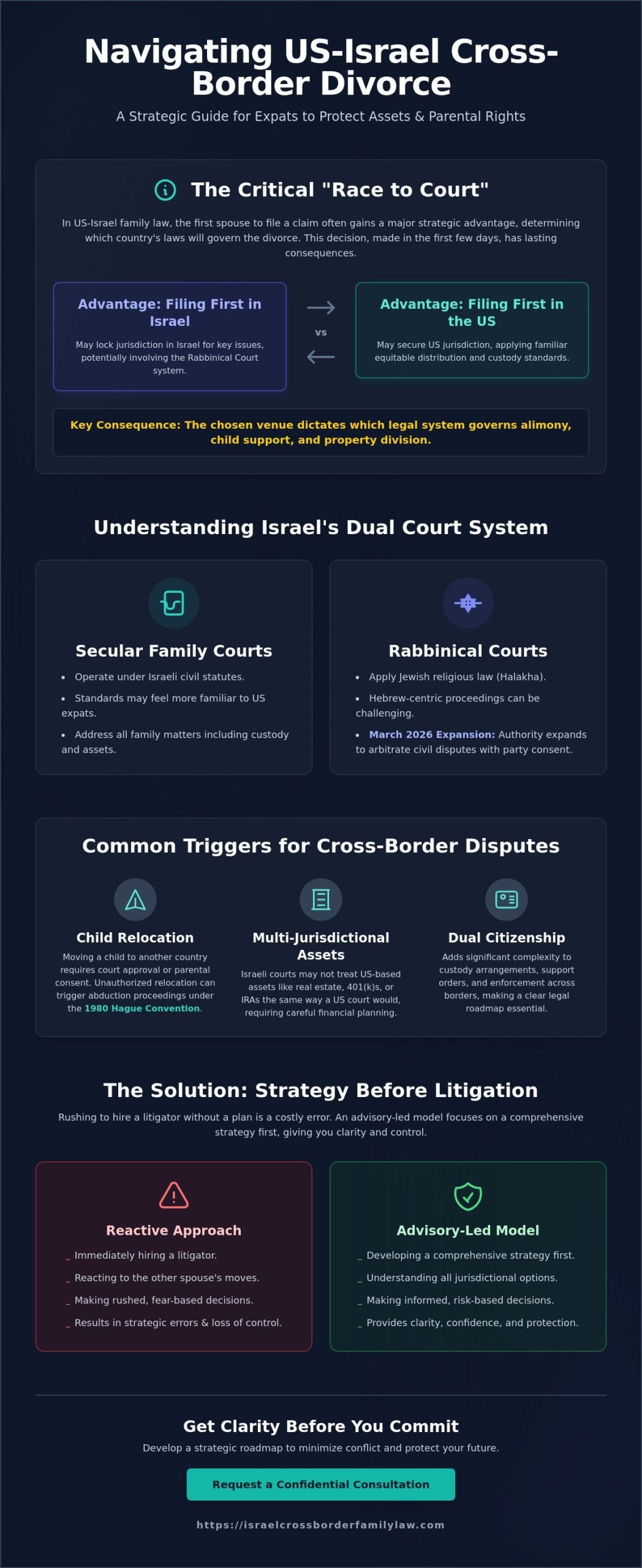
Cross-border family law describes legal situations where parties, assets, or children span multiple jurisdictions. For US expats living in IL, this complexity isn’t just a technicality; it’s a fundamental challenge that dictates the outcome of their most personal disputes. One of the most critical elements in this landscape is the “Race to Court.” This phenomenon occurs because the first spouse to file a claim in a specific venue often gains a significant strategic advantage in determining which legal system governs matters like alimony or property division. Decisions made during the first few days of a dispute can have lasting financial and parental consequences.
Expectations of fairness often clash when US citizens enter the Israeli legal system. Many expats assume that the equitable distribution or “best interests of the child” standards they recognize from the US will translate perfectly to Israel. However, Israeli statutes and cultural norms regarding family life often differ substantially. This is why israelcrossborderfamilylaw.com operates as an independent advisory platform. We provide the strategic clarity needed to bridge the gap between these two distinct legal cultures before you commit to a specific course of action.
To better understand how these laws apply when a spouse is abroad, watch this helpful video:
The Dual Court System: Family vs. Rabbinical
IL utilizes a dual court system that can be incredibly confusing for foreign residents. Secular Family Courts operate alongside state Rabbinical Courts. While secular courts apply civil statutes, Rabbinical Courts apply Jewish religious law. In March 2026, the Knesset passed legislation expanding the authority of these religious courts to arbitrate civil disputes if both parties consent. For non-citizens, establishing which court has jurisdiction requires a deep understanding of residency and status. English-speaking families often struggle with the Hebrew-centric nature of these proceedings, which can lead to feelings of isolation and a lack of control over their own cases.
Common Triggers for Cross-Border Disputes
Relocation requests are a frequent source of conflict. Moving a child from IL to the US, or vice versa, requires either the written consent of both parents or a specific court order. If a parent relocates a child without authorization, they may face proceedings under the Hague Convention on International Child Abduction. Financial assets also complicate matters. Israeli courts may not always view US-based real estate, 401ks, or IRAs through the same lens as a US court would. Dual citizenship adds another layer of complexity to custody and support orders, making it essential for expats and foreign nationals to have a comprehensive roadmap. Strategic planning at israelcrossborderfamilylaw.com ensures these international variables are accounted for early in the process.
This article is published on an independent advisory platform and does not constitute a law firm or an attorney-client relationship. Legal services are only provided by licensed attorneys under a separate engagement.
The Advisory Model: Why Strategy Precedes Representation
Most individuals facing a cross-border dispute react by immediately searching for a courtroom advocate. While having a skilled litigator is important, rushing into the “Race to Court” without a comprehensive plan often leads to strategic errors that are difficult to reverse. An advisor manages the big picture strategy, ensuring that your actions in Israel align with your long-term goals in the US. This approach allows you to step back and analyze the situation before legal papers are served. At israelcrossborderfamilylaw.com, we believe that representation is the tool, but strategy is the blueprint.
The advisory model works in tandem with your local Israeli and US legal teams. Instead of replacing your lawyers, an advisor acts as a central coordinator who speaks both legal languages. This prevents a scenario where a victory in an Israeli family court inadvertently creates a disadvantage in a US jurisdiction. By focusing on risk-based decision-making, you can identify pitfalls such as unfavorable support formulas or restrictive custody arrangements before they become permanent court orders. You can learn more about how this coordination benefits your case by reviewing how it works in practice.
Bridging the Gap for International Families
Local lawyers in IL are often experts in domestic statutes but may miss the international jurisdictional nuances that affect US expats. High-stakes cases involving multi-jurisdictional assets require bicultural and bilingual guidance to ensure nothing is lost in translation. This isn’t just about language; it’s about understanding the cultural expectations of fairness in both systems. Managing the emotional and financial cost of cross-border litigation becomes much easier when you have a clear roadmap. Without this bridge, families often find themselves trapped in expensive, repetitive cycles of litigation that could have been avoided with early strategic intervention.
The Independent Advisory Platform Advantage
It’s vital to maintain a distinction between advisory services and legal representation. This platform operates as an independent advisory, meaning the focus is on objective strategy rather than accumulating billable litigation hours. This independence allows for a frank assessment of risks and benefits. Gabriel Lior’s personal journey through the Israeli legal system informs the advisory’s mission, providing a level of empathy and practical insight that traditional law firms may not offer. At israelcrossborderfamilylaw.com, we prioritize educational guidance so you can make informed choices about your future. Before you commit to a specific legal path, you might find it beneficial to request a confidential case review to gain perspective on your options.
This article is published on an independent advisory platform and does not constitute a law firm or an attorney-client relationship. Legal services are only provided by licensed attorneys under a separate engagement.
Custody, Relocation, and the Hague Convention
When children are involved in a cross-border dispute, the legal stakes shift from financial assets to fundamental parental rights. The primary mechanism governing these situations is the 1980 Hague Convention on the Civil Aspects of International Child Abduction. This treaty ensures that custody is decided in the child’s country of “habitual residence” rather than the country where a parent may have unilaterally moved them. For families connected to both the US and Israel, understanding these rules is vital. Rushed decisions or travel without clear legal consent can trigger severe international legal consequences. At israelcrossborderfamilylaw.com, we emphasize that these cases require a strategy that accounts for both Israeli statutes and international treaties.
Relocation, known in Hebrew as Hagirah, follows strict legal standards in Israeli courts. Unlike some US jurisdictions where a primary custodial parent may have more flexibility, Israeli law requires the written consent of the other parent or a specific court order for any move that changes a child’s residence. The court’s interpretation of the “best interests of the child” is the guiding principle, but this interpretation often involves deep involvement from court-appointed social workers. This process can be daunting for English-speaking parents who are unfamiliar with the Israeli welfare system. Securing a clear roadmap for international custody and relocation is the first step toward protecting your family’s future.
Hague Convention Risks and Protections
A Hague petition can be filed for “wrongful removal,” where a child is taken to another country without consent, or “wrongful retention,” where a child stays past an agreed-upon visit. Defenses against these petitions have a very high legal threshold. You must prove a “grave risk of harm” or show that the child is of an age and maturity where their objection should be considered. Managing these high-stakes cases requires a “team on the ground” in Israel that understands the specific timelines and evidentiary requirements of the Family Court. Without this strategic oversight, parents often find themselves facing court-ordered returns that disrupt the child’s life and the parent’s legal standing.
Enforcing Child Support Across Borders
Financial support for children often becomes a point of friction when one parent resides in the US and the other in Israel. US child support orders are not automatically enforced shekel-for-shekel in IL; they often require a formal recognition process. The Israeli Ministry of Justice, specifically the Department of International Affairs, plays a central role in cross-border enforcement. However, discrepancies between US state laws and Israeli support formulas can lead to unexpected financial gaps. Understanding the nuances of child support and cross-border enforcement ensures that your financial planning remains realistic and enforceable. At israelcrossborderfamilylaw.com, we provide the educational clarity needed to navigate these multi-jurisdictional financial obligations without unnecessary conflict.
This article is published on an independent advisory platform and does not constitute a law firm or an attorney-client relationship. Legal services are only provided by licensed attorneys under a separate engagement.
Critical First Steps for Expats Facing Family Disputes
Determining whether to proceed in an Israeli court or a US jurisdiction is the most consequential decision you’ll make. This assessment isn’t about choosing the “best” system; it’s about identifying which one is more favorable for your specific goals regarding assets, support, and custody. At israelcrossborderfamilylaw.com, we help you analyze these variables before a single document is filed. Gathering your international financial records early is essential. This includes US bank statements, tax returns, and Israeli salary slips (tlushim). You should also maintain a secure log of communication, as these records often form the backbone of evidentiary claims in cross-border litigation.
Confidentiality is paramount during this initial stage. A Confidential Case Review provides a secure environment to explore your options without alerting the other party. This allows you to avoid the “Race to Court” pitfalls, where a rushed filing in the wrong venue can lock you into unfavorable legal standards for years. Sometimes, the best strategy is to move fast. Other times, waiting for a specific jurisdictional trigger is the wiser choice. Making an informed move requires a map of the entire legal landscape.
Evaluating Legal Representation
When interviewing an English-speaking family lawyer in IL, don’t just ask about their success rate. Ask how many cases they’ve handled involving international assets or the 1980 Hague Convention. Understanding their fee structure is equally vital. Some firms charge by the hour, while others use a global fee for specific stages of litigation. You should also determine if they favor a mediation-first approach or are prepared for high-conflict litigation. Your legal team must have the capacity to coordinate with US counsel to ensure a seamless strategy across borders. This bicultural expertise is often the difference between a protected future and a costly mistake.
The Impact of Early Decisions
Temporary orders in Israeli Family Courts can dictate the final outcome of a multi-year case. One of the most significant risks for expats is the Tzav Ikur Yetzia, or “stay of exit” order. This can prevent a parent or a child from leaving Israel until a case is resolved or a high financial bond is posted in Israeli Shekel (₪). Strategizing around the “Start-up Nation” lifestyle is also crucial. High-value assets like RSUs, stock options, and intellectual property require specialized valuation that accounts for both Israeli and US tax implications. To ensure your interests are protected from the start, speak with a strategy expert today.
This article is published on an independent advisory platform and does not constitute a law firm or an attorney-client relationship. Legal services are only provided by licensed attorneys under a separate engagement.
Securing Clarity for Your International Family
US-Israel cases involve more than just filing papers; they require a sophisticated understanding of how two distinct cultures and legal systems interact. Relying solely on local litigation without a broader perspective often results in fragmented outcomes that don’t protect your interests in both countries. At israelcrossborderfamilylaw.com, the focus remains on providing a comprehensive map of your legal landscape. This transparency ensures that you understand the risks and rewards of every decision before you invest in high-cost representation. It’s about moving from a reactive stance to a proactive strategy.
Moving from a state of confusion to one of focused strategy is a deliberate process. It involves stripping away the emotional noise of a dispute to look at the objective facts of your situation. Whether you are dealing with assets in the “Start-up Nation” or managing a complex custody arrangement, ethics and clarity must lead the way. An independent advisor provides a third-party perspective that isn’t incentivized by the length of your court case. This objective guidance helps you avoid the common pitfalls that often trap international families in the Israeli system.
Resources for English-Speaking Families
Education is your strongest defense against the unknown. You can find detailed visual explanations of these concepts on the Israel Family Law YouTube channel. For those needing specific written roadmaps, our guides for Expats & Foreign Nationals offer deep dives into the issues that affect the Anglo community most. These resources serve as a bridge. They help you translate your US expectations into the reality of the Israeli system, ensuring nothing is lost in translation during high-stakes litigation.
Next Steps: Risk-Based Decision Making
Initiating a strategic review is the first step toward reclaiming control over your situation. By using a risk-based approach, you can weigh the potential costs against the likely outcomes in both jurisdictions. While simple domestic cases may be straightforward, international matters can quickly see legal fees exceed ₪75,000 when managed without a clear plan. Objective advisory is especially vital in high-conflict matters where emotions can cloud long-term judgment. You don’t have to navigate this complexity alone. Get clarity before you commit. Request a confidential consultation.
This article is published on an independent advisory platform and does not constitute a law firm or an attorney-client relationship. Legal services are only provided by licensed attorneys under a separate engagement.
Building Your Strategic Path Forward
Success in a cross-border dispute isn’t defined by a single court victory. It’s measured by the long-term security of your family and the protection of your global assets. We’ve examined how early jurisdictional choices and a deep understanding of the Hague Convention serve as the foundation for any international case. Gabriel Lior, LLB, MBA, established israelcrossborderfamilylaw.com as an independent advisory platform to meet the unique needs of the Anglo community. With over 10 years of firsthand experience within the Israeli legal system, our focus remains on providing objective, strategy-first guidance that litigation-only firms often overlook.
Navigating the friction between US expectations and Israeli statutes requires a bicultural roadmap. Whether you are managing high-value assets or complex custody arrangements, having a clear plan allows you to act with confidence rather than reacting out of fear. You don’t have to face these multi-jurisdictional challenges alone. Get clarity before you commit. Request a confidential consultation. You deserve a focused strategy that honors your rights and protects your children’s future.
This article is published on an independent advisory platform and does not constitute a law firm or an attorney-client relationship. Legal services are only provided by licensed attorneys under a separate engagement.
Frequently Asked Questions
Is israelcrossborderfamilylaw.com a law firm?
No, israelcrossborderfamilylaw.com is an independent advisory platform rather than a law firm. It provides objective strategy, risk assessment, and educational guidance for international families. While it coordinates with legal teams, actual legal representation and services are only provided by licensed attorneys under a separate, formal engagement. This model ensures you receive a big-picture roadmap before committing to specific litigation.
Can an Israeli court decide on my US-based assets?
Yes, Israeli courts can issue rulings regarding foreign property if they have personal jurisdiction over both parties. While enforcing an Israeli order on a US-based 401k or real estate requires additional legal steps in America, the court in IL can offset the value of those assets against property located in Israel. Strategic planning is essential to ensure your global portfolio is protected from unfavorable offsets.
What is the ‘Race to Court’ in Israeli family law?
The ‘Race to Court’ is a jurisdictional competition where the first spouse to file a claim determines whether the secular Family Court or the Rabbinical Court hears the case. Filing first in the Rabbinical Court can bind matters like alimony and property division to religious law. This creates a high-stakes environment where the choice of venue and timing significantly impacts the financial outcome of the divorce.
How does the Hague Convention apply to my custody case in Israel?
The Hague Convention applies when a child is wrongfully removed to or retained in Israel from their country of habitual residence. Israeli Family Courts are active signatories and prioritize returning children to their home jurisdiction for custody determinations. Data from 2005 indicates that Israel’s court-ordered return rate was 32%, which aligns with the global average for international parental child abduction cases.
Do I need a lawyer in both the US and Israel?
Most cross-border cases require a coordinated legal team in both jurisdictions to prevent conflicting court orders. A US lawyer manages state-specific matters like pension division, while an Israeli lawyer handles local litigation and ‘stay of exit’ orders. An independent advisor at israelcrossborderfamilylaw.com acts as the bridge between these professionals, ensuring your strategy remains consistent across both legal systems.
Can I enforce a US child support order in Israel?
Yes, you can enforce a US support order, but it requires a formal recognition process through the Israeli Ministry of Justice. The court will review the foreign judgment to ensure it doesn’t contradict local public policy or civil rights. It’s common for support amounts to be re-evaluated based on Israeli cost-of-living standards and specific local formulas for child maintenance.
What should I do if my spouse threatens to take our children to Israel?
You must act immediately to secure an emergency order preventing the children’s removal from their current country. This often involves a ‘ne exeat’ order or the court taking custody of the children’s passports. If the children are already in IL, you should file a Hague Convention petition within one year to avoid the legal defense that the children are now ‘well-settled’ in their new environment.
Are US prenuptial agreements valid in Israeli courts?
Israeli courts generally recognize foreign prenuptial agreements if they were executed fairly and meet basic legal standards. However, the agreement must be formally validated by an Israeli court to be enforceable regarding local assets or divorce proceedings. There is an increasing trend in the Israeli system toward enforcing these contracts, provided they don’t violate the Women’s Equal Rights Law or other fundamental statutes.
Get clarity before you commit. Request a confidential consultation.

Article by
Gabriel Lior
A Personal Journey That Became a Mission
The advisory was founded by an American father Gabriel Lior, LLB, MBA , global entrepreneur, and cross-border advisor who spent more than a decade navigating the Israeli family court system firsthand and now lives in Singapore with his son.
As a divorced parent in a cross-border family, Gabriel faced nearly every legal challenge a foreign parent can encounter in Israel — including child custody disputes, child support proceedings, property matters in Israel and abroad, false accusations, and complex immigration and relocation proceedings.
Over the years, he learned the hard way how difficult it is for non-Israeli parents to understand the system, identify the right legal strategy, and choose the right legal representation — especially when language, culture, and jurisdictional differences are involved. He also witnessed how foreign parents and new immigrants are often disadvantaged or taken advantage of by service providers and institutions simply because they lack local knowledge or fluency.
From Client to Advisor
To truly understand — and survive — the system, Gabriel pursued formal legal education in Israel, completing two Israeli law degrees, alongside a BA and MBA earned in the United States. This was never about becoming a practicing attorney, but about gaining a deep, structural understanding of how the system works — and where it breaks down for foreign parents.
This rare combination of:
Firsthand client experience
Israeli legal and US business education
International business and negotiation training
Decades of commercial execution
created a unique perspective – one that understands both sides of the table.
After years of litigation, persistence, and at times self-representation, he ultimately succeeded in securing custody of his son and relocating abroad through a rare legal victory in the Israeli Supreme Court — becoming one of the first fathers in Israel to do so under these circumstances.
Disclaimer
Important Disclaimer:
The information provided on this website and in its content is for general informational and educational purposes only and does not constitute legal advice, legal opinion, or legal representation.
Gabriel Lior is not licensed to practice law in Israel (nor is he interested in doing so) and does not provide legal services, despite having completed 2 Law Degrees. The services offered are advisory in nature and are intended to provide general guidance, strategic insight, and information regarding cross-border family law considerations.
No attorney-client relationship is formed by accessing this website, reading its content, or communicating with us.
Any decisions made based on this information are at your own discretion and risk. For legal advice specific to your situation, you should consult a licensed attorney in the relevant jurisdiction.
Where appropriate, we may refer clients to independent, licensed attorneys or professionals. Such referrals do not constitute legal representation and no liability is assumed for services provided by third parties.