For parents navigating the complexities of a cross-border divorce or separation, the paramount concern is always the child’s well-being. This concern is often accompanied by significant uncertainty and the fear of feeling powerless within an unfamiliar legal system. You may question whether your child’s voice will be truly heard or if their expressed wishes will hold any weight in an Israeli courtroom. Understanding the legal standing of a child’s preference in Israeli custody cases is therefore not just a matter of legal strategy, but a critical component of ensuring your child’s emotional security through this challenging process.
This definitive guide is designed to demystify the Israeli legal landscape, providing clear and authoritative insight. We will meticulously navigate the framework that governs how, when, and to what extent a judge considers a child’s wishes in both custody and international relocation decisions. You will gain a comprehensive understanding of the factors evaluated, the process for determining a child’s true preference, and the strategies for ensuring their voice is presented appropriately. Our aim is to empower you with the knowledge to achieve a custody outcome that genuinely reflects your child’s best interests.
Key Takeaways
- Understand that the paramount principle guiding all judicial decisions is ‘tovath hayeled’ (the best interests of the child), a standard that supersedes all other considerations.
- Learn the key factors, including age and maturity, that determine the weight given to a child’s preference in Israeli custody cases and how the court protects them during the process.
- Recognize how a child’s stated wishes gain particular significance in complex cross-border matters, including international relocation and Hague Convention abduction cases.
- Discover strategic approaches for parents to navigate custody proceedings, ensuring your conduct supports your child’s well-being and avoids any perception of undue influence.
The ‘Best Interests of the Child’: The Guiding Principle in Israeli Law
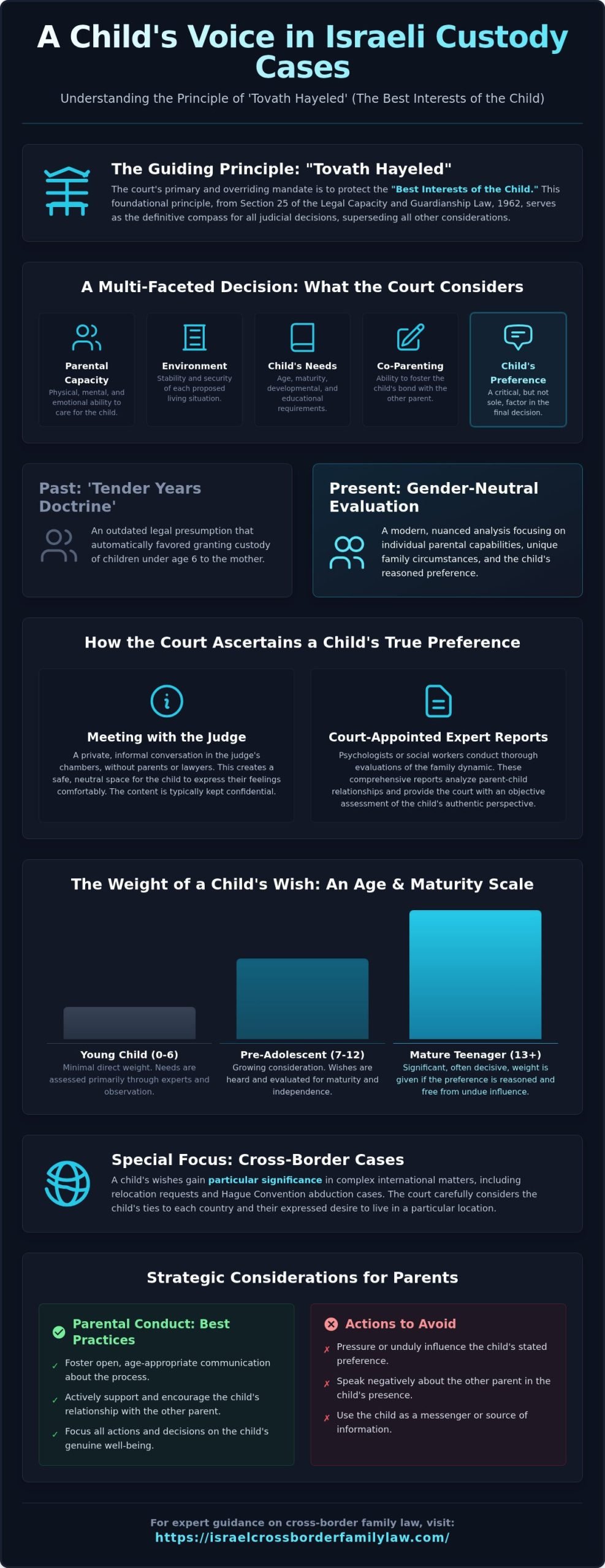
In any legal proceeding involving child custody in Israel, the court’s primary and overriding mandate is to protect and uphold the “best interests of the child,” or tovath hayeled. This foundational principle, enshrined in Section 25 of the Legal Capacity and Guardianship Law, 1962, serves as the definitive compass guiding all judicial decisions regarding a child’s physical and legal custody, residence, and visitation rights. It is a comprehensive and multi-faceted standard that requires a meticulous examination of the child’s total welfare.
While the court gives significant weight to the child’s wishes, it is crucial to understand that the child’s preference in Israeli custody cases is one critical component among many. The court’s duty is to conduct a holistic assessment, balancing the child’s stated desires against a broad spectrum of factors to arrive at a determination that best serves their long-term well-being. These considerations often include:
- Each parent’s respective physical, mental, and emotional capacity to care for the child.
- The stability and security of each proposed living environment.
- The child’s age, maturity level, and specific developmental or educational needs.
- The ability of each parent to foster and encourage a healthy relationship between the child and the other parent.
Moving Beyond the ‘Tender Years Doctrine’
Historically, Israeli courts adhered to the ‘Tender Years Doctrine’ (chazakat hagil harach), a legal presumption that automatically favored granting custody of children under the age of six to the mother. However, modern Israeli jurisprudence has evolved significantly, recognizing this presumption as outdated. Today, the focus is on a gender-neutral evaluation of individual parental capabilities and the unique circumstances of each family. This shift allows for a more nuanced analysis, creating greater space for the court to properly consider a mature child’s reasoned preference.
What Does ‘Best Interests’ Encompass?
The concept of a child’s best interests is intentionally broad, allowing the court to tailor its decision to the specific facts of a case. This holistic assessment, a standard recognized in international family law as the best interests of the child doctrine, encompasses a child’s complete well-being. It requires a sophisticated evaluation of their physical, emotional, and psychological health, their need for stability and continuity, and their educational and social development. This comprehensive framework is precisely why the child’s preference in Israeli custody cases is weighed and contextualized, not simply obeyed, ensuring the final arrangement truly supports their future.
How Israeli Courts Ascertain a Child’s Preference
The Israeli legal framework mandates that the court must afford a child, capable of forming an independent opinion, the opportunity to be heard in any judicial proceeding affecting their custody. This principle is deeply rooted in the state’s commitment to the Convention on the Rights of the Child, which prioritizes the child’s welfare above all else. The process is meticulously designed to be non-coercive, employing several direct and indirect methods to ascertain a child’s true wishes. The paramount objective is to understand the child’s authentic perspective while insulating them from loyalty conflicts and parental pressure.
Meeting with the Judge in Chambers
In certain circumstances, particularly involving older and more mature children, the family court judge may hold a private meeting with the child. This informal conversation takes place in the judge’s chambers without parents or their legal representatives present. The judge’s objective is not to conduct a cross-examination but to create a safe, neutral environment where the child feels comfortable expressing their feelings and desires. The specific content of this discussion is typically kept confidential to protect the child’s privacy and encourage open communication.
Reports from Social Services and Court-Appointed Experts
One of the most common methods for understanding a child’s perspective is through a comprehensive report from a court-appointed expert, such as a psychologist or social worker. These professionals conduct thorough evaluations of the entire family dynamic, utilizing clinical interviews and assessments to analyze parent-child relationships, parental capacity, and the child’s emotional state. They meet with the child and parents separately to form an impartial recommendation. Their final report provides the court with crucial, expert insights into the child’s preference in Israeli custody cases and the underlying reasons for it.
The Role of a Guardian Ad Litem (Apottropos L’Din)
In high-conflict or particularly complex custody disputes, the court may appoint a Guardian Ad Litem (GAL), known in Hebrew as an Apottropos L’Din. This individual is an attorney specifically tasked with representing the child’s independent legal interests. The GAL meets with the child, family members, and other relevant parties to form a comprehensive view of the situation. Unlike other experts, the GAL acts as the child’s legal counsel, advocating for their rights and ensuring their perspective is coherently and powerfully represented throughout the proceedings.
Key Factors Influencing the Weight of a Child’s Wishes
The Israeli Family Court engages in a sophisticated balancing act when determining custody arrangements. While a child’s stated wish is an important piece of evidence, it is by no means determinative. The court does not simply accept a preference at face value; rather, the judge undertakes a comprehensive assessment to gauge the maturity, credibility, and rationale behind the child’s desire. For parents involved in these complex proceedings, understanding the factors that lend weight to a child’s preference in Israeli custody cases is of paramount strategic importance.
Age and Maturity Level
While Israeli law does not specify a definitive age at which a child’s opinion becomes decisive, age is a significant consideration. The preferences of older children, particularly teenagers aged 13 and above, are generally afforded substantial weight. For younger children, typically between the ages of 6 and 12, the court’s focus shifts from chronological age to the child’s individual maturity level, their ability to articulate their feelings, and their comprehension of the long-term consequences of their choice.
The Reasons for the Preference
The court meticulously scrutinizes the underlying reasons for a child’s stated preference. A desire rooted in a genuine emotional bond, a sense of stability, and the perceived well-being provided by one parent will carry significant influence. Conversely, preferences based on superficial or transient factors-such as one parent being more permissive, offering more extravagant gifts, or having fewer household rules-are given considerably less weight. The court seeks to validate that the child’s choice is rational and aligned with their best interests.
The Risk of Parental Alienation
Israeli courts are acutely aware of the destructive dynamic of parental alienation, where one parent deliberately manipulates a child to reject the other parent without legitimate justification. If the court suspects that a child’s preference is not their own authentic wish but rather the product of coaching or negative influence, it will act decisively. In such situations, the court often appoints psychological experts to evaluate the family dynamic. A finding of parental alienation can completely invalidate a child’s stated preference, as it is not considered a true reflection of the child’s needs or welfare.
A Child’s Preference in Complex Cross-Border Cases
When custody disputes transcend national borders, the legal framework becomes substantially more complex. These multi-jurisdictional cases introduce a sophisticated overlay of international treaties, foreign laws, and logistical challenges that must be carefully navigated. While the child’s best interests remain the guiding principle for Israeli courts, the weight given to their preference is often examined through the prism of these international obligations. In the high-stakes arenas of international relocation and child abduction, the child’s voice can become a particularly significant, though not solitary, factor in the court’s final determination.
International Relocation (‘Hagira’)
International relocation, or ‘Hagira’, involves a petition by one parent to permanently move abroad with their child. In these sensitive matters, the opinion of an older, mature child can be a powerful and sometimes decisive element. The court undertakes a meticulous analysis, weighing the child’s articulated desire to relocate against the fundamental right to maintain a meaningful and consistent relationship with the other parent. This requires a deep and nuanced understanding of international custody and relocation law, as the court must balance competing rights and predict the child’s long-term welfare in a new country.
Hague Convention on Child Abduction Cases
The Hague Convention on the Civil Aspects of International Child Abduction is the paramount international treaty designed to secure the prompt return of children wrongfully removed to or retained in a foreign country. While its primary objective is the child’s immediate return to their country of habitual residence, a critical exception exists. Under Article 13, a court may refuse to order the child’s return if it finds that the child objects and has attained an age and degree of maturity at which it is appropriate to take their views into account. Meeting this exception represents a very high legal bar, a standard explored in depth in cases involving the Hague Convention.
Ultimately, the role of a child’s preference in Israeli custody cases with an international dimension is a delicate balancing act. The court must harmonise the child’s wishes with binding treaty obligations and the intricate legal realities of a cross-border family structure. Given the profound implications of these decisions, securing expert legal guidance from counsel experienced in navigating the complexities of international family law is indispensable for protecting your rights and your child’s future. For a comprehensive assessment of your case, we invite you to contact our firm.
Strategic Considerations for Parents in Custody Disputes
In any custody proceeding, your conduct is under intense scrutiny. The Israeli Family Court evaluates parental behavior not merely as a reflection of character, but as a primary indicator of your ability to prioritize your child’s welfare above the conflict. How you act during this period can significantly influence the weight given to the child’s preference in Israeli custody cases and the final custody arrangement. The court consistently favors the parent who demonstrates a capacity to foster a healthy, stable, and conflict-free environment for the child.
Do’s: Actions that Support Your Case
A parent who acts in the child’s best interest strengthens their legal position. Demonstrating maturity and a child-centric focus is paramount. We advise clients to:
- Encourage the Child’s Other Relationships: Proactively facilitate and encourage a strong, positive relationship between your child and the other parent. This is often viewed as the hallmark of a secure and responsible parent.
- Cooperate with Professionals: Engage transparently and cooperatively with court-appointed social workers, psychologists, and mediators. Your willingness to participate constructively is a critical factor.
- Maintain Stability: Focus on creating and maintaining a consistent, loving, and predictable home environment. Stability in routine, schooling, and social activities is highly valued by the court.
- Document Your Involvement: Keep organized records of your active participation in your child’s life, including school meetings, medical appointments, and extracurricular activities, to provide concrete evidence of your commitment.
Don’ts: Actions that Harm Your Case
Certain actions can irrevocably damage your credibility and be interpreted as contrary to the child’s well-being. It is imperative to avoid:
- Coaching the Child: Never instruct or pressure your child on what to say to a judge, social worker, or custody evaluator. Experts are trained to detect manipulation, which will severely undermine your case.
- Interrogating the Child: Do not question your child about their time with the other parent or use them as a source of information. This places an inappropriate burden on the child.
- Involving the Child in Disputes: Shield your child from all adult conflicts, including discussions about legal strategy, financial matters, or negative opinions of the other parent.
- Making Conditional Promises: Avoid making promises of gifts or privileges in exchange for the child expressing a preference to live with you. This is a form of bribery that the court will not tolerate.
Seeking Expert Legal Counsel
Navigating the sophisticated legal and psychological nuances of the child’s preference in Israeli custody cases demands experienced legal guidance. An expert family law attorney can effectively present your case while simultaneously protecting your child from the pressures of the legal process. This requires a deep understanding of the family court system, its judges, and the appointed experts. For a tailored strategy designed to secure your child’s best interests, consider a confidential case review with our specialists.
Navigating Complex Custody Determinations with Strategic Counsel
Ultimately, Israeli Family Courts are guided by the paramount principle of the child’s best interests. While a child’s expressed wishes are a significant factor, their weight is meticulously evaluated based on age, maturity, and the absence of undue influence. Understanding the nuances of the child’s preference in Israeli custody cases is therefore essential, particularly in multi-jurisdictional disputes where complexities are magnified. These sophisticated legal matters demand seasoned and strategic representation.
Our firm offers decades of experience navigating the Israeli Family Court system, providing specialized expertise in complex US-Israel cross-border family law. We are committed to a client-focused approach that prioritizes your child’s long-term well-being. If you are facing a custody dispute, we invite you to Schedule a Confidential Case Review to Discuss Your Specific Situation. Taking this decisive step can provide the clarity and confidence needed to protect your child’s future.
Frequently Asked Questions
At what specific age does a child’s opinion become a deciding factor in Israeli custody cases?
Israeli law does not stipulate a definitive age where a child’s opinion becomes the sole deciding factor. Instead, the judiciary assesses the child’s maturity and cognitive development on a case-by-case basis. Generally, from the age of 10, a child’s wishes are given considerable weight, and this influence increases significantly as they approach their teenage years. However, the paramount consideration for the court always remains the child’s overarching welfare and best interests, not just their stated preference.
Can a child in Israel refuse to see one of their parents (refuse visitation)?
While a child may express a refusal to participate in court-ordered visitation, this does not unilaterally terminate a parent’s rights. The Family Court is mandated to investigate the underlying causes of such resistance, which may involve allegations of parental alienation or other complex familial dynamics. The court will typically appoint a social worker or psychologist to provide an expert opinion and may order therapeutic intervention before modifying an established visitation schedule, always prioritizing the child’s long-term well-being.
What happens if my ex-partner is coaching our child on what to say in court?
Allegations of parental coaching, a form of parental alienation, are treated with significant gravity by the Israeli courts. Should the court suspect such undue influence, it will typically appoint a neutral, third-party expert to assess the child’s testimony and the family dynamics. A finding of manipulation can have severe repercussions for the offending parent, potentially leading to a modification of custody arrangements, supervised visitation, or other court-ordered sanctions to protect the child’s best interests.
How does the Israeli Family Court handle a situation where siblings have different preferences?
The Israeli judiciary operates under a strong presumption that keeping siblings together is in their best interests. However, this principle is not absolute. In complex situations where siblings express divergent residential preferences, the court conducts a thorough analysis, considering factors such as their age, maturity, and the specific reasons for their choices. While separating siblings is a measure of last resort, the court will make a determination guided by the unique welfare of each individual child involved.
Will my child be forced to testify in open court against a parent?
It is exceptionally rare for a child to be compelled to testify in open court during custody proceedings in Israel. The legal system is structured to shield minors from the adversarial nature of litigation. Instead, the child’s preference is typically ascertained through more sensitive, private mechanisms. This may include an informal meeting with the judge in chambers, interviews with a court-appointed expert, or representation by a guardian ad litem who communicates their wishes to the court.
How is a child’s preference handled differently in Rabbinical Courts versus Family Courts?
Both the Family Court and the Rabbinical Court are governed by the overarching principle of the child’s best interests (tovat ha’yeled). However, procedural and interpretive nuances exist. While Family Courts heavily utilize secular psychological evaluations, Rabbinical Courts may also weigh factors guided by Halakha (Jewish law), such as the religious environment provided by each parent. The fundamental consideration of a child’s preference in Israeli custody cases is present in both jurisdictions, though its weight may be balanced against different contextual factors.
If my child expresses a preference, how long does the custody order based on it last?
A custody order is not considered permanently final until the child reaches the age of majority (18). The order remains in effect unless and until a party can demonstrate a “material change in circumstances” to the court. A significant evolution in a child’s preference, particularly as they mature, can constitute such a change, providing grounds to petition the court for a modification. Therefore, the duration of the order is contingent upon the stability of the circumstances upon which it was based.

Article by
Gabriel Lior
A Personal Journey That Became a Mission
The advisory was founded by an American father Gabriel Lior, LLB, MBA , global entrepreneur, and cross-border advisor who spent more than a decade navigating the Israeli family court system firsthand and now lives in Singapore with his son.
As a divorced parent in a cross-border family, Gabriel faced nearly every legal challenge a foreign parent can encounter in Israel — including child custody disputes, child support proceedings, property matters in Israel and abroad, false accusations, and complex immigration and relocation proceedings.
Over the years, he learned the hard way how difficult it is for non-Israeli parents to understand the system, identify the right legal strategy, and choose the right legal representation — especially when language, culture, and jurisdictional differences are involved. He also witnessed how foreign parents and new immigrants are often disadvantaged or taken advantage of by service providers and institutions simply because they lack local knowledge or fluency.
From Client to Advisor
To truly understand — and survive — the system, Gabriel pursued formal legal education in Israel, completing two Israeli law degrees, alongside a BA and MBA earned in the United States. This was never about becoming a practicing attorney, but about gaining a deep, structural understanding of how the system works — and where it breaks down for foreign parents.
This rare combination of:
Firsthand client experience
Israeli legal and US business education
International business and negotiation training
Decades of commercial execution
created a unique perspective – one that understands both sides of the table.
After years of litigation, persistence, and at times self-representation, he ultimately succeeded in securing custody of his son and relocating abroad through a rare legal victory in the Israeli Supreme Court — becoming one of the first fathers in Israel to do so under these circumstances.
Disclaimer
Important Disclaimer:
The information provided on this website and in its content is for general informational and educational purposes only and does not constitute legal advice, legal opinion, or legal representation.
Gabriel Lior is not licensed to practice law in Israel (nor is he interested in doing so) and does not provide legal services, despite having completed 2 Law Degrees. The services offered are advisory in nature and are intended to provide general guidance, strategic insight, and information regarding cross-border family law considerations.
No attorney-client relationship is formed by accessing this website, reading its content, or communicating with us.
Any decisions made based on this information are at your own discretion and risk. For legal advice specific to your situation, you should consult a licensed attorney in the relevant jurisdiction.
Where appropriate, we may refer clients to independent, licensed attorneys or professionals. Such referrals do not constitute legal representation and no liability is assumed for services provided by third parties.