This article is published on an independent advisory platform and does not constitute legal representation or legal advice. Legal services are only provided by licensed attorneys under a separate engagement.
Can a civil court order in 2026 truly provide freedom if your religious community still considers you married? For many international families, the realization that a secular divorce doesn’t automatically grant the right to remarry under Jewish law is a source of profound emotional and social distress. You’ve worked hard to build a life across borders, so it’s natural to feel overwhelmed when the legal systems you rely on don’t seem to speak the same language. You’ll gain a clear, calm understanding of the status of agunot and the practical legal strategies used to resolve the “chained woman” problem in both Israel and the US. We’ll explore how to use specific legal tools to compel a get and, more importantly, how to prevent this status through strategic planning before a crisis begins. This guide provides the strategic path forward you need to find clarity without unnecessary aggression.
Key Takeaways
- Understand the critical distinction between a civil decree and the religious ‘get’ to avoid the status of agunot and ensure your future right to remarry.
- Explore how the Israeli Rabbinical Court may claim jurisdiction in cross-border cases and the implications for couples living between the US and Israel.
- Identify proactive legal tools, such as Halachic Prenuptial Agreements, that serve as essential safeguards against potential get-refusal.
- Learn how a strategy-first advisory approach helps navigate the sophisticated intersection of secular civil law and religious tradition.
- Gain clarity on the risks and requirements of the Israeli legal system to make informed decisions before committing to a course of action.
This article is published on an independent advisory platform and does not constitute legal representation or an attorney-client relationship. Legal services are only provided by licensed attorneys under a separate engagement.
What is an Agunah? Defining the ‘Chained Woman’ in Jewish Law
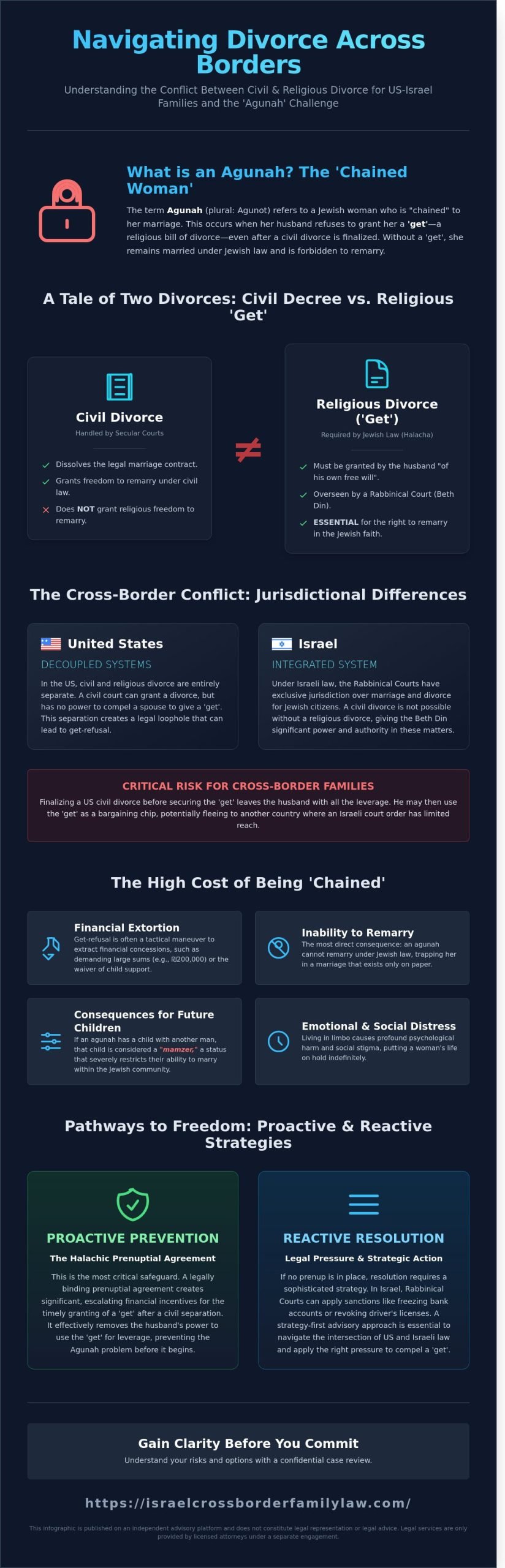
The term agunah refers to a woman who is “chained” to a marriage that has effectively ended but cannot be dissolved under religious law. This occurs when a husband refuses to grant a formal deed of divorce, known as a get. While a couple might obtain a civil divorce in a foreign jurisdiction, the State of Israel grants the Rabbinical Courts exclusive jurisdiction over the marriage and divorce of Jewish citizens and residents. Consequently, a woman remains an agunah if her husband withholds the get, leaving her unable to remarry or move forward with her life according to halacha. Defining the ‘Chained Woman’ in Jewish Law requires an understanding of this intersection between ancient religious requirements and modern legal realities.
To better understand the practical implications of this status and the public efforts to resolve such cases, watch this report on a high-profile instance of get-refusal:
Historically, the status of agunot applied primarily to women whose husbands disappeared during war or were lost at sea without witnesses. In 2026, the problem has shifted toward intentional get-refusal. Husbands may use the religious divorce as a strategic tool to extract financial concessions or influence child custody arrangements. The psychological impact is severe. An agunah often faces social stigma and the biological reality that she cannot have children with a new partner without facing grave religious consequences for those children.
The Role of the ‘Get’ in Jewish Divorce
A get is a specific document written by a scribe under the direction of a Beth Din (Rabbinical Court). For the divorce to be valid, the husband must deliver the document to his wife of his own free will. This requirement creates a significant legal hurdle. If a husband is coerced into giving the get through physical violence, the divorce may be considered a “get me’usah” (a forced divorce) and rendered void. If a woman remarries without a valid get, any children from the new relationship are considered “mamzerim,” a status that severely restricts their ability to marry within the Jewish community in the future.
Why Agunah Status Occurs in Modern Divorces
In contemporary Israel, get-refusal is frequently a tactical maneuver. A spouse might demand ₪200,000 or the waiver of future child support payments in exchange for the religious release. While a “chained” husband (known as an Ogen) can also exist, the legal consequences for women are traditionally more restrictive. Israeli Rabbinical Courts have the power to issue sanctions, such as freezing bank accounts or revoking driver’s licenses, but they cannot physically force the husband to speak the necessary words of consent. For international families, the complexity increases when one spouse flees the country, leaving the Israeli court with limited enforcement capabilities across borders.
Get clarity before you commit. Request a confidential consultation.
The Conflict Between Civil Divorce and the Religious Get
The legal landscape for Jewish divorce differs significantly between the United States and Israel. In the US, civil and religious divorce are decoupled; a person can be civilly divorced while remaining religiously married. However, under the 1953 Rabbinical Courts Jurisdiction Law in Israel, the Beth Din holds exclusive authority over the marriage and divorce of Jewish citizens and residents. This integration means that while civil family courts may handle property division or child custody, the actual dissolution of the marriage remains within the religious sphere. This structural overlap often leads to The Conflict Between Civil Divorce and the Religious Get, where the timing of legal filings determines the future freedom of both parties.
One of the primary risks for agunot involves finalizing a civil divorce before the religious get is secured. In cross-border cases, a spouse might obtain a civil decree in a foreign jurisdiction, only to find their partner refuses to cooperate with the Beth Din. This leaves the individual in a state of legal limbo, unable to remarry under Jewish law or have children who are recognized as legitimate in religious contexts. Strategic planning before filing any paperwork is essential to ensure both systems move in tandem. Early decisions regarding where to file for divorce can dictate whether a spouse retains leverage or becomes vulnerable to long term refusal.
Get Refusal as Domestic Abuse
Modern legal perspectives increasingly categorize get-refusal as a form of psychological or economic abuse. In Israel, the legal system has evolved to allow civil tort claims for damages caused by the withholding of a get. Since a landmark 2004 ruling, Israeli family courts have awarded plaintiffs compensatory sums ranging from ₪100,000 to over ₪500,000 for the emotional distress and loss of autonomy associated with being “chained.” In the US, the 1992 New York Get Law serves as a vital precedent, allowing civil judges to consider the removal of barriers to remarriage when distributing marital assets or determining maintenance.
The Beth Din’s Power to Sanction
The Rabbinical Court possesses a unique set of tools to encourage compliance, known as Harchakot De’rabbeinu Tam. These sanctions include social shaming, publishing the refuser’s name in public forums, and requesting the revocation of professional licenses or driver’s licenses. While these measures are effective within Israel, the Beth Din’s ability to enforce them internationally is limited by jurisdictional boundaries. Seeking clarity on jurisdiction before initiating proceedings is a critical step for international families to avoid the agunot trap.
Get clarity before you commit. Request a confidential consultation.
Cross-Border Challenges: When US and Israeli Laws Intersect
International families face a unique set of hurdles when a marriage ends. The legal friction between the United States civil system and the Israeli religious system often leads to strategic “forum shopping.” One spouse might prefer the US for its predictable equitable distribution of assets, while the other might seek the Israeli Rabbinical Court’s jurisdiction to leverage religious laws. This choice of venue has life-altering consequences for women at risk of becoming agunot. Decisions made in the first 48 hours of a dispute often dictate the legal landscape for years to come.
Jurisdictional Overlap in International Families
The “Race to the Court” is a critical factor in cross-border divorces. In Israel, the first court to receive a filing usually gains the authority to decide on related matters like alimony and property division. The Israeli Rabbinical Court often claims jurisdiction over any Jewish couple, even if they live in New York or London, provided one party is physically present in Israel. This can lead to a “stay of exit” order (tzav ikuv yetzia min ha’aretz), which prevents a spouse from leaving the country until the divorce is resolved. For an expat visiting family in Israel, a surprise filing can result in being stuck in the country for months. Understanding Divorce for International Families is essential to avoid these traps and protect your freedom of movement.
Custody disputes add another layer of complexity. While the Hague Convention on the Civil Aspects of International Child Abduction governs the return of children taken across borders, it doesn’t solve the religious “get” issue. A mother might win a Hague case in a US court, but find herself unable to remarry because the Israeli Rabbinical Court refuses to recognize the civil decree without a religious divorce. These conflicting orders create a legal limbo that is difficult to resolve without a coordinated strategy.
Enforcement of Rabbinical Decrees Abroad
US courts generally respect the First Amendment’s separation of church and state. This means a judge in New York typically won’t order a husband to give a “get” because it’s seen as a religious act. However, legal teams often use Strategies to Prevent Agunah Status by drafting civil contracts that include financial penalties for refusing a religious divorce. These penalties, sometimes reaching ₪1,800 per day or more, are often enforceable in civil courts as contractual obligations rather than religious mandates.
Coordinating a strategy between Tel Aviv and US cities requires a bicultural approach. Success depends on aligning the civil divorce timeline with the religious process. It’s about ensuring that a judgment in one country doesn’t inadvertently create a “chained” status in the other. Effective management requires a team that understands both the Israeli Rabbinical system and US civil procedure. Get clarity before you commit. Request a confidential consultation.
This article is published on an independent advisory platform and does not constitute an attorney-client relationship or legal advice. Legal services are only provided by licensed attorneys under a separate engagement.
Strategies to Prevent Agunah Status: Prenups and Legal Pressure
Preventing the status of agunot requires a proactive approach that integrates religious requirements with civil legal protections. In the current Israeli legal landscape, relying solely on the goodwill of a spouse is a high-risk strategy. Instead, international families and expats should utilize structured agreements to create clear, enforceable expectations before conflict arises. By addressing the religious divorce at the outset, couples can avoid the years of litigation that often accompany get-refusal.
The Power of the Halachic Prenup
The Halachic Prenuptial Agreement is the most effective mechanism for preventing get-refusal. This document establishes a financial framework where a spouse agrees to pay a daily support amount, typically ranging from ₪500 to ₪1,500, if they refuse to grant or accept a get after the marriage has effectively ended. These agreements don’t force a divorce; they create a financial incentive for the parties to resolve their religious status promptly. Most modern Rabbinical authorities and Israeli civil courts favor these documents because they provide clarity and reduce the likelihood of prolonged litigation. It’s best for young couples to sign these agreements before the wedding ceremony to ensure their future is protected from the start.
Tactical Use of Civil Courts to Compel Religious Cooperation
In cases where no prenup exists, civil courts provide alternative forms of pressure. Lawyers often draft settlement agreements where asset distribution or alimony payments are conditional upon the delivery of the get. For instance, a spouse might receive a larger share of liquid assets only after the religious divorce is finalized. Under the “Clean Hands” doctrine, Israeli civil judges may penalize a party who acts in bad faith by withholding a get while seeking financial relief from the court. This principle ensures that one cannot use religious law as a shield to behave unfairly in civil proceedings.
In cross-border situations, it’s essential to include specific “Get-Provisions” in any divorce settlement to ensure the decree is recognized in both jurisdictions. This strategy requires a deep understanding of how different legal systems interact. Without these protections, a person might find themselves civilly divorced in one country but still religiously bound in another. To avoid these complexities, it’s vital to have a clear roadmap before entering the legal process.
Managing the complexities of a cross-border divorce involves balancing religious traditions with civil mandates. Without a strategic plan, the risk of becoming an agunah increases significantly. Get clarity before you commit. Request a confidential case review to assess your strategy.
This article is published on an independent advisory platform, not a law firm. The information provided is for educational purposes and does not constitute legal representation or an attorney-client relationship. Legal services are only provided by licensed attorneys under a separate engagement.
Navigating Your Options: How an Advisory Approach Provides Clarity
Resolving a cross-border divorce requires more than just reactive legal filing; it demands a comprehensive strategy that prioritizes long-term freedom over short-term emotional victories. For those at risk of becoming agunot, the path to a resolution often depends on how well they understand the intersection of two distinct legal worlds. While US civil law focuses on equitable distribution and child best interests, Israeli religious law operates on a different set of principles regarding the marital bond. An advisory approach helps bridge this gap by identifying risks before they manifest as permanent legal barriers.
A strategic advisor analyzes the specific jurisdictional threats that could lead to a refusal of the Get. This involves assessing whether a case should be heard in a civil Family Court or the Rabbinical Court in Israel. Decisions made in the early stages carry heavy financial and personal weight. For instance, litigation costs in complex international cases frequently exceed ₪50,000 in the first year alone. Understanding these costs and the procedural risks associated with each court system allows you to move forward with confidence rather than fear.
The Importance of Strategy Before Filing
The first 30 days of a divorce process are often the most critical for potential agunot. Under Israel’s 2016 Law for the Resolution of Family Disputes, couples must generally undergo a mandatory 45-day “cooling off” or mediation period before litigation can begin. This window is a vital time to secure your legal standing. Filing in the wrong jurisdiction or making impulsive concessions during this period can inadvertently give a recalcitrant spouse leverage to withhold a religious divorce. You can learn more about how to structure this phase by reviewing the advisory process used to guide international families.
Common mistakes, such as failing to properly serve papers across borders or ignoring the implications of the Ketubah in Israeli court, lead to years of “chained” status. Avoiding these pitfalls requires a bird’s-eye view of both the American and Israeli systems. A strategy-first approach ensures that every civil move you make supports your eventual religious freedom.
Your Next Steps Toward Resolution
Finding a resolution starts with gathering an expert team that understands the bicultural nuances of your situation. You’ll need advisors who are fluent in the “Start-up Nation” legal environment and the traditional requirements of the Dayanim (judges). Start by organizing your essential documentation. This includes your original Ketubah (marriage contract), civil marriage licenses, and any previous agreements made in foreign jurisdictions. Having these records ready can save months of procedural delays in the Israeli court system.
You aren’t alone in this process. There are clear legal paths to freedom, provided you act with a clear plan. By focusing on risk-based decision-making rather than emotional escalation, you can protect your future and your family’s well-being.
Get clarity before you commit. Request a confidential consultation.
Securing Your Future in a Complex Jurisdictional Landscape
Navigating the intersection of civil divorce and Rabbinical law requires a calculated, strategic approach. The risk of becoming one of the many agunot trapped in a legal limbo is a reality for international families who fail to plan for the religious “get” process early. Success depends on understanding how US and Israeli courts interact, as well as the specific pressures available through the 1995 Rabbinical Courts Law regarding sanctions. Protecting your freedom isn’t about aggression; it’s about clarity. Whether you’re dealing with a recalcitrant spouse or simply want to ensure your cross-border divorce proceeds without a “chained woman” scenario, early intervention is vital.
Our advisory focus provides a steady hand through complex jurisdictional conflicts. We help you bridge the gap between two distinct legal systems using proven strategies like halakhic prenups and strategic legal pressure. You don’t have to face these multi-jurisdictional challenges alone. Professional guidance ensures you understand the risks before they become permanent obstacles. By focusing on a strategy-based advisory model, you can move toward a resolution that respects both your civil rights and religious obligations. Get clarity before you commit. Request a confidential consultation.
Taking the first step toward a clear strategy is the best way to regain control over your life and future.
This article is published on an independent advisory platform, not a law firm. The information provided is for educational purposes and does not constitute an attorney-client relationship. Legal services are only provided by licensed attorneys under a separate engagement.
Frequently Asked Questions
Can a woman be an agunah if she has a civil divorce?
Yes, a woman remains religiously “chained” if she holds a civil divorce decree but hasn’t received a religious Get. In Israel, the Rabbinical Court holds exclusive jurisdiction over the marriage and divorce of Jewish citizens and residents. According to 2023 data from the Rabbinical Courts, thousands of individuals are civilly divorced but cannot remarry within the Jewish faith because their religious marriage remains intact under Halacha.
Is it possible for a man to be ‘chained’ (an Ogen)?
Men can technically be “chained” if a wife refuses to accept the Get, though the legal and social consequences differ significantly. While the term agunot specifically refers to women, a man in this position is known as an “Ogen.” Under the Rabbinical Courts Jurisdiction Law of 1953, the court can apply sanctions against a recalcitrant wife. However, men may eventually seek a “Heter Meah Rabbanim,” which is a rare permission from 100 rabbis to remarry that isn’t available to women.
How long does it take for a Rabbinical court to declare someone an agunah?
There’s no fixed statutory timeframe, but courts typically wait between 12 and 24 months of active refusal before issuing a “compulsion” order. Every case depends on the specific circumstances and the evidence of recalcitrance presented to the Dayanim. In 2022, the average time to resolve complex cases involving divorce refusal was approximately 18 months. It’s vital to have a team on the ground to push the process forward through strategic filings.
Can the Israeli Rabbinical Court stop me from leaving the country (Stay of Exit)?
The Israeli Rabbinical Court has the legal authority to issue a Stay of Exit order (Tzav Ikur Yetzia Min Haaretz) to prevent a party from fleeing the jurisdiction. This is a common tool used in cross-border disputes to ensure a spouse doesn’t become unreachable during proceedings. Under Regulation 166 of the Dayanim Regulations, the court can issue this order quickly if there’s a genuine risk that the person will leave Israel to avoid their obligations.
Does a US prenuptial agreement work in the Israeli Beth Din?
A US prenuptial agreement isn’t automatically enforceable in Israel unless it meets the specific requirements of the Israeli Financial Relations Act of 1973. For an agreement to be valid, it must be formally approved by an Israeli Family Court or Rabbinical Court. Many international families use bicultural attorneys to ensure their documents bridge the gap between the two legal systems. You shouldn’t assume a foreign document will protect you without a formal review by an expert in the Israeli marketplace.
What happens if my husband lives in the US and I am in Israel (or vice versa)?
Cross-border cases require the Israeli court to establish jurisdiction, which it can often do if the petitioner is a resident of Israel. The 2018 “Agunot Law” expanded the Rabbinical Court’s global reach, allowing it to hear cases even if the marriage and primary residence were abroad. Managing these multi-jurisdictional complexities requires a sophisticated strategy to serve legal papers and enforce Israeli rulings in foreign territories like the US or Europe.
Can I get a get if I don’t know where my husband is?
Obtaining a Get when a husband’s whereabouts are unknown is a complex legal challenge that requires the court to declare him “missing.” This is the classical definition of agunot, where the woman is stuck because the husband cannot be found to deliver the divorce. The court will initiate an investigation process, often involving private investigators and international agencies. In 2026, modern technology and international cooperation make it easier to track individuals, but the religious requirements for a Get remain strict.
What are the financial costs involved in resolving an agunah case?
Legal fees for a complex case involving international litigation can range from ₪35,000 to over ₪150,000 depending on the level of conflict. These costs include court filing fees, which are approximately ₪600, along with expenses for private investigators, expert witnesses, and document translations. It’s important to get clarity on these costs before you commit to a specific legal path. Strategic planning early in the process can often prevent the financial drain of a protracted multi-year battle.
Get clarity before you commit. Request a confidential consultation.
For more information on navigating the Israeli legal system, visit: https://www.youtube.com/@IsraelFamilyLaw

Article by
Gabriel Lior
A Personal Journey That Became a Mission
The advisory was founded by an American father Gabriel Lior, LLB, MBA , global entrepreneur, and cross-border advisor who spent more than a decade navigating the Israeli family court system firsthand and now lives in Singapore with his son.
As a divorced parent in a cross-border family, Gabriel faced nearly every legal challenge a foreign parent can encounter in Israel — including child custody disputes, child support proceedings, property matters in Israel and abroad, false accusations, and complex immigration and relocation proceedings.
Over the years, he learned the hard way how difficult it is for non-Israeli parents to understand the system, identify the right legal strategy, and choose the right legal representation — especially when language, culture, and jurisdictional differences are involved. He also witnessed how foreign parents and new immigrants are often disadvantaged or taken advantage of by service providers and institutions simply because they lack local knowledge or fluency.
From Client to Advisor
To truly understand — and survive — the system, Gabriel pursued formal legal education in Israel, completing two Israeli law degrees, alongside a BA and MBA earned in the United States. This was never about becoming a practicing attorney, but about gaining a deep, structural understanding of how the system works — and where it breaks down for foreign parents.
This rare combination of:
Firsthand client experience
Israeli legal and US business education
International business and negotiation training
Decades of commercial execution
created a unique perspective – one that understands both sides of the table.
After years of litigation, persistence, and at times self-representation, he ultimately succeeded in securing custody of his son and relocating abroad through a rare legal victory in the Israeli Supreme Court — becoming one of the first fathers in Israel to do so under these circumstances.
Disclaimer
Important Disclaimer:
The information provided on this website and in its content is for general informational and educational purposes only and does not constitute legal advice, legal opinion, or legal representation.
Gabriel Lior is not licensed to practice law in Israel (nor is he interested in doing so) and does not provide legal services, despite having completed 2 Law Degrees. The services offered are advisory in nature and are intended to provide general guidance, strategic insight, and information regarding cross-border family law considerations.
No attorney-client relationship is formed by accessing this website, reading its content, or communicating with us.
Any decisions made based on this information are at your own discretion and risk. For legal advice specific to your situation, you should consult a licensed attorney in the relevant jurisdiction.
Where appropriate, we may refer clients to independent, licensed attorneys or professionals. Such referrals do not constitute legal representation and no liability is assumed for services provided by third parties.