For an Israeli family, the most challenging part of international surrogacy isn’t the medical procedure abroad, but the legal bridge back to Israel. You’ve likely spent months researching clinics and jurisdictions, yet the fear of being stuck at a border without an Israeli passport for your newborn remains a heavy burden. It’s natural to feel overwhelmed by how international surrogacy laws Israel intersect with foreign regulations, especially when your family’s future is at stake.
This guide provides a clear roadmap to help you navigate these complexities, ensuring your child’s legal status and citizenship are protected before you commit financially. We will examine the mandatory DNA testing requirements, the specific risks associated with different jurisdictions, and the 2026 legal framework for establishing parentage in the Israeli Family Court. By understanding the path ahead, you can move forward with the security that your parental rights are recognized under both systems.
Please note that this content is published on an independent advisory platform and does not constitute a law firm or formal legal representation. The following information is provided for educational and strategic purposes to help international families make informed decisions. For a deeper look at these topics, you may also find our videos on the IsraelFamilyLaw YouTube channel helpful.
Key Takeaways
- Understand the foundational requirements of the Embryo Carrying Agreements Law, including the mandatory genetic link between at least one parent and the child.
- Learn how international surrogacy laws Israel impact your journey, specifically regarding the 2022 High Court ruling that expanded access for same-sex couples and single men.
- Discover the essential legal steps for returning home, such as the mandatory DNA testing process and obtaining a Declaratory Judgment of Paternity in Israeli courts.
- Gain practical insights into vetting international agencies and securing necessary travel documents like “Exit Permits” to ensure your newborn’s safe entry into Israel.
- Identify the critical decision points where strategic advisory can help mitigate cross-border risks before you make significant financial commitments.
Understanding the Landscape of International Surrogacy Laws in Israel
Israel’s approach to surrogacy is governed by the Embryo Carrying Agreements (Agreement Approval and Status of the Newborn) Law, 5756-1996. This legislation established Israel as one of the first nations to implement a comprehensive, state-supervised framework. While the law focuses on domestic arrangements, its principles deeply influence how authorities view international surrogacy. Because legal systems vary significantly across surrogacy laws by country, the Israeli government maintains a high level of oversight to ensure the child’s welfare and the parents’ legal standing are protected.
To better understand how these laws have evolved to become more inclusive, watch this report on recent legislative changes:
Central to the Israeli model is the requirement for a genetic link between at least one intended parent and the child. This ensures a biological foundation for parenthood that the state recognizes. Oversight is managed by the National Supervisor for the Carriage of Fetuses and the state-appointed Agreement Approval Committee. This committee evaluates every domestic contract to ensure it remains altruistic. While intended parents compensate surrogates for lost time, medical costs, and effort, the law prohibits “for-profit” agencies from operating within Israeli borders. This distinction is vital when comparing domestic options to the international surrogacy laws Israel residents must navigate when looking abroad.
The Legal Basis for Surrogacy in Israel
The 1996 law has undergone significant evolution, most notably in January 2022, when the High Court of Justice expanded access to same-sex couples and single men. By 2026, the system has matured into a highly regulated environment where the “Agreement Approval” stage serves as the ultimate safeguard. This process involves a multidisciplinary team of medical, psychological, and legal experts who vet every participant. This rigorous domestic standard is why Israeli authorities apply such intense scrutiny to international arrangements, seeking to ensure that cross-border journeys do not bypass ethical or legal protections.
Domestic vs. International: A Crucial Distinction
The distinction between domestic and international surrogacy is legally profound. When a child is born via surrogacy within Israel, the legal status is established through a streamlined administrative process. However, for cross-border families, the “Status of the Newborn” is not automatic. Israel does not recognize foreign parental orders at face value. Families must navigate family court proceedings to obtain a Declaratory Judgment of Paternity. This gap between foreign birth certificates and Israeli recognition is where the most significant legal risks reside, particularly regarding citizenship and the child’s right to enter the country.
This content is published on an independent advisory platform and does not constitute a law firm or formal legal representation. For information on how our strategic guidance helps families manage these risks, you can learn more about how it works.
The “Israeli Model” vs. Overseas Surrogacy: Key Legal Differences
Israeli surrogacy is defined by a centralized, state-managed system. While Israel’s Embryo Carrying Agreements Law provides a clear path for residents, the criteria for surrogates are significantly more rigid than in many international hubs. For instance, an Israeli surrogate must be between 22 and 39 years old, have given birth to her own child, and generally share the same religion as the intended mother. These religious and medical constraints, coupled with a limited pool of candidates, often lead to domestic wait times that can exceed two years.
Families frequently look abroad to avoid these delays or to access jurisdictions with different regulatory standards. However, the intersection of international surrogacy laws Israel and foreign jurisdictions creates a complex legal landscape. The Israeli Ministry of Justice has issued specific warnings regarding emerging hubs. Recent notices have highlighted surrogacy in Albania and Kenya, citing concerns over local legal stability and the potential for administrative hurdles. Similar warnings remain in place for Ukraine due to the ongoing conflict and its impact on the safety of the process.
Expansion of Eligibility: Who Can Apply?
The landscape shifted dramatically following the January 2022 High Court of Justice ruling. This landmark decision removed previous barriers, allowing same-sex couples and single men to access domestic surrogacy on equal footing with heterosexual couples. To qualify, at least one intended parent must be an Israeli resident and demonstrate a medical necessity for the procedure. While this inclusivity has increased domestic demand, many still find the Israeli system restrictive due to the Approval Committee’s deep involvement in personal psychological and financial vetting.
International Hubs and Israeli Oversight
When families venture to the USA, Canada, or Georgia, they enter legal territories where surrogacy is often governed by entirely different “public policy” standards. Israel maintains a strict stance on these arrangements; it doesn’t automatically recognize a child born abroad as an Israeli citizen. The Ministry of Justice evaluates these cases through the lens of Israeli public policy, which prioritizes the protection of the surrogate and the biological link to the parent. If you are weighing the benefits of domestic versus international options, it’s essential to request a confidential strategic review to understand how these global shifts affect your specific situation.
This content is published on an independent advisory platform and provides strategic guidance rather than formal legal representation. Establishing a clear plan before signing an international contract is the only way to mitigate the risk of legal limbo. Differences between legal systems can lead to significant delays if the proper documentation isn’t prepared well in advance of the birth.
Navigating the Legal Minefield of Parenthood Recognition and Citizenship
Establishing parenthood after an overseas birth is the most critical hurdle for families. While the child may have a foreign birth certificate, Israel does not automatically recognize this document as proof of a legal relationship. This creates a period of legal uncertainty that can complicate your return. To resolve this, families must engage with the Israeli court system immediately following the birth to bridge the gap between foreign and domestic law.
Establishing the Genetic Link
Israel requires a high standard of proof for biological parenthood. The Family Court must issue an order for tissue classification, commonly known as a DNA test. This test is mandatory under international surrogacy laws Israel and must be conducted at an accredited Israeli laboratory. You can’t use a private kit or a local foreign lab for this purpose. Once the results confirm the biological link, the court issues a Declaratory Judgment of Paternity. Only then can the Israeli consulate process the child’s registration and issue an Israeli passport. Families often face delays of several weeks or months at consulates while waiting for these court orders. Planning for an extended stay abroad is a practical necessity.
For US-Israel dual citizens, a specific conflict of laws often arises. The US government may issue a Consular Report of Birth Abroad (CRBA) based on the local birth certificate, granting the child a US passport. However, an Israeli parent is legally obligated to enter Israel with their child on an Israeli travel document. Attempting to enter on a foreign passport to bypass the DNA requirement can lead to significant complications with the Ministry of Interior. This state of “legal liminality” means your child could be a US citizen but remain “unrecognized” in the eyes of the Israeli state. This affects their access to healthcare and future residency rights. Families of expats and foreign nationals must be particularly careful to align these two legal systems.
Recognition of the Non-Biological Parent
For the non-genetic parent, the path to recognition involves a “Parental Order” or a formal adoption process. The Israeli legal system has become more efficient in granting these orders, particularly for married couples, but it’s not an automatic right. Unmarried couples or those in jurisdictions with less robust documentation may face additional scrutiny. Recent precedents have allowed for more streamlined applications, but the final order is only granted after the child is born and the genetic link of the first parent is confirmed. Seeking clarity on these requirements before you commit to a specific jurisdiction is essential.
This content is published on an independent advisory platform and is intended for informational purposes. It does not constitute legal representation or formal legal advice. Understanding these procedural weights early in your journey is vital for a secure transition for your family.
Strategic Planning for Cross-Border Surrogacy: Due Diligence and Compliance
Success in a cross-border journey depends on meticulous due diligence long before the medical phase begins. While the clinical aspects are often the primary focus for intended parents, the operational and legal framework determines whether you can actually bring your child home. Navigating international surrogacy laws Israel requires a proactive approach to compliance, ensuring that every document and contract aligns with the expectations of the Israeli Family Court and the Ministry of Interior.
One of the most significant risks in international arrangements is the potential for human trafficking allegations. To mitigate this, families must ensure that all payments to the surrogate are transparent, documented, and compliant with both local and international labor standards. Failure to provide a clear financial trail can lead to delays in the court’s recognition of the process. It’s essential to establish a robust legal paper trail that proves the arrangement was ethical and consensual from the outset.
Vetting International Jurisdictions
The regulatory landscape is constantly shifting. For example, while countries like Albania and Kenya emerged as popular hubs, the Ministry of Justice issued specific cautionary notices throughout 2024 and 2025 regarding the stability of their local surrogacy frameworks. When vetting a jurisdiction, you should investigate:
- The surrogate’s legal right to withdraw consent after birth, which varies significantly between the US, Georgia, and emerging markets.
- Local requirements for “Exit Permits” and how they interact with the Israeli consulate’s timeline for issuing travel documents.
- The availability of apostilled birth records, which are mandatory for any filing in an Israeli court.
The Role of an International Family Law Advisor
An independent advisor serves as a bridge between your foreign clinic and the Israeli legal system. This role is distinct from that of the clinic’s lawyer; an advisor ensures that the foreign contract doesn’t contain clauses that contradict Israeli public policy. They oversee the complex process of getting documents properly translated and apostilled, which is a frequent cause of administrative delays. Because early decisions carry so much weight, you should request a confidential consultation before signing any foreign agreements.
This content is published on an independent advisory platform and provides strategic guidance rather than formal legal representation. To understand the depth of our experience in these matters, you can read more about the advisory. Taking the time to build a compliant strategy today prevents the “legal liminality” that can leave families stranded abroad for months while waiting for the proper exit documentation.
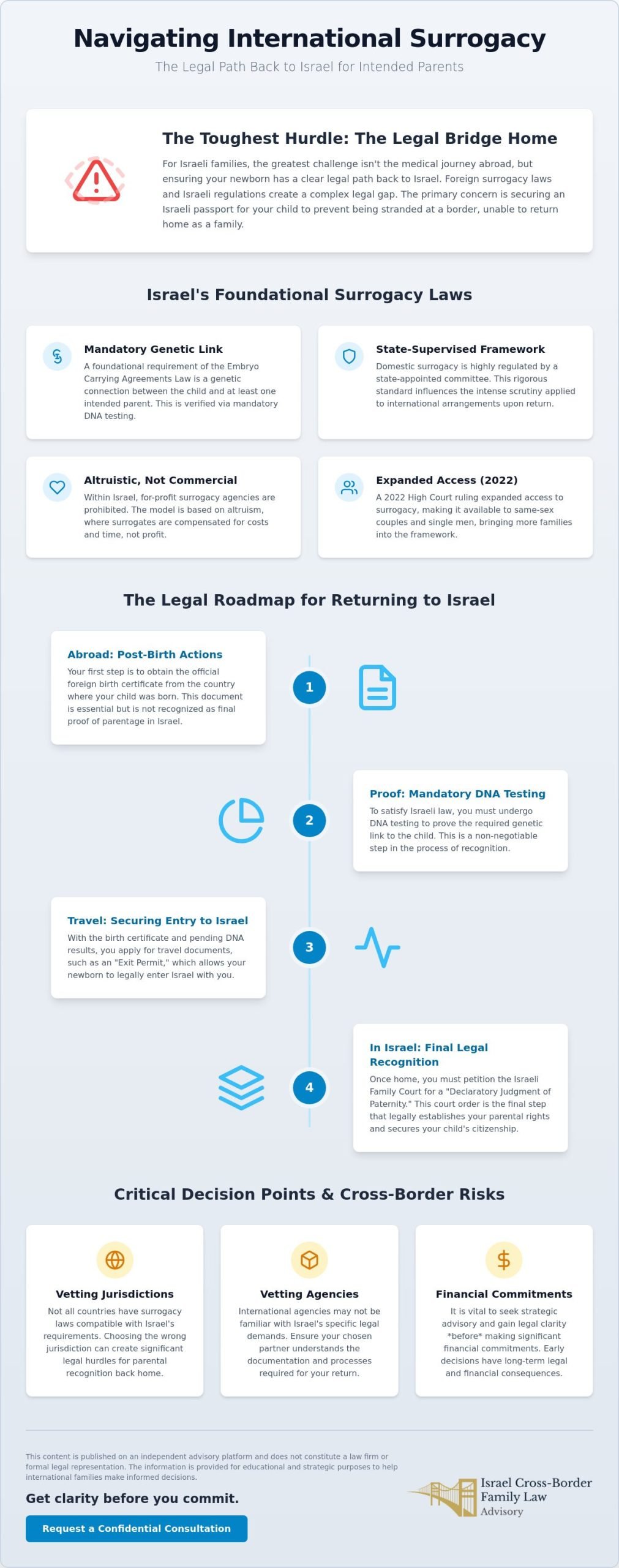
Seeking Clarity: Professional Guidance for Your International Surrogacy Journey
The journey to parenthood across borders is undeniably complex. While medical technology makes the process possible, it’s the legal architecture that makes your family permanent in the eyes of the state. Every decision made in the early stages of a surrogacy arrangement carries significant weight. Decisions made during the contract phase or jurisdiction selection can lead to months of delay in bringing a child home. Understanding international surrogacy laws Israel is not just a matter of compliance; it’s about providing your child with a secure legal foundation from day one.
For families living between two cultures or legal systems, the pressure to “get it right” is immense. The Israeli system is rigorous and centralized, which can be intimidating for those used to more decentralized or commercial models found in other countries. Seeking professional guidance allows you to move from a place of uncertainty to a position of informed confidence. By addressing the legal hurdles before they become crises, you can focus on the most important part of this process: preparing for the arrival of your child.
The Importance of a Cross-Border Strategy
Standard contracts provided by international clinics are designed to protect the clinic and the surrogate under local laws. They rarely account for the specific requirements of the Israeli Family Court or the Ministry of Interior. A tailored cross-border strategy ensures your documentation meets the high evidentiary standards required for paternity judgments and citizenship applications. This proactive planning helps families avoid complications related to international treaties, such as the Hague Convention, which can arise if custody or residency is challenged. You can learn how we support expats and foreign nationals in aligning these divergent legal systems.
Next Steps for Intended Parents
If you feel overwhelmed by the technical requirements or the conflicting advice from various agencies, the best path forward is to seek clarity through a structured review. An independent advisor acts as your advocate. They vet the legal risks of your chosen jurisdiction without the commercial bias of a surrogacy agency. For more educational resources on these topics, we invite you to explore the IsraelFamilyLaw YouTube channel. This platform provides a wealth of information for families navigating the intersection of Israeli and international family law.
This content is published on an independent advisory platform and is intended for informational and educational purposes only. It doesn’t constitute legal representation or a formal attorney-client relationship. Legal services are only provided by licensed attorneys under a separate, signed engagement agreement.
Get clarity before you commit. Request a confidential consultation.
Securing Your Family’s Legal Future
The path to parenthood through international surrogacy requires more than medical success; it demands a rigorous legal strategy to bridge the gap between foreign birth and Israeli recognition. Successfully navigating international surrogacy laws Israel residents face involves establishing a genetic link through court-ordered DNA testing and obtaining a Declaratory Judgment of Paternity. These steps are essential to protect your child’s citizenship and ensure their right to an Israeli passport.
We provide authoritative guidance tailored for expats and international families, leveraging specialized expertise in US-Israel cross-border family law. Our advisory features licensed practitioners in both jurisdictions who understand the multi-jurisdictional complexity of these cases. By conducting due diligence before you commit to an overseas clinic, you can avoid the risks of legal liminality and administrative delays. This platform provides independent advisory services and strategy rather than formal legal representation. Legal services are only provided by licensed attorneys under a separate engagement.
Get clarity before you commit. Request a confidential consultation to discuss your family’s journey. Your future deserves the security of a well-planned legal roadmap.
Frequently Asked Questions
Is international surrogacy legal for Israeli citizens in 2026?
International surrogacy is legal for Israeli citizens, but the state doesn’t automatically recognize parenthood established abroad. While you can sign contracts in other countries, the international surrogacy laws Israel enforces require you to prove a biological link through the Israeli Family Court system. You shouldn’t assume a foreign birth certificate is sufficient for entry. Seeking strategic advice before signing foreign agreements is the best way to prevent legal delays.
How do I get an Israeli passport for a baby born via surrogacy abroad?
You must obtain a Declaratory Judgment of Paternity from an Israeli Family Court before the consulate issues a passport. This process involves filing a petition after the birth and completing a court-ordered DNA test. Once the court confirms the genetic link, the Ministry of Interior updates the population registry. Only then can your child receive an Israeli travel document to enter the country legally.
Can same-sex couples pursue surrogacy in Israel?
Yes, same-sex couples and single men have had full legal access to surrogacy in Israel since a landmark High Court ruling in January 2022. This change ensured that all family structures are treated equally under the Embryo Carrying Agreements Law. While domestic options are available, many same-sex families still look abroad due to the limited number of Israeli surrogates and strict religious requirements in the local system.
What happens if there is no genetic link to either parent?
Israeli law doesn’t currently recognize parenthood through surrogacy if there’s no genetic link to at least one intended parent. The legal framework is built on the principle of biological connection. If neither parent is genetically related to the child, you’ll likely face significant hurdles in establishing citizenship or residency for the newborn. It’s critical to verify these requirements before selecting an embryo or a donor.
Do I need a DNA test for my baby born via surrogacy in the US?
Yes, a DNA test is mandatory for children born via surrogacy in the United States if you want them recognized as Israeli citizens. Even if you have a US court order or a birth certificate naming you as the parents, the Israeli authorities require a tissue classification test. This test must be performed at a lab approved by the Israeli Ministry of Health to satisfy the court’s evidentiary standards.
What are the risks of surrogacy in countries like Albania or Kenya for Israelis?
The primary risks include legal instability and administrative delays that can leave your child in legal liminality. The Ministry of Justice has issued specific cautionary notices for jurisdictions like Albania and Kenya due to evolving international surrogacy laws Israel residents must navigate. These countries may lack the established legal precedents found in the US, making the return process more unpredictable and potentially more complex for families.
How long does the legal process take to bring a baby home to Israel?
The legal process typically takes between four and eight weeks after the child is born, though timelines vary based on court efficiency. You must account for the time needed to conduct the DNA test, receive results, and obtain the court’s judgment. Planning for an extended stay in the birth country is a practical necessity to ensure all travel documents are properly issued by the Israeli consulate.
Can a US prenuptial agreement impact my surrogacy rights in Israel?
A US prenuptial agreement can influence how an Israeli court views parental intent and financial obligations in the event of a dispute. Israeli family courts often look at the totality of the circumstances, and foreign agreements are part of that record. It’s essential to ensure your cross-border documents are drafted with both legal systems in mind to avoid contradictions that could complicate your journey or future custody rights.
This FAQ is published on an independent advisory platform and provides strategic guidance rather than formal legal representation. For more educational resources, visit the IsraelFamilyLaw YouTube channel. Get clarity before you commit. Request a confidential consultation.

Article by
Gabriel Lior
A Personal Journey That Became a Mission
The advisory was founded by an American father Gabriel Lior, LLB, MBA , global entrepreneur, and cross-border advisor who spent more than a decade navigating the Israeli family court system firsthand and now lives in Singapore with his son.
As a divorced parent in a cross-border family, Gabriel faced nearly every legal challenge a foreign parent can encounter in Israel — including child custody disputes, child support proceedings, property matters in Israel and abroad, false accusations, and complex immigration and relocation proceedings.
Over the years, he learned the hard way how difficult it is for non-Israeli parents to understand the system, identify the right legal strategy, and choose the right legal representation — especially when language, culture, and jurisdictional differences are involved. He also witnessed how foreign parents and new immigrants are often disadvantaged or taken advantage of by service providers and institutions simply because they lack local knowledge or fluency.
From Client to Advisor
To truly understand — and survive — the system, Gabriel pursued formal legal education in Israel, completing two Israeli law degrees, alongside a BA and MBA earned in the United States. This was never about becoming a practicing attorney, but about gaining a deep, structural understanding of how the system works — and where it breaks down for foreign parents.
This rare combination of:
Firsthand client experience
Israeli legal and US business education
International business and negotiation training
Decades of commercial execution
created a unique perspective – one that understands both sides of the table.
After years of litigation, persistence, and at times self-representation, he ultimately succeeded in securing custody of his son and relocating abroad through a rare legal victory in the Israeli Supreme Court — becoming one of the first fathers in Israel to do so under these circumstances.
Disclaimer
Important Disclaimer:
The information provided on this website and in its content is for general informational and educational purposes only and does not constitute legal advice, legal opinion, or legal representation.
Gabriel Lior is not licensed to practice law in Israel (nor is he interested in doing so) and does not provide legal services, despite having completed 2 Law Degrees. The services offered are advisory in nature and are intended to provide general guidance, strategic insight, and information regarding cross-border family law considerations.
No attorney-client relationship is formed by accessing this website, reading its content, or communicating with us.
Any decisions made based on this information are at your own discretion and risk. For legal advice specific to your situation, you should consult a licensed attorney in the relevant jurisdiction.
Where appropriate, we may refer clients to independent, licensed attorneys or professionals. Such referrals do not constitute legal representation and no liability is assumed for services provided by third parties.