Did you know that nearly half of all millennials entering marriage today choose to secure their financial future before saying “I do”? In Israel, where over 40% of marriages dissolve within the first seven years, the decision to sign a prenuptial agreement israel is no longer just a trend for the wealthy; it’s a strategic necessity for international couples. You likely feel that your cross-border life is already complicated enough without worrying about how two different legal systems might treat your family inheritance or pre-marital property. It’s natural to feel anxious when the laws of your home country clash with the Israeli Spouses’ Property Relations Law of 1973.
This guide will clarify how to bridge the gap between US and Israeli jurisdictions to ensure your assets remain protected regardless of where life takes you. We’ll explore the mandatory validation process in the Israeli Family Court, the risks of relying on foreign contracts, and how to safeguard family gifts from being shared in a future dispute. This information is published on an independent advisory platform to help you understand the strategy and risks involved in cross-border family planning. It’s intended for educational purposes rather than as formal legal representation.
Key Takeaways
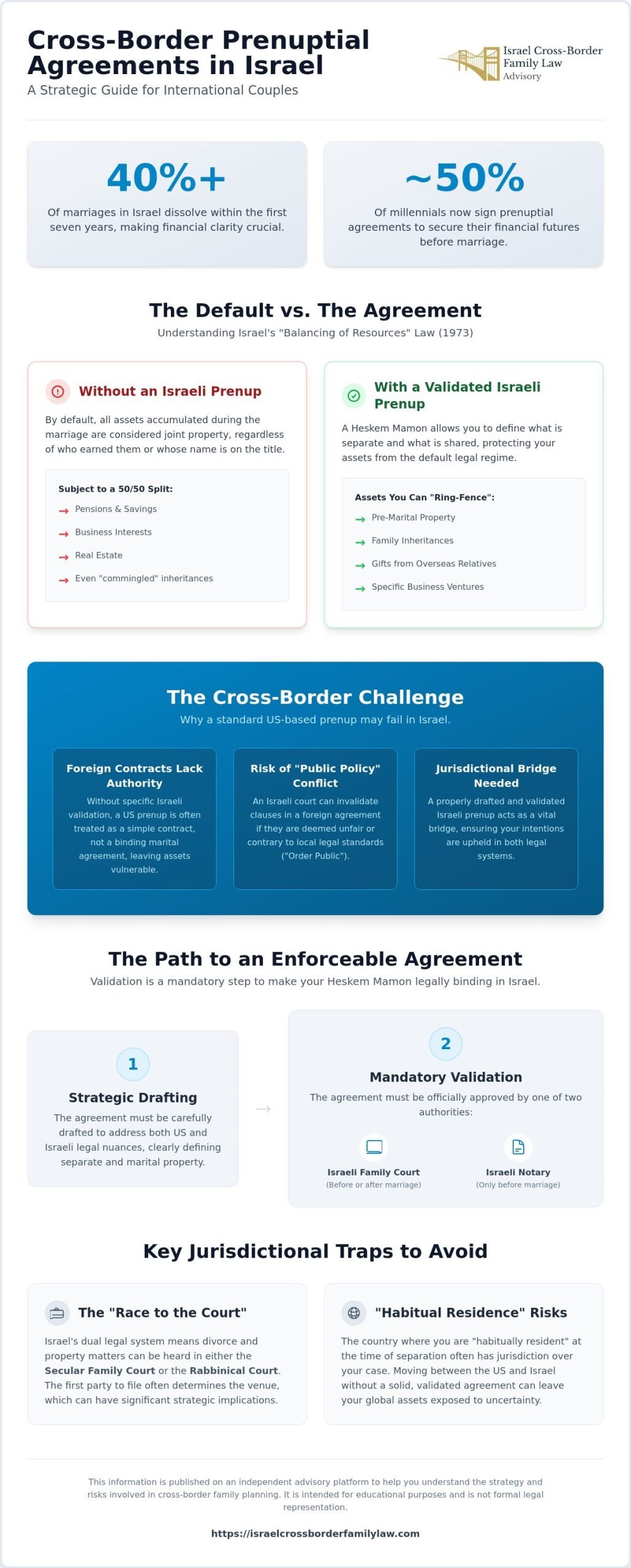
- Understand how the Spouses’ Property Relations Law of 1973 creates a default “balancing of resources” that may not align with your financial goals without a specific contract.
- Discover why a standard US-based contract may not be sufficient and how a properly drafted prenuptial agreement israel serves as a vital jurisdictional bridge.
- Learn strategic methods to ring-fence family inheritances, business interests, and gifts from overseas relatives to ensure they remain separate property.
- Navigate the mandatory validation process through an Israeli Family Court judge or notary to ensure your agreement is legally binding and enforceable.
- Identify the jurisdictional traps of “habitual residence” that could leave your global assets vulnerable if you move between countries.
Understanding the Israeli Prenuptial Agreement: The Heskem Mamon
In Israel, a prenuptial agreement is formally known as a Heskem Mamon. While many English speakers use the term “prenup” interchangeably with the Israeli version, the legal reality is quite different. A prenuptial agreement israel is a specific financial contract designed to override the default property regime established by the state. Without this document, the law dictates how your assets are handled, regardless of what you and your partner might have verbally agreed upon during your engagement.
The primary principle governing marital property is known as the “Balancing of Resources.” This concept assumes that any assets accumulated by either spouse during the marriage belong to both parties equally. This includes pensions, business interests, and real estate, even if only one name appears on the title. For international families with assets in multiple countries, this default 50/50 split can create significant financial exposure. A properly drafted prenuptial agreement israel serves as a strategic shield against these default rules.
The Legal Framework of the Financial Relations Law
The Financial Relations Law of 1973 is the governing statute for spousal property in Israel. Under this law, assets owned before the marriage are technically separate. However, the line between “pre-marital” and “marital” property often blurs over time. If you use an inheritance to pay off a mortgage on a family home or deposit personal funds into a joint account, those assets may become “commingled.” Israeli courts often view such actions as an intention to share the asset, making it subject to division. A well-structured agreement creates a clear boundary that prevents this automatic balancing from applying to your protected wealth.
Secular vs. Religious Court Oversight
Israel operates under a dual legal system that can be confusing for those from the US or UK. Divorce and property matters can be heard in either the secular Family Court or the Rabbinical Court. This creates a situation often described as a “race to the court,” where the first party to file determines which system will oversee the case. While the secular court follows civil law, the Rabbinical Court applies religious principles to certain aspects of the separation.
Understanding the Jewish prenuptial agreement is essential for couples marrying within this system. While the religious court primarily manages the granting of the divorce decree, it can also rule on property if the issue is “attached” to the divorce claim. Seeking clarity on these jurisdictional overlaps before committing to a marriage path is vital. This content is published on an independent advisory platform, not a law firm, and focuses on strategy and risk mitigation rather than an attorney-client relationship.
The Cross-Border Challenge: Why US Prenups May Fail in Israel
Many couples believe that a prenuptial agreement signed in New York, Florida, or California will automatically protect them if they move to Israel. This is a risky assumption. While Israel may recognize foreign contracts in a general sense, a prenuptial agreement israel requires specific judicial validation to carry full legal weight under the 1973 Financial Relations Law. Without this formal approval, your foreign agreement may be treated as a simple contract rather than a binding marital document. This leaves your assets vulnerable to being divided according to local defaults during a dispute.
Differences in legal standards often cause friction between the two systems. US states typically require full financial disclosure and independent counsel for both parties. While these are excellent practices, an Israeli court might find certain clauses in a US document contrary to “Order Public,” which is the local standard for public policy. If a clause is seen as extremely one-sided or if it attempts to waive rights that are protected under Israeli law, a judge might refuse to enforce it. Understanding the Jewish perspective on prenuptial agreements helps clarify why certain cultural and religious expectations are woven into the local legal fabric. Developing a strategy for a prenuptial agreement israel involves more than just translating a document; it requires ensuring the logic of the contract holds up in a different legal culture.
Enforceability of Foreign Agreements in Israeli Courts
Section 2 of the Financial Relations Law mandates that any marital property agreement must be approved by a judge or a notary. This rule applies even if the contract was signed abroad. Many expats discover too late that their foreign prenup lacks this specific stamp of approval, making it difficult to enforce in a local family court. This platform provides specific guidance for expats and foreign nationals who need to bridge the gap between their home country’s laws and the requirements in Israel. This content is published on an independent advisory platform and focuses on strategy and decision-making guidance rather than an attorney-client relationship.
Habitual Residence and Jurisdictional Clauses
The “center of life” test is a critical factor in cross-border cases. If a couple moves from the US to Israel and establishes their life here, an Israeli court may claim jurisdiction over their divorce. Even if your agreement states that “New York law applies,” an Israeli judge might still apply local principles to assets located within Israel. This creates the risk of expensive multi-jurisdictional litigation. To avoid this, many couples choose to draft “mirror agreements” that meet the validation requirements of both countries. Taking the time to discuss your specific situation can help you identify these jurisdictional traps before they become a problem.
Strategic Asset Protection: Inheritance, Gifts, and Business Interests
Strategic asset protection is often the primary driver for couples seeking a prenuptial agreement israel. When your financial life spans two countries, the legal lines between personal property and shared marital assets can become blurred. This complexity is particularly evident when dealing with assets that aren’t earned through daily labor, such as family gifts, future inheritances, or equity in a foreign business. Without a clear strategy, these assets may inadvertently fall into the “balancing of resources” pool described in earlier sections.
One of the most frequent mistakes international couples make is commingling separate assets with joint funds. If you receive a gift from US-based relatives and deposit it into a joint Israeli account to cover living expenses, you may be unintentionally signaling an “intent to share” that asset. Over time, even property held in your name alone can be viewed as marital property if joint funds were used for its maintenance or improvement. A well-drafted agreement provides the necessary clarity to prevent this outcome.
Inheritance and Parental Gifts from Abroad
Israeli law generally views inherited property as separate. However, there is a significant exception regarding the family home. If a couple lives in an apartment purchased with one spouse’s inheritance, the court may eventually rule that the property has become a joint asset due to the shared life lived within its walls. To keep foreign gifts truly separate, you must maintain a clear paper trail and include specific language in your contract that overrides these common law assumptions. For more practical examples on safeguarding family wealth, you can view the educational resources available on the Israel Family Law YouTube channel.
Cross-Border Business and Corporate Interests
For entrepreneurs and tech professionals, protecting business interests is a top priority. Whether you hold equity in an Israeli startup or a US-based LLC, valuing these interests during a divorce is a complex and expensive process. A prenuptial agreement israel allows you to define exactly how business growth, intellectual property, and future dividends will be handled. This prevents a situation where a spouse might claim a portion of the company’s increased value during the marriage. Business owners should also consider how these personal agreements interact with corporate structures by reviewing our US-Israel M&A guide.
This information is published on an independent advisory platform and focuses on strategy, risks, and decision-making guidance rather than an attorney-client relationship. It’s essential to recognize that a prenup is often just the first step in a comprehensive international estate plan. Aligning your agreement with your long-term goals ensures that your family’s legacy remains protected across borders.
Validation Procedures: Making Your Agreement Legally Binding
In many jurisdictions, a prenuptial agreement is considered valid the moment it’s signed and notarized. In Israel, however, a prenuptial agreement israel is not legally binding until it has been formally approved by a judicial authority or a licensed notary. This validation is a critical procedural step. Without it, the document is often treated as a mere statement of intent rather than an enforceable contract. This content is published on an independent advisory platform and focuses on strategy and risk mitigation rather than an attorney-client relationship.
The law requires this extra layer of oversight to protect both parties. The validating official has a legal duty to ensure that you and your spouse have entered into the agreement of your own free will, fully understanding the consequences of the clauses you’ve signed. This is especially important for international couples who may be dealing with complex financial arrangements across multiple countries. The goal is to prevent coercion and ensure that the “informed consent” standard is met before the marriage begins.
The Judicial Approval Process
A judge in the Family Court or a certified notary must personally interview both parties. They’ll often ask questions to verify that the agreement wasn’t signed under duress and that both individuals understand they are opting out of the default “balancing of resources” regime. If you’re intending to marry, follow this sequence to ensure your prenuptial agreement israel is recognized:
- Finalize the draft with a focus on cross-border asset protection and jurisdictional clarity.
- File a formal request for approval with the Family Court or schedule an appointment with a qualified notary.
- Attend the validation session in person, where the official will review the document with you.
- Confirm your understanding and voluntary consent during the judicial interview.
- Obtain the official court stamp or notarial certificate, which grants the agreement the status of a court judgment.
Post-nuptial Agreements in Israel
If you’re already married and didn’t sign an agreement beforehand, you can still create a post-nuptial agreement. However, the legal process shifts. Once the marriage has commenced, only the Family Court or a Rabbinical Court has the authority to validate the document; a notary can no longer do so. The court may scrutinize these agreements more closely, especially if there has been a significant change in circumstances or the acquisition of new international assets. Understanding the costs involved is a key part of the planning process, and you can find more information on pricing transparency for these advisory services on our platform.
For those currently living in the US but planning a future in Israel, it’s possible to begin the drafting process abroad. However, the final validation usually requires a physical presence or a specific procedure through an Israeli consulate to meet local standards. Because every family’s financial footprint is unique, it’s helpful to request a confidential consultation to discuss how these validation requirements apply to your specific cross-border situation.
Drafting for the Future: Strategy and Decision-Making
Choosing to enter a marriage with a clear financial roadmap is a sign of respect for both your partner and your family’s legacy. A prenuptial agreement israel is not just a document; it’s a strategic decision that requires careful thought before any commitments are made. Seeking clarity early in the process allows you to approach the conversation with your partner from a place of education rather than emotion. This proactive stance is the most effective way to avoid the confusion that often arises when cross-border families encounter the Israeli legal system for the first time.
Many couples are tempted by “do-it-yourself” templates found online, but these are particularly dangerous for international families. A generic form cannot account for the specific validation requirements of the Israeli Family Court or the intricate tax and trust implications of US-based assets. Relying on a template often creates a false sense of security, leaving you with a document that may be unenforceable in one or both jurisdictions. Professional drafting ensures that the logic of your contract is robust enough to withstand the scrutiny of two different legal cultures.
Choosing the Right Legal Strategy
Evaluating which jurisdiction’s law should govern your contract is a foundational step. You must consider where you intend to live, where your primary assets are located, and where you might eventually retire. A collaborative approach is often the most secure path. This involves ensuring your strategy in Israel aligns with the advice of your local US counsel, creating a unified plan that protects your global interests. The weight of these early decisions cannot be overstated. A mistake in how you define “separate property” today could lead to significant challenges in the future if your center of life shifts between countries. Understanding these risks is part of a neutral assessment of what an agreement can and cannot achieve. For instance, you should be aware that under Israeli law, a prenuptial agreement cannot determine future child custody or child support, as these are always decided based on the “best interests of the child” at the time of separation.
Moving Forward with Confidence
This content is published on an independent advisory platform and is not a law firm. Our goal is to provide you with the strategic framework and decision-making guidance necessary to navigate these complexities with confidence. By addressing these issues calmly and educationally, you can build a foundation for your marriage that is based on transparency and mutual understanding. Legal services are only provided by licensed attorneys under a separate engagement, and we encourage you to seek qualified counsel to finalize any binding documents.
Get clarity before you commit. Request a confidential consultation.
Securing Your Future Across Borders
Navigating the intersection of two legal systems requires a steady hand and a clear strategy. The default “balancing of resources” in Israel can significantly impact your global assets if you don’t have a validated prenuptial agreement israel in place. As we’ve explored, relying on a foreign contract without local judicial approval leaves your family inheritance and business interests vulnerable to local defaults. Protecting these assets requires more than a signature; it demands an understanding of how jurisdictional clauses and the “center of life” test function in practice.
Our advisory platform provides specialized expertise in US-Israel cross-border family law, offering a calm and authoritative resource for international expats. This content is published on an independent advisory platform and is not a law firm. We focus on complex multi-jurisdictional asset protection and the strategic risks involved in transnational life. By seeking clarity now, you ensure that your financial future is built on a foundation of transparency rather than uncertainty. Get clarity before you commit. Request a confidential consultation.
Frequently Asked Questions
Is a US prenuptial agreement valid in Israel?
A US agreement is treated as a general contract but isn’t automatically a binding marital document in Israel. To gain full legal status under the 1973 Financial Relations Law, it must be ratified by an Israeli Family Court judge or a certified notary. This process ensures the document meets the specific informed consent standards required by the Israeli legal system.
Does a prenuptial agreement in Israel cover inheritance from the US?
Yes, a properly drafted prenuptial agreement israel can specifically ring-fence inherited property or future gifts from US relatives. While Israeli law generally excludes inheritances from the 50/50 split, a formal agreement is necessary to prevent these assets from becoming “commingled” if they’re used for shared family expenses or home improvements. This creates a clear boundary for foreign assets.
Do I need a lawyer in both Israel and the US for my prenup?
It’s highly advisable for cross-border couples to seek guidance in both countries to ensure global enforceability. An agreement that works in a US state might not meet Israeli validation standards; conversely, an Israeli document might lack the specific financial disclosures required by US courts. Coordinating between both jurisdictions ensures your strategy holds up regardless of where a dispute might occur.
Can we sign a prenuptial agreement after we are already married in Israel?
You can sign an agreement after the wedding, though the validation process becomes more formal. These are known as post-nuptial agreements and they must be approved by a Family Court or Rabbinical Court judge. Unlike pre-marital agreements, a notary doesn’t have the authority to approve a financial contract once the marriage has already commenced.
What happens if we have a prenup but divorce in the Rabbinical Court?
The Rabbinical Court is generally obligated to respect the property provisions of a validated prenuptial agreement israel. If the property issues are “attached” to the divorce claim, the religious court will oversee the enforcement. However, the agreement must have been properly approved by a judge or notary before the divorce proceedings began to be considered binding.
How much does it cost to validate a prenuptial agreement in the Israeli Family Court?
The Israeli government sets specific fees for the mandatory validation process. As of June 2026, the court filing fee for the approval of a prenuptial agreement is approximately ₪368. If you choose to validate the agreement through a notary before the wedding, the Ministry of Justice fee is ₪446 as of late 2025. These are standard administrative costs.
Does an Israeli prenup protect assets I own in the United States?
An Israeli agreement provides a clear roadmap for how an Israeli court should treat your US-based assets. To ensure these protections are recognized by US courts, the document should also meet the specific fairness and disclosure standards of the relevant US state. Many international families use “mirror agreements” to provide redundant protection across both legal systems.
What is the difference between a prenuptial agreement and a Heskem Mamon?
Heskem Mamon is the formal Hebrew term for a financial agreement governed by the 1973 Financial Relations Law. While “prenuptial agreement” is the term most English speakers use, the Heskem Mamon is the specific legal instrument required in Israel to opt out of the default property regime. Both terms refer to the same strategic goal of asset protection.

Article by
Gabriel Lior
A Personal Journey That Became a Mission
The advisory was founded by an American father Gabriel Lior, LLB, MBA , global entrepreneur, and cross-border advisor who spent more than a decade navigating the Israeli family court system firsthand and now lives in Singapore with his son.
As a divorced parent in a cross-border family, Gabriel faced nearly every legal challenge a foreign parent can encounter in Israel — including child custody disputes, child support proceedings, property matters in Israel and abroad, false accusations, and complex immigration and relocation proceedings.
Over the years, he learned the hard way how difficult it is for non-Israeli parents to understand the system, identify the right legal strategy, and choose the right legal representation — especially when language, culture, and jurisdictional differences are involved. He also witnessed how foreign parents and new immigrants are often disadvantaged or taken advantage of by service providers and institutions simply because they lack local knowledge or fluency.
From Client to Advisor
To truly understand — and survive — the system, Gabriel pursued formal legal education in Israel, completing two Israeli law degrees, alongside a BA and MBA earned in the United States. This was never about becoming a practicing attorney, but about gaining a deep, structural understanding of how the system works — and where it breaks down for foreign parents.
This rare combination of:
Firsthand client experience
Israeli legal and US business education
International business and negotiation training
Decades of commercial execution
created a unique perspective – one that understands both sides of the table.
After years of litigation, persistence, and at times self-representation, he ultimately succeeded in securing custody of his son and relocating abroad through a rare legal victory in the Israeli Supreme Court — becoming one of the first fathers in Israel to do so under these circumstances.
Disclaimer
Important Disclaimer:
The information provided on this website and in its content is for general informational and educational purposes only and does not constitute legal advice, legal opinion, or legal representation.
Gabriel Lior is not licensed to practice law in Israel (nor is he interested in doing so) and does not provide legal services, despite having completed 2 Law Degrees. The services offered are advisory in nature and are intended to provide general guidance, strategic insight, and information regarding cross-border family law considerations.
No attorney-client relationship is formed by accessing this website, reading its content, or communicating with us.
Any decisions made based on this information are at your own discretion and risk. For legal advice specific to your situation, you should consult a licensed attorney in the relevant jurisdiction.
Where appropriate, we may refer clients to independent, licensed attorneys or professionals. Such referrals do not constitute legal representation and no liability is assumed for services provided by third parties.