What if the attorney you select for your Israeli family matter has never navigated the specific administrative hurdles of child support enforcement US Israel? Many international families assume that a high-profile domestic litigator is automatically equipped to handle the jurisdictional friction between two different legal systems. It’s a common point of confusion for expats and English speakers who find themselves caught between the familiar rules of their home country and the unique requirements of the Israeli Family Court. You aren’t alone in feeling that the gap between these systems is a significant risk to your family’s financial security.
You likely understand that the stakes are high, and the early decisions you make often carry the most weight. This article provides a professional overview of Hagit Halevy’s role in the Israeli legal landscape and explains how her domestic expertise intersects with complex cross-border issues. We’ll explore her professional standing and clarify the difference between standard domestic litigation and a comprehensive international strategy. By the end, you’ll have actionable steps to help you prepare for a legal consultation with confidence.
Key Takeaways
- Understand Hagit Halevy’s professional credentials as a mediator and arbitrator within the Israeli legal system.
- Identify the unique challenges of child support enforcement US Israel and why local domestic orders require specialized cross-border handling.
- Learn why pairing domestic litigation expertise with a comprehensive international strategy is essential for families living between two countries.
- Discover the essential documentation foreign nationals need to gather to maximize the efficiency of their first legal meeting.
- Recognize the importance of seeking neutral advisory guidance to bridge the gap between different legal cultures and expectations.
Who is Hagit Halevy? An Introduction to Her Legal Practice
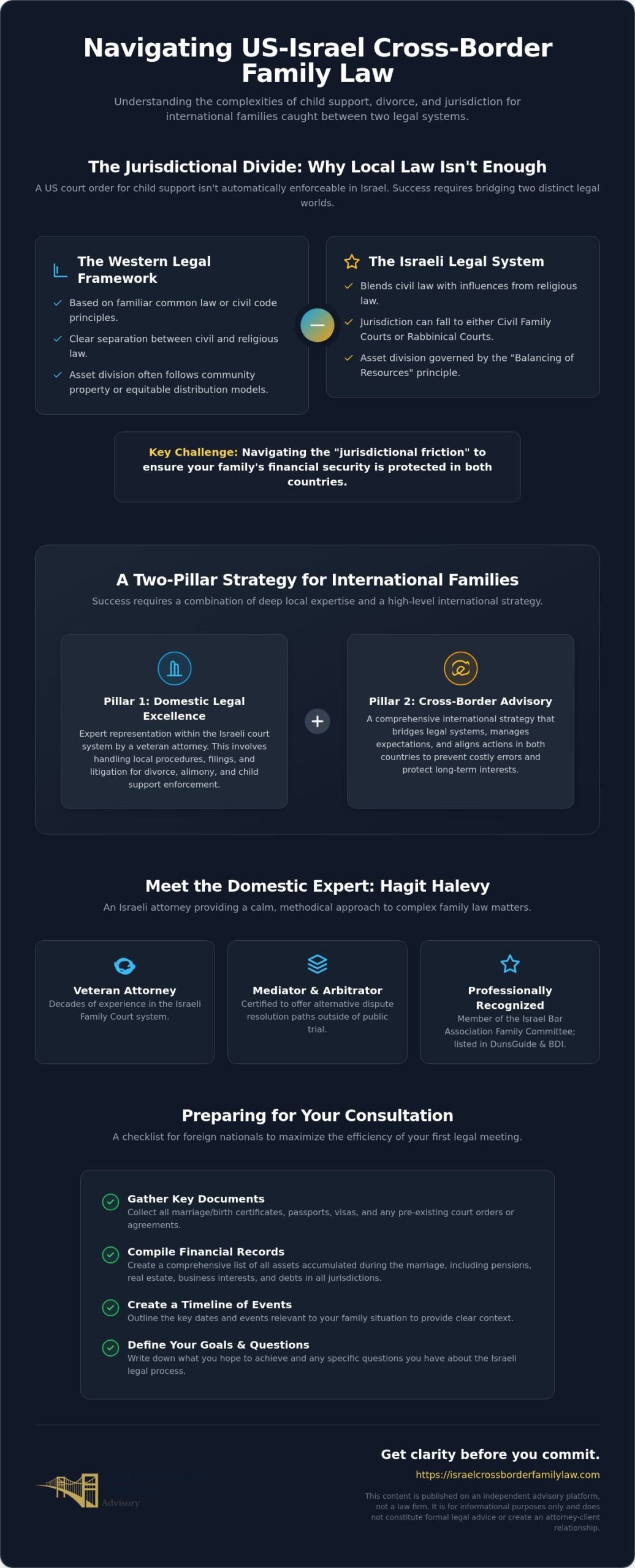
Hagit Halevy has established herself as a central figure within the Israeli family law arena, serving as a veteran attorney, mediator, and arbitrator. Her practice is built on a foundation of rigorous academic training and decades of experience in the Israeli Family Court system. For international families, understanding her role is the first step in bridging the gap between domestic litigation and the broader strategy required for matters like child support enforcement US Israel. She is known for a calm, methodical approach that prioritizes long-term stability over short-term legal wins.
The Israeli legal environment is distinct, often blending civil law with religious influences. A foundational understanding of child support laws in Israel is vital for anyone entering the local court system, as these rules often differ significantly from Western expectations. Halevy’s reputation for uncompromising professionalism allows her to represent clients in high-stakes disputes where local procedural knowledge is the primary driver of success. She handles the intricate details of the Israeli system so that her clients don’t have to manage the stress of foreign bureaucracy alone.
To better understand the mechanics of these legal procedures, watch this helpful video:
Professional Credentials and Certifications
Her qualifications begin with her Bachelor of Laws (LLB), followed by specialized certifications that expand her reach beyond traditional litigation. As a certified mediator and arbitrator, she offers alternative dispute resolution paths that can be more efficient for families who want to avoid the friction of a public trial. Her long-standing membership in the Family Committee of the Israel Bar Association ensures she remains at the forefront of legislative changes and judicial trends. This involvement provides her clients with a practitioner who doesn’t just react to the law but understands the internal mechanics of how it’s shaped and applied in the Tel Aviv district and beyond.
Recognition in the Israeli Legal Community
Professional standing in Israel is often measured by inclusion in prestigious industry directories like DunsGuide and BDI, where Halevy’s firm is consistently recognized. Operating from the legal hub of Tel Aviv, she maintains a physical presence that is critical for active engagement in the courts. For expats and foreign nationals, her firm offers an intelligent, personalized approach to complex cases that often involve multi-jurisdictional assets. Before engaging a litigator for a domestic case, many international families use an independent cross-border strategy to develop a plan that complements local representation. While her focus is on domestic excellence, the strategic implications of her work often ripple across borders, particularly regarding child support enforcement US Israel.
Core Practice Areas: Divorce, Alimony, and Child Support Enforcement
Halevy’s practice centers on the complex realities of Israeli family law, where jurisdiction often shifts between civil Family Courts and religious Rabbinical Courts. For an international family, this “race for jurisdiction” is often the first hurdle to clear. Her firm manages the entire lifecycle of a divorce, from initial filings to the enforcement of final decrees. This includes the strategic drafting of financial agreements that protect assets while ensuring compliance with local standards. She focuses on providing a steady hand through these sensitive processes, ensuring that the legal framework serves the family’s long-term stability.
Navigating Divorce and Property Division
In Israel, the division of assets is governed by the principle of “Balancing of Resources.” This isn’t always a simple 50/50 split of physical property. It involves a comprehensive calculation of all assets accumulated during the marriage, including pensions, business interests, and real estate. Halevy’s firm emphasizes the role of pre-negotiated divorce agreements to bypass the high costs and emotional toll of protracted litigation. For those managing partnerships within a family business, these agreements act as a critical safeguard against the dissolution of commercial value. Dealing with these matters early prevents the court from making arbitrary decisions about your financial future.
Child Support Enforcement and Visitation
Managing child support involves more than just setting a monthly figure. Under Israeli guidelines, the essential needs of a child typically range from ₪1,400 to ₪1,600 per month, though this is adjusted based on the parents’ income and custody arrangements. Since the landmark 2017 Supreme Court ruling, there’s a clear trend toward shared financial responsibility for children aged 6 to 15. This shift means that both parents’ incomes and the actual time spent with the children are factored into the final ₪ amount.
When cases involve child support enforcement US Israel, the legal framework relies on a Memorandum of Understanding (MOU) between the two nations. This agreement ensures that enforcement procedures are generally provided without cost to the applicant through the Ministry of Justice. For a deeper look at the administrative side, the Guide to Processing US-Israel Cases provides a technical roadmap for how these orders move between jurisdictions. Understanding these procedures is essential for maintaining the financial support your children are entitled to across borders.
Halevy also handles sensitive visitation and joint custody schedules. These plans must be durable enough to withstand the pressures of international travel or potential relocation. While many families seek a clean break, others explore “Domestic Peace” agreements, which allow couples to attempt reconciliation while pre-setting the terms of a divorce should the attempt fail. If you’re unsure how these local rules apply to your specific situation, you can reach out for a confidential discussion about your strategy.
Effective child support cross-border enforcement requires a proactive approach. It’s often better to resolve these issues through mediation rather than leaving the decision to a judge who may not fully grasp the nuances of an expat’s financial life abroad. Clear, enforceable agreements are the best defense against future litigation.
The Cross-Border Challenge: Why Domestic Expertise Needs Strategy
While a litigator provides essential representation within the Israeli courtroom, international families face a layer of complexity that transcends domestic borders. The legal landscape in Israel operates on principles that often clash with Western expectations, creating a high-stakes environment for those with assets or residency in multiple countries. Success in these matters depends on more than just local procedural knowledge; it requires a comprehensive strategy that accounts for the interaction between two distinct legal systems. Without this strategic bridge, even the most skilled domestic litigation can lead to unintended consequences in a foreign jurisdiction.
Jurisdictional Conflicts between the US and Israel
In many cross-border disputes, the first legal hurdle is the “Race to the Court.” This occurs when one spouse files for divorce or custody in the United States while the other initiates proceedings in Israel. The court that establishes jurisdiction first often dictates the legal framework for the entire case, which can significantly impact the outcome of property division and support. This is particularly sensitive in international custody and relocation matters, where a single filing decision determines which country’s laws govern a child’s future. Israeli courts are increasingly scrutinizing foreign judgments to ensure due process was respected, meaning a US order issued without proper service may be unenforceable in Israel.
Child Support Enforcement US Israel: The Strategic Layer
The division of global assets requires a level of coordination that goes beyond standard domestic practice. Dividing real estate in California while balancing a pension in Tel Aviv requires a strategy that accounts for tax implications and valuation differences in both nations. For families managing child support enforcement US Israel, the strategy must also address how financial agreements signed in Israel interact with existing US prenuptial or postnuptial agreements. An agreement that is valid in one jurisdiction might be challenged in another if it doesn’t meet specific local requirements or if the disclosure of worldwide assets was incomplete.
Early decisions carry immense weight in these cases. Choosing where to file or how to respond to a summons can lock a family into a legal path that lasts for years. This is why utilizing an independent advisory platform is a vital step before engaging a litigator. It allows you to clarify your goals and identify potential risks before you commit to a specific legal course. By the time you work with a domestic expert, you should have a clear understanding of your child support cross-border enforcement options and a roadmap that protects your interests in both jurisdictions. Seeking clarity before making commitments is the most effective way to manage the inherent complexity of transnational family law.
Preparing for a Consultation: A Checklist for Foreign Nationals
Engaging with high-level counsel in Israel requires a structured approach to ensure your interests are protected from the first meeting. Most expats feel overwhelmed by the Hebrew-language requirements and the fast-paced nature of the Family Court system. Walking into a meeting with a litigator without a clear plan often leads to wasted time and unnecessary costs. Strategic preparation ensures that your consultation focuses on high-level decision-making rather than basic administrative catch-up. It’s about moving from confusion to a position of informed control.
Document Preparation for Cross-Border Cases
Gathering the right paperwork is the most practical step you can take to streamline your legal journey. You’ll need comprehensive financial records from both the United States and Israel, including bank statements, recent tax returns, and property valuations. If your case involves child support enforcement US Israel, you must have a copy of any existing US court orders. These documents require an Apostille, which is a specialized certificate that authenticates them for international use under the Hague Convention.
Israeli courts operate exclusively in Hebrew, so factor in the time and cost for certified translations of all foreign documents. Additionally, expats should identify if their relationship falls under the “Publicly Known” status (Yeduim BaTzibur). This unique Israeli legal category can grant rights similar to marriage even if you weren’t formally wed, which significantly impacts asset division and support obligations. Having these details ready allows your attorney to assess your standing immediately.
Formulating Key Questions
Your goals will dictate whether you pursue aggressive litigation, a mediated settlement, or a strategic exit plan. Understanding the financial baseline is part of this preparation; for instance, the court filing fee for a family claim in Israel is ₪568 as of early 2026. Knowing these fixed costs helps you evaluate the broader fee structures proposed by local firms. You should also prepare specific questions regarding the “race to the court” between Rabbinical and Civil systems, as your choice of venue can change the outcome of your case.
Ask about the expected timeline for dispute settlement and how local Israeli holidays might affect your proceedings. It’s also vital to clarify how a local divorce agreement will be recognized back in your home jurisdiction. For more targeted guidance on these nuances, explore our resources for expats and foreign nationals to see how these issues typically unfold for international families. Using an independent advisory review before your consultation allows you to enter the room as an informed participant rather than a passenger in your own case. If you’re ready to organize your strategy, you can request a confidential case review to begin the process.
Get Clarity Before You Commit: Navigating Your Legal Journey
The transition from domestic legal issues to transnational disputes is rarely linear. It requires a fundamental shift in how families approach the Israeli court system. For those managing child support enforcement US Israel, the goal isn’t just to win a case; it’s to ensure the final order is durable and enforceable in both countries. Educational resources, such as the YouTube channel Israel Family Law, offer a vital starting point for families who need to understand the cultural and procedural nuances of the Israeli legal environment before they commit to a litigator. Moving from a state of confusion to one of informed control is the most effective way to protect your family’s financial future.
The Advisory Path
Strategic guidance serves as a bridge between your current uncertainty and a successful legal outcome. Unlike traditional legal representation, which focuses primarily on courtroom tactics, an advisory review looks at the entire cross-border landscape. You can learn more about how it works to see how this preparation reduces the risks and emotional toll of high-conflict family matters. This calm, methodical approach allows you to weigh your options without the immediate pressure of a litigation timeline. It ensures that when you do engage a domestic expert, you are doing so with a clear, pre-vetted strategy that accounts for the differences between US and Israeli expectations.
Next Steps for International Families
Clarity is your best protection against the inherent complexity of transnational law. Before signing an engagement agreement with any law firm, you should have a firm grasp of the jurisdictional risks and the potential costs involved. Please note that this platform is an independent advisory and not a law firm; we provide strategic guidance and decision-making support rather than formal legal representation. Legal services are only provided by licensed attorneys under a separate engagement. This distinction ensures you receive neutral, strategy-first advice that prioritizes your long-term goals over immediate litigation.
If you’re ready to define your goals and prepare for the challenges ahead, you can request a confidential case review. This initial step helps you navigate child support enforcement US Israel with a roadmap that accounts for your specific family needs. Early decisions carry significant weight in cross-border cases, and seeking clarity before making commitments is the most effective way to manage these risks.
Get clarity before you commit. Request a confidential consultation.
Securing Your Family’s Future Across Borders
Navigating the intersection of two distinct legal systems requires more than just a local litigator; it demands a comprehensive roadmap that accounts for the specific challenges faced by the Anglo community in Israel. While Hagit Halevy offers deep domestic expertise within the Israeli Family Court, international families must ensure their approach covers the unique administrative and jurisdictional friction inherent in transnational disputes. This balanced perspective is the most effective way to protect your long-term interests and ensure your legal path remains steady.
Success in matters like child support enforcement US Israel depends on your ability to move from uncertainty to a position of informed control. By prioritizing strategic preparation and clear documentation before you engage in the courtroom, you reduce the risks of high-stakes decision-making. Our independent advisory serves as the strategic bridge, focusing on complex US-Israel jurisdictional strategy to help you understand every implication of your choices. You don’t have to face these cross-border complexities alone or without a plan.
Get clarity before you commit. Request a confidential consultation.
Frequently Asked Questions
Is Hagit Halevy licensed to practice law in the United States?
No, Hagit Halevy is a veteran Israeli attorney and is not licensed to practice law in the United States. Her expertise is centered on the Israeli legal system, where she is an active member of the Israel Bar Association. Families with US-based legal needs typically coordinate her domestic representation with a qualified American attorney to manage their cross-border interests effectively.
Does Hagit Halevy’s firm handle cases in the Rabbinical Courts?
Yes, her practice includes representation in both the civil Family Courts and the Rabbinical Courts. This is a critical capability in Israel because the “race for jurisdiction” often determines which system will hear a divorce or custody case. She understands the procedural nuances of both venues and helps clients navigate these complex jurisdictional choices to reach the most stable outcome.
Can Hagit Halevy help with the enforcement of a US divorce decree in Israel?
Yes, she assists clients with the formal process of recognizing and enforcing foreign judgments within the Israeli system. When handling child support enforcement US Israel, she works within the framework of international agreements to ensure that support orders are registered and enforced locally. This process requires a deep understanding of both Israeli law and the specific requirements for foreign document authentication.
What is the difference between a consultation with an attorney and a strategic advisory review?
An attorney consultation focuses on the tactical implementation of local litigation and formal representation. In contrast, a strategic advisory review through our independent platform provides a neutral, high-level analysis of your cross-border risks. This review helps you understand the interaction between child support enforcement US Israel and your overall jurisdictional strategy before you commit to a specific litigator or court path.
Does Hagit Halevy provide services in English for Anglo expats?
Yes, her firm regularly serves English-speaking clients and provides the communication necessary to bridge the language gap. While all official court filings and hearings in Israel must be conducted in Hebrew, she ensures that Anglo expats receive clear explanations in English. This support is vital for international families who need to understand the weight of their legal decisions without language barriers.
How does Hagit Halevy approach mediation versus aggressive litigation?
She is a certified mediator and arbitrator who often advocates for settlements that minimize emotional and financial friction for the family. Her approach is generally calm and strategic, prioritizing mediation whenever possible. However, when a settlement cannot be reached, she is recognized for her professional and assertive representation within the Israeli Family Court system to protect her clients’ essential rights.
What are the primary office locations for Hagit Halevy & Co.?
Her firm is based in the Tel Aviv legal district, which serves as the central hub for many of Israel’s most complex family law cases. This location provides her team with direct access to the major Family and Rabbinical courts in the central region. This physical presence is essential for maintaining active engagement with the court system and managing urgent filings for her clients.
Can Hagit Halevy assist with drafting a will for assets located in both Israel and the US?
She specializes in drafting Israeli wills and managing local estate matters. For families with assets in both countries, she often collaborates with US-based counsel to ensure that the Israeli documents are part of a cohesive global estate plan. This coordination is necessary to avoid legal conflicts between jurisdictions and to ensure that assets in both nations are distributed according to the client’s wishes.

Article by
Gabriel Lior
A Personal Journey That Became a Mission
The advisory was founded by an American father Gabriel Lior, LLB, MBA , global entrepreneur, and cross-border advisor who spent more than a decade navigating the Israeli family court system firsthand and now lives in Singapore with his son.
As a divorced parent in a cross-border family, Gabriel faced nearly every legal challenge a foreign parent can encounter in Israel — including child custody disputes, child support proceedings, property matters in Israel and abroad, false accusations, and complex immigration and relocation proceedings.
Over the years, he learned the hard way how difficult it is for non-Israeli parents to understand the system, identify the right legal strategy, and choose the right legal representation — especially when language, culture, and jurisdictional differences are involved. He also witnessed how foreign parents and new immigrants are often disadvantaged or taken advantage of by service providers and institutions simply because they lack local knowledge or fluency.
From Client to Advisor
To truly understand — and survive — the system, Gabriel pursued formal legal education in Israel, completing two Israeli law degrees, alongside a BA and MBA earned in the United States. This was never about becoming a practicing attorney, but about gaining a deep, structural understanding of how the system works — and where it breaks down for foreign parents.
This rare combination of:
Firsthand client experience
Israeli legal and US business education
International business and negotiation training
Decades of commercial execution
created a unique perspective – one that understands both sides of the table.
After years of litigation, persistence, and at times self-representation, he ultimately succeeded in securing custody of his son and relocating abroad through a rare legal victory in the Israeli Supreme Court — becoming one of the first fathers in Israel to do so under these circumstances.
Disclaimer
Important Disclaimer:
The information provided on this website and in its content is for general informational and educational purposes only and does not constitute legal advice, legal opinion, or legal representation.
Gabriel Lior is not licensed to practice law in Israel (nor is he interested in doing so) and does not provide legal services, despite having completed 2 Law Degrees. The services offered are advisory in nature and are intended to provide general guidance, strategic insight, and information regarding cross-border family law considerations.
No attorney-client relationship is formed by accessing this website, reading its content, or communicating with us.
Any decisions made based on this information are at your own discretion and risk. For legal advice specific to your situation, you should consult a licensed attorney in the relevant jurisdiction.
Where appropriate, we may refer clients to independent, licensed attorneys or professionals. Such referrals do not constitute legal representation and no liability is assumed for services provided by third parties.