What if the most important legal decision you make isn’t in a courtroom, but in a one-hour video call before you ever file a single document? If you’re facing a divorce, custody dispute, or family matter that touches both the United States and Israel, that question deserves a serious answer. Scheduling an online consultation with an international family lawyer isn’t a preliminary formality. It’s often the most strategically significant step you can take.
You already sense how complicated this is. Two countries, two legal systems, and in Israel’s case, a Rabbinical court structure that operates by rules most Anglos and expats have never encountered. The confusion over which country holds jurisdiction, and which court might rule against your interests, is real and completely understandable.
This article explains what a cross-border consultation actually covers, why the timing of that conversation matters more than most people realize, and how it can give you a clear picture of your legal position before you commit to any course of action. You’ll come away understanding the key risks, how US and Israeli courts differ in practice, and what concrete steps you can take right now to protect your family and your future.
Key Takeaways
- An online consultation with an international family lawyer is far more than an introductory call — it is a focused strategy session that maps your legal risks across two different countries before you make any binding decisions.
- Certain situations, such as a spouse relocating to Israel or a dispute involving children across borders, demand cross-border legal guidance early — waiting can seriously limit your options under both US and Israeli law.
- The US-Israel jurisdictional landscape is uniquely complex, with Israeli Rabbinical courts and civil family courts sometimes competing for authority in ways that can catch foreign nationals completely off guard.
- Knowing how to prepare — including which documents to gather and what questions to prioritize — determines how much strategic value you get from your consultation session.
- Israel Cross Border Advisory operates as an independent advisory platform, not a law firm, with a specific focus on helping Anglos and expats understand their position and make informed decisions before committing to any legal path.
What to Expect from an Online Consultation with an International Family Lawyer
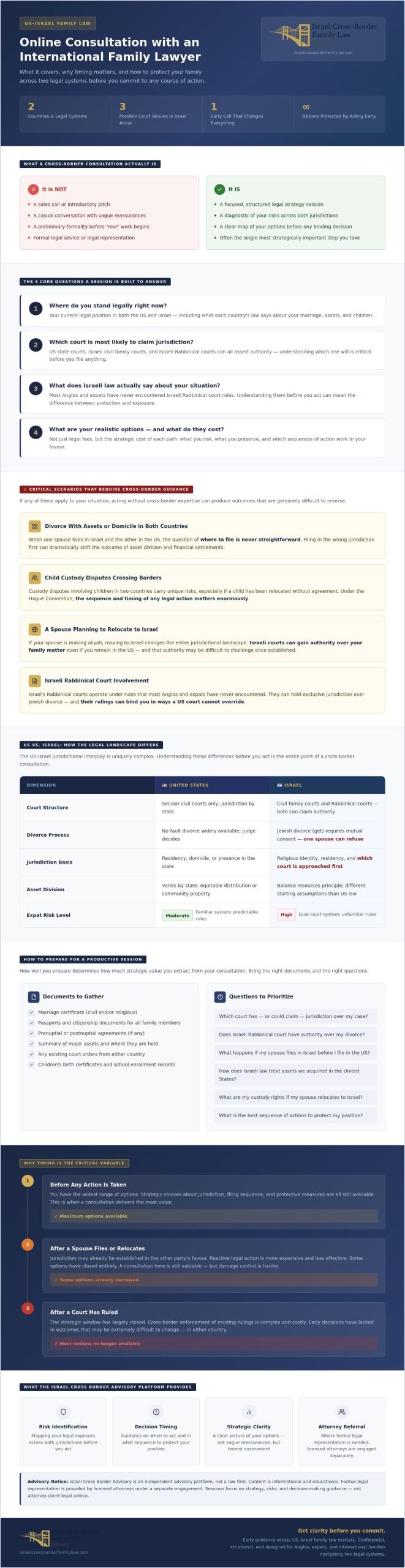
A virtual meeting with a cross-border family law advisor is not a sales call, and it’s not a casual introduction. It’s a focused, structured session designed to map your legal exposure across two distinct jurisdictions before you take any action that could bind you to an outcome you didn’t anticipate.
The core purpose is assessment. Where do you stand legally? Which country’s courts are most likely to claim jurisdiction over your divorce or custody matter? What does Israeli law actually say about your situation, and how does that compare to your rights under US law? These are the questions a properly structured online consultation with an international family lawyer is built to answer.
Think of it as a diagnostic session rather than a treatment plan. You leave with a clear picture of your position, the risks on both sides, and a realistic sense of what your options are. That’s a very different outcome from a general conversation that ends with vague reassurances.
The Difference Between a General Chat and a Strategic Advisory
Many people begin their search with a free consultation, and there’s nothing wrong with that as a starting point. The problem is that free introductory calls are rarely structured for complexity. They’re designed to establish rapport and outline services, not to interrogate the jurisdictional tension between a New York marriage and an Israeli domicile.
An advisory-first model is different. The session is prepared in advance, focused on your specific facts, and oriented toward identifying the decisions that carry the most legal weight. For US-Israel matters, where a single misstep, such as filing in the wrong jurisdiction first, can dramatically shift the balance of a case, that level of preparation isn’t a luxury. It’s the point.
Early strategic clarity does something else, too. It prevents the kind of reactive decision-making that tends to be expensive to undo. Understanding your position before you commit to any legal path gives you genuine choices rather than damage control.
Technological Ease and Confidentiality
Secure video platforms make it straightforward to have a substantive, confidential conversation regardless of where you’re located. Whether you’re in New York, Los Angeles, or Tel Aviv, a scheduled session over a secure platform removes the logistical barriers that once made cross-border legal guidance difficult to access.
Confidentiality matters in this context. Discussions during a properly structured advisory session are treated with the same discretion you’d expect in a formal professional engagement. Time zone differences are manageable with advance scheduling, and the format, typically video with document sharing if needed, supports the kind of detailed, document-specific conversation that cross-border family matters require.
Israel Cross Border Advisory operates as an independent advisory platform, not a law firm. Sessions are focused on strategy, risk identification, and decision-making guidance. Formal legal representation, where required, is provided by licensed attorneys under a separate engagement. You can learn more about how the advisory process works at israelcrossborderfamilylaw.com/how-it-works.
Critical Scenarios Requiring a Cross-Border Legal Strategy
Not every family law matter requires cross-border expertise. But certain situations carry risks that a purely domestic attorney, whether based in the US or Israel, simply isn’t equipped to identify. If any of the following circumstances apply to your situation, an online consultation with an international family lawyer isn’t just useful — it’s likely essential.
The scenarios below are the ones where getting the sequence wrong, or acting without understanding both legal systems, can produce outcomes that are genuinely difficult to reverse.
Divorce and Asset Division with a Foreign Connection
When one spouse lives in Israel and the other in the United States, the question of where to file for divorce is never straightforward. Both jurisdictions may have a legitimate claim, and the choice of forum can significantly influence how assets are divided, how support is calculated, and how long the process takes.
“Dual-resident” status adds another layer of complexity. A spouse who holds legal ties to both countries may find that Israeli courts apply different property frameworks than those familiar to US-based practitioners. US retirement accounts such as 401(k)s and IRAs are governed by federal rules that Israeli courts may not fully account for. Conversely, Israeli pension funds, known as keren pensia, are treated as marital assets under Israeli law in ways that can surprise American spouses who assumed those funds were separate.
Real estate holdings, business interests, and bank accounts spread across both countries each require careful analysis before any settlement is proposed. A division that looks fair on paper in one jurisdiction may create serious tax or enforcement problems in the other. Expats and foreign nationals navigating this terrain can find additional context at israelcrossborderfamilylaw.com/for-expats-foreign-nationals.
The same principle applies to prenuptial agreements. An agreement drafted to satisfy New York law may not meet the enforceability standards applied by an Israeli civil or Rabbinical court. If you’re considering a prenup, or trying to enforce one, both jurisdictions need to be addressed from the outset.
International Child Custody and Support
Custody disputes that cross borders introduce a specific set of legal questions that domestic family courts aren’t designed to resolve alone. The first is determining which country qualifies as the child’s “habitual residence.” This concept, not nationality or citizenship, is the primary factor courts use to establish jurisdiction over a child’s welfare. It’s a factual determination, and it can be contested.
Where the stakes rise sharply is in relocation cases. If one parent moves a child from the US to Israel, or vice versa, without the other parent’s consent or a court order, the Hague Convention on the Civil Aspects of International Child Abduction may apply. Both the US and Israel are signatories, and the Convention creates a legal mechanism for seeking the return of a child who has been wrongfully removed or retained. But the process is not automatic, and the outcome depends heavily on timing and the specific facts of the case.
Child support enforcement across borders presents its own challenges. An order issued by a US court doesn’t automatically compel compliance in Israel, and the reverse is equally true. Understanding how enforcement works between the two countries before a dispute arises is far easier than trying to collect across jurisdictions after the fact. For a fuller picture of how custody and relocation issues are handled in cross-border cases, see israelcrossborderfamilylaw.com/international-custody-relocation.
If your situation involves children, property, or a spouse in Israel, the time to understand your legal position is before any move is made. Request a confidential case review to get a clear picture of where you stand.
The Complexity of the US-Israel Jurisdictional Interplay
One of the most disorienting aspects of US-Israel family law is that there isn’t a single Israeli legal system handling divorce and family matters. There are two, and they can compete directly for authority over your case. Understanding that competition, and how to navigate it, is something an online consultation with an international family lawyer is specifically designed to address.
Israeli legal practitioners refer to this competition as merotz samchuyot, which translates roughly as a “race to jurisdiction.” The concept is straightforward: whichever court is petitioned first may acquire authority over the matter, and that early filing can constrain what the other court is willing to do. For parties spread across two countries, the stakes of that race are significant. Filing in the wrong jurisdiction first, or filing too late, can shift the entire legal landscape of a case before meaningful negotiations have even begun.
Civil vs. Religious Courts in Israel
Jewish divorce in Israel isn’t purely a civil matter. The Rabbinical court system holds exclusive authority to grant a get, the religious bill of divorce required under Jewish law. Without one, a Jewish woman is considered an agunah, bound to a marriage that civil courts in Israel may have already dissolved. This creates a situation that has no real equivalent in US family law.
For dual citizens and American Jews with ties to Israel, the interaction between this religious framework and US civil law can be genuinely disorienting. A US court can grant a civil divorce that is fully valid under American law, while the marriage remains unresolved under Israeli religious law. The reverse is also possible. This is what legal professionals call a “limping marriage,” a status recognized in one country but not the other, and it carries real consequences for remarriage, inheritance rights, and the legal status of future children.
The civil family court system in Israel operates separately from the Rabbinical courts and handles matters including property division, custody, and support. But jurisdiction between these two systems isn’t always clean. A spouse who files in the Rabbinical court first, for example, may draw certain financial matters into that forum, even if the other spouse would have preferred civil court. That choice, made early and often without full information, can be difficult to undo.
Enforcement of Foreign Orders
A common assumption among US-based spouses is that a court order issued in America carries automatic weight in Israel. It doesn’t. Israeli courts apply their own recognition process before a foreign judgment can be enforced domestically. That process involves specific legal criteria, and outcomes aren’t guaranteed.
Child support is a clear example. A US support order isn’t self-executing in Israel. Enforcement depends on whether the Israeli court recognizes the originating judgment, whether the terms are compatible with Israeli public policy, and whether the procedural requirements of the original proceeding were met. For a full picture of how this process works in practice, see Child Support Cross-Border Enforcement.
The cultural dimension matters here, too. Anglos and expats often arrive at this process with expectations shaped entirely by the US legal system: defined timelines, predictable procedures, and courts that operate independently of religious authority. Israeli family law, particularly where the Rabbinical court is involved, operates on different assumptions. Recognizing that gap before you act, rather than after, is precisely what early cross-border guidance is designed to help you do.
How to Prepare for a Productive Virtual Strategy Session
The quality of guidance you receive from an online consultation with an international family lawyer depends heavily on what you bring to it. A session with no preparation tends to produce general answers to general questions. A session built around your specific facts, documents, and priorities produces something far more useful: a clear picture of your actual legal position.
Start by identifying your primary goal. Are you trying to protect specific assets before a filing? Understand your custody rights if a spouse moves to Israel? Or simply gather enough information to know what decisions you’re facing? Knowing your objective in advance shapes the entire session. It prevents the conversation from drifting into areas that aren’t immediately relevant to your situation.
Once you’ve defined your goal, gather the documents that reflect your legal and financial reality. The most useful items to have on hand include:
- Your marriage certificate, and any prenuptial or postnuptial agreement
- A summary of your shared and individual assets, including property in both countries
- Relevant financial statements: bank accounts, pension funds, retirement accounts
- Any existing court orders, custody arrangements, or legal correspondence
- Passports and documentation of residency status in both the US and Israel
You don’t need to have everything organized perfectly. But having these materials nearby allows the advisor to ask specific questions rather than working from assumptions.
Prepare a brief, factual timeline of your residency history and the dispute itself. When did you or your spouse move to Israel? When did the marriage difficulties begin? Has any legal action been initiated, even informally? A clear sequence of events helps the advisor identify which jurisdiction is most likely to claim authority and where the pressure points are.
Finally, write down your three most pressing concerns before the session begins. This simple step ensures that the conversation addresses what matters most to you, rather than running out of time before the issues you care about are reached.
The Importance of Honesty and Disclosure
An advisory session is a confidential space for exploring your options, not a courtroom. The assessment you receive is only as accurate as the facts you share. If there are assets you haven’t disclosed, residency details that are complicated, or actions you’ve already taken that you’re uncertain about, those are exactly the things that need to be on the table. A strategy built on incomplete information can point you in the wrong direction entirely.
There’s no commitment required from a consultation. You’re gathering information and understanding your position. That’s the entire point.
Defining Success in a Cross-Border Context
It helps to reframe what a successful outcome looks like at this stage. The goal isn’t to “win” a session; it’s to leave with a realistic map of your options and the risks attached to each one. In cross-border family matters, that often means understanding which outcomes are achievable, which are unlikely, and where early decisions carry the most long-term weight.
A written summary or roadmap following the session makes that clarity actionable. It gives you something concrete to refer back to as circumstances develop, and it provides a foundation for any licensed attorney you engage subsequently. You can review how the advisory process is structured at israelcrossborderfamilylaw.com/how-it-works.
Get clarity before you commit. Request a confidential case review and arrive at your session prepared to make the most of it.
Strategic Guidance Through the Israel Cross Border Advisory
Israel Cross Border Advisory exists to bridge a gap that most people don’t know exists until they’re already in it. The gap between what US-based family attorneys understand about Israeli law, and what Israeli practitioners understand about the American legal context, is wider than most clients expect. The advisory platform is built specifically to occupy that space, providing strategic orientation to Anglos, expats, and international families who need to understand both sides before committing to any course of action.
The approach here is deliberate. Rather than moving immediately toward litigation or formal filings, the focus is on helping you understand where you stand, what your realistic options are, and which early decisions carry the most long-term weight. That’s a different orientation from most legal engagements, and it’s intentional. In cross-border family matters, the cost of moving in the wrong direction early is almost always higher than the cost of taking the time to understand your position first.
Clarity and risk assessment take priority over aggressive strategy. That isn’t a passive approach; it’s a recognition that in complex multi-jurisdictional matters, the most valuable thing you can have at the outset is an accurate picture of the terrain. An online consultation with an international family lawyer through this platform is designed to deliver exactly that: a structured, honest assessment of your position across both legal systems, without pressure to escalate before you’re ready.
The Independent Advisory Advantage
Israel Cross Border Advisory is an independent advisory platform, not a law firm. Formal legal representation, where required, is provided by licensed attorneys under a separate engagement. That distinction matters. It means the guidance you receive in a strategy session is oriented entirely toward your decision-making, not toward building a case file. You get a neutral, informed perspective before entering any formal legal process. Learn more about how the advisory is structured at israelcrossborderfamilylaw.com/about-the-advisory.
Next Steps: Moving from Confusion to Confidence
The first step in an international family matter is often the hardest. Not because the paperwork is complicated, but because the stakes feel high and the landscape is unfamiliar. That feeling is a signal, not a reason to delay. The sooner you understand your legal position across both jurisdictions, the more genuine choices you have.
Don’t make binding decisions from a place of uncertainty. For additional context on how Israeli family law works in practice, the Israel Family Law Channel offers accessible, plain-English guidance on the questions that matter most to international families.
Get clarity before you commit. Request a confidential case review and take the first step toward understanding your options.
Your Next Step Toward Cross-Border Clarity
US-Israel family matters don’t resolve themselves by waiting. The jurisdictional complexity is real, the stakes are high, and early decisions carry consequences that are genuinely difficult to reverse. What this article has shown is that understanding your position across both legal systems isn’t a luxury reserved for people already in crisis. It’s the most practical thing you can do before any formal step is taken.
Israel Cross Border Advisory is an independent advisory platform, not a law firm, built specifically for expats, Anglos, and international families navigating this terrain. The focus is on strategy, honest risk assessment, and helping you make informed decisions before you commit to a path.
An online consultation with an international family lawyer through this platform gives you exactly that: a structured, confidential session oriented entirely toward your situation and your choices.
Get clarity before you commit. Request a confidential consultation and take the first step toward understanding where you stand.
Frequently Asked Questions
Is an online legal consultation as effective as an in-person meeting?
For cross-border family matters, an online consultation is genuinely as effective as sitting in the same room, and in some respects more practical. Secure video platforms allow document sharing, detailed discussion, and focused analysis without the logistical barriers of international travel. The substance of what gets covered depends on preparation and the structure of the session, not on physical proximity.
What matters most is that the session is built around your specific facts rather than general information. A well-prepared virtual strategy session with a cross-border advisor will cover jurisdiction, risk, and decision-making in the same depth as any in-person equivalent.
What documents should I have ready for a cross-border family law consultation?
The most useful documents to have on hand are your marriage certificate, any prenuptial or postnuptial agreement, a summary of assets held in both countries, recent financial statements, existing court orders or legal correspondence, and passports or residency documentation for both the US and Israel. You don’t need everything perfectly organized, but having these materials nearby allows the advisor to ask specific questions rather than working from assumptions.
A brief written timeline of your residency history and the key events in your situation is also worth preparing. Knowing when you or your spouse moved to Israel, and whether any legal steps have already been taken, helps the advisor identify where jurisdictional authority is most likely to land.
Will an international family lawyer understand both US and Israeli law?
A cross-border advisor with genuine US-Israel expertise should be able to address both legal frameworks, including how they interact in practice. That’s a meaningful distinction from a domestic attorney in either country. A US-based family lawyer may have limited familiarity with Israeli Rabbinical court structures or pension fund treatment under Israeli law. An Israeli practitioner may not fully account for how US retirement accounts or federal tax rules affect a proposed settlement.
Israel Cross Border Advisory is built specifically to bridge that gap, providing strategic orientation across both systems before any formal legal engagement begins. Where licensed representation is required, that’s handled separately by qualified attorneys.
Can I get a consultation if my spouse is already in Israel and I am in the US?
Yes, and this is one of the most common situations that makes an online consultation with an international family lawyer genuinely urgent. When spouses are already in different countries, the question of which jurisdiction acts first becomes immediately relevant. A spouse who files in Israel before you’ve taken any steps in the US can significantly shift the legal landscape of the case.
Geographic separation doesn’t prevent a productive session; it makes one more necessary. The advisory process is designed to work across time zones, and sessions can be scheduled to accommodate both US and Israeli locations.
How do I know which country has jurisdiction over my divorce?
Jurisdiction in a US-Israel divorce isn’t determined by a single rule. Courts look at factors including where the marriage took place, where both spouses currently reside, where shared assets are located, and in custody matters, where the children habitually live. Both countries may have a legitimate claim, and the outcome often depends on which jurisdiction is petitioned first.
Israel adds a further layer of complexity because civil family courts and Rabbinical courts can both assert authority over different aspects of the same case. Understanding which forum applies to your specific circumstances, and how to approach that strategically, is one of the core purposes of a cross-border advisory session.
What happens after the online consultation is over?
A well-structured session should leave you with a clear picture of your legal position, the key risks in your situation, and a realistic sense of the options available to you. At Israel Cross Border Advisory, the focus is on providing a written summary or strategic roadmap following the session, giving you something concrete to refer back to as your situation develops.
There’s no obligation to proceed with any formal legal engagement after a consultation. The session is designed to inform your decision-making, not to commit you to a particular path. If licensed legal representation becomes necessary, that’s arranged separately with qualified attorneys.
Are online legal consultations confidential when discussing international assets?
Confidentiality is treated seriously in any properly structured advisory session. Discussions are handled with the same discretion you’d expect from a formal professional engagement, and secure platforms are used to protect the privacy of the conversation. You should feel comfortable disclosing the full picture of your financial situation, including assets in both countries, because an accurate assessment depends on complete information.
It’s worth noting that an advisory platform operates differently from a law firm. Israel Cross Border Advisory is an independent advisory platform, not a law firm, and sessions are focused on strategy and risk guidance rather than formal legal representation. That context doesn’t diminish confidentiality; it simply clarifies the nature of the engagement.
How much does a typical international family law consultation cost?
Consultation fees for cross-border family law matters vary depending on the platform, the advisor’s qualifications, and the complexity of the situation being discussed. We don’t publish a fixed price here, and you should verify current session fees directly with any advisor before booking. What’s worth keeping in mind is that the cost of a focused strategy session is almost always modest relative to the cost of proceeding without one.
Early clarity on jurisdiction, risk, and your legal position across two countries can prevent decisions that are expensive to reverse. The session fee isn’t the relevant comparison; the relevant comparison is what uninformed early decisions can cost you later. To find out what a consultation involves and how to schedule one, visit israelcrossborderfamilylaw.com/how-it-works.

Article by
Gabriel Lior
A Personal Journey That Became a Mission
The advisory was founded by an American father Gabriel Lior, LLB, MBA , global entrepreneur, and cross-border advisor who spent more than a decade navigating the Israeli family court system firsthand and now lives in Singapore with his son.
As a divorced parent in a cross-border family, Gabriel faced nearly every legal challenge a foreign parent can encounter in Israel — including child custody disputes, child support proceedings, property matters in Israel and abroad, false accusations, and complex immigration and relocation proceedings.
Over the years, he learned the hard way how difficult it is for non-Israeli parents to understand the system, identify the right legal strategy, and choose the right legal representation — especially when language, culture, and jurisdictional differences are involved. He also witnessed how foreign parents and new immigrants are often disadvantaged or taken advantage of by service providers and institutions simply because they lack local knowledge or fluency.
From Client to Advisor
To truly understand — and survive — the system, Gabriel pursued formal legal education in Israel, completing two Israeli law degrees, alongside a BA and MBA earned in the United States. This was never about becoming a practicing attorney, but about gaining a deep, structural understanding of how the system works — and where it breaks down for foreign parents.
This rare combination of:
Firsthand client experience
Israeli legal and US business education
International business and negotiation training
Decades of commercial execution
created a unique perspective – one that understands both sides of the table.
After years of litigation, persistence, and at times self-representation, he ultimately succeeded in securing custody of his son and relocating abroad through a rare legal victory in the Israeli Supreme Court — becoming one of the first fathers in Israel to do so under these circumstances.
Disclaimer
Important Disclaimer:
The information provided on this website and in its content is for general informational and educational purposes only and does not constitute legal advice, legal opinion, or legal representation.
Gabriel Lior is not licensed to practice law in Israel (nor is he interested in doing so) and does not provide legal services, despite having completed 2 Law Degrees. The services offered are advisory in nature and are intended to provide general guidance, strategic insight, and information regarding cross-border family law considerations.
No attorney-client relationship is formed by accessing this website, reading its content, or communicating with us.
Any decisions made based on this information are at your own discretion and risk. For legal advice specific to your situation, you should consult a licensed attorney in the relevant jurisdiction.
Where appropriate, we may refer clients to independent, licensed attorneys or professionals. Such referrals do not constitute legal representation and no liability is assumed for services provided by third parties.