Did you know that moving your child to Israel without explicit legal clearance could be classified as international child abduction under the Hague Convention, even if you have primary custody in the United States? The process of relocating to israel with child after divorce involves far more than just booking a flight. It requires a deep understanding of how two different legal systems interact. It’s natural to feel anxious about how Israeli courts interpret the “best interests of the child” or how they define parental guardianship compared to US definitions.
This guide provides a strategic roadmap for navigating these multi-jurisdictional complexities. You’ll learn the essential steps for obtaining legal relocation permission, the significant risks of moving without formal consent, and how to protect your parental rights across borders. We will examine the 1962 Legal Capacity and Guardianship Law and the role of the Hague Convention in cross-border disputes. This information is published on an independent advisory platform to provide strategic guidance and is not a substitute for formal legal representation. By understanding the weight of early decisions, you can move forward with greater confidence and legal security.
Key Takeaways
- Understand how the Legal Capacity and Guardianship Law governs the process of relocating to israel with child after divorce, establishing that major life changes require mutual parental consent.
- Learn why the “best interests of the child” serves as the supreme legal standard in Israeli courts and how it influences judicial decisions over parental preferences.
- Identify the significant legal risks and international consequences of moving a child without a court-sanctioned agreement or formal written consent.
- Discover the procedural steps required for a successful move, including the transition from mediation efforts to filing a formal Motion for Relocation.
- Gain strategic clarity on how early choices define “habitual residence” and why informal arrangements may leave your parental rights vulnerable across borders.
Understanding the Legal Framework for International Relocation
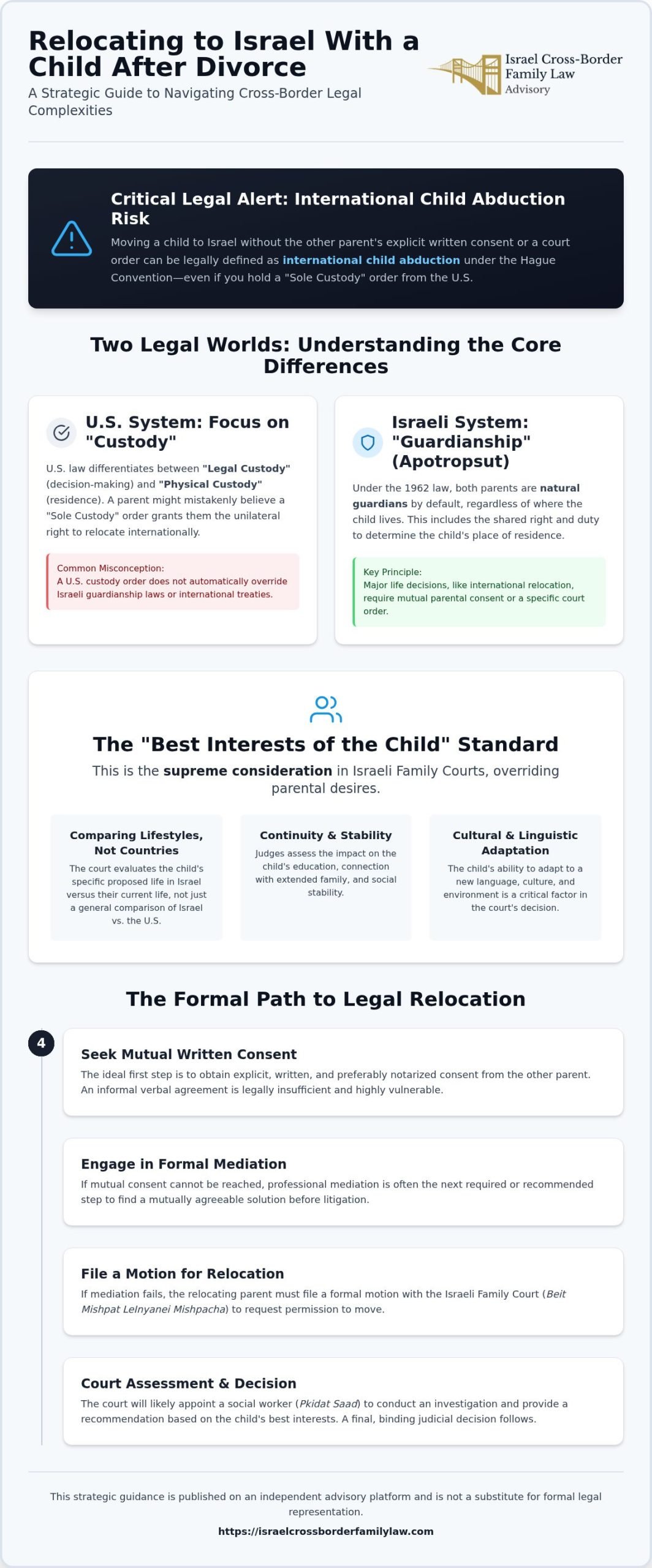
International relocation is legally defined as a fundamental change in a child’s life. It is not a unilateral right held by the primary custodial parent. In Israel, the primary statute governing these moves is the Legal Capacity and Guardianship Law (5722-1962). This law establishes that both parents are the natural guardians of their children. Consequently, any significant decision, such as moving a child across international borders, requires the explicit, written consent of both parents or a formal order from a competent court. When relocating to israel with child after divorce, you must navigate these requirements carefully to avoid severe legal repercussions.
It’s vital to distinguish between a legal relocation and what the law classifies as international child abduction. If a parent removes a child from their country of habitual residence without the other parent’s consent, they may trigger the Hague Convention on the Civil Aspects of International Child Abduction. Israel is a signatory to this treaty and takes its enforcement seriously. This content is published on an independent advisory platform, not a law firm, to help you understand these strategic risks before making life-altering commitments.
To better understand how these rules apply in practice, watch this overview:
Guardianship vs. Custody: A Critical Distinction
In the United States, parents often focus on “legal custody” and “physical custody.” Israel uses the concept of Apotropsut, or guardianship. Under the 1962 law, both parents remain natural guardians regardless of who the child lives with most of the time. Guardianship includes the right and duty to determine a child’s education, healthcare, and place of residence. Many parents mistakenly believe a US “Sole Custody” order provides a green light for relocating to israel with child after divorce. However, unless that order specifically terminates the other parent’s guardianship rights, the Israeli legal system will likely require their consent for the move. You can find more details on how these systems clash in our guide to international custody and relocation.
The Family Court Jurisdiction (Beit Mishpat LeInyanei Mishpacha)
The Family Court, known as Beit Mishpat LeInyanei Mishpacha, holds the primary authority over relocation disputes. These courts operate with a focus on child welfare rather than just parental rights. During the process, the court often appoints a social worker, or Pkidat Saad, to conduct an investigation and provide a recommendation. While religious courts have concurrent jurisdiction in some divorce matters, the civil Family Court is the standard venue for international relocation cases. Decisions made here carry significant weight and are difficult to overturn once a child’s “habitual residence” is established in a new country. Seeking clarity on these jurisdictional boundaries is a necessary step in cross-border strategy.
The “Best Interests of the Child” Standard in Relocation Cases
In the Israeli legal system, the child’s welfare is categorized as the “supreme consideration.” This standard effectively overrides the personal desires or professional ambitions of the parents. When you are relocating to israel with child after divorce, the court’s primary lens is how the move will impact the child’s emotional, physical, and social development. Judges don’t simply compare two countries; they compare two specific lives. They look for continuity in education, the presence of extended family, and the child’s ability to adapt to a new linguistic and cultural environment. Because the system is often slow, with an average of 228 days to handle judicial complaints in 2025, getting your strategy right from the start is vital for the child’s stability.
A significant factor in these cases is the “Tender Years Presumption.” Traditionally, Israeli law favored the mother as the primary caregiver for children under the age of six. While this doctrine still exists, modern courts apply it with much less rigidity. Today, judges balance this presumption against the father’s fundamental right to maintain a meaningful relationship with his child. The court will examine the current “quality of life” in the US versus the proposed environment in Israel. If the move is seen as a way to improve the child’s support network through Israeli family ties, the court may view it more favorably than a move based solely on a parent’s career advancement.
Evaluating the Relocating Parent’s Motivation
Courts are trained to distinguish between “Good Faith” and “Bad Faith” relocations. A good faith move typically involves a clear plan for career growth, proximity to family support, or a return to a parent’s home country. Conversely, moves intended to alienate the child from the other parent are viewed with extreme skepticism. You must present a concrete plan for facilitating visitation. This includes managing travel costs and ensuring regular digital communication. Understanding these requirements is part of Preventing International Child Abduction and protecting your long-term parental rights. If you feel uncertain about how your motivations might be interpreted, you may want to seek a strategic review of your relocation plan.
The Child’s Voice and Developmental Needs
As children grow older, usually starting around age 10 to 12, the court may choose to hear their preferences directly. However, the child’s voice is only one factor and is never the sole deciding point. For infants and toddlers, the focus remains almost entirely on the primary caregiver’s stability. For school-age children, the disruption of their social and educational life becomes a major hurdle. Israeli courts frequently appoint expert psychologists to assess the potential impact of the move. These experts provide an objective evaluation of the child’s “best interests,” and their recommendations carry significant weight in the final judicial decision.
Navigating the Hague Convention and International Risks
The 1980 Hague Convention on the Civil Aspects of International Child Abduction is the primary international treaty governing cross-border custody disputes. Both the United States and Israel are signatories to this agreement. Its main purpose is to ensure the prompt return of a child who has been “wrongfully removed” or “wrongfully retained” away from their country of habitual residence. If you are relocating to israel with child after divorce without the other parent’s explicit written consent or a court order, you risk a Hague petition being filed against you. This content is published on an independent advisory platform to provide strategic guidance on these risks; it doesn’t constitute formal legal representation.
A central component of these disputes is the “habitual residence” test. Courts use this to determine which country has the legal authority to decide on the child’s future. It isn’t just about where the child is physically located. Instead, it looks at the child’s degree of integration in a specific social and family environment. If a US court determines that the child’s habitual residence remains in the United States, it can order the immediate return of the child from Israel. This often happens regardless of the parent’s reasons for moving. Moving a child unilaterally is a form of “self-help” that legal systems around the world view with extreme skepticism.
Preventing Accusations of International Abduction
To mitigate the risk of being accused of abduction, you must establish a formal, court-approved Relocation Agreement. A key strategy for international families is the use of “Mirror Orders.” This process involves obtaining a specific custody and relocation order in a US court and then having that exact order registered and approved by an Israeli Family Court. This creates a bridge between the two legal systems, ensuring that the terms of your move are enforceable in both jurisdictions. You can find more detail on this protective measure in our guide to International Custody and Relocation.
Enforcement of Visitation Across Borders
Protecting the rights of the non-relocating parent is a major priority for judges. When relocating to israel with child after divorce, the court will require clear mechanisms to ensure visitation takes place. One common tool is the requirement of a financial bond or a bank guarantee. These funds are held as security to ensure that the child is returned to the other parent after a scheduled visit or that the relocating parent follows the agreed-upon travel schedule. For a deeper look at the financial complexities of these arrangements, see our resources on Child Support Cross-Border Enforcement. Taking these steps early demonstrates your commitment to maintaining the child’s relationship with both parents.
Procedural Steps for Relocating with Children
The legal journey for relocating to israel with child after divorce follows a specific sequence designed to protect the child’s welfare and ensure both parents’ rights are considered. This content is provided by an independent advisory platform for informational purposes and does not establish an attorney-client relationship. The process typically moves through these five key stages:
- Step 1: Attempt to reach a consensual Relocation Agreement through mediation. In Israel, this often begins with a mandatory “Settlement of Dispute” application, which carries a filing fee of 119 NIS as of January 2026.
- Step 2: File a formal Motion for Relocation with the appropriate Family Court if mediation does not result in an agreement.
- Step 3: The court appoints a social worker, known as a Pkidat Saad, to conduct a comprehensive investigation into the child’s living conditions and parental relationships.
- Step 4: Attend evidentiary hearings where the court reviews expert testimonies, psychological assessments, and the social worker’s findings.
- Step 5: Receive the final judgment and the issuance of a formal relocation order, which specifies the new residency and visitation terms.
Given that over 90,000 cases were filed in Israeli Family Courts in 2023, you should prepare for a process that requires patience and meticulous documentation. Systemic delays are common. In 2025, the average handling time for complaints against judges reached 228 days, highlighting the importance of a clear strategy from the very beginning.
The Social Worker Report (Tazkir)
The social worker’s report, or Tazkir, is perhaps the most influential document in your case. Judges rarely deviate from the recommendations provided by the Pkidat Saad. You should expect several home visits and detailed interviews with both parents and the child. During these meetings, it’s essential to present your relocation plan professionally. Focus on concrete details like school registrations, healthcare access, and a sustainable visitation schedule. Instead of highlighting your personal career goals, emphasize how the move provides the child with a superior emotional and social support system.
Relocating TO Israel: Special Considerations for Aliyah
When moving from the US to Israel, many parents believe the “Right of Return” or the ideological benefits of Aliyah grant them a legal advantage. However, Israeli courts prioritize the child’s existing relationship with the US-based parent over the Zionist identity of the move. While the court acknowledges the cultural benefits of living in Israel, these are given limited weight compared to the risk of parental alienation. If you are planning an Aliyah move after a US divorce, you need a strategy that addresses the cross-border distance and maintains the other parent’s bond. You can contact us for a strategic review to ensure your relocation plan meets the rigorous standards of the Israeli legal system.
Strategic Decision-Making: Clarity Before Commitment
Early decisions in a relocation case carry immense weight. Once a child begins attending school and forming social bonds in a new country, the legal definition of “habitual residence” starts to shift. This shift makes it increasingly difficult to reverse a move through the courts later. When relocating to israel with child after divorce, you aren’t just moving house; you’re fundamentally altering the jurisdictional landscape of your family’s life. Handshake deals or informal “gentleman’s agreements” with an ex-spouse are particularly risky. Without a court-sanctioned order, these arrangements offer no protection against future accusations of abduction or sudden changes of heart by the other parent.
Adopting a cross-border advisory approach helps you avoid a state of legal “limbo.” This occurs when one country’s court claims jurisdiction while the other refuses to recognize the move. To see how these complex strategies unfold in real-world scenarios, you can find extensive expert guidance on the Israel Family Law YouTube channel. Visualizing the process can help demystify the differences between the US and Israeli systems before you take the first formal step.
The Importance of a Pre-Relocation Strategy
You should consult a cross-border expert before you notify your ex-spouse of your intent to move. This isn’t about being deceptive. It’s about assessment. You need to understand your “litigation risk” versus your “negotiation opportunity.” If you announce your plans without a clear legal strategy, you may inadvertently trigger a preemptive legal filing from the other parent that freezes the child’s travel. Understanding how it works when managing cases between two countries allows you to enter negotiations from a position of clarity rather than reaction. A well-timed proposal that includes a detailed visitation and financial plan is often more successful than a sudden demand.
Seeking Professional Clarity
The complexity of US-Israel legal differences cannot be overstated. From the “Apotropsut” definitions mentioned earlier to the concurrent jurisdiction of religious courts, every detail matters. This content is published on an independent advisory platform and is intended solely for informational and educational purposes. It doesn’t constitute legal representation or formal legal advice. Legal services are only provided by licensed attorneys under a separate, formal engagement.
The goal of this guide is to provide you with the strategic framework necessary to make informed decisions. Protecting your parental rights across borders requires a proactive, rather than reactive, stance. Get clarity before you commit. Request a confidential case review to explore the specific risks and opportunities of your situation.
Securing Your Family’s Cross-Border Future
Relocating to israel with child after divorce is a sophisticated legal undertaking that requires far more than just a passport. It demands a clear understanding of the “best interests of the child” standard and the protective role of the Hague Convention. As we have explored, early strategic decisions regarding “habitual residence” and court-sanctioned Mirror Orders are essential to prevent accusations of international abduction. This content is published on an independent advisory platform to help you navigate these risks before making permanent commitments.
Our advisory-first strategy is built on specialized US-Israel cross-border expertise. We serve as a bridge between divergent legal cultures, with practitioners licensed in multiple jurisdictions who understand the nuances of both systems. Navigating these complexities alone can lead to significant delays or legal setbacks. By seeking professional clarity now, you can protect your parental rights and ensure a stable transition for your child. Taking the time to build a solid legal foundation today protects your family’s tomorrow.
Get clarity before you commit. Request a confidential consultation.
Frequently Asked Questions
Can I move to Israel with my child if I have primary custody in the US?
You cannot move to Israel unilaterally even if you hold primary physical custody in the United States. International relocation is considered a fundamental change in a child’s life that requires either the written consent of the other parent or a specific court order. Most US custody orders do not grant the right to leave the country permanently without further legal proceedings. Moving without this authority can result in serious legal consequences under international law.
What happens if I relocate to Israel without the father’s consent?
Relocating without consent is legally classified as international child abduction under the Hague Convention. Because Israel is a signatory to this treaty, the Israeli Central Authority can facilitate the child’s prompt return to their country of habitual residence. Such a move can lead to the loss of custody rights and significant financial penalties. It’s vital to seek strategic clarity before making any physical move to avoid being labeled an abductor.
How long does the relocation process take in the Israeli Family Court?
The timeline for relocating to israel with child after divorce depends heavily on the court’s caseload and the complexity of the dispute. In 2023, Israeli Family Courts managed over 90,000 proceedings, which often leads to significant scheduling delays. You should prepare for a process that lasts several months or even over a year. The requirement for a social worker’s investigation and expert psychological reports naturally extends the duration of the case.
Is the “Tender Years Presumption” still used in Israel?
The Tender Years Presumption still exists in Israeli law for children under the age of six, but its application has become less rigid in recent years. Modern courts now weigh this presumption against the “best interests of the child” and the father’s right to maintain a meaningful relationship. Judges increasingly focus on shared parental responsibility and the child’s need for stability with both parents rather than defaulting to one parent based on age alone.
Can my ex-spouse stop me from taking the child on vacation to Israel?
Yes, an ex-spouse can stop a vacation if they have a reasonable fear that the child will not be returned to their home country. They may file for a “stay of exit” order to prevent the child from leaving. To resolve this, parents often negotiate the placement of a financial bond or a bank guarantee. These funds serve as security to ensure the child returns to their habitual residence by the scheduled date.
What is a Mirror Order and why do I need one for relocation?
A Mirror Order is a court order issued in one jurisdiction that is then formally registered and approved by a court in another jurisdiction. When relocating to israel with child after divorce, a Mirror Order ensures that your US custody and visitation terms are legally recognized and enforceable in Israel. This prevents a jurisdictional vacuum where one parent might try to ignore the original court’s instructions once the child is abroad.
Do I need an Israeli lawyer if my divorce was finalized in the US?
You generally need an Israeli lawyer because US court orders are not automatically enforceable within the Israeli legal system. To make your US divorce or custody decree valid in Israel, you must complete a formal registration or enforcement process in the Israeli Family Court. This content is published on an independent advisory platform to help you understand these requirements; it is not a substitute for formal legal representation by a licensed attorney.
How does the court decide if moving to Israel is in the child’s best interest?
The court determines the child’s best interests by evaluating their emotional, social, and educational needs through a “supreme consideration” lens. Judges rely on the Tazkir, a comprehensive report prepared by a court-appointed social worker, and often seek opinions from child psychologists. They assess whether the move to Israel offers a superior support network and long-term stability compared to the child’s current environment in the United States.

Article by
Gabriel Lior
A Personal Journey That Became a Mission
The advisory was founded by an American father Gabriel Lior, LLB, MBA , global entrepreneur, and cross-border advisor who spent more than a decade navigating the Israeli family court system firsthand and now lives in Singapore with his son.
As a divorced parent in a cross-border family, Gabriel faced nearly every legal challenge a foreign parent can encounter in Israel — including child custody disputes, child support proceedings, property matters in Israel and abroad, false accusations, and complex immigration and relocation proceedings.
Over the years, he learned the hard way how difficult it is for non-Israeli parents to understand the system, identify the right legal strategy, and choose the right legal representation — especially when language, culture, and jurisdictional differences are involved. He also witnessed how foreign parents and new immigrants are often disadvantaged or taken advantage of by service providers and institutions simply because they lack local knowledge or fluency.
From Client to Advisor
To truly understand — and survive — the system, Gabriel pursued formal legal education in Israel, completing two Israeli law degrees, alongside a BA and MBA earned in the United States. This was never about becoming a practicing attorney, but about gaining a deep, structural understanding of how the system works — and where it breaks down for foreign parents.
This rare combination of:
Firsthand client experience
Israeli legal and US business education
International business and negotiation training
Decades of commercial execution
created a unique perspective – one that understands both sides of the table.
After years of litigation, persistence, and at times self-representation, he ultimately succeeded in securing custody of his son and relocating abroad through a rare legal victory in the Israeli Supreme Court — becoming one of the first fathers in Israel to do so under these circumstances.
Disclaimer
Important Disclaimer:
The information provided on this website and in its content is for general informational and educational purposes only and does not constitute legal advice, legal opinion, or legal representation.
Gabriel Lior is not licensed to practice law in Israel (nor is he interested in doing so) and does not provide legal services, despite having completed 2 Law Degrees. The services offered are advisory in nature and are intended to provide general guidance, strategic insight, and information regarding cross-border family law considerations.
No attorney-client relationship is formed by accessing this website, reading its content, or communicating with us.
Any decisions made based on this information are at your own discretion and risk. For legal advice specific to your situation, you should consult a licensed attorney in the relevant jurisdiction.
Where appropriate, we may refer clients to independent, licensed attorneys or professionals. Such referrals do not constitute legal representation and no liability is assumed for services provided by third parties.