Imagine the confusion of arriving at Ben Gurion Airport as a divorced individual, only to discover the Israeli Population Registry still considers you married. This scenario, often called a “limping marriage,” occurs when a legal status change in one country fails to translate to another. It’s a distressing reality for many expats who assume a court order from London or New York automatically carries weight in Jerusalem. Understanding the complexities of Marriage and Divorce Recognition Between Countries is essential for anyone living a cross-border life, as legal friction between jurisdictions can lead to significant personal and financial complications.
We understand that dealing with both Israeli Rabbinical courts and civil authorities feels overwhelming. You want your status clear, your assets protected, and your parental rights secure. At Israel Cross Border Law Firm, we provide a strategic roadmap for navigating these multi-jurisdictional challenges. This guide will examine the requirements for registering foreign status changes in Israel and the steps necessary to achieve legal certainty. While this content is for informational purposes and does not constitute legal advice, our goal at Israel Cross Border Law Firm is to provide the clarity you need to make informed decisions. Formal legal representation requires a direct engagement with a licensed attorney from our firm.
Key Takeaways
- Understand how the principle of comity shapes Marriage and Divorce Recognition Between Countries and why domestic Israeli law ultimately dictates the validity of your foreign documents.
- Learn to navigate the complex dual jurisdiction of Israel’s Civil Family Courts and Religious Courts to ensure your marital status is correctly registered.
- Identify the legal risks associated with “limping marriages” and why the “race to the courthouse” makes the timing of your filing a critical strategic decision.
- Master the technical requirements for document validation, including the specific process for obtaining an Apostille on US court orders and marriage certificates.
- Recognize the importance of a unified strategy between Israeli and foreign counsel to protect your long-term inheritance and parental rights across borders.
Understanding the Principles of International Legal Recognition
The foundation of cross-border legal status rests on the legal principle of “comity.” This concept describes the practice where one nation’s courts respect the legislative, executive, or judicial acts of another. It isn’t an absolute legal requirement; instead, it is a matter of mutual courtesy and utility between sovereign states. While comity facilitates the smooth operation of international relations, the actual Marriage and Divorce Recognition Between Countries remains firmly within the hands of domestic authorities. In Israel, this means that while a foreign decree is respected, it must still satisfy specific local legal criteria before it is officially recorded in the national registry.
Expats often mistake validity for enforceability. A marriage certificate issued in Nevada or a divorce decree from a London court is legally valid in those specific jurisdictions. However, that validity doesn’t automatically grant enforceability in Israel. To change your status in the Israeli Population Registry, the foreign document must undergo a formal recognition process. This content is published on an independent advisory platform, not a law firm, and is provided for informational purposes only. It focuses on strategy and risk management rather than an attorney-client relationship.
The Role of Treaties and Conventions
There is no single global treaty that mandates the automatic recognition of divorces across all nations. Instead, the legal landscape is a patchwork of domestic laws and specific international conventions. The Hague Convention of 1961 is the most significant tool for international families. It simplifies the authentication of documents through an Apostille, ensuring that a US state official’s signature is recognized as authentic by Israeli authorities. Even with an Apostille, the bilateral legal relationship between the US and Israel determines how the underlying substance of a decree is treated. The process of Marriage and Divorce Recognition Between Countries requires careful coordination to ensure that the language used in a foreign court order aligns with Israeli legal standards.
Why Status Recognition Matters for Expats
For foreigners and expats in Israel, legal status affects almost every aspect of daily life. Without formal recognition of a foreign divorce, you cannot legally remarry in Israel. This lack of clarity also creates severe risks for Israel US estate planning. If the state doesn’t recognize your current marital status, your inheritance rights and tax obligations may be calculated based on outdated or incorrect information. Securing your status ensures that parental rights and asset distribution remain protected across both jurisdictions. Legal certainty prevents future disputes and provides a stable foundation for families living between two cultures.
How Israel Recognizes Foreign Marriage and Divorce Decrees
In the Israeli legal context, recognition refers to the formal validation of a foreign decree by either the Family Court or the Rabbinical Court. This isn’t a simple administrative filing but a judicial review that ensures the foreign order doesn’t conflict with local laws. The Marriage and Divorce Recognition Between Countries process in Israel is governed by a dual-track system where jurisdiction is split between civil and religious authorities. While the Civil Family Court handles most matters for non-Jewish citizens or civil aspects of a case, the Rabbinical Court maintains exclusive jurisdiction over the marital status of Jewish residents.
This dual jurisdiction means that a document recognized by one authority might still require validation by another for different purposes. Israeli courts also apply a “Public Policy” exception when reviewing foreign orders. If a US court issued a decree without providing the other party proper notice, or if the ruling fundamentally violates Israeli principles of justice, the court may refuse recognition. This safeguard prevents the enforcement of “surprise” divorces or marriages that don’t meet basic due process standards. Properly managing Marriage and Divorce Recognition Between Countries ensures your legal status remains consistent across borders, preventing the “limping marriage” trap where you’re considered married in one country but single in another.
Recognizing Foreign Divorces in Israel
For Jewish couples, a US civil divorce decree is rarely the final step. To be considered fully divorced in Israel, you must also obtain a religious divorce, known as a “Get,” through the Rabbinical Court. Israeli judges will perform a judicial review to verify that the foreign proceedings were fair and that both parties had a reasonable opportunity to present their case. Exequatur is the judicial procedure where a domestic court confirms and adopts a foreign judgment, granting it the same legal force as a local ruling. Without this formal step, you may find yourself unable to remarry or update your status in the national registry.
Marriage Recognition for US Citizens
Registering a US civil marriage with the Ministry of Interior (Misrad HaPnim) is a standard requirement for expats living in Israel. This registration is essential for securing residency rights, health insurance, and joint tax benefits. If a spouse isn’t registered correctly, they may face significant hurdles when dealing with government agencies or during inheritance proceedings. You can find visual guides on the specific steps for registration on the Israel Family Law YouTube channel. Securing expert strategic advice before you begin the registration process is often the most effective way to protect your rights and ensure your status is recognized without delay.
Common Pitfalls: Limping Marriages and Jurisdictional Conflicts
A “limping marriage” occurs when a legal status change is recognized in one jurisdiction but ignored in another. For international families, this isn’t merely an administrative oversight; it’s a significant legal risk that can leave individuals tethered to a former spouse in one country while being legally single in another. This discrepancy often stems from the complexities of Marriage and Divorce Recognition Between Countries, where different legal systems apply conflicting standards to the same set of facts. When your status remains unresolved, you risk facing unexpected legal obligations or losing rights to assets that you assume were already settled.
The “race to the courthouse” is a common reality in cross-border disputes. The jurisdiction that first accepts a filing typically retains control over the case, which can drastically alter the outcome of property division or support payments. For example, Israeli law regarding the division of assets may differ significantly from the community property or equitable distribution rules found in various US states. When laws contradict each other, individuals face the financial danger of conflicting orders. You could find yourself ordered to pay alimony in a US court while an Israeli court issues a contradictory ruling on the same financial obligation.
The Danger of Partial Recognition
Partial recognition is a frequent pitfall where a court validates a divorce decree but refuses to enforce secondary orders like maintenance or child support. This situation often leads to a legal vacuum, making cross-border child support enforcement difficult to manage without a coordinated strategy. A “limping” status also complicates tax filings and social security benefits, as authorities in both countries may disagree on your eligibility for certain credits or payments. Without a clear status in the Israeli Population Registry, you may find yourself ineligible for benefits that would otherwise be available to a resident with a fully recognized status.
Strategic Timing in Cross-Border Filings
Early decisions carry immense weight in international family law. The choice of where to file can trigger the doctrine of “Forum Non Conveniens,” where a court decides it isn’t the most appropriate place to hear a case. A US court might defer to an Israeli court if it determines that Israel is the more appropriate and convenient forum for the litigation based on the habitual residence of the children or the location of the family’s primary assets. Understanding these procedural nuances is vital for anyone seeking Marriage and Divorce Recognition Between Countries, as once a court claims jurisdiction, it’s incredibly difficult to move the case elsewhere. Strategic clarity before committing to a specific filing location helps protect your long-term interests.
Essential Steps for Validating Your Marital Status in Israel
Validating a foreign marital status in Israel requires a structured approach to satisfy both civil and religious authorities. The process of Marriage and Divorce Recognition Between Countries is not automatic; it involves a series of technical steps designed to prove the authenticity and finality of foreign legal acts. For expats, the goal is to bridge the gap between a US court order and the Israeli Population Registry, ensuring that your life in Israel reflects your actual legal standing. Following a precise protocol prevents administrative delays and ensures that your rights remain protected under Israeli law.
The standard procedure for recognition generally follows these five essential steps:
- Step 1: Obtain a certified copy of the final divorce decree or marriage certificate from the issuing court or vital records office.
- Step 2: Secure an Apostille from the relevant US state authority to authenticate the document for international use.
- Step 3: Arrange for a professional translation into Hebrew, accompanied by a Notary’s certification of the translation’s accuracy.
- Step 4: File a formal application for recognition with the appropriate Israeli court, typically the Family Court or the Rabbinical Court.
- Step 5: Present the court’s validation order to the Population Registry (Misrad HaPnim) to officially update your personal status record.
The Document Checklist for US-Israel Recognition
Navigating the Israeli Court Application
Choosing the correct venue is a strategic decision that depends on your religious status and the nature of your foreign decree. While the Family Court handles civil recognition, Jewish residents may need to involve the Rabbinical Court to ensure their status is recognized for future religious marriages. Understanding how the advisory process works can help you determine the most efficient path for your specific circumstances. In 2026, judicial recognition timelines typically range from three to six months, depending on the complexity of the case and the current court backlog. To begin securing your legal status, you should request a confidential case review to assess your documentation and filing strategy.
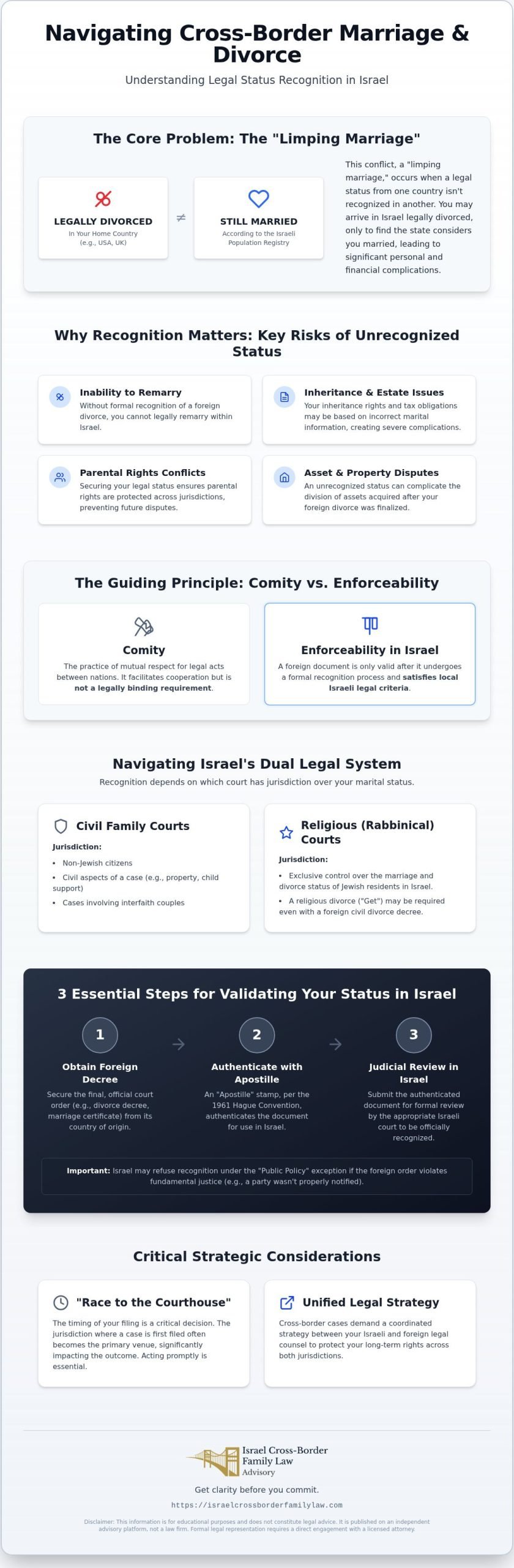
Navigating Cross-Border Family Law with Strategic Clarity
Success in international family law requires more than just following administrative checklists. Every family’s situation is unique, and a “one size fits all” approach inevitably fails when applied to the complexities of Marriage and Divorce Recognition Between Countries. Because legal systems in the US and Israel operate on fundamentally different principles, a strategy that works in a local New York court might create significant obstacles when you attempt to register that same status in Israel. Strategic clarity isn’t just about winning a case; it’s about ensuring the results are durable across every border you cross.
A coordinated strategy between your US and Israeli counsel is the only way to ensure that a ruling in one country won’t be undermined by the laws of another. This collaboration is vital for effective risk management. By addressing potential conflicts early, you can protect your assets and parental rights before they are ever contested in a courtroom. Waiting until a dispute arises often means you’ve already lost the advantage of choice regarding jurisdiction or applicable law. Legal recognition serves as the foundation of your international life, providing the security needed to build a future in a new country without the shadow of unresolved legal ties.
The Value of Expert Advisory
An international family lawyer acts as a critical bridge between divergent legal cultures, translating complex requirements into actionable steps. They help you avoid the heavy emotional and financial costs associated with a “limping” legal status, where your rights are in limbo. By aligning your legal actions in both jurisdictions, you ensure that your divorce or marriage is recognized fully, rather than partially. If you’re unsure of your current standing or need to plan your next steps, you can start by requesting a confidential case review to gain a professional perspective on your situation.
Closing Guidance
The weight of early decisions in cross-border cases can’t be overstated. You need complete clarity before making life-altering commitments, such as moving children between countries or signing property settlement agreements. This guide is published on an independent advisory platform to help you understand the landscape of Marriage and Divorce Recognition Between Countries without the pressure of formal representation. Get clarity before you commit. We invite you to request a confidential consultation to discuss your specific needs and develop a strategy that protects your interests in both Israel and the United States.
Securing Your Legal Status Across Borders
Navigating the intersection of two distinct legal systems requires foresight and a commitment to technical precision. You’ve learned that achieving Marriage and Divorce Recognition Between Countries isn’t a simple administrative task but a strategic judicial process involving both Civil and Religious authorities in Israel. By securing the proper Apostilles, obtaining certified translations, and filing correctly with the Family or Rabbinical Court, you prevent the risk of a “limping marriage” and protect your long-term inheritance and parental rights.
This advisory platform serves as a vital bridge for US-Israel families, drawing on decades of cross-border experience and practitioners licensed in multiple jurisdictions to provide the strategic focus your case demands. These complex multi-jurisdictional issues are best addressed with clarity before they become contested disputes. Get clarity before you commit. Request a confidential consultation. We’re here to help you move forward with confidence and legal certainty.
Frequently Asked Questions
Is a US divorce decree automatically recognized in Israel?
A US divorce decree is not automatically recognized in Israel and must undergo a formal validation process through the Family Court or Rabbinical Court. This judicial review ensures the decree aligns with Israeli public policy and that due process was followed in the original jurisdiction. Without this step, your status in the Israeli Population Registry remains “married,” which can complicate legal rights and future personal status changes within the country.
What is an Apostille and why do I need one for my marriage certificate?
An Apostille is a specialized certificate issued by a government authority that authenticates the signature on a public document for use in other countries. You need one for your marriage certificate because Israel is a signatory to the Hague Convention, which requires this specific verification to accept foreign documents. It proves to the Israeli Ministry of Interior that your US marriage certificate is a legitimate legal document issued by a valid state authority.
Can the Israeli Rabbinical Court refuse to recognize my US divorce?
Yes, the Rabbinical Court can refuse recognition if the divorce does not meet specific religious criteria or if there were procedural flaws in the US case. For Jewish couples, a civil divorce alone is often insufficient for religious status changes in Israel. The court may require the delivery of a “Get” to ensure that Marriage and Divorce Recognition Between Countries is fully realized under both civil and religious frameworks.
What happens if I am divorced in the US but still married in Israel?
This situation creates a “limping marriage,” where you are single in the US but legally tethered to your former spouse in Israel. This discrepancy can lead to conflicting inheritance claims, tax complications, and the inability to legally remarry within Israel. It also leaves you vulnerable to alimony or property claims in the Israeli court system, even if those issues were seemingly resolved by your American divorce decree.
Do I need to travel to Israel to have my marriage recognized?
You generally don’t need to travel to Israel to have your marriage recognized if you engage a qualified professional to handle the filing on your behalf. Most registration and court validation processes can be managed through power of attorney and the submission of authenticated documents. However, ensuring you have the correct Apostilles and notarized translations before submission is critical to avoid administrative delays that might eventually require your physical presence.
How long does the recognition process take in the Israeli Family Court?
The recognition process in the Israeli Family Court typically takes between three and six months, depending on the court’s current caseload and the complexity of your specific case. If the application is straightforward and all documents are correctly authenticated, the timeline is shorter. However, if the other party contests the recognition or if there are gaps in the documentation, the judicial review can extend well beyond the average six month window.
Will Israel recognize a same-sex marriage performed in the United States?
Israel recognizes same-sex marriages performed abroad for the purpose of registration in the Population Registry, granting couples the same civil rights as other married pairs. While the religious courts do not recognize these unions, the Ministry of Interior must record the status based on a valid foreign marriage certificate. This ensures that same-sex couples can access joint tax benefits, residency rights, and other civil protections afforded to married residents under Israeli law.
Can I enforce a US child support order in Israel without full divorce recognition?
You can often enforce a US child support order in Israel even before the divorce itself is fully recognized. Israeli courts prioritize the welfare of the child and can adopt foreign support orders through a separate enforcement procedure. This allows for the collection of payments through the Israeli Enforcement and Collection Authority, ensuring that financial support continues while the broader complexities of Marriage and Divorce Recognition Between Countries are being resolved.

Article by
Gabriel Lior
A Personal Journey That Became a Mission
The advisory was founded by an American father Gabriel Lior, LLB, MBA , global entrepreneur, and cross-border advisor who spent more than a decade navigating the Israeli family court system firsthand and now lives in Singapore with his son.
As a divorced parent in a cross-border family, Gabriel faced nearly every legal challenge a foreign parent can encounter in Israel — including child custody disputes, child support proceedings, property matters in Israel and abroad, false accusations, and complex immigration and relocation proceedings.
Over the years, he learned the hard way how difficult it is for non-Israeli parents to understand the system, identify the right legal strategy, and choose the right legal representation — especially when language, culture, and jurisdictional differences are involved. He also witnessed how foreign parents and new immigrants are often disadvantaged or taken advantage of by service providers and institutions simply because they lack local knowledge or fluency.
From Client to Advisor
To truly understand — and survive — the system, Gabriel pursued formal legal education in Israel, completing two Israeli law degrees, alongside a BA and MBA earned in the United States. This was never about becoming a practicing attorney, but about gaining a deep, structural understanding of how the system works — and where it breaks down for foreign parents.
This rare combination of:
Firsthand client experience
Israeli legal and US business education
International business and negotiation training
Decades of commercial execution
created a unique perspective – one that understands both sides of the table.
After years of litigation, persistence, and at times self-representation, he ultimately succeeded in securing custody of his son and relocating abroad through a rare legal victory in the Israeli Supreme Court — becoming one of the first fathers in Israel to do so under these circumstances.
Disclaimer
Important Disclaimer:
The information provided on this website and in its content is for general informational and educational purposes only and does not constitute legal advice, legal opinion, or legal representation.
Gabriel Lior is not licensed to practice law in Israel (nor is he interested in doing so) and does not provide legal services, despite having completed 2 Law Degrees. The services offered are advisory in nature and are intended to provide general guidance, strategic insight, and information regarding cross-border family law considerations.
No attorney-client relationship is formed by accessing this website, reading its content, or communicating with us.
Any decisions made based on this information are at your own discretion and risk. For legal advice specific to your situation, you should consult a licensed attorney in the relevant jurisdiction.
Where appropriate, we may refer clients to independent, licensed attorneys or professionals. Such referrals do not constitute legal representation and no liability is assumed for services provided by third parties.