This article is published on an independent advisory platform (not a law firm). Do NOT use language that implies attorney-client relationship, legal representation, or giving legal advice. Focus on strategy, risks, and decision-making guidance. Soft CTA to advisory call / WhatsApp.
The decision of where to file for divorce first might be the single most important financial choice you ever make, yet many international families in Caesarea leave it to chance. In the dual-court system of Israel, being the first to file can determine whether your case is heard in a civil Family Court or a religious Rabbinical Court. For those with assets or residency ties in the United States, consulting a cross-border family law expert Caesarea is often the first step in preventing a jurisdictional nightmare that could impact your business interests or real estate holdings.
It’s understandable to feel paralyzed by the complexity of two different legal systems. You shouldn’t have to guess which country has jurisdiction or fear how international child custody rules will apply to your family. This guide provides a strategic advisory framework to help you navigate these hurdles. We’ll explore the critical "race for jurisdiction," the protection of multi-jurisdictional assets, and how to make informed decisions before you commit to a specific legal path, especially given recent changes to court authority over child support.
Key Takeaways
- Understand how the “race for jurisdiction” between Israeli Family Courts and Rabbinical Courts dictates the legal framework for your entire case.
- Learn why consulting a cross-border family law expert Caesarea is essential for managing the intersection of US expectations and Israeli legal realities.
- Discover strategic methods to protect high-value assets like tech equity and RSUs through the lens of US-Israel tax treaties.
- Gain clarity on why early decision-making and forum shopping between Israel and the US can significantly alter your long-term financial outcome.
- Shift your focus from immediate litigation to a comprehensive advisory strategy that prioritizes informed choice and risk mitigation.
This article is published on an independent advisory platform (not a law firm). Do NOT use language that implies attorney-client relationship, legal representation, or giving legal advice. Focus on strategy, risks, and decision-making guidance. Soft CTA to advisory call / WhatsApp.
Understanding the Multi-Jurisdictional Landscape for Caesarea Residents
Cross-border family law isn’t just about local statutes; it’s about the intersection of two distinct legal systems. For residents of Caesarea, many of whom maintain deep ties to the United States, a standard divorce or estate plan often fails to account for transnational complexities. Unlike domestic cases, these matters involve understanding conflict of laws, which determines which country’s rules apply to your assets, your children, and your future. Engaging a cross-border family law expert Caesarea ensures that you aren’t just reacting to local filings but are executing a global strategy.
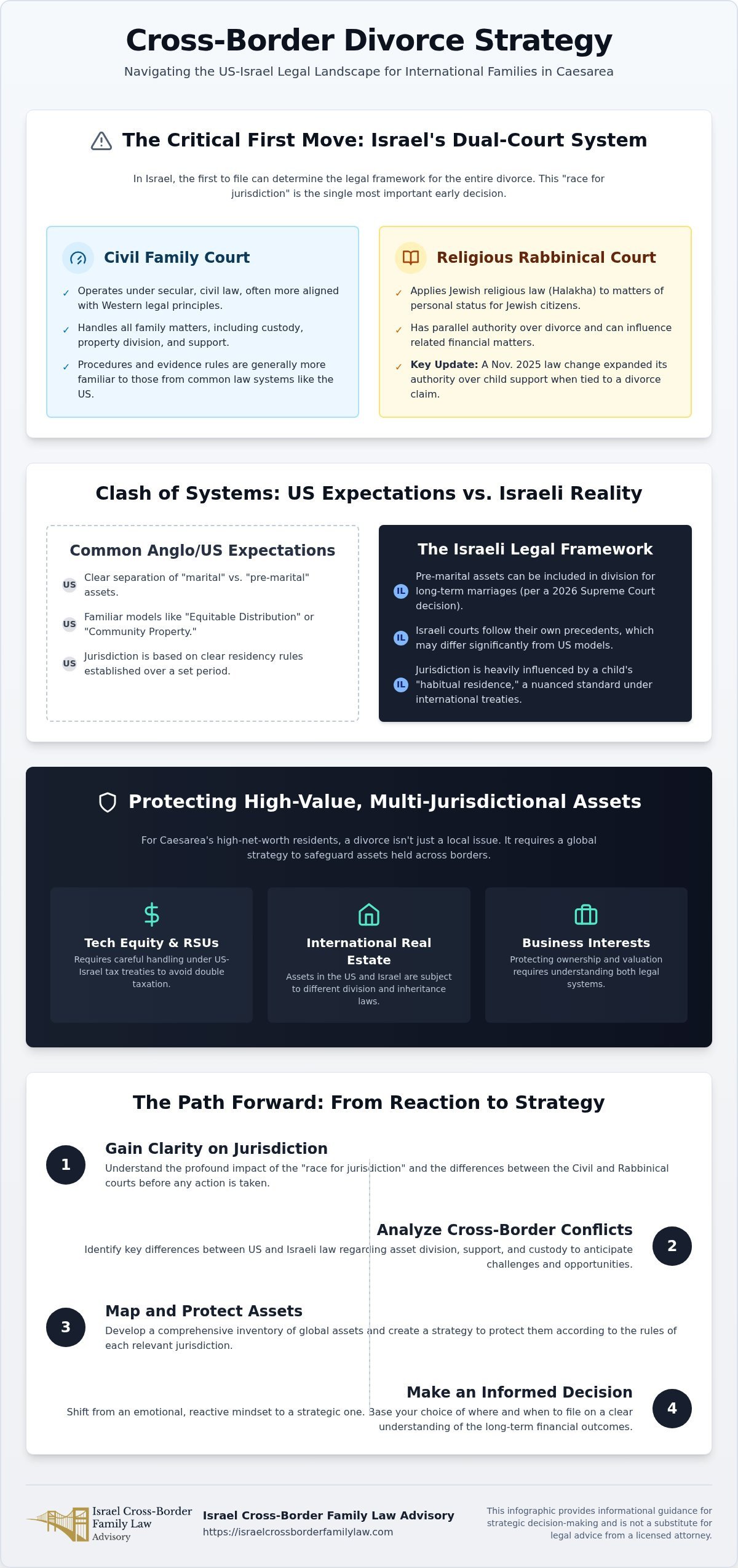
Israel operates a dual-court system that often surprises Anglos. You have the civil Family Courts and the religious Rabbinical Courts. Both have the authority to handle divorce and related matters, but they apply different philosophies and procedures. This creates a unique landscape where the court that first receives a filing often gains the right to decide most aspects of the case. A cross-border family law expert Caesarea can help you understand how these systems interact, especially since a November 2025 law change granted Rabbinical Courts expanded authority over child support matters when included in a divorce claim.
The Expat and High-Net-Worth Context in Caesarea
Caesarea is home to a high concentration of tech entrepreneurs, executives, and families with global footprints. When your life spans multiple borders, your residency status isn’t just a tax detail; it’s a jurisdictional trigger. Strategic planning is required to ensure that your legal standing in Israel doesn’t inadvertently compromise your rights in the US. Our guidance for expats and foreign nationals emphasizes that your "habitual residence" can dictate which court has the final say in custody or asset division. For high-net-worth individuals, the stakes involve protecting international business interests and real estate that may be subject to different rules in each country.
Conflict of Laws: US vs. Israeli Legal Frameworks
A common misconception among Anglos is that Israeli law mirrors the US "equitable distribution" or "community property" models. In reality, Israeli courts have their own precedents, such as a 2026 Supreme Court decision that makes pre-marital assets more likely to be included in the division of resources for long-term marriages. Understanding the concept of habitual residence is critical; it’s the legal standard used to decide where a child’s life is centered under international treaties. Without a clear strategy, you might find yourself litigating in a system that doesn’t align with your initial expectations. An advisor acts as a bridge, translating these complex overlaps into a clear decision-making path before any formal legal action begins.
Get clarity before you commit. Request a confidential consultation.
This article is published on an independent advisory platform (not a law firm). Soft CTA to advisory call / WhatsApp.
Critical Strategy: Jurisdiction, Forum Shopping, and Early Decisions
Jurisdiction is often the most contested element in a US-Israel case. It’s not simply about where you live; it’s about which court system will best protect your long-term interests. Choosing the wrong forum can lead to years of litigation in a system that doesn’t recognize your pre-marital property or uses a different standard for alimony. A cross-border family law expert Caesarea provides the foresight needed to evaluate these risks before the first document is filed. Strategic decisions made in the early stages often dictate whether you’ll be litigating under Israeli civil law, religious law, or the statutes of a specific US state.
The Race to the Courtroom: Why Timing Matters
In Israel, the "race for jurisdiction" is a defining feature of the legal landscape. The court where a case is filed first, whether the civil Family Court or the Rabbinical Court, often dictates the legal framework for the entire proceeding. For international families, this race extends across oceans. If your spouse files in a US state while you wait to file in Israel, you may face a clash of jurisdictions. US courts might assert authority over assets or custody based on their own residency rules, creating a situation where two different countries are issuing conflicting orders. This is particularly critical given the November 2025 law change that allows Rabbinical Courts to hear child support matters when bundled with a divorce claim.
Delay is the greatest risk in these scenarios. once a court in one country establishes its jurisdiction, it’s incredibly difficult to move the case elsewhere. Strategic forum shopping involves analyzing which jurisdiction offers more favorable outcomes for specific assets, such as high-tech equity or US-based real estate. It’s about clarity before commitment. You can explore your strategic options during a confidential advisory session to understand how timing impacts your specific situation and asset protection goals.
International Child Custody and the Hague Convention
When children are involved, the legal landscape becomes even more rigid. The Hague Conference on the Civil Aspects of International Child Abduction is the primary treaty governing these disputes. In 2026, Israeli courts continue to interpret this treaty very restrictively. They prioritize the return of the child to their "habitual residence" and rarely grant exceptions. This means that an unauthorized move, even if intended as a temporary visit to the US, can be legally classified as child abduction.
Strategic planning for international custody and relocation must happen long before a move is contemplated. Whether you’re considering moving back to the US or staying in Israel, you must understand how the courts define residency and what permissions are required. Missteps in this area can lead to claims of wrongful retention, which are costly and emotionally draining. An advisory approach helps you map out these risks and build a global legal strategy that protects your parental rights.
Get clarity before you commit. Request a confidential consultation.
This article is published on an independent advisory platform (not a law firm). Soft CTA to advisory call / WhatsApp.
Key Criteria for Selecting a Cross-Border Family Law Expert in Caesarea
Finding the right support for a transnational case requires more than just checking a local directory. While many practitioners handle domestic divorce, a cross-border family law expert Caesarea must possess a specific set of skills that bridge the gap between US common law expectations and the Israeli civil and religious systems. This expertise is critical when your case involves assets or residency status that trigger regulations in both countries. Selecting an advisor who understands these dual pressures allows you to build a strategy that accounts for risks in both jurisdictions before you ever step into a courtroom.
Local presence in the Caesarea and Netanya region is also a practical necessity for logistical efficiency. An advisor who maintains a physical presence within the target market is better positioned to navigate the nuances of local court schedules and regional professional networks. This local grounding, combined with a global perspective, provides the security and comprehensive support international families require during high-stakes transitions.
Assessing Multi-Jurisdictional Licensing and Experience
A generalist might understand the basics of an Israeli divorce, but a specialist focuses on the transnational operations that define your life. You’re looking for an advisor who understands the intersection of divergent legal cultures. Ask specifically about their history with US-Israel matters and whether they’ve handled cases involving split residencies or assets held in US trusts. Differentiating between a generalist and a cross-border specialist often comes down to their ability to anticipate international conflicts. They should be able to explain how a US state court might react to an Israeli filing or how the 2026 Supreme Court decision on pre-marital assets affects your specific holdings.
Cultural and Linguistic Fluency in US-Israel Matters
Linguistic fluency is only the surface level of effective communication. You need an advisor who understands the cultural nuances of the "Anglo" experience in Israel. This involves more than just translating Hebrew documents into English; it requires explaining the Israeli system in a way that aligns with your previous experiences with US legal norms. If an advisor can’t explain why a Rabbinical Court might have jurisdiction over your child support despite your US residency, they may lack the cross-cultural depth required for your case. You can find more Insights on Israel Family Law to help you understand these cultural and legal shifts. Clarity in communication ensures that you aren’t just following a process but are actively making informed choices about your future.
Get clarity before you commit. Request a confidential consultation.
This article is published on an independent advisory platform (not a law firm). Soft CTA to advisory call / WhatsApp.
High-Value Asset Protection and International Wealth Management
High-value divorce in Caesarea isn’t just about dividing a bank account. For residents of this coastal enclave, wealth is often tied up in complex international structures that span multiple jurisdictions. Managing tech equity, Restricted Stock Units (RSUs), and startup interests requires a sophisticated understanding of both US financial instruments and Israeli asset division rules. A cross-border family law expert Caesarea serves as a strategic advisor to ensure these assets are valued correctly and protected from unnecessary exposure. You shouldn’t leave the valuation of your hard-earned equity to a court system that may not fully grasp the nuances of US vesting schedules.
The intersection of US-Israel tax treaties is another critical layer that many overlook until it’s too late. Settlements that look fair on paper can become financial burdens if they trigger unexpected tax liabilities in either country. For example, US retirement accounts like 401ks and IRAs are subject to specific federal rules that an Israeli court might not fully account for without expert guidance. In the 2026 market, the cost for a comprehensive forensic accounting report covering these multi-jurisdictional assets typically ranges from ₪18,000 to ₪50,000. This investment is often necessary to provide the clarity needed for a truly equitable division of international wealth.
Protecting Business Interests and Tech Equity
Shielding corporate interests during a family dispute is paramount for entrepreneurs and executives. If you’re involved in a startup or a multinational firm, your equity might be your largest asset. Valuation challenges often arise when an Israeli-based tech company has a US parent or significant US operations. You must navigate these waters carefully to avoid disrupting business continuity or triggering clawback provisions. Strategic guidance can help you understand how to structure settlements that respect marital property rules while preserving your professional legacy. For more on the business side of these transitions, you can read about navigating US-Israel M&A.
Real Estate and Trusts in Cross-Border Estates
Israeli courts have a unique perspective on international trusts and offshore holdings. While trusts are a common tool for US estate planning, their recognition in Israel can be inconsistent and may lead to unexpected legal hurdles during a divorce or probate. Securing your home in Caesarea while navigating foreign property interests requires harmonizing your US and Israeli estate planning documents. Without this alignment, you risk a situation where your US will or trust is contested or ignored by Israeli authorities. Early strategic intervention is the best way to protect inherited wealth or pre-existing real estate from being pulled into a general pool of marital assets.
Request a strategic asset review
Get clarity before you commit. Request a confidential consultation.
This article is published on an independent advisory platform (not a law firm). Soft CTA to advisory call / WhatsApp.
The Path Forward: Strategy Before Legal Action
Immediate litigation is often a reflexive response to the stress of a family dispute, but in a transnational context, it’s frequently the most dangerous path. Rushing into the Israeli court system without a comprehensive plan can lock you into a jurisdictional framework that doesn’t account for your US interests. A cross-border family law expert Caesarea focuses on providing an advisory bridge, ensuring you understand every risk before a single document is filed. This approach prioritizes strategy over conflict, allowing you to weigh the benefits of different forums and legal systems in a calm, controlled manner.
Choosing an advisory approach means you aren’t just reacting to your spouse’s actions. Instead, you’re building a foundation that considers the long-term impact on your professional and personal life. In the 2026 legal climate, where 35% to 40% of Jewish marriages in Israel end in divorce, the difference between a successful outcome and a protracted battle often lies in the quality of your initial decisions. Strategic foresight prevents the common mistake of filing in a court that may be less favorable for your specific asset profile or custody goals.
Building a Global Legal Strategy
Coordinating between professional teams in both the US and Israel is a core component of a successful strategy. You shouldn’t have to manage separate legal battles that don’t communicate with each other. By identifying risks in the early stages, such as the mandatory 119 NIS "Settlement of Dispute" application fee required before other claims can be filed, you can time your actions to maximize your legal standing. Understanding these procedural requirements is essential for maintaining control over the narrative of your case. Our guide on how the advisory works explains this collaborative process in detail.
Moving from Confusion to Informed Choice
Clarity is your most valuable asset when facing multi-jurisdictional complexity. A neutral advisory role isn’t about pushing you toward a specific outcome; it’s about providing the data you need to make an informed choice. High-stakes family law requires a steady hand and a clear vision of the long-term impact on your business, real estate, and parental rights. Confusion often stems from the cultural and systemic differences between US and Israeli law. A neutral advisor helps you bridge this gap without the immediate pressure of a formal legal engagement. This allows for an honest assessment of risks, such as the 2026 Supreme Court precedents regarding pre-marital assets, without the bias of a litigation-driven agenda. You can begin this process by requesting a confidential case review to map out your specific challenges before they escalate.
Get clarity before you commit. Request a confidential consultation.
This article is published on an independent advisory platform (not a law firm). Soft CTA to advisory call / WhatsApp.
Securing Your Future Through Strategic Foresight
Navigating the intersection of US and Israeli legal systems requires more than just local representation; it demands a global perspective. By prioritizing strategy before legal action, you protect high-value assets like tech equity and ensure that jurisdictional decisions are made in your favor. Engaging a cross-border family law expert Caesarea allows you to bridge the gap between two complex systems while maintaining clarity and control over your family’s future.
This strategic approach transforms a confusing process into a series of informed choices. Whether you’re managing international real estate or coordinating custody across borders, early decisions often dictate the ultimate outcome. You can move forward with confidence by focusing on risk mitigation and multi-jurisdictional alignment before any formal steps are taken. Professional guidance ensures that your long-term interests remain the priority throughout the transition.
Request a strategic advisory session
Get clarity before you commit. Request a confidential consultation.
This article is published on an independent advisory platform (not a law firm). Soft CTA to advisory call / WhatsApp.
Frequently Asked Questions
Can a US court decide on my divorce if I live in Caesarea?
A US court can assert jurisdiction over your divorce if you or your spouse maintains a legal residence in a US state or if you have substantial assets there. This often creates a jurisdictional overlap where both US and Israeli courts claim authority. Navigating this requires an advisory approach that evaluates which forum offers the most favorable legal framework. Consulting a cross-border family law expert Caesarea helps you understand the risks of conflicting orders before you file any formal paperwork.
How is child support enforced between the US and Israel?
Child support enforcement is facilitated through international treaties such as the 2007 Hague Maintenance Convention. If an order is issued in a US state, it can often be registered and enforced through the Israeli Ministry of Justice. This reciprocal process ensures that obligations are met regardless of where the parents reside. Strategic advisory helps you understand these enforcement mechanisms and the potential risks of cross-border collection before you enter into a formal support agreement.
What happens to my US retirement accounts in an Israeli divorce?
US retirement accounts like 401ks and IRAs are subject to specific federal regulations that an Israeli court may not fully recognize. While an Israeli judge can order these assets divided, you typically need a Qualified Domestic Relations Order (QDRO) from a US court to execute the transfer without tax penalties. Coordinating between both systems is vital to ensure that your retirement savings are protected and that any division complies with the relevant US-Israel tax treaties.
Is an American prenuptial agreement enforceable in Israel?
An American prenuptial agreement is not automatically valid in Israel and must be reviewed by an Israeli court to ensure it meets local standards. The court will examine whether the agreement was signed with full disclosure and without coercion. For international families, it’s often strategic to have the agreement validated or mirrored in Israel to avoid future disputes. This proactive step provides security for pre-marital assets and clarity for both civil and religious courts.
How does the Israeli Rabbinical Court affect a cross-border divorce?
The Rabbinical Court holds exclusive jurisdiction over the marriage and divorce of Jewish residents in Israel. It can also rule on related matters like property and child support if they are included in the initial divorce claim. For Anglos living in Caesarea, this religious system introduces different evidentiary rules and philosophies compared to US courts. Understanding how these courts interact with civil Family Courts is a critical part of building a successful global legal strategy.
What is the Hague Convention, and how does it apply in Caesarea?
The Hague Convention on the Civil Aspects of International Child Abduction is a treaty designed to return children to their country of habitual residence. In Caesarea, this applies if a parent moves a child to or from the US without proper legal consent. Israeli courts interpret these rules very strictly, often prioritizing the immediate return of the child. Understanding these international protocols is essential for parents considering relocation or managing visitation schedules across different borders.
Do I need a lawyer in both the US and Israel for my family law case?
Managing a case that spans two countries often requires coordinated efforts from legal professionals in both the US and Israel. While your Israeli team handles local court procedures, you may need US counsel to manage American-based assets like real estate or business interests. A cross-border family law expert Caesarea facilitates this collaboration, ensuring that actions taken in one country don’t negatively impact your standing in the other. This integrated approach is essential for protecting multi-jurisdictional interests.
How long does a cross-border family law process typically take?
The timeline for a cross-border case depends on the complexity of international assets and whether the parties can reach an agreement. Disputes involving the Hague Convention or forensic accounting for US-based equity can extend the process significantly. However, the mandatory Israeli mediation step is intended to resolve conflicts more efficiently. Gaining clarity before you commit to a specific path helps you manage expectations and avoid the lengthy delays often associated with uncoordinated, multi-jurisdictional litigation.
Get clarity before you commit. Request a confidential consultation.

Article by
Gabriel Lior
A Personal Journey That Became a Mission
The advisory was founded by an American father Gabriel Lior, LLB, MBA , global entrepreneur, and cross-border advisor who spent more than a decade navigating the Israeli family court system firsthand and now lives in Singapore with his son.
As a divorced parent in a cross-border family, Gabriel faced nearly every legal challenge a foreign parent can encounter in Israel — including child custody disputes, child support proceedings, property matters in Israel and abroad, false accusations, and complex immigration and relocation proceedings.
Over the years, he learned the hard way how difficult it is for non-Israeli parents to understand the system, identify the right legal strategy, and choose the right legal representation — especially when language, culture, and jurisdictional differences are involved. He also witnessed how foreign parents and new immigrants are often disadvantaged or taken advantage of by service providers and institutions simply because they lack local knowledge or fluency.
From Client to Advisor
To truly understand — and survive — the system, Gabriel pursued formal legal education in Israel, completing two Israeli law degrees, alongside a BA and MBA earned in the United States. This was never about becoming a practicing attorney, but about gaining a deep, structural understanding of how the system works — and where it breaks down for foreign parents.
This rare combination of:
Firsthand client experience
Israeli legal and US business education
International business and negotiation training
Decades of commercial execution
created a unique perspective – one that understands both sides of the table.
After years of litigation, persistence, and at times self-representation, he ultimately succeeded in securing custody of his son and relocating abroad through a rare legal victory in the Israeli Supreme Court — becoming one of the first fathers in Israel to do so under these circumstances.
Disclaimer
Important Disclaimer:
The information provided on this website and in its content is for general informational and educational purposes only and does not constitute legal advice, legal opinion, or legal representation.
Gabriel Lior is not licensed to practice law in Israel (nor is he interested in doing so) and does not provide legal services, despite having completed 2 Law Degrees. The services offered are advisory in nature and are intended to provide general guidance, strategic insight, and information regarding cross-border family law considerations.
No attorney-client relationship is formed by accessing this website, reading its content, or communicating with us.
Any decisions made based on this information are at your own discretion and risk. For legal advice specific to your situation, you should consult a licensed attorney in the relevant jurisdiction.
Where appropriate, we may refer clients to independent, licensed attorneys or professionals. Such referrals do not constitute legal representation and no liability is assumed for services provided by third parties.