Facing a threat to your personal safety in a foreign country presents a unique and distressing challenge, where the complexities of an unfamiliar legal system can amplify feelings of vulnerability. For foreign nationals and expatriates residing in Israel, the immediate need for security can seem at odds with the intimidating process of seeking legal protection. However, securing a protective order in Israel is a decisive legal remedy available to you, providing a critical first step toward ensuring your safety and that of your family. This comprehensive guide is designed to demystify the process, providing clear, actionable guidance specifically for individuals navigating cross-border and multi-jurisdictional complexities. We will walk you through the essential steps for petitioning the court, detail the types of evidence required to build a compelling case, and explain how these orders are enforced. Our objective is to empower you with the knowledge to confidently assert your rights, achieve immediate safety, and understand the strategic legal options available to you within the Israeli judicial framework.
Understanding the Legal Framework: Israel’s Two Paths to Protection
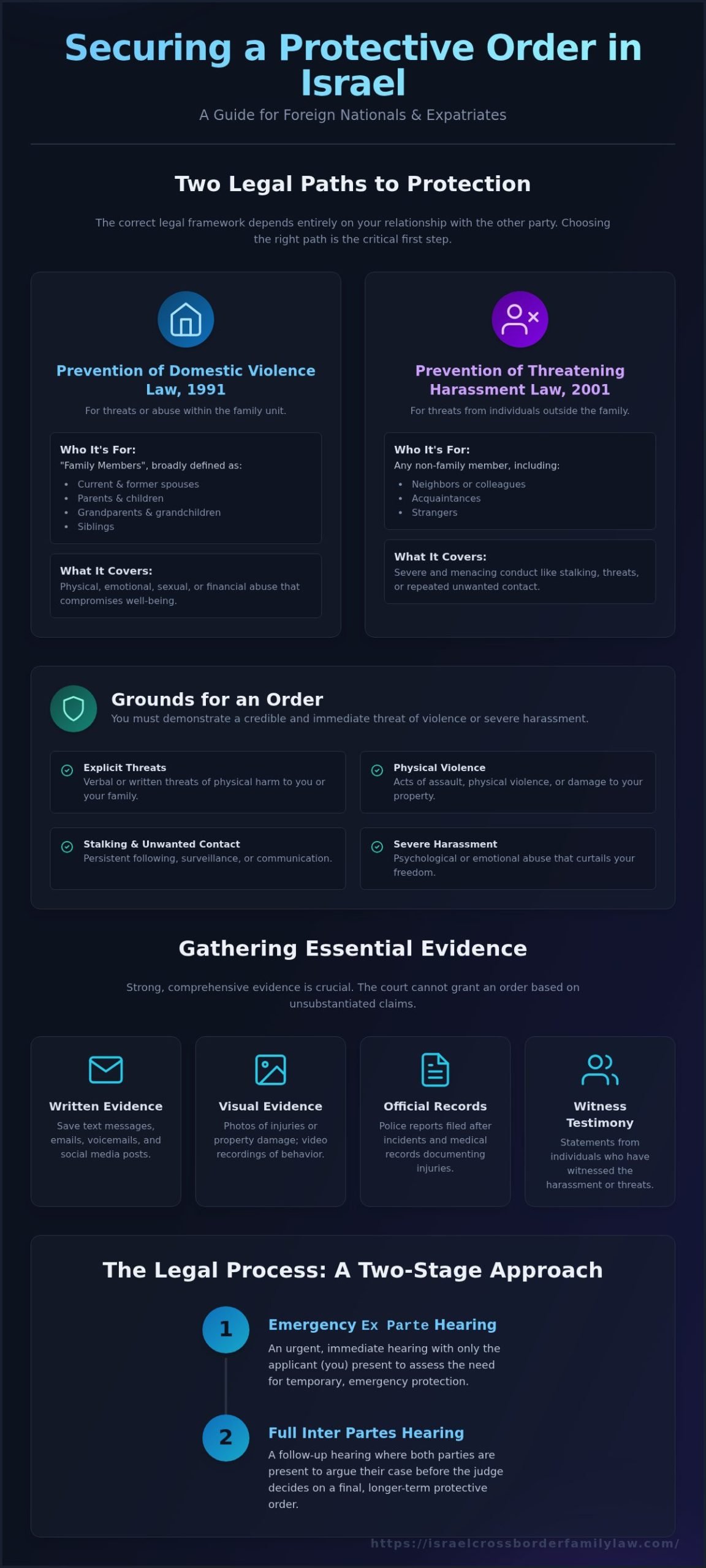
When seeking legal protection from violence, threats, or harassment, it is critical to understand that the legal system provides two distinct statutory frameworks for obtaining a protective order israel. The appropriate path for securing this legal instrument-often known more generally as a restraining order-is determined entirely by the petitioner’s relationship to the individual from whom protection is sought. This fundamental distinction is the first and most crucial step in navigating the process, as selecting the correct law dictates the legal standards, evidence required, and the jurisdiction of the court. To better understand the core concepts involved, the following video provides a helpful overview:
The Prevention of Domestic Violence Law, 1991
This legislation is specifically engineered to address and prevent violence within the family unit. The law defines ‘family member’ with considerable breadth, encompassing current and former spouses, parents and their children, grandparents and grandchildren, and siblings. The protection extends beyond physical harm to include severe emotional, sexual, or financial abuse that compromises an individual’s well-being. This statute is the primary legal tool for obtaining a protective order israel in family court, especially for individuals needing protection during contentious matters such as divorce or separation, providing a direct avenue for safeguarding vulnerable parties.
The Prevention of Threatening Harassment Law, 2001
For situations where the threatening party is not a family member, the Prevention of Threatening Harassment Law provides the necessary legal recourse. This law is applicable to a wide range of perpetrators, including neighbors, colleagues, acquaintances, or even strangers. The focus of this statute is on conduct that constitutes threatening harassment, such as stalking, repeated unwanted contact, threats of violence, or any behavior that significantly invades an individual’s privacy and causes them to fear for their safety. Obtaining a protective order israel under this law requires demonstrating to the court that the harassment is of a severe and menacing nature, justifying judicial intervention.
Who Can Apply for a Protective Order and on What Grounds?
In the Israeli legal system, any individual who has a reasonable basis to fear for their personal safety or liberty due to the actions of another person may apply for a protective order. The fundamental principle guiding the court is the demonstration of a credible and immediate threat of violence or severe harassment. While the judiciary is committed to providing protection, it must also carefully weigh the significant implications of restricting an individual’s freedom of movement and communication. Therefore, a successful application for a protective order in Israel hinges on presenting a compelling case supported by substantive evidence of threatening behavior.
Establishing Grounds for the Order
The legal grounds for issuing a protective order are established when an applicant can prove that the respondent’s behavior poses a tangible danger to their well-being. The court will assess whether the conduct causes a reasonable fear of harm. The basis for such orders is codified in key legislation, such as the Prevention of Family Violence Law, which provides a framework for judicial intervention. Grounds can be established through either a single, severe incident of violence or a persistent pattern of behavior, which may include:
- Explicit threats of physical harm to the applicant or their family.
- Acts of physical violence, assault, or property damage.
- Stalking, including persistent, unwanted following, surveillance, or communication.
- Severe psychological or emotional harassment that curtails the applicant’s freedom.
Essential Evidence to Support Your Application
A court cannot grant a protective order in Israel based on unsubstantiated claims. It is imperative for the applicant to systematically document every incident and gather robust evidence to corroborate their application. The strength of your petition is directly correlated with the quality and comprehensiveness of the evidence presented. Key evidentiary materials include:
- Written Evidence: Preserve all threatening or harassing communications, such as text messages, emails, voicemails, and social media posts or messages.
- Visual Evidence: Photographs of physical injuries, damaged property, or video recordings of the respondent’s threatening behavior can provide powerful, objective proof.
- Official Records: Any police reports filed in response to incidents, as well as medical records that document injuries resulting from abuse, add significant weight and credibility to your claims.
- Witness Testimony: Statements from individuals who have personally witnessed the harassment, threats, or the resulting impact on your well-being can be instrumental in supporting your case.
The Step-by-Step Process for Obtaining a Protective Order in Israel
The Israeli legal system recognizes the urgency inherent in situations of domestic violence or harassment. Consequently, the process for obtaining a protective order in Israel is structured for swift intervention. It is a multi-stage procedure designed to provide immediate safety while ensuring due process for all parties. The framework begins with an emergency ex parte hearing and culminates in a full hearing where both parties are present. Successfully navigating these steps is significantly enhanced by the guidance of experienced legal counsel who can ensure all procedural requirements are met effectively.
Step 1: Filing the Application
The process commences with the formal submission of an application at the appropriate judicial venue, typically the Magistrate’s Court (Beit Mishpat HaShalom) or the Family Court (Beit Mishpat Le’Inyanei Mishpacha). The applicant is required to complete a designated form and submit a sworn affidavit (ta’tzhir). This affidavit is the cornerstone of the application, as it must meticulously detail the specific facts, dates, and nature of the violence, threats, or harassment. This initial filing is a critical step, particularly for expats and foreign nationals who may be unfamiliar with Israeli court procedures and evidentiary standards.
Step 2: The Initial Ex Parte Hearing
To address the immediate threat, an initial hearing is typically scheduled on the same day the application is filed. This is an ex parte hearing, meaning it is conducted with only the applicant (and their legal representative) present. The respondent is not notified at this stage to prevent any potential escalation of risk. During this session, the judge reviews the affidavit and hears testimony to determine if there is a prima facie basis for issuing an order. If satisfied, the judge will grant a temporary protective order, usually valid for a maximum of seven days, to ensure the applicant’s immediate safety pending a full hearing.
Step 3: The Full Hearing with Both Parties
Following the issuance of a temporary order, the court schedules a second, comprehensive hearing where the respondent is summoned to appear. At this proceeding, both the applicant and the respondent are present and have the right to be heard. Each party may present evidence, call witnesses, and submit arguments. This hearing provides the respondent with the opportunity to contest the allegations. The judge weighs all the evidence presented to decide whether to extend the order, often for a period of up to six months. The court’s final determination is a serious matter, aligning with national policies on Domestic Violence – Prevention and Treatment, and will result in a long-term order if the grounds are sufficiently proven.
What a Protective Order Enforces: Conditions, Duration, and Violations
A protective order is not merely a request; it is a legally binding directive issued by an Israeli court, carrying significant legal authority. Its primary objective is to establish a secure environment for the applicant by imposing specific, enforceable restrictions on the respondent. Comprehending the precise terms and conditions stipulated within the order is paramount for ensuring your safety and leveraging the full protection afforded by Israeli law.
Common Conditions Included in an Order
The court tailors the conditions of a protective order to the specific circumstances of the case, aiming to prevent further harassment or violence. While terms may vary, several conditions are frequently imposed to create a safe distance and eliminate avenues of contact:
- Prohibition of Entry: The respondent is forbidden from entering the applicant’s residence, workplace, or other specified locations such as a child’s school.
- Maintaining Distance: An order will mandate that the respondent maintain a specified physical distance (e.g., 100 or 200 meters) from the applicant and their children at all times.
- No Contact Clause: A comprehensive ban on all forms of communication is standard, including phone calls, text messages, emails, social media interactions, or messages sent via third parties.
- Surrender of Firearms: If the respondent possesses a firearm license, the court is authorized under the Prevention of Family Violence Law to order the immediate surrender of the weapon to the police.
Duration and Extensions
An initial protective order in Israel is typically granted for a period of up to six months. However, the legal framework provides for extensions if the threat persists. Upon application, the court may extend the order for a total duration of up to one year. In special and justifiable circumstances, a further extension for up to two years in total may be granted, though this requires a compelling demonstration of ongoing danger. It is critical to initiate the extension process by filing a request with the court before the existing order is set to expire to avoid any lapse in protection.
Consequences for Violating an Order
Any breach of the conditions set forth in the order constitutes a criminal offense under Israeli law. The legal framework for a protective order israel is designed with robust enforcement mechanisms. If the respondent violates any term-such as making contact or approaching your location-you should contact the Israeli Police (dialing 100) without delay. The police are empowered to arrest the individual for the violation. A conviction for breaching a protective order can result in significant penalties, including substantial fines and imprisonment, underscoring the gravity with which the Israeli legal system treats such violations. Effectively managing the terms of an order and responding to violations requires strategic legal guidance. If you need assistance, our firm provides expert counsel on cross-border family law matters.
Special Considerations for Expats and Cross-Border Cases
For foreign nationals residing in Israel, seeking legal protection against domestic violence presents a unique set of complexities. Navigating the Israeli legal system can be a formidable task, often compounded by significant language barriers, the absence of a familiar support network, and a lack of inherent familiarity with local statutes and procedures. These multi-jurisdictional challenges underscore the critical need for sophisticated legal counsel to ensure your rights are fully protected when pursuing a protective order israel.
Using Evidence from Abroad
Evidence originating from other countries, such as police reports from the United States or prior court filings, can be instrumental in your case. However, for this documentation to be admissible in Israeli Family Court, it must be properly authenticated and professionally translated. Digital communications like emails and text messages sent from abroad are also highly relevant. An experienced lawyer can manage these procedural requirements, ensuring your international evidence is presented effectively to the court.
Impact on International Custody and Relocation
A protective order is often a pivotal factor in complex international custody disputes. The existence of such an order can decisively demonstrate a risk of harm to a child, significantly impacting parental relocation requests and overall custody arrangements. Israeli courts give substantial weight to any history of domestic violence when determining the best interests of the child, and an order can provide the foundation for arguments against unsupervised visitation.
Enforcement and Recognition Across Borders
While an Israeli protective order is enforced by law within Israel’s borders, its influence extends internationally. The order serves as an official judicial finding that can be presented to courts in other jurisdictions, such as the United States, during related divorce or custody proceedings. It substantiates claims of abuse and can influence foreign court decisions. Our firm is adept at guiding clients on how legal actions taken in Israel will affect their status and legal strategy abroad, providing a seamless approach for multi-jurisdictional family law matters.
Securing Your Safety: Final Steps for Your Protective Order in Israel
Navigating the legal system to secure your safety is a paramount concern, especially as an expat or foreign national. This guide has illuminated the critical aspects of the process, from understanding Israel’s dual legal pathways for protection to the specific grounds and procedures required for an application. The key takeaway is that while the system is accessible, its procedural intricacies, particularly in cross-border cases, demand meticulous attention. Successfully obtaining a protective order israel hinges on a comprehensive understanding of these legal and cultural nuances. When facing such a sensitive and complex matter, you do not have to proceed alone. Our firm specializes in US-Israel cross-border family law, offering dedicated guidance for the unique challenges faced by expats and foreign nationals. With extensive experience navigating the Israeli court system, we are positioned to provide the sophisticated representation required to protect your interests. We invite you to Request a Confidential Case Review to Discuss Your Protection Needs and take the definitive step toward securing your safety. Your security is our priority. Allow our experienced team to provide the steady, authoritative guidance you need during this critical time.
Frequently Asked Questions About Protective Orders in Israel
Is legal representation required to get a protective order in Israel?
While an individual can file an application for a protective order without legal representation, it is highly advisable to engage experienced counsel. Navigating the nuances of the Prevention of Family Violence Law and presenting a compelling case before the court requires specific legal expertise. Professional representation ensures that all procedural requirements are met and that your arguments are articulated effectively, significantly increasing the likelihood of a successful outcome and securing the necessary protections.
What is the cost of filing for a protective order?
The Israeli legal system ensures that financial constraints do not impede access to safety. There is no court filing fee (known as an agra) for an application seeking a protective order under the Prevention of Family Violence Law. The primary costs associated with the process are for legal representation, should you choose to retain an attorney. These professional fees will vary depending on the complexity of the case and the specific legal firm engaged.
What happens if someone makes a false accusation to get a protective order?
Israeli courts treat the misuse of the legal process with significant gravity. If an application for a protective order is determined by the court to be frivolous, vexatious, or based on false pretenses, it will be dismissed. Furthermore, the court has the authority to impose sanctions on the applicant, which can include ordering them to pay the respondent’s legal costs and, in certain cases, compensation for damages incurred due to the baseless accusation.
Can I get a protective order to protect my child?
Yes. The legal framework in Israel is designed to safeguard the welfare of minors. A parent or legal guardian can file an application for a protective order in Israel on behalf of a child who is a victim of, or is at imminent risk of, violence or abuse by a family member. In these sensitive matters, the court’s paramount consideration is the safety and best interests of the child, and it will act swiftly to grant protection where warranted.
How quickly can I get protection after filing the application?
The system is structured to provide immediate relief in urgent circumstances. After an application is filed, an ex parte hearing (a hearing in the presence of the applicant only) is typically held on the same day or within 24 hours. If the judge is satisfied that there is an immediate danger, a temporary protective order can be issued on the spot. A second hearing, with both parties present, is then scheduled to take place within seven days.
Can a protective order force someone to leave our shared home?
Absolutely. One of the most critical and common provisions of a protective order in Israel is the authority to remove the respondent from a shared residence. The court can mandate that the individual vacate the property for the duration of the order, irrespective of ownership rights. This measure is designed to create immediate physical safety for the applicant and any children by ensuring the abusive party is kept at a distance from the family home.
What should I do if the other person violates the order?
A violation of a court-issued protective order is a criminal offense in Israel and must be reported immediately. You should contact the Israel Police by dialing 100 and inform them of the breach, providing them with a copy of the order if possible. The police are empowered to arrest the individual for violating the order. It is also crucial to notify your legal counsel, who can initiate contempt of court proceedings to seek further sanctions from the court.

Article by
Gabriel Lior
A Personal Journey That Became a Mission The advisory was founded by an American father Gabriel Lior, LLB, MBA , global entrepreneur, and cross-border advisor who spent more than a decade navigating the Israeli family court system firsthand and now lives in Singapore with his son.
As a divorced parent in a cross-border family, Gabriel faced nearly every legal challenge a foreign parent can encounter in Israel — including child custody disputes, child support proceedings, property matters in Israel and abroad, false accusations, and complex immigration and relocation proceedings. Over the years, he learned the hard way how difficult it is for non-Israeli parents to understand the system, identify the right legal strategy, and choose the right legal representation — especially when language, culture, and jurisdictional differences are involved. He also witnessed how foreign parents and new immigrants are often disadvantaged or taken advantage of by service providers and institutions simply because they lack local knowledge or fluency. From Client to Advisor To truly understand — and survive — the system, Gabriel pursued formal legal education in Israel, completing two Israeli law degrees, alongside a BA and MBA earned in the United States. This was never about becoming a practicing attorney, but about gaining a deep, structural understanding of how the system works — and where it breaks down for foreign parents. This rare combination of: Firsthand client experience Israeli legal and US business education International business and negotiation training Decades of commercial execution created a unique perspective – one that understands both sides of the table. After years of litigation, persistence, and at times self-representation, he ultimately succeeded in securing custody of his son and relocating abroad through a rare legal victory in the Israeli Supreme Court — becoming one of the first fathers in Israel to do so under these circumstances.
Disclaimer
Important Disclaimer: The information provided on this website and in its content is for general informational and educational purposes only and does not constitute legal advice, legal opinion, or legal representation. Gabriel Lior is not licensed to practice law in Israel (nor is he interested in doing so) and does not provide legal services, despite having completed 2 Law Degrees. The services offered are advisory in nature and are intended to provide general guidance, strategic insight, and information regarding cross-border family law considerations. No attorney-client relationship is formed by accessing this website, reading its content, or communicating with us. Any decisions made based on this information are at your own discretion and risk. For legal advice specific to your situation, you should consult a licensed attorney in the relevant jurisdiction. Where appropriate, we may refer clients to independent, licensed attorneys or professionals. Such referrals do not constitute legal representation and no liability is assumed for services provided by third parties.