Initiating legal action against an individual in the United States from Israel presents a formidable set of procedural challenges. The uncertainty surrounding cross-border regulations and the fear of a critical error that could jeopardize your entire legal matter are significant concerns. Understanding precisely how to serve someone in the us from israel is not a mere logistical step; it is a foundational legal requirement governed by sophisticated international treaties. An error at this crucial stage can result in costly delays or even the dismissal of your case, creating substantial risk.
This comprehensive guide is engineered to demystify this complex process and provide authoritative clarity. We will navigate you through the legally recognized methods for effecting service of process, including the specific protocols of the Hague Service Convention. Our objective is to equip you with a clear, step-by-step framework, ensuring your actions are fully compliant with both Israeli and U.S. law. By following this guide, you will gain the confidence that your service will be legally recognized, allowing you to move your case forward effectively.
Key Takeaways
- Successful cross-border service of process hinges on strict compliance with the Hague Service Convention, the primary international treaty governing these complex legal procedures.
- Utilizing the formal Central Authority channel is the most legally secure method for service, providing a clear and recognized path to validation in both Israeli and U.S. courts.
- Navigating how to serve someone in the US from Israel involves understanding alternative methods permitted by the Convention, which may offer greater speed but require careful assessment of potential legal risks.
- Engaging experienced legal counsel is essential, as procedural errors in international service can lead to case dismissal and significant delays, jeopardizing your entire legal matter.
The Legal Foundation: Understanding the Hague Service Convention
In any legal action, “service of process” is the formal procedure of delivering official court documents, such as a summons or complaint, to a defendant. This is not a mere administrative step; it is a fundamental pillar of the judicial system, providing official notice of legal action and ensuring the defendant has an opportunity to respond. Without proper service, a court cannot exercise jurisdiction over a party, which can render subsequent legal proceedings invalid from the outset.
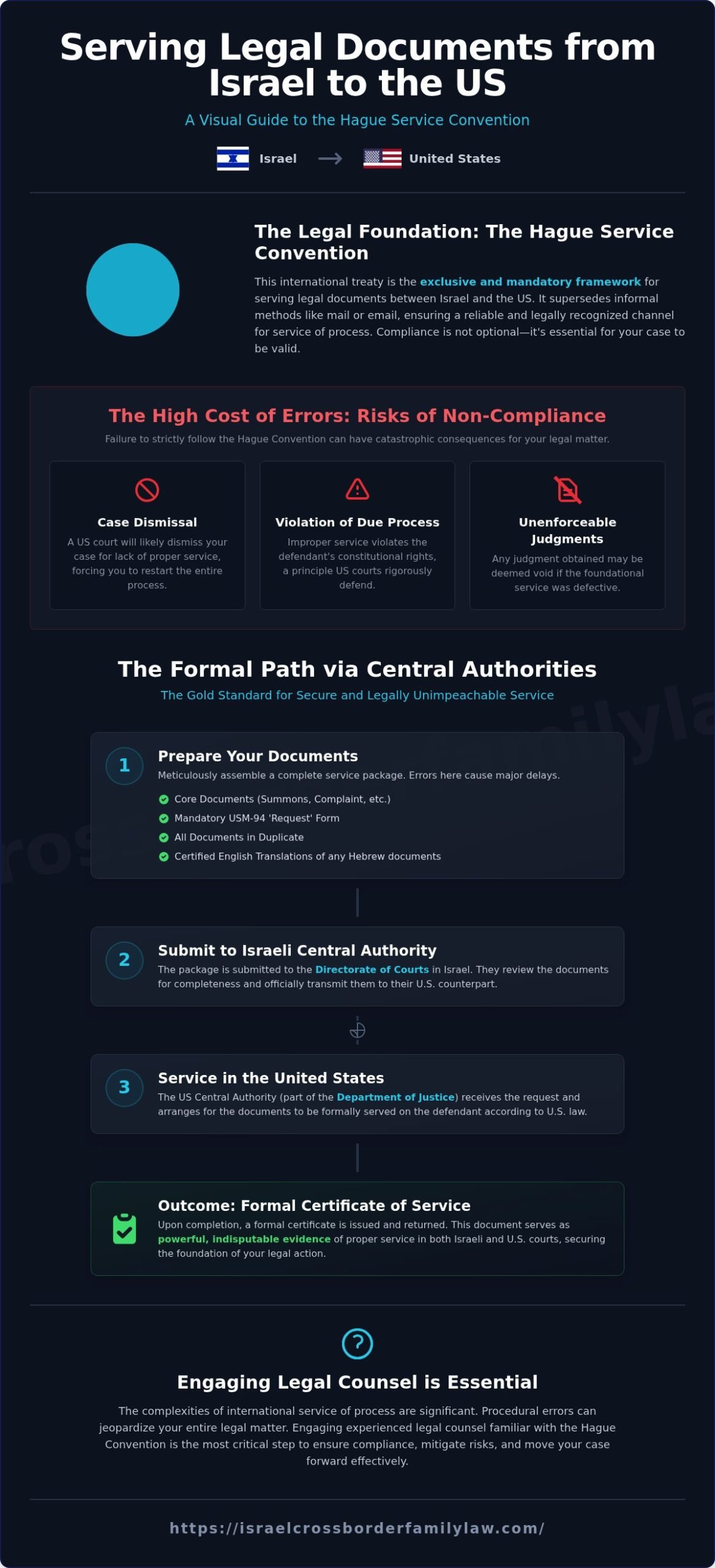
When a legal matter crosses international borders, the complexity of service multiplies. The primary international treaty governing this sophisticated process is The Hague Service Convention, formally the Convention on the Service Abroad of Judicial and Extrajudicial Documents in Civil or Commercial Matters. As both the United States and Israel are signatories, this treaty provides the exclusive and mandatory framework for service between the two nations. Its principal objective is to establish a reliable and efficient channel for transmitting judicial documents, thereby superseding informal and legally insufficient methods like international mail or email. Understanding this convention is the first critical step when navigating how to serve someone in the us from israel.
What is a Central Authority?
A cornerstone of the Hague Convention is the establishment of a Central Authority in each member state. This designated government body acts as the official intermediary for all incoming and outgoing service requests. For Israel, this function is managed by the Directorate of Courts. In the United States, the designated body is the Office of International Judicial Assistance, a component of the Department of Justice (DOJ). The Central Authority is responsible for receiving formal requests from abroad and executing service upon the intended recipient in accordance with its own domestic laws.
Why Following the Convention is Non-Negotiable
Adherence to the Hague Convention’s protocols is not merely a recommendation; it is a strict legal requirement with significant consequences for non-compliance. Improper service can have a catastrophic impact on your legal case, leading to outcomes such as:
- Case Dismissal: A US court will likely dismiss your case for lack of proper service, forcing you to restart the entire process and incur substantial additional costs and delays.
- Violation of Due Process: Correct service ensures the defendant’s constitutional right to due process is upheld, a principle US courts rigorously defend.
- Unenforceable Judgments: Even if a default judgment is obtained, it may be deemed void and unenforceable in the US or abroad if the foundational service was defective.
Method 1: The Formal Path via the Central Authorities
For individuals and corporations seeking the most secure and legally unimpeachable route, utilizing the formal channel established by the Hague Service Convention is the preeminent choice. This method provides a robust, government-to-government framework for serving legal documents. While this process is meticulous and can be more time-consuming than other alternatives, its primary advantage is the issuance of a formal certificate of service. This certificate serves as powerful, often indisputable, evidence in court, making it the gold standard for those learning how to serve someone in the US from Israel in complex or high-stakes litigation.
Step 1: Preparing Your Documents and Request
The initial phase requires meticulous preparation of a comprehensive service package. This package must include the core legal documents to be served, such as a summons, complaint, or divorce petition. Crucially, you must also complete the mandatory ‘Request for Service Abroad’ form (USM-94). All documents must be prepared in duplicate, and if any originals are in Hebrew, they must be accompanied by a certified translation into English to ensure compliance with US requirements. Failure to provide accurate and complete documentation can result in significant delays.
Step 2: Submission to the Israeli Central Authority
Once your document package is assembled, it must be submitted to Israel’s designated Central Authority, which is the Directorate of Courts. This body acts as the official conduit for all outgoing service requests under the Hague Convention. The Directorate will conduct a thorough review of your application to verify its completeness and accuracy. Upon approval, the Israeli authority formally transmits the request to its counterpart in the United States, initiating the cross-border legal process.
Step 3: Execution of Service in the United States
Upon receipt, the official U.S. Hague Service Convention Central Authority forwards the documents to a qualified process server in the relevant jurisdiction. This server is tasked with locating the designated individual or entity and executing service in accordance with local U.S. state law. Following the service attempt, the server completes a formal certificate detailing the outcome-when, where, and how the documents were delivered, or why service could not be completed. This certificate is then returned to you through the same official channels. This evidentiary integrity is particularly crucial for international families navigating divorce or separation.
Method 2: Alternative Channels Under the Hague Convention
While the Central Authority route offers maximum legal certainty, the Hague Service Convention provides for alternative methods of service. The United States has not objected to these channels, making them permissible options for Israeli litigants. These alternative routes can offer a significant advantage in terms of speed, but they introduce complex legal variables and potential risks that demand careful consideration. The viability of these methods often depends on the specific laws of the US state where service is being effected, making expert legal guidance indispensable before proceeding.
Navigating these options is a critical aspect of understanding how to serve someone in the us from israel effectively. A strategic decision to use an alternative channel must be based on a thorough analysis of the case specifics, the defendant’s likely response, and the procedural rules of the relevant jurisdictions.
Service Directly via a US Process Server
Under Articles 10(b) and 10(c) of the Convention, it is permissible to effect service through judicial officers or other competent persons of the destination state. For practical purposes, this allows an Israeli plaintiff to directly engage a private process server in the US. This is often the most expedient method, potentially reducing the service timeline from several months to a matter of days or weeks. However, the affidavit of service must be meticulously executed to comply with the procedural rules of both the Israeli court and the specific US state and federal court, a failure of which could invalidate the service.
Service by Mail: A Risky Option
Article 10(a) of the Convention permits sending judicial documents directly to a person abroad by postal channels. The U.S. Supreme Court’s decision in Water Splash, Inc. v. Menon affirmed that the Convention allows for service by mail if the destination country does not object. Despite this, service by mail is a high-risk strategy. It is frequently challenged in US courts, and obtaining legally sufficient proof of delivery that will be accepted by both Israeli and US courts is exceptionally difficult. This method should only be attempted under the explicit guidance of legal counsel familiar with the nuances of cross-border litigation.
Common Challenges and How to Overcome Them
Executing service of process across international borders presents a unique set of logistical and legal hurdles. Proactive planning and sophisticated legal expertise are essential to mitigate the risks of costly delays and procedural failures. These issues are particularly acute for expats and foreign nationals who may be unfamiliar with the stringent requirements of the U.S. legal system. Failure to properly address these challenges can halt a legal matter in its tracks, adding significant expense and complexity to the proceedings.
The Defendant is Evading Service
A primary obstacle arises when the defendant actively attempts to evade service. Professional process servers in the United States are adept at handling evasive individuals, employing strategies such as surveillance and attempting service at a place of employment. If multiple attempts at personal delivery fail due to evasion, your legal counsel can petition the U.S. court for ‘substituted service,’ which allows for alternative methods like leaving documents with an adult at the defendant’s residence or even service by mail, ensuring the legal process can advance.
Incorrect or Outdated Address Information
The entire process of how to serve someone in the US from Israel hinges on a precise and current address for the defendant. Submitting a request with outdated or inaccurate information will result in an immediate rejection and wasted time and resources, potentially costing thousands of shekels. To prevent this, it is often necessary to engage professional skip tracing services in the U.S. These investigators use specialized databases and techniques to verify a person’s current whereabouts, providing the accurate location data required for successful service.
Translation and Document Formalities
Strict adherence to documentary requirements is non-negotiable. All legal documents originating in Hebrew must be accompanied by a certified, professional English translation. Furthermore, the documents must comply with specific U.S. court formatting rules, which may include notarization or apostilles. Even minor errors, such as an incorrect caption or a missing signature, are common grounds for rejection by a U.S. court or Central Authority, forcing the entire submission process to be restarted from the beginning.
Navigating these multi-jurisdictional complexities requires a firm with deep cross-border experience. To ensure your legal documents are served correctly and efficiently, consult with our legal team for guidance tailored to your specific case.
Why Legal Counsel is Essential for Cross-Border Service
Attempting to navigate the intricate web of the Hague Service Convention and U.S. federal and state civil procedure is a significant risk for any litigant. The process of how to serve someone in the US from Israel is not a procedural formality to be handled without expert guidance. A single misstep-an incorrectly completed form, improper translation, or failure to follow a specific state’s rules-can have severe consequences, potentially leading to the dismissal of your case, costly delays, or a default judgment being declared unenforceable.
Engaging experienced international legal counsel from the outset is the most critical step in safeguarding your legal interests. An attorney specializing in multi-jurisdictional litigation ensures that every procedural requirement is meticulously met, transforming a complex challenge into a managed, compliant process.
Strategic Method Selection
An experienced lawyer does more than simply follow a checklist; they conduct a strategic analysis of your case to select the most effective method of service. This involves balancing the need for speed against the imperative of legal robustness. Depending on the urgency, jurisdiction, and nature of the defendant, we determine whether service via the Hague Central Authority, a private process server, or another permissible method offers the strongest position while preventing future challenges to the service’s validity.
Ensuring Compliance and Peace of Mind
Our firm provides comprehensive management of the entire service of process. From the initial preparation and translation of legal documents to coordinating with our established network of trusted U.S. process servers and filing the final proof of service, we handle all correspondence and troubleshoot any issues that arise. You can understand how our process works to protect your interests, allowing you to focus on the substance of your legal matter, not its complex procedures.
Handling Complex Family Law Cases
In sensitive and high-stakes family law matters, proper service is the foundational step that establishes jurisdiction for critical issues like divorce, child custody, and financial support. An error in this initial phase can derail urgent proceedings. For example, mistakes can cause significant delays in vital actions such as cross-border child support enforcement, impacting the well-being of your family. Securing proper service ensures the court has the authority to issue and enforce binding orders.
To ensure your US legal matter is initiated correctly and effectively from Israel, contact our firm for a consultation on your cross-border legal needs.
Ensuring Enforceable Service in Complex US-Israel Matters
Successfully effecting service of process across international borders is a multi-jurisdictional challenge governed by strict legal frameworks. As this guide has detailed, the Hague Service Convention provides the primary mechanism, but choosing between the formal Central Authority path and its alternative channels requires strategic foresight. Understanding how to serve someone in the us from israel is not merely a procedural step; it is a critical foundation for the validity of your entire legal action, where missteps can lead to significant delays and complications.
Navigating these complexities demands specialized expertise. Our firm offers a proven track record in US-Israel cross-border family law, with bilingual attorneys who are deeply fluent in the legal systems and cultures of both countries. We provide the sophisticated, nuanced counsel necessary to overcome common challenges and ensure compliance. To protect your interests and achieve your objectives, we invite you to Request a Confidential Case Review to discuss your cross-border legal needs.
Let our experienced team provide the strategic direction required to advance your case with confidence.
Frequently Asked Questions: Service of Process from Israel to the U.S.
How long does it take to serve someone in the US from Israel?
The timeline for completing service of process in the United States varies based on the method employed. Engaging a professional U.S. process server is the most expeditious route, typically taking between one to three weeks. This is significantly faster than relying on formal channels like the Hague Service Convention, which can extend the process to several months. Factors such as the defendant’s location and ease of access can also influence the overall duration of this critical cross-border procedure.
What are the estimated costs associated with international service of process?
The costs for serving legal documents from Israel to the U.S. are variable, generally ranging from ₪800 to ₪2,500. This estimate is influenced by several factors, including the urgency of the service (rush service incurs higher fees), the geographic location of the individual being served, and whether investigative services like skip tracing are required to locate the person. Our firm provides a detailed cost structure tailored to the specific and complex requirements of your multi-jurisdictional case.
Do I need to translate my Israeli court documents into English?
Yes, translation is a mandatory and non-negotiable requirement. For service of process to be legally valid and enforceable under United States law, all documents served upon the defendant must be translated into English. This ensures compliance with constitutional due process standards, which mandate that the individual being served fully understands the nature of the legal action against them. Failure to provide accurate translations can result in the service being deemed invalid by the court.
To ensure your documents meet these stringent requirements, you can learn more about Translators USA for professional, certified legal translations.
What is ‘proof of service’ and why is it so important for my case?
Proof of service, often submitted as a sworn affidavit or declaration, is the official legal document that confirms papers were successfully delivered to the defendant. It is executed by the process server and meticulously details the date, time, location, and method of service. This document is fundamentally important as it provides the Israeli court with the necessary evidence that the defendant has been properly notified of the proceedings, allowing your case to move forward without jurisdictional challenges.
Can I just send the legal documents via FedEx or email to the person in the US?
No, utilizing commercial courier services like FedEx or electronic methods such as email is generally insufficient for formal, initial service of process in the United States. U.S. courts have stringent rules that require personal delivery by a legally authorized third party to ensure proper notice is given. Relying on mail or email risks having the service declared invalid, which can lead to significant delays or even the dismissal of your case on procedural grounds.
What happens if the person to be served has moved and I don’t know their new address?
When an individual’s location is unknown, the appropriate course of action is to engage a professional for ‘skip tracing’ services. This is a sophisticated investigative process that utilizes specialized databases and resources not available to the general public to locate a current, valid address for the individual. Successfully locating the person is a prerequisite for completing service, making skip tracing an essential tool for navigating the complexities of how to serve someone in the us from israel when their whereabouts are uncertain.
Is the process different for serving someone in New York versus California?
Yes, the process differs significantly from state to state. The United States operates under a federal system where each state maintains its own distinct Rules of Civil Procedure governing service of process. These rules dictate permissible methods of service, who is authorized to act as a process server, and other critical requirements. Navigating these jurisdictional nuances, whether in New York, California, or any other state, demands expert guidance to ensure full legal compliance and validity.

Article by
Gabriel Lior
A Personal Journey That Became a Mission
The advisory was founded by an American father Gabriel Lior, LLB, MBA , global entrepreneur, and cross-border advisor who spent more than a decade navigating the Israeli family court system firsthand and now lives in Singapore with his son.
As a divorced parent in a cross-border family, Gabriel faced nearly every legal challenge a foreign parent can encounter in Israel — including child custody disputes, child support proceedings, property matters in Israel and abroad, false accusations, and complex immigration and relocation proceedings.
Over the years, he learned the hard way how difficult it is for non-Israeli parents to understand the system, identify the right legal strategy, and choose the right legal representation — especially when language, culture, and jurisdictional differences are involved. He also witnessed how foreign parents and new immigrants are often disadvantaged or taken advantage of by service providers and institutions simply because they lack local knowledge or fluency.
From Client to Advisor
To truly understand — and survive — the system, Gabriel pursued formal legal education in Israel, completing two Israeli law degrees, alongside a BA and MBA earned in the United States. This was never about becoming a practicing attorney, but about gaining a deep, structural understanding of how the system works — and where it breaks down for foreign parents.
This rare combination of:
Firsthand client experience
Israeli legal and US business education
International business and negotiation training
Decades of commercial execution
created a unique perspective – one that understands both sides of the table.
After years of litigation, persistence, and at times self-representation, he ultimately succeeded in securing custody of his son and relocating abroad through a rare legal victory in the Israeli Supreme Court — becoming one of the first fathers in Israel to do so under these circumstances.
Disclaimer
Important Disclaimer:
The information provided on this website and in its content is for general informational and educational purposes only and does not constitute legal advice, legal opinion, or legal representation.
Gabriel Lior is not licensed to practice law in Israel (nor is he interested in doing so) and does not provide legal services, despite having completed 2 Law Degrees. The services offered are advisory in nature and are intended to provide general guidance, strategic insight, and information regarding cross-border family law considerations.
No attorney-client relationship is formed by accessing this website, reading its content, or communicating with us.
Any decisions made based on this information are at your own discretion and risk. For legal advice specific to your situation, you should consult a licensed attorney in the relevant jurisdiction.
Where appropriate, we may refer clients to independent, licensed attorneys or professionals. Such referrals do not constitute legal representation and no liability is assumed for services provided by third parties.