This article is published on an independent advisory platform and does not constitute a law firm or an attorney-client relationship. Legal services are only provided by licensed attorneys under a separate engagement.
What if the wedding ceremony you choose today inadvertently places your future legal rights under a jurisdiction you never intended to join? For international families and expats, understanding israel marriage laws is rarely about the celebration and almost always about the complex legal framework that follows. You likely recognize that the system here is unique, but the fear of being “trapped” in a religious legal system or facing uncertainty about the validity of a foreign marriage is a common and valid concern. It’s natural to feel overwhelmed by a system where no domestic civil marriage option exists.
We’ll provide the clarity you need to navigate these cross-border complexities with confidence. This guide explains the specific eligibility requirements for religious ceremonies, the ₪1980 Utah online marriage alternative, and the multi-year “Graduated Procedure” for foreign spouses. You’ll learn how to ensure your marriage is recognized in both Israel and the US while implementing a strategy to mitigate legal risks before you make a formal commitment. We’ll examine the jurisdictional “trapdoors” of the religious courts and the practical steps to secure your family’s legal standing. Get clarity before you commit. Request a confidential consultation.
Key Takeaways
- Understand the religious jurisdictional system and why domestic civil marriage is not currently performed within Israel.
- Identify the specific eligibility requirements for religious ceremonies and how israel marriage laws impact interfaith or secular couples seeking legal recognition.
- Explore recognized alternatives for international families, including civil ceremonies in Cyprus and the legal status of Utah online marriages.
- Learn how the “race for jurisdiction” affects property and divorce rights, even for couples who married outside of the country.
- Discover how to mitigate cross-border risks through bilingual financial agreements and proactive legal strategy for dual citizens.
This article is published on an independent advisory platform and does not imply an attorney-client relationship. Legal services are only provided by licensed attorneys under a separate engagement.
Understanding the Religious Framework of Israel Marriage Laws
The legal structure governing israel marriage laws is rooted in the historical Ottoman “Millet” system. This framework delegates authority over personal status matters, such as marriage and divorce, to the recognized religious communities rather than a centralized civil authority. Consequently, no civil marriage ceremonies are performed within the borders of Israel. This often creates a complex landscape for expats and foreign nationals who expect a secular administrative process similar to those in the US or Europe.
Understanding the distinction between performing a marriage and recognizing one is vital for international families. While the state does not conduct civil ceremonies, the Ministry of Interior (Misrad HaPnim) is legally obligated to register valid marriages performed abroad. This unique duality allows the religious authorities to maintain control over domestic ceremonies while the civil registry maintains an accurate record of the population’s marital status based on international standards. Your religious identity, or the lack thereof, dictates which legal path you must follow. This means your heritage often determines your legal standing more than your personal convictions.
The Authority of Religious Courts
The Rabbinical, Sharia, and Christian ecclesiastical courts hold exclusive jurisdiction over the marriages of their respective members. In Israeli legal terminology, these matters fall under “personal status.” Your religious identity, as defined by these courts, dictates your legal options. Even secular citizens are often subject to these religious laws because the system classifies individuals based on their heritage. For a comprehensive look at this structure, you can research the history of Marriage in Israel, which outlines how these jurisdictions evolved and continue to influence israel marriage laws today.
Why Foreigners Often Find the System Surprising
Most Western expats come from systems with a clear separation of church and state. In Israel, the lack of this separation in family law means a religious court’s ruling can have the same weight as a civil court’s decision. For international families, the first step is often verifying their status with the relevant religious authority. For example, Jewish couples may need to undergo a verification of Jewishness (Birur Yahadut) before they can marry. This process requires specific documentation that may take weeks or months to gather. Starting this verification early is a critical part of any cross-border strategy to avoid unexpected delays. Get clarity before you commit. Request a confidential consultation.
This article is published on an independent advisory platform and does not imply an attorney-client relationship. Legal services are only provided by licensed attorneys under a separate engagement.
Eligibility and Restrictions: Who Can Marry in Israel?
Building on the religious framework discussed previously, the eligibility to marry within the country depends entirely on your classification within a recognized religious community. Under israel marriage laws, the Rabbinate, Sharia courts, or Christian ecclesiastical courts must approve each couple before a ceremony can take place. This creates significant barriers for those who fall outside traditional definitions. For example, the Rabbinate maintains a “Marriage Prohibited” (Psulei Chitun) list. This list includes individuals who cannot marry under Jewish law, such as a Kohen and a divorcee, or those whose Jewish status is in doubt. Same-sex couples and interfaith couples also face a total restriction on performing ceremonies locally, though they can seek recognition through other means.
The current fee for registering a marriage with the Israeli Rabbinate is 709 NIS as of May 2026. A 40% discount is available for individuals who are new immigrants (Oleh Chadash) within their first two years of Aliyah. It’s often the simplest part of the process. The administrative requirements for proving eligibility are usually where international couples encounter the most friction.
Proving Your Status to the Rabbinate
For many Anglos, the most daunting hurdle is the Birur Yahadut, or the proof of Jewishness. The Rabbinical courts require clear, documented evidence of Jewish lineage. This usually involves letters from recognized congregational rabbis in your home country. In some complex cases, the court may even request DNA evidence to establish maternal lineage, though this remains an exception. Converts and those from non-Orthodox backgrounds often face additional scrutiny. Their conversions must be recognized by the Chief Rabbinate to qualify for a domestic wedding. Because of these hurdles, gathering documentation months in advance is essential to avoid administrative delays.
Interfaith and Secular Challenges
Couples where one partner isn’t recognized as Jewish can’t marry on Israeli soil. This restriction is a primary driver for the popularity of Civil Marriage in Israel alternatives, where couples marry abroad and register the union later. For those with no religious affiliation at all, the state offers the “Covenant of Marriage” (Brit Zugiut). However, this is not a full legal equivalent to marriage and is only available to couples where both partners are registered as having “no religion.” Many expats and international families find these domestic israel marriage laws too restrictive and choose to bypass the local system entirely to maintain control over their legal status. If you are unsure how your heritage affects your eligibility, it is helpful to review your specific circumstances with a professional before making travel plans.
This article is published on an independent advisory platform and does not imply an attorney-client relationship. Legal services are only provided by licensed attorneys under a separate engagement.
Civil Marriage Alternatives for Expats and International Couples
Since israel marriage laws do not permit domestic civil ceremonies, international couples often seek alternative pathways to secure their legal status. The most established method is the “Cyprus Route,” which remains a primary choice due to the proximity of the island and the streamlined administrative process for foreigners. However, a significant shift occurred with the rise of online civil marriages. As of April 24, 2026, couples can utilize Zoom-based ceremonies conducted through jurisdictions like Utah, USA. These ceremonies, which cost approximately ₪1980 through specialized agencies, are legally recognized by Israeli authorities and allow couples to bypass the need for international travel.
Once a ceremony is completed abroad or online, the marriage must be registered with the Population and Immigration Authority (PIBA). It’s essential to plan for the administrative logistics of this registration. As of January 1, 2026, cash payments are no longer accepted at Population Administration Bureaus, so all transactions must be handled digitally or via credit card. While there is no fee for updating your marital status at the Ministry of Interior (Misrad Hapnim), the process requires meticulous documentation to ensure the state recognizes the union for residency and tax purposes.
Getting Married Abroad: Procedure and Recognition
To ensure a foreign marriage certificate is valid in Israel, it must carry an Apostille stamp from the country of origin. This stamp acts as an international verification of the document’s authenticity. Upon registration, the state creates a “legal fiction” where the couple is considered married for civil matters, such as health insurance and joint taxation, even if the religious courts do not recognize the ceremony. For international families, this registration is often the first step in the “Graduated Procedure,” a multi-year residency process for non-Israeli spouses that typically takes a minimum of 4.5 to 5 years to complete.
Common Law Partnership (Yeduim BeTzibur)
Couples who prefer to avoid formal registration altogether may opt for “Yeduim BeTzibur” (Known in Public) status. This common-law arrangement grants partners nearly all the same legal rights as a registered marriage, including inheritance rights and shared parental responsibilities. It is a vital option for same-sex couples or those who cannot marry under current israel marriage laws due to religious restrictions. Because these relationships are not documented with a single certificate, protecting your interests with a Financial Agreement is a necessary strategic step. This document clarifies the division of assets and financial obligations, providing a clear framework if the relationship ends. Get clarity before you commit. Request a confidential consultation.
This article is published on an independent advisory platform and does not imply an attorney-client relationship. Legal services are only provided by licensed attorneys under a separate engagement.
The Legal Consequences of Marriage: Property, Divorce, and Jurisdiction
One of the most significant complexities of israel marriage laws is the “race for jurisdiction” that occurs if a relationship ends. In Israel, two separate court systems have the authority to handle matrimonial matters: the civil Family Courts and the religious courts. Because these systems apply different principles to alimony and property division, the first spouse to file a petition often determines which legal framework will govern the case. This creates a high-stakes environment where early tactical decisions have long-term financial consequences for international families.
Marrying abroad in a civil ceremony does not automatically exempt Jewish couples from the jurisdiction of the Rabbinical courts when it comes to dissolution. Even if the state registered your marriage based on a foreign certificate, the Rabbinical court may still require a “Get,” which is a religious divorce decree, to finalize the process. This requirement can lead to significant legal complications if one party refuses to cooperate. Regarding assets, the Spousal Property Relations Law of 1973 generally mandates an equal division of property acquired during the marriage. However, religious courts may interpret “equitable distribution” differently based on traditional law, leading to outcomes that differ from civil expectations.
The Jurisdiction Trap
The Rabbinical Court can claim jurisdiction over a civilly married couple if one spouse “binds” matters like property or custody to a divorce petition. This is why International Custody and Relocation planning is essential before a dispute arises. Decisions regarding where you live and where you file impact your rights to spousal maintenance and child support significantly. Waiting to see how things develop often results in losing the ability to choose the more favorable civil forum. It’s a strategic reality that many expats overlook until a crisis occurs.
Cross-Border Divorce Realities
International families face the added challenge of conflicting laws between Israel and their home countries. While Israel is a signatory to the Hague Convention, which governs international child abduction and jurisdictional disputes, enforcing a foreign divorce decree in Israel is not always straightforward. US citizens must be particularly cautious. A judgment from a court in a US state might not be fully recognized by an Israeli religious court if it contradicts local public policy. Understanding these multi-jurisdictional risks is vital before entering into any formal commitment. If you are concerned about how these overlapping systems might affect your future, it is prudent to discuss your jurisdictional strategy with an experienced professional. Get clarity before you commit. Request a confidential consultation.
This article is published on an independent advisory platform and does not imply an attorney-client relationship. Legal services are only provided by licensed attorneys under a separate engagement.
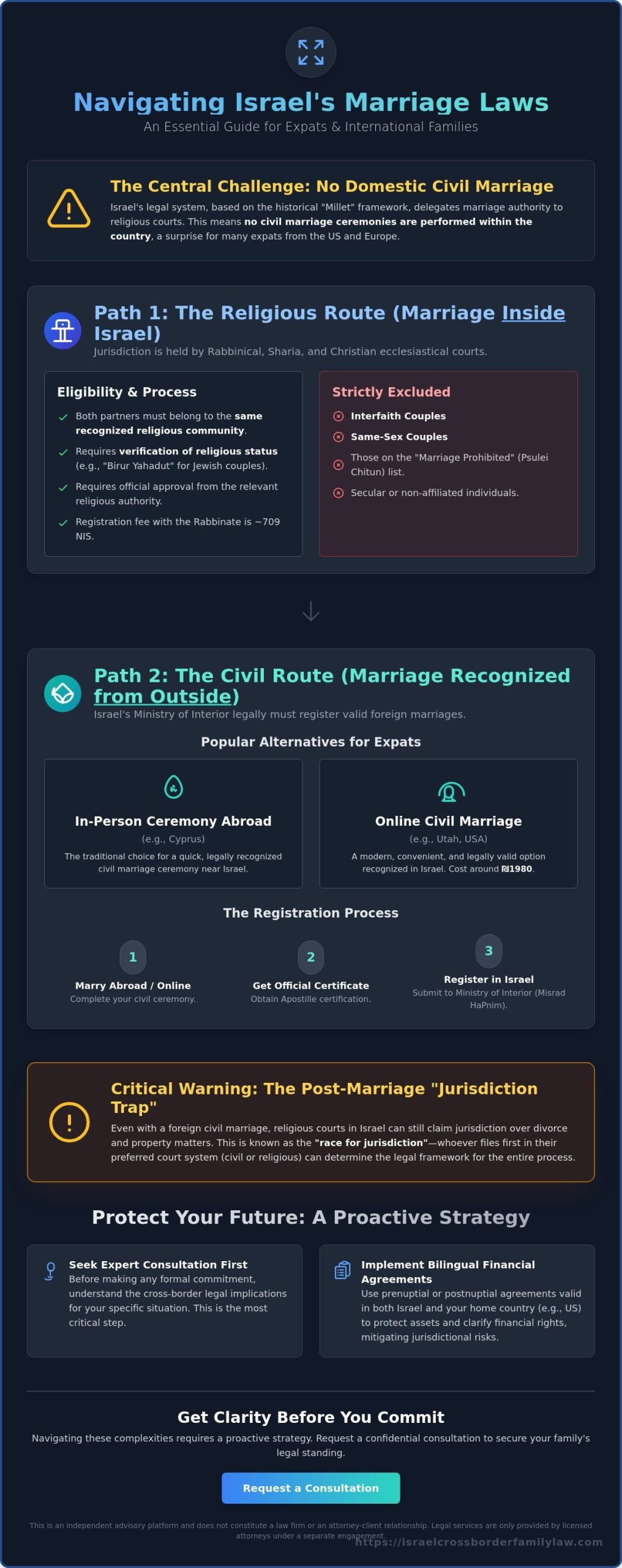
Navigating Cross-Border Legal Strategy Before You Commit
Adopting a “wait and see” approach is a high-risk strategy within the Israeli legal system. Because the “race for jurisdiction” can determine your financial future, the most effective way to manage the complexities of israel marriage laws is through proactive planning. For international families, this means addressing potential conflicts between legal systems before they arise. Whether you’re entering the multi-year Graduated Procedure for residency or managing assets across continents, early decisions carry significant weight. Strategy is your best defense against the inherent unpredictability of overlapping religious and civil jurisdictions.
For US-Israel dual citizens, the stakes are particularly high. A legal arrangement that works in Tel Aviv might not be recognized in New York or California without specific drafting. You must consider how your marital status and property rights translate across borders. Seeking clarity before making life-altering commitments isn’t just about protection; it’s about ensuring that your intentions are legally enforceable in every jurisdiction that touches your life.
Drafting a Robust Financial Agreement
A “Heskem Mamon,” or financial agreement, is the primary tool for mitigating risk. To be effective for international couples, these agreements must be tailored to be enforceable in both Israel and the US. This involves clearly addressing assets located outside of Israel, such as retirement accounts, real estate, or business interests. In Israel, a prenuptial agreement is not legally binding until it’s approved and authenticated by a Family Court judge or a marriage registrar. This formal approval ensures the document meets the requirements of the Spousal Property Relations Law, providing a secure framework for both parties.
Next Steps for International Families
The first step toward security is a thorough review of your specific circumstances. Consulting with a cross-border family lawyer allows you to identify jurisdictional “trapdoors” before they become problematic. You can begin this process by reviewing the Advisory’s pricing and structured approach to case reviews. For additional visual guidance on these topics, you can also watch our educational content on the Israel Family Law YouTube channel. Informed decision-making is the only way to navigate a system where heritage and geography dictate legal outcomes. Get clarity before you commit. Request a confidential consultation.
This article is published on an independent advisory platform and does not imply an attorney-client relationship. Legal services are only provided by licensed attorneys under a separate engagement.
Securing Your Family’s Legal Future in Israel
The decentralized nature of the Israeli legal system requires a level of foresight that many international families find unexpected. You now understand that while domestic civil options are absent, the path to a recognized union involves navigating religious court jurisdiction or utilizing established foreign alternatives. Successfully managing these israel marriage laws depends on identifying jurisdictional risks before you sign a marriage registry or move assets. By implementing a bilingual financial agreement and acknowledging the “race for jurisdiction,” you can protect your rights in both Israel and the US. Strategy is your best defense.
We specialize in these complex US-Israel cross-border matters, providing a steady hand through a strategy-based advisory. Our bilingual and bicultural legal expertise serves as a bridge between two very different cultures and legal frameworks. You don’t have to navigate these multi-jurisdictional complexities alone. Get clarity before you commit. Request a confidential consultation. We are here to help you move forward with confidence and peace of mind.
This article is published on an independent advisory platform and does not imply an attorney-client relationship. Legal services are only provided by licensed attorneys under a separate engagement.
Frequently Asked Questions
Can two US citizens get married in Israel?
Yes, provided they meet the religious criteria of one of the recognized religious communities. For Jewish US citizens, this involves the Birur Yahadut process with the Rabbinical court to prove their Jewish status. If the couple is interfaith or secular, they can’t marry domestically and must use a civil alternative, such as the ₪1980 Utah online ceremony or traveling to Cyprus.
Is civil marriage recognized in Israel if performed abroad?
Yes, Israel legally recognizes civil marriages performed outside its borders. Under israel marriage laws, the Ministry of Interior is required to register these unions once you present a valid marriage certificate with an Apostille stamp. This recognition grants the couple civil rights, including joint taxation and health insurance, even if religious authorities don’t recognize the ceremony itself.
What is a “Get” and why does it matter for civilly married couples?
A “Get” is a religious divorce document required by Jewish law to dissolve a marriage. Even if you married in a civil ceremony in the US, the Israeli Rabbinical Court may claim jurisdiction if both spouses are Jewish. This means you might need a religious divorce in addition to a civil one to be considered legally single in the eyes of the Israeli state.
Does Israel recognize common-law marriage for visa purposes?
Yes, Israel recognizes Yadua B’Tzibur status for the Graduated Procedure residency process. This allows foreign partners of Israeli citizens to obtain legal status without a formal marriage certificate. The process is complex and requires extensive evidence of a shared household. It typically takes a minimum of 4.5 to 5 years to complete the requirements for citizenship.
Can an interfaith couple get married in Israel?
No, interfaith marriages can’t be performed on Israeli soil because marriage is governed exclusively by religious courts. Each court only performs ceremonies between two members of its own faith. Couples in interfaith relationships usually choose to marry abroad or use the Utah online marriage option, which the Ministry of Interior then registers as a valid union for all civil purposes.
What happens if we get married in the US and move to Israel?
Your US marriage is legally valid in Israel once you register it with the Population and Immigration Authority. You must provide your original marriage certificate with an Apostille stamp from the country of origin. While this grants you civil status, israel marriage laws may still subject you to religious court jurisdiction for future matters such as divorce or inheritance rights.
How much does it cost to register a foreign marriage in Israel?
There is no fee for updating your marital status at the Ministry of Interior as of May 2026. However, you’ll likely incur costs for obtaining the Apostille stamp and for professional Hebrew translations of your documents. As of January 1, 2026, any related administrative payments at the bureau must be made digitally since cash is no longer accepted.
Is a US prenuptial agreement valid in Israel?
A US prenuptial agreement isn’t automatically enforceable in Israel and often requires specific validation. To ensure it holds weight, it’s best to have the agreement approved by an Israeli Family Court judge. This process verifies that the document aligns with the Spousal Property Relations Law. Relying solely on a foreign document without local validation creates significant risks for your assets. Get clarity before you commit. Request a confidential consultation.

Article by
Gabriel Lior
A Personal Journey That Became a Mission
The advisory was founded by an American father Gabriel Lior, LLB, MBA , global entrepreneur, and cross-border advisor who spent more than a decade navigating the Israeli family court system firsthand and now lives in Singapore with his son.
As a divorced parent in a cross-border family, Gabriel faced nearly every legal challenge a foreign parent can encounter in Israel — including child custody disputes, child support proceedings, property matters in Israel and abroad, false accusations, and complex immigration and relocation proceedings.
Over the years, he learned the hard way how difficult it is for non-Israeli parents to understand the system, identify the right legal strategy, and choose the right legal representation — especially when language, culture, and jurisdictional differences are involved. He also witnessed how foreign parents and new immigrants are often disadvantaged or taken advantage of by service providers and institutions simply because they lack local knowledge or fluency.
From Client to Advisor
To truly understand — and survive — the system, Gabriel pursued formal legal education in Israel, completing two Israeli law degrees, alongside a BA and MBA earned in the United States. This was never about becoming a practicing attorney, but about gaining a deep, structural understanding of how the system works — and where it breaks down for foreign parents.
This rare combination of:
Firsthand client experience
Israeli legal and US business education
International business and negotiation training
Decades of commercial execution
created a unique perspective – one that understands both sides of the table.
After years of litigation, persistence, and at times self-representation, he ultimately succeeded in securing custody of his son and relocating abroad through a rare legal victory in the Israeli Supreme Court — becoming one of the first fathers in Israel to do so under these circumstances.
Disclaimer
Important Disclaimer:
The information provided on this website and in its content is for general informational and educational purposes only and does not constitute legal advice, legal opinion, or legal representation.
Gabriel Lior is not licensed to practice law in Israel (nor is he interested in doing so) and does not provide legal services, despite having completed 2 Law Degrees. The services offered are advisory in nature and are intended to provide general guidance, strategic insight, and information regarding cross-border family law considerations.
No attorney-client relationship is formed by accessing this website, reading its content, or communicating with us.
Any decisions made based on this information are at your own discretion and risk. For legal advice specific to your situation, you should consult a licensed attorney in the relevant jurisdiction.
Where appropriate, we may refer clients to independent, licensed attorneys or professionals. Such referrals do not constitute legal representation and no liability is assumed for services provided by third parties.