This article is published on an independent advisory platform and is not a law firm. It does not imply an attorney-client relationship. Legal services are only provided by licensed attorneys under a separate engagement.
Did you know that in Israel, the simple act of being the first to file a document can fundamentally change the legal rules that govern your divorce, your assets, and your children’s future? For many members of the international community, the “race of jurisdiction” between civil Family Courts and religious Rabbinical Courts creates a stressful environment where a single day’s delay can have permanent consequences. Finding a qualified Family Lawyer in Tel Aviv for Expats is not just about legal representation; it’s about securing a strategic guide who understands how to bridge the gap between your home country’s expectations and the complex reality of the Israeli system.
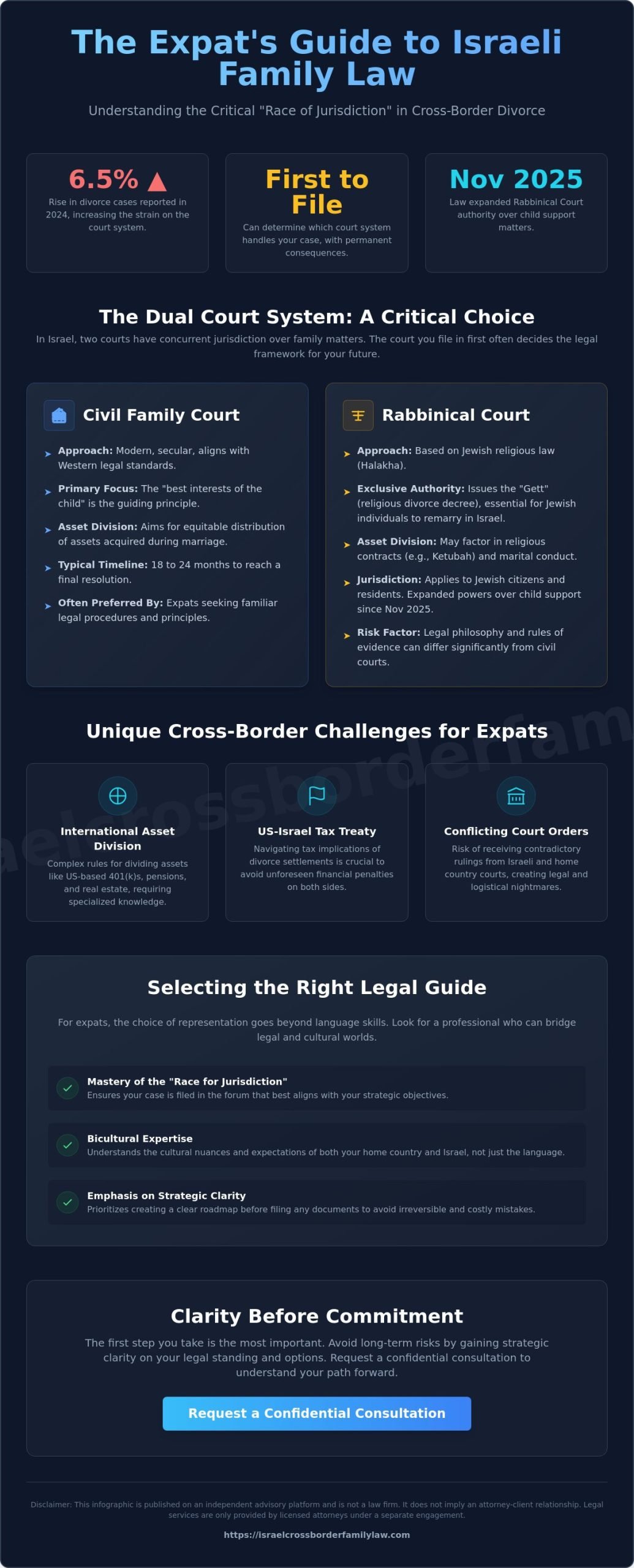
We understand that you may feel overwhelmed by the 6.5% rise in divorce cases reported in 2024 or the recent November 2025 law that expanded Rabbinical court authority over child support. You likely want to know how your US based assets will be treated or how to manage 2026 court fees, such as the 3,447 NIS fee for non-fixed property claims. This article provides a clear roadmap of the Israeli family law landscape to help you manage the unique risks of cross-border matters. You’ll gain strategic clarity on your legal standing, learn how to protect international assets, and find out how to work with a professional who understands your culture.
Key Takeaways
- Navigate the unique dual court system by understanding the concurrent jurisdiction between civil Family Courts and religious Rabbinical Courts.
- Protect your international assets and navigate the US-Israel tax treaty by engaging a family lawyer in tel aviv for expats who possesses bicultural expertise.
- Master the “race for jurisdiction” to ensure your case is heard in the forum that best aligns with your strategic objectives.
- Evaluate potential representation based on their ability to bridge cultural gaps rather than just their language skills.
- Prioritize strategic clarity before filing any documents to avoid the long term risks of irreversible legal decisions.
Understanding the Dual Court System in Tel Aviv
This article is published on an independent advisory platform and does not imply an attorney-client relationship. Legal services are only provided by licensed attorneys under a separate engagement.
The Israeli judicial system operates under a unique framework of concurrent jurisdiction. For anyone seeking a family lawyer in tel aviv for expats, it’s vital to understand that two separate court systems have the authority to hear your case. The civil Family Court and the religious Rabbinical Court both handle matters of divorce, custody, and assets. For international families, religious affiliation often dictates which court has the initial authority to rule on specific issues. This dual system creates a complex environment where the rules of evidence and the legal philosophy can differ significantly between the two venues.
The choice of forum is not merely a formality; it has a profound impact on the outcome of alimony and property division. Since January 1, 2026, the Israeli Judicial Authority updated Family Court fees, setting the claim for property matters at 3,447 NIS. Deciding where to file requires a strategic assessment of your international assets and your long term goals. Making a mistake at this early stage can lead to years of unnecessary litigation in a court that may not be favorable to your specific cross-border situation.
To better understand how these systems handle financial matters and the risks involved, watch this helpful video:
The Family Court (Civil System)
The Family Court in Tel Aviv provides a modern, secular approach to domestic issues. Its primary focus remains the “best interests of the child” in all custody and relocation matters. For expats, this court is often the preferred venue because its procedures align more closely with Western legal standards. While every case is different, a typical civil proceeding in IL can take between 18 and 24 months to reach a final resolution. This court handles the division of assets acquired during the marriage with a focus on equitable distribution, regardless of religious considerations.
The Rabbinical Court (Religious System)
A case may end up in the Rabbinical Court even if you aren’t an Israeli citizen, provided you are Jewish. This court holds exclusive authority over the “Gett,” which is the religious divorce decree required for Jewish individuals to remarry in Israel. In November 2025, the government passed an interim measure that expanded the Rabbinical courts’ power to rule on all financial needs for children. This change highlights the importance of understanding divorce and separation for international families. Unlike the civil system, Rabbinical courts may factor in religious contracts or marital conduct when determining property settlements, making early strategic clarity essential.
Get clarity before you commit. Request a confidential consultation.
Cross-Border Challenges: Why Expats Need Specialized Representation
Living as an expat in Tel Aviv often involves maintaining a foot in two worlds. This duality becomes a significant legal liability during a divorce or custody dispute. Managing assets across borders requires a family lawyer in tel aviv for expats who understands the intricate interplay between Israeli statutes and foreign legal systems. It’s not just about the law in the “start-up nation.” It’s about how those laws interact with your home country’s regulations. Without a sophisticated strategy, you risk facing conflicting court orders that are nearly impossible to reconcile.
One of the most complex areas involves the US-Israel tax treaty. Divorce settlements involving US-based assets, such as 401(k) plans or real estate, can trigger unexpected tax liabilities if they aren’t structured correctly under both jurisdictions. Strategic planning must happen before any documents are filed. Filing in the wrong order or the wrong location can lead to “parallel proceedings,” where two different countries claim authority over your life. You can find detailed visual explainers on these multi-jurisdictional complexities on the Israel Cross Border Law Firm YouTube channel.
International Child Custody and the Hague Convention
Israel is a signatory to the Hague Convention, which provides a legal framework for the return of children taken across borders without consent. However, relocation is viewed very differently in IL than in many US states. In Israel, even moving a child a short distance that impacts the other parent’s access can be considered a breach of custody rights. If you are considering a move, you must understand how international custody and relocation rules apply to your specific situation to avoid claims of international child abduction.
Enforcing Foreign Support and Alimony Orders
If you already have a US court order for alimony or child support, it doesn’t automatically apply in Tel Aviv. You must go through a process called “domestication” to make the order enforceable. This requires proving that the foreign judgment meets specific Israeli family law regulations. The Israeli Central Authority often plays a critical role in these cases, especially regarding child support cross-border enforcement. Ensuring your foreign orders are recognized locally is essential for maintaining your financial security while living abroad.
Before you take any legal steps that could impact your international standing, it’s wise to request a confidential strategy review with Israel Cross Border Law Firm to understand your options.
Strategic Risk Management in Israeli Family Law
Effective legal management in Israel requires a shift from an emotional response to a risk-based strategy. For international families, the stakes are elevated by the presence of assets in multiple countries and the potential for conflicting judicial orders. Engaging a family lawyer in tel aviv for expats allows you to assess these risks through a professional lens before any public action is taken. This proactive approach ensures that your decisions are based on long term security rather than immediate impulse. You must secure strategic clarity on your legal standing to avoid the pitfalls that often trap those unfamiliar with the local landscape.
The “Race for Jurisdiction” Explained
In the Israeli legal framework, the first court to be formally seized of a matter generally retains the authority to rule on it. This phenomenon, known as the “race for jurisdiction,” means that the spouse who files first can effectively choose between the civil Family Court and the religious Rabbinical Court. This choice isn’t just a matter of preference; it fundamentally sets the legal tone for alimony, child support, and property division. As noted by The Rackman Center at Bar-Ilan University, the dual system presents unique challenges that require a sophisticated understanding of both civil and religious statutes. Filing in the “wrong” court for your specific situation can lead to years of unnecessary litigation and significantly higher legal costs.
Initiating a legal proceeding with speed and professional discretion is often required to ensure your case is heard in the forum that most effectively protects your cross-border interests. Choosing the civil court might offer a more secular approach to property division, while the Rabbinical court could handle certain marital obligations differently. A family lawyer in tel aviv for expats will help you evaluate which venue aligns with your financial and personal objectives. The goal is to move forward with a plan that minimizes exposure and prevents your spouse from dictating the jurisdictional terms of the dispute.
Financial Agreements as Risk Mitigation
One of the most effective ways to manage risk is through the use of prenuptial and postnuptial agreements. In the Israeli context, these documents provide a layer of protection for assets acquired both before and during the marriage. However, it’s a common mistake to assume that a US-drafted prenuptial agreement will be automatically enforced in IL. These foreign documents often require specific “tailoring” to meet local legal requirements and must be approved by an Israeli court to be fully binding. Seeking clarity before commitment regarding marital property ensures that both parties understand their rights and obligations under two different legal systems.
Strategic planning is the only way to navigate the inherent complexity of cross-border family matters. Before you take any public legal action, it’s essential to undergo a confidential case review to map out your options. This initial step allows you to understand how early decisions will impact your international assets and your relationship with your children for years to come.
Get clarity before you commit. Request a confidential consultation.
Selecting a Family Lawyer in Tel Aviv: Key Criteria for Expats
Choosing a family lawyer in tel aviv for expats requires looking beyond a basic legal license. You need a strategist who functions as a bridge between the “start-up nation” and your specific cultural background. The Israeli legal system is highly efficient but operates with a different rhythm than the courts in the United States. To ensure your interests are protected, you should evaluate potential representation based on five critical pillars: cross-border experience, bicultural fluency, strategic transparency, a collaborative professional network, and a physical presence in Tel Aviv. These criteria help you avoid the common pitfalls of international litigation.
Transparent communication regarding fees is a non-negotiable requirement. According to industry data from 2026, a contested divorce in Israel can range from 15,000 NIS to 30,000 NIS in lawyer’s fees, while complex cases involving international assets can exceed 100,000 NIS. You should expect your lawyer to provide a clear breakdown of these costs alongside the updated January 2026 court fees, such as the 3,447 NIS filing fee for property claims. A lawyer who avoids discussing these financial realities or the risks of your case is not providing the steady, authoritative guidance you need.
The Importance of Bicultural Advocacy
Being bilingual is a baseline requirement, but being bicultural is what truly protects an expat. Israeli courtroom culture is often more direct and assertive than what many Anglos expect. Without a bicultural advocate, the nuances of your testimony or the specific intent behind your US based financial structures can be lost in translation. You need a professional who can translate these legal complexities into plain English while maintaining a “team on the ground” in Tel Aviv to manage local filings and negotiations. This ensures that global standards of professionalism are applied to the local Israeli context.
Evaluating Cross-Border Expertise
When interviewing a family lawyer in tel aviv for expats, you must ask specific questions about their multi-jurisdictional history. Inquire about their experience with the Hague Convention on child abduction or how they handle the division of digital assets and tech stock options, which are becoming central to Israeli cases in 2026. Specialized knowledge of how the US-Israel tax treaty affects inheritance and divorce settlements is essential for protecting your long term wealth. To understand how this level of expertise integrates into your case, you can review how it works within our advisory framework.
Securing the right representation is the most important decision you will make in this process. To ensure your strategy is sound from day one, speak with a bicultural advisor today.
Get clarity before you commit. Request a confidential consultation.
Clarity Before Commitment: The Path Forward for International Families
This article is published on an independent advisory platform and is not a law firm. It does not imply an attorney-client relationship. Legal services are only provided by licensed attorneys under a separate engagement.
When facing a legal crisis, the impulse to act immediately is often the greatest risk to your long term security. Decisions made in the first few days of a dispute are frequently irreversible, especially within the context of the Israeli “race for jurisdiction” discussed earlier. Taking a breath to seek expert strategy before filing any documents allows you to maintain control over the legal narrative. An independent advisory provides a neutral, risk-based roadmap that helps you identify potential pitfalls before they become permanent legal hurdles. Finding a family lawyer in tel aviv for expats should be the final step in your strategic plan, not the first impulsive action.
The complexity of managing assets in both IL and the United States requires a steady hand. With divorce rates among Jewish Israelis rising by 6.5% in 2024, the courts are increasingly crowded, making early tactical errors even more costly. A strategic review ensures you don’t enter the system blindly. It allows you to evaluate whether the civil Family Court or the Rabbinical Court offers the most protection for your specific cross-border interests.
Your Strategic Roadmap
Before you commit to any legal path or sign a retainer with a family lawyer in tel aviv for expats, you must establish a clear foundation. This roadmap helps you gather the necessary intelligence to protect your future:
- Secure Digital Privacy: Change passwords for all personal accounts and ensure your communication with advisors remains confidential.
- Inventory Cross-Border Assets: Gather documentation for assets in both IL and abroad, including 401(k) plans, tech stock options, and real estate holdings.
- Identify Hidden Risks: Use a confidential case review to spot jurisdictional vulnerabilities that could trigger international child abduction claims or tax liabilities.
- Analyze Court Costs: Factor in the updated 2026 judicial fees, such as the 3,447 NIS fee for property claims, into your financial planning.
Requesting Professional Guidance
There is a significant difference between a general consultation and a comprehensive strategy session. A strategic review focuses on risk mitigation and jurisdictional advantages rather than just court procedures. You should seek clarity on pricing and process early on to avoid surprises during litigation. Understanding the total cost, which can exceed 100,000 NIS for complex international cases, is essential for informed decision-making. Professional guidance provides the bicultural bridge you need to navigate the Israeli system with confidence.
Get clarity before you commit. Request a confidential consultation.
Securing Your Future in the Israeli Legal Landscape
Managing a cross-border legal matter requires a proactive strategy that accounts for the “race for jurisdiction” and the nuances of the dual court system. As we have discussed, filing in the wrong forum can lead to years of litigation and unexpected financial exposure. Selecting a family lawyer in tel aviv for expats who understands both the Israeli courtroom and your cultural background is essential for protecting your international assets and your children’s best interests.
Our bicultural and bilingual advisory team brings decades of collective experience in cross-border US-Israel law to your unique situation. We maintain a specialized focus on international families and expats who require sophisticated, strategic guidance before making irreversible legal commitments. You don’t have to navigate this complex landscape alone. Get clarity before you commit. Request a confidential consultation. We are here to help you move forward with confidence and strategic clarity.
Frequently Asked Questions
Is a US divorce decree valid in Israel?
A US divorce decree isn’t automatically recognized in Israel and requires a formal process called domestication. The Israeli court must review the foreign judgment to ensure it doesn’t contradict local public policy or laws. Once the court grants recognition, the decree becomes legally binding within the Israeli jurisdiction for matters like asset division or status changes.
Can I move back to the US with my children without my spouse’s consent?
You can’t legally relocate children outside of Israel without the written consent of the other parent or a specific court order. Israel is a signatory to the Hague Convention, which treats unilateral relocation as international child abduction. If you move without authorization, the court can issue a return order, forcing the children back to Israel until a custody hearing occurs.
How much does a family lawyer in Tel Aviv cost for an expat?
Lawyer fees for a contested divorce in Israel typically range from 15,000 NIS to 30,000 NIS according to 2026 market data. Complex cases involving multi-jurisdictional assets can exceed 100,000 NIS. Engaging a family lawyer in tel aviv for expats ensures you receive a clear breakdown of these costs alongside the 3,447 NIS property claim fee set by the Judicial Authority.
What happens to my US-based property in an Israeli divorce?
Israeli courts generally apply the principle of community property to assets acquired during the marriage, regardless of their physical location in the US. Assets owned before the marriage or received via inheritance are usually excluded from the division. The actual distribution of US real estate or retirement accounts requires a sophisticated strategy to manage the US-Israel tax treaty and local state regulations.
Do I have to go to a Rabbinical court if I am not religious?
Jewish individuals must obtain a religious divorce decree known as a ‘Gett’ to be legally considered single in Israel. This requirement applies to secular and religious people alike. If your spouse files a claim in the Rabbinical court before you act, that venue may gain jurisdiction over other financial or custodial matters regardless of your religious views.
How long does the divorce process take in Tel Aviv for foreigners?
A typical contested divorce for international families in Tel Aviv generally lasts between 18 and 24 months. If both parties reach a mutual consent agreement, the process is significantly shorter and can be finalized within a few months. The timeline often extends if there are complex disputes regarding the valuation of international business interests or tech stock options.
Can I enforce a US child support order in Israel?
You can domesticate a US child support order in Israel through the process facilitated by the Israeli Central Authority. You must demonstrate that the original US court had proper jurisdiction and that the order is final and not subject to further appeal. Once recognized, the order can be enforced locally to ensure consistent financial support for children living in Israel.
What is the “Race for Jurisdiction” in Israeli law?
The “race for jurisdiction” is a legal rule where the spouse who files a claim first determines whether the case is heard in civil Family Court or religious Rabbinical Court. This decision is critical because each court applies different legal philosophies to matters like alimony and property division. Consulting a family lawyer in tel aviv for expats before your partner files is the only way to protect your jurisdictional interests.

Article by
Gabriel Lior
A Personal Journey That Became a Mission
The advisory was founded by an American father Gabriel Lior, LLB, MBA , global entrepreneur, and cross-border advisor who spent more than a decade navigating the Israeli family court system firsthand and now lives in Singapore with his son.
As a divorced parent in a cross-border family, Gabriel faced nearly every legal challenge a foreign parent can encounter in Israel — including child custody disputes, child support proceedings, property matters in Israel and abroad, false accusations, and complex immigration and relocation proceedings.
Over the years, he learned the hard way how difficult it is for non-Israeli parents to understand the system, identify the right legal strategy, and choose the right legal representation — especially when language, culture, and jurisdictional differences are involved. He also witnessed how foreign parents and new immigrants are often disadvantaged or taken advantage of by service providers and institutions simply because they lack local knowledge or fluency.
From Client to Advisor
To truly understand — and survive — the system, Gabriel pursued formal legal education in Israel, completing two Israeli law degrees, alongside a BA and MBA earned in the United States. This was never about becoming a practicing attorney, but about gaining a deep, structural understanding of how the system works — and where it breaks down for foreign parents.
This rare combination of:
Firsthand client experience
Israeli legal and US business education
International business and negotiation training
Decades of commercial execution
created a unique perspective – one that understands both sides of the table.
After years of litigation, persistence, and at times self-representation, he ultimately succeeded in securing custody of his son and relocating abroad through a rare legal victory in the Israeli Supreme Court — becoming one of the first fathers in Israel to do so under these circumstances.
Disclaimer
Important Disclaimer:
The information provided on this website and in its content is for general informational and educational purposes only and does not constitute legal advice, legal opinion, or legal representation.
Gabriel Lior is not licensed to practice law in Israel (nor is he interested in doing so) and does not provide legal services, despite having completed 2 Law Degrees. The services offered are advisory in nature and are intended to provide general guidance, strategic insight, and information regarding cross-border family law considerations.
No attorney-client relationship is formed by accessing this website, reading its content, or communicating with us.
Any decisions made based on this information are at your own discretion and risk. For legal advice specific to your situation, you should consult a licensed attorney in the relevant jurisdiction.
Where appropriate, we may refer clients to independent, licensed attorneys or professionals. Such referrals do not constitute legal representation and no liability is assumed for services provided by third parties.