This article is published on an independent advisory platform (not a law firm) and does not constitute an attorney-client relationship or legal advice.
What if the most recognizable name in the Israeli legal market isn’t the most strategic choice for your US-based assets? Many international families feel their options are limited to high-volume litigation practices, yet exploring alternatives to Hait Family Law allows you to prioritize a model built specifically for cross-border complexity rather than standard courtroom volume. At Israel Cross Border Law Firm, we believe that navigating the dual legal tracks in IL requires a steady, knowledgeable guide who understands how local decisions impact your global standing.
We understand the anxiety that comes with managing assets across two countries and the confusion surrounding the religious and civil court systems. This article will help you understand the different strategic approaches to family law in Israel to ensure your representation matches your specific international needs. We’ll examine the criteria for evaluating multi-jurisdictional counsel and explain how a strategic advisory model can help you avoid the pitfalls of the traditional litigation-first trap.
Key Takeaways
- Distinguish between firms that simply speak English and true cross-border specialists who understand the legal requirements of both Israel and the United States.
- Identify critical qualifications for international representation, including multi-jurisdictional licensure and specific experience with the Hague Convention on Child Abduction.
- Explore how strategic advisory models serve as effective alternatives to Hait Family Law by prioritizing pre-legal planning to minimize time spent in court.
- Understand the impact of the US-Israel Tax Treaty and the specific procedures required to divide US-based retirement accounts like 401ks within an Israeli divorce.
- Learn why early risk assessment and a strategic approach can help you avoid the aggressive “race to the court” often found in the Israeli legal system.
The Landscape of English-Speaking Family Law in IL
Many international families in Israel find themselves navigating a legal market that feels surprisingly narrow. When searching for alternatives to Hait Family Law, the primary objective is often to find a practitioner who recognizes that “English-speaking” is not a substitute for “cross-border qualified.” In the local Anglo community, a few prominent names tend to dominate social media and community forums, leading many to believe their choices are limited to a high-volume litigation model. However, the complexity of a dual-track legal system requires a more nuanced approach than traditional, trial-focused firms often provide.
The Israeli legal landscape is defined by the coexistence of civil family courts and religious rabbinical courts, a structure that can be deeply confusing for those raised in the American legal tradition. Understanding the foundational Israeli marriage and divorce laws is the first step in recognizing why your choice of representation matters. A firm that lacks a deep understanding of how these local systems interact with foreign jurisdictions can inadvertently jeopardize your legal standing in the United States or lead to settlements that are unenforceable abroad. Translation isn’t strategy.
To understand the difference between traditional court battles and alternative paths, watch this video:
Why Families Seek Alternatives to Traditional Firms
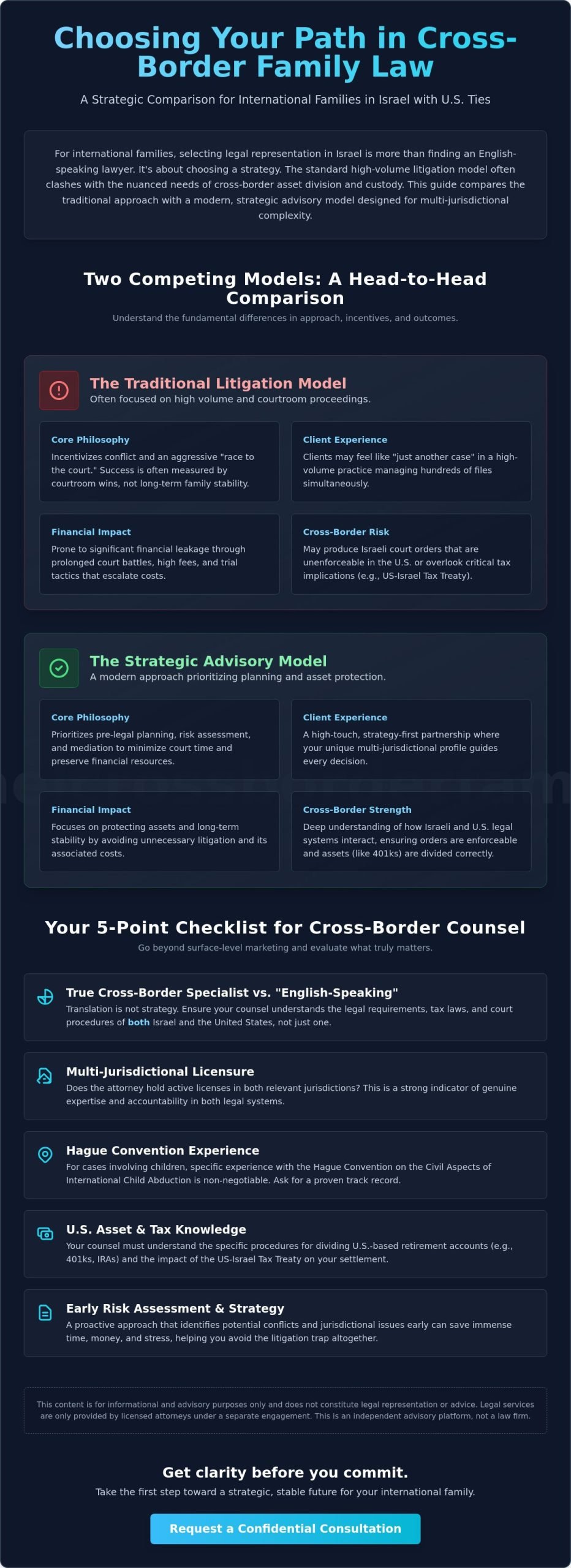
The shift toward strategic advisory models is driven by a desire for a less adversarial process that preserves family relationships and financial resources. Traditional firms are often built for litigation, which inherently incentivizes conflict and the aggressive “race to the court.” For families with assets in both Israel and the US, a litigation-heavy approach can lead to significant financial leakage through court fees and prolonged trial tactics. Seeking alternatives to Hait Family Law is frequently a search for a high-touch, strategy-first partner who prioritizes asset protection and long-term stability over courtroom volume. This is especially relevant for those who feel like “just another case” in a firm that manages hundreds of files simultaneously.
The Anglo Niche in Israeli Law: A Growing Market
The increase in immigration from English-speaking countries has created a demand for “bridge” lawyers; professionals who can translate not just the language, but the complex legal and cultural expectations of both countries. Common misconceptions about English services in IL include the idea that linguistic fluency automatically translates to multi-jurisdictional expertise. In reality, a lawyer focusing only on IL law may fail to secure orders that are enforceable in US courts or may overlook the implications of foreign corporate structures. Finding a strategic fit involves looking beyond marketing to ensure your representation truly understands the multi-jurisdictional complexity of your family’s life.
Criteria for Evaluating International Family Law Representation
When evaluating legal representation in Israel, you should look past the high-volume marketing often associated with large, established firms. Seeking alternatives to Hait Family Law means finding a practitioner who prioritizes your specific multi-national profile over standard litigation templates. A firm’s core philosophy significantly dictates your experience; a litigation-heavy firm might push you toward the “race of jurisdiction,” while a mediation-friendly approach could preserve both your assets and your familial relationships. You need to ensure that your legal partner understands the technicalities of the Israeli Family Court System and how its rulings will be interpreted by US authorities.
Transparency in fee structures is another critical factor for international families. Cross-border cases often involve unpredictable variables, such as certified document translations or expert real estate appraisals, which typically cost between ₪2,000 and ₪5,000 in Israel. A firm that provides a clear, structured breakdown of costs helps you manage your financial expectations without the anxiety of hidden litigation expenses. Exploring your options through a preliminary advisory discussion can clarify these requirements before you commit to a specific path.
The Multi-Jurisdictional Factor
Licensure in both Israel and a US state is not just a credential; it’s a necessity for effective asset division. If your lawyer doesn’t understand the US side of the equation, they may overlook the requirements for a Qualified Domestic Relations Order (QDRO) needed to divide a 401(k) or IRA. Jurisdictional expertise serves as the primary safety net for expats by ensuring that an Israeli court order will actually be recognized and enforced by US authorities. This is particularly vital in cases involving the Hague Convention on Child Abduction, where a deep understanding of international treaties is the only way to protect your parental rights.
Communication and Cultural Nuance
Language is often the first barrier, but cultural nuance is the more dangerous one. Even if a lawyer speaks fluent English, they might not grasp the “Anglo” mindset regarding financial privacy or parenting styles. US-born clients are often shocked by the intensity of Israeli court proceedings or the significant role of religious courts in personal status matters. A bridge lawyer anticipates these cultural shocks and prepares you for the systemic differences you’ll encounter. Without this cultural alignment, critical strategic points can easily be lost in translation, leading to decisions that don’t reflect your long-term goals.
Strategic Advisory vs. Traditional Litigation Models
Most people believe that hiring a trial lawyer is the mandatory first step in a divorce. This isn’t always the case. A strategic advisory model focuses on pre-legal planning to minimize the time you actually spend in court. This approach is designed to map out your global exposure before any formal legal action begins. When searching for alternatives to Hait Family Law, it’s helpful to consider whether you need a high-volume litigation firm or an advisor who can provide a neutral second opinion on your cross-border risks.
In Israel, the choice between the civil Family Court and the religious Rabbinical Court is a high-stakes decision. The person who files first often dictates which court hears the case, a process known as the “race of jurisdiction.” This choice can have significant implications for child support or asset division. For instance, a 2025 legal change clarified that Rabbinical Courts now have the jurisdiction to hear all matters related to child support in a divorce lawsuit. Understanding the complexities of Legal Aid for Family Law and the broader Israeli landscape ensures you don’t make these decisions under pressure.
The Litigation-First Trap
The Israeli legal system often rewards the fastest filer. This creates an environment where families are pushed into aggressive early filings that escalate conflict quickly. A litigation-heavy strategy can lead to years of expensive court battles and emotional strain. Your first move in Israel is often your most expensive because it sets the tone for the entire proceeding. If you rush into filing without a clear plan, you risk a ruling that may not be recognized or enforceable by US authorities. Rushing to court without a strategy is a common pitfall that can jeopardize your US-based retirement accounts or real estate.
The Advisory Advantage
An independent advisor helps you focus on how it works rather than just rushing to hire a trial attorney. This model provides strategic clarity, allowing you to evaluate your options before they become part of a public court record. By obtaining a confidential case review, you can assess the strengths and weaknesses of your position from a neutral perspective. This layer of planning is one of the most effective alternatives to Hait Family Law for those who want to avoid the litigation funnel. It allows you to move forward with a logical strategy that protects your interests in both Israel and the United States.
Key Considerations for US-Israel Dual Citizens
Dual citizenship introduces layers of legal complexity that a standard domestic law firm may not be equipped to handle. While many families initially gravitate toward high-volume litigation practices, those seeking alternatives to Hait Family Law are often looking for deeper technical expertise regarding the US-Israel nexus. Decisions made in an Israeli court regarding US-based assets can lead to unintended tax consequences or unenforceable orders if the strategy doesn’t account for American legal requirements from the outset. Seeking clarity on these intersections is essential for protecting your global financial standing.
One of the most significant factors for dual citizens is the US-Israel Tax Treaty. As of January 1, 2026, new tax disclosure rules in Israel require Olim and returning residents to report foreign assets to the Israel Tax Authority. This change increases the visibility of US-based accounts in divorce proceedings, making it more critical than ever to have a clear strategy. Israeli courts typically apply a “balancing of resources” model, which splits assets accumulated during the marriage 50/50. However, dividing a US retirement account like a 401(k) or IRA usually requires a Qualified Domestic Relations Order (QDRO) from a US court to be executed correctly without triggering massive penalties.
Cross-Border Asset Division
Israeli courts often struggle with complex US corporate structures, such as LLCs or family trusts. If your financial profile includes business interests or inherited assets held in the United States, a standard Israeli divorce decree may not provide the protection you need. It’s vital to create a financial agreement that is recognized and enforceable in both nations to prevent future litigation in a second jurisdiction. For a deeper look at how to structure these agreements, you should review our guidance on Divorce & Separation for International Families. This proactive approach ensures that your US assets remain shielded from local jurisdictional overreach whenever possible.
International Custody and the Hague Convention
Custody disputes involving international travel require a nuanced understanding of the Hague Convention on Child Abduction. Every expat must understand that “Habitual Residence” is a specific legal term that determines which country has the right to make decisions about a child’s life. If a parent moves a child without explicit consent, they could face a Hague petition for the child’s return. In Israel, the risk of being trapped in the country due to a “No Exit” order (Tzav Ikur) is a reality that can prevent a parent or child from leaving for the duration of the legal proceedings. If you have assets or family interests in both countries, it’s wise to discuss your specific financial and family profile with a cross-border advisor before taking any formal steps.
This article is published on an independent advisory platform (not a law firm) and does not constitute an attorney-client relationship or legal advice.
Israel Cross Border Law Firm: A Modern Alternative
Israel Cross Border Law Firm represents a shift in how international families approach the Israeli legal landscape. While traditional litigation models often prioritize immediate court filings, our advisory model emphasizes the strategic architecture of your case before a single document is submitted. Families researching alternatives to Hait Family Law frequently discover that they require a neutral space to evaluate risks without the pressure of an immediate trial. This approach ensures you understand the long-term impact of your decisions on both sides of the Atlantic, focusing on strategy rather than just courtroom tactics.
Strategic planning is the cornerstone of our operations. Instead of rushing into a high-conflict race for jurisdiction, we focus on a comprehensive risk assessment that accounts for cross-border complexity. By engaging in a Confidential Case Review, you can map out a strategy that protects your interests in both IL and the United States. This step provides the clarity needed to decide whether a specific legal path is truly in your best interest, allowing you to visualize the outcome before you commit to the financial and emotional costs of a trial lawyer.
A Bridge Between Legal Systems
As an independent advisory platform, our role is to act as a bridge between the Israeli and American legal systems. We don’t replace your local legal counsel; instead, we coordinate with your existing US-based legal and financial teams to ensure a unified strategy. This coordination ensures that an Israeli settlement doesn’t inadvertently trigger US tax penalties or violate the terms of a domestic trust. Having a multi-qualified practitioner on your side means your strategy is vetted by someone who understands the divergent business cultures and legal frameworks of both nations.
Taking the First Step Securely
We prioritize education and the use of plain English to demystify a system that often feels overwhelming. The Israeli legal landscape is filled with nuances, from Rabbinical Court authority to the 2026 shifts in custody standards. Understanding these changes in simple terms allows you to make informed choices. If you already have representation, an independent advisory can provide a second opinion on your current IL legal strategy to ensure no international risks have been overlooked. Get clarity before you commit. We invite you to reach out for an advisory call or WhatsApp message to discuss your specific needs.
Choosing Your Path with Strategic Confidence
Navigating the dual legal tracks of Israel requires a strategy that looks beyond local boundaries. You must account for the technicalities of the US-Israel Tax Treaty and the specific procedures required to divide American retirement assets like 401(k) plans. Prioritizing a strategic advisory model instead of a litigation-first approach can protect you from the aggressive “race of jurisdiction” and minimize emotional strain. When evaluating alternatives to Hait Family Law, look for partners who offer specialized US-Israel cross-border expertise and hold licensure in multiple jurisdictions.
Success in international family matters depends on the decisions you make before your case enters the court record. Our advisory focuses on strategy over litigation to ensure your global interests remain secure. By seeking clarity early, you can avoid common pitfalls that affect your assets and your parental rights. Get clarity before you commit. Request a confidential consultation to discuss your specific needs. Protecting your family’s future in two countries starts with an informed and logical plan.
Frequently Asked Questions
Is Hait Family Law the only firm for English speakers in Israel?
No, there are several firms and independent advisors who specialize in serving the Anglo community. While high-volume litigation firms are often the most visible, many international families seek alternatives to Hait Family Law to find a more strategic, high-touch advisory model. This approach is particularly beneficial for those who prioritize cross-border planning and asset protection over traditional courtroom battles.
Can a US lawyer represent me in an Israeli family court?
Only lawyers licensed by the Israel Bar Association can provide formal representation in Israeli courts. However, a practitioner who is multi-qualified in both Israel and a US jurisdiction can act as a vital bridge. They ensure that your Israeli proceedings don’t negatively impact your legal standing or financial interests in the United States, which is a common risk for dual citizens.
What is the difference between a law firm and a cross-border advisory?
A traditional law firm focuses primarily on litigation and courtroom representation within the Israeli system. A cross-border advisory acts as a strategic partner that coordinates between multiple legal systems. This model prioritizes risk assessment and global planning before you commit to a trial lawyer, ensuring that your strategy accounts for the complexities of living and owning assets in two different countries.
How do I know if my US assets are at risk in an Israeli divorce?
Your US assets are often subject to the Israeli “balancing of resources” model, which typically splits marital property 50/50. Because Israeli courts may not fully grasp the technicalities of US retirement accounts or trusts, these assets are at risk of being divided incorrectly. Strategic planning is necessary to ensure any Israeli order is enforceable and tax-efficient according to American regulations.
What should I ask an English-speaking lawyer before hiring them in IL?
You should ask if they hold a license in a US jurisdiction and how they handle the division of 401(k) or IRA accounts. Inquire about their specific experience with the Hague Convention and their understanding of the US-Israel Tax Treaty. A lawyer who simply speaks English may lack the technical expertise required to manage complex international assets or cross-border custody issues effectively.
Is it better to file for divorce in the US or in Israel first?
The decision depends entirely on your specific financial profile and your long-term custody goals. Israel’s “race of jurisdiction” means the first person to file often determines whether the case is heard in a civil or religious court. Filing in the US first might offer better protection for specific assets, but it could also complicate your status in Israel. You should evaluate these risks thoroughly before filing.
How does the Hague Convention affect my custody case in IL?
The Hague Convention is an international treaty designed to prevent parents from moving children across borders without explicit consent. If a child is moved to or from Israel without legal permission, the other parent can file a petition for their return. Israeli courts strictly enforce this treaty, so understanding the legal concept of “Habitual Residence” is vital for any expat parent involved in a custody dispute.

Article by
Gabriel Lior
A Personal Journey That Became a Mission
The advisory was founded by an American father Gabriel Lior, LLB, MBA , global entrepreneur, and cross-border advisor who spent more than a decade navigating the Israeli family court system firsthand and now lives in Singapore with his son.
As a divorced parent in a cross-border family, Gabriel faced nearly every legal challenge a foreign parent can encounter in Israel — including child custody disputes, child support proceedings, property matters in Israel and abroad, false accusations, and complex immigration and relocation proceedings.
Over the years, he learned the hard way how difficult it is for non-Israeli parents to understand the system, identify the right legal strategy, and choose the right legal representation — especially when language, culture, and jurisdictional differences are involved. He also witnessed how foreign parents and new immigrants are often disadvantaged or taken advantage of by service providers and institutions simply because they lack local knowledge or fluency.
From Client to Advisor
To truly understand — and survive — the system, Gabriel pursued formal legal education in Israel, completing two Israeli law degrees, alongside a BA and MBA earned in the United States. This was never about becoming a practicing attorney, but about gaining a deep, structural understanding of how the system works — and where it breaks down for foreign parents.
This rare combination of:
Firsthand client experience
Israeli legal and US business education
International business and negotiation training
Decades of commercial execution
created a unique perspective – one that understands both sides of the table.
After years of litigation, persistence, and at times self-representation, he ultimately succeeded in securing custody of his son and relocating abroad through a rare legal victory in the Israeli Supreme Court — becoming one of the first fathers in Israel to do so under these circumstances.
Disclaimer
Important Disclaimer:
The information provided on this website and in its content is for general informational and educational purposes only and does not constitute legal advice, legal opinion, or legal representation.
Gabriel Lior is not licensed to practice law in Israel (nor is he interested in doing so) and does not provide legal services, despite having completed 2 Law Degrees. The services offered are advisory in nature and are intended to provide general guidance, strategic insight, and information regarding cross-border family law considerations.
No attorney-client relationship is formed by accessing this website, reading its content, or communicating with us.
Any decisions made based on this information are at your own discretion and risk. For legal advice specific to your situation, you should consult a licensed attorney in the relevant jurisdiction.
Where appropriate, we may refer clients to independent, licensed attorneys or professionals. Such referrals do not constitute legal representation and no liability is assumed for services provided by third parties.