This article is published on an independent advisory platform (not a law firm) and does not imply an attorney-client relationship. Legal services are only provided by licensed attorneys under a separate engagement.
What if the “trusted recommendation” you received from a local social media group is actually the highest risk factor in your Israeli legal matter? Relying on informal networks often leads to a common expat pitfall: choosing a provider based on familiarity rather than verified competence. When you’re facing language barriers in legal documents or feeling uneasy about the local culture of “Protektzia,” finding a trustworthy professional in israel requires a shift from social proof to regulatory verification. It’s understandable to feel overwhelmed by a system that often seems to operate on social connections rather than merit.
This guide provides a strategic, risk-based framework designed to help the international community vet Israeli professionals with confidence. You’ll learn how to navigate the latest regulatory landscape, including the February 17, 2025, government reform that allows professionals to start certification before arriving in the country. We’ll detail exactly where to verify licenses through official registries and explain how to interpret professional standards without needing a law degree. By the end of this article, you’ll have a clear checklist to ensure your professional choice is grounded in transparency. Get clarity before you commit. Request a confidential consultation.
Key Takeaways
- Understand how the local concept of ‘Protektzia’ influences professional networks and why objective vetting is safer than relying solely on social recommendations.
- Master the process of finding a trustworthy professional in israel by utilizing official registries and identifying the governing bodies that regulate legal and financial services.
- Identify the critical differences between local-only providers and cross-border specialists who understand the unique complexities facing international families in IL.
- Implement a step-by-step framework to evaluate potential allies based on their transparency, communication standards, and specific experience with Anglo clients.
- Adopt a strategic approach to professional selection that prioritizes risk management and clarity before you make any significant financial or legal commitments.
Understanding the Professional Culture and Landscape in Israel
This article is published on an independent advisory platform (not a law firm) and does not imply an attorney-client relationship. Legal services are only provided by licensed attorneys under a separate engagement. Finding a trustworthy professional in israel requires looking past the surface of personal recommendations. The Israeli market operates on a unique blend of formal regulation and informal social structures. For international families, the first step is recognizing that the rules of engagement here differ significantly from those in the U.S. or U.K.
One of the most pervasive cultural elements is ‘Protektzia,’ or the reliance on personal influence and networks. While this often helps locals navigate red tape, it creates a transparency gap for outsiders. If a professional is hired solely because of a social connection, you may lose the ability to demand the objective standards you expect. Early decisions in cross-border matters, such as where to file a motion or how to structure a will, carry heavy weight. A choice made out of convenience rather than verified expertise can complicate your case for years; there’s no substitute for a strategic foundation when finding a trustworthy professional in israel.
To better understand the foundations of professional trust and standards, watch this helpful video:
The Role of Informal Networks
Facebook groups and community forums are common starting points for Anglos. While these platforms offer a sense of comfort, they often lack the technical depth needed for family law or estate planning. Relying on a recommendation from someone who “liked” a lawyer’s personality doesn’t verify that lawyer’s success rate with complex jurisdictional issues. This “Anglo bubble” can actually shield you from seeing the full market of qualified experts. You must transition from social trust to professional verification by checking registries and demanding clear, strategic plans that address your specific needs.
Cultural Nuances in Professional Services
Israeli professional communication is famously direct. This “Dugri” style means you might receive blunt assessments that feel dismissive or aggressive to an English-speaking ear. It’s often just a drive for efficiency in a system where the bureaucracy moves slowly. For those seeking resources for expats and foreign nationals, it’s vital to find a professional who acts as a cultural bridge. They should provide plain English explanations that align with the high standards of Jewish business ethics while respecting the procedural realities of the Israeli courts. This ensures you aren’t just getting a translation, but a true understanding of the risks involved.
This article is published on an independent advisory platform (not a law firm) and does not imply an attorney-client relationship. Legal services are only provided by licensed attorneys under a separate engagement.
Verifying Credentials: How to Check Licenses and Registries
Verification is the only objective shield against the risks of ‘Protektzia’ mentioned in the previous section. While social trust is common in IL, finding a trustworthy professional in israel requires a formal audit of their standing with governing bodies. The Israel Bar Association is the statutory body that regulates the legal profession in Israel, ensuring that all practicing attorneys meet specific educational and ethical standards. For other sectors, the Ministry of Justice and the Ministry of Health maintain registries for regulated professions in Israel, including accountants, mediators, and healthcare providers.
A professional in “Good Standing” has an active license and is current with their regulatory obligations. For instance, in January 2025, the Knesset approved a 20% reduction in membership dues for the Bar Association to support practitioners. Verification confirms that your chosen ally is not just experienced but also legally permitted to represent your interests. If you find the process complex, you might consider how a structured approach can help you understand the strategy behind professional selection before you commit.
The Israel Bar Association and Legal Practitioners
The Bar Association’s website offers a searchable database of all licensed attorneys. You can verify a lawyer’s status by searching their name or license number. It’s particularly useful for expats to look for bicultural attorneys who bridge the gap between systems. Recent reforms from August 8, 2024, have made it easier for foreign-trained lawyers to practice in IL. Those with over four years of experience abroad can now complete an abbreviated six-month internship. These professionals must also pass a Professional Ethics exam, which carried a registration fee of 160 NIS as of April 2026. A dual-licensed professional often provides a higher level of trust because they understand both the Israeli system and your home country’s legal culture.
Regulated Professions and Government Oversight
Beyond law, many services require specific government permits. Accountants and mediators are listed in registries managed by the Ministry of Justice. When vetting, you should also ask for proof of professional indemnity insurance. This insurance protects you if a professional error occurs. If a name doesn’t appear in the official registry, it’s a significant red flag. Some practitioners, such as foreign-trained family therapists, may practice privately without an IL license, but for legal or financial matters, a lack of local registration is a risk you shouldn’t take. Always cross-reference names against government portals to ensure you’re dealing with a verified expert.
This article is published on an independent advisory platform (not a law firm) and does not imply an attorney-client relationship. Legal services are only provided by licensed attorneys under a separate engagement.
Local vs. Cross-Border Expertise: Choosing the Right Ally
The search for a qualified representative often stops once an expat finds someone who speaks fluent English. However, finding a trustworthy professional in israel involves a deeper assessment of their jurisdictional literacy. A professional may be highly competent in domestic Israeli law but entirely unfamiliar with the tax implications or reporting requirements of the U.S. Internal Revenue Service. This gap in knowledge can lead to unintentional non-compliance or the loss of assets located abroad. Choosing the right ally requires a clear understanding of whether your matter is strictly local or spans multiple legal systems.
International families face unique pressures that a standard local practitioner may not fully grasp. The distinction between a “local-only” approach and a “cross-border” strategy is often the difference between a resolved case and a lingering legal complication. To understand how a strategic framework can protect your interests, you can explore how it works within our advisory model. Trust isn’t just about language; it’s about the professional’s ability to act as a bridge between two distinct cultures and legal frameworks.
When a Local Professional is Sufficient
There are certainly scenarios where a local practitioner is the most practical choice. If your legal needs are confined to standard domestic transactions or simple administrative tasks within a specific Israeli municipality, a local expert provides essential “boots on the ground” knowledge. These neighborhood-specific issues often benefit from a professional’s close proximity to local authorities. From a cost perspective, localized services are generally more appropriate for matters that don’t involve foreign assets, international custody disputes, or complex jurisdictional overlaps. In these cases, the primary goal is navigating the immediate Israeli bureaucracy effectively.
When Your Situation Requires Cross-Border Literacy
If you manage assets in both IL and the U.S. simultaneously, the complexity of your situation increases exponentially. Local professionals often lack the sophisticated training required to manage the interplay between Israeli statutes and international treaties. This is especially critical in family law, where the 1980 Hague Convention on the Civil Aspects of International Child Abduction may apply. A local-only lawyer might overlook the nuances of international custody and relocation, potentially leading to conflicting court orders in different countries. Finding a trustworthy professional in israel who possesses cross-border literacy ensures that your global footprint is protected by a unified strategy rather than fragmented, local advice.
This article is published on an independent advisory platform (not a law firm) and does not imply an attorney-client relationship. Legal services are only provided by licensed attorneys under a separate engagement.
A Step-by-Step Vetting Framework for English Speakers
Finding a trustworthy professional in israel requires more than a casual conversation. It demands a systematic approach that moves beyond social recommendations. By following a structured framework, you can mitigate the risks associated with cultural differences and unfamiliar legal standards. This process ensures that your choice is based on objective data rather than just a comfortable rapport.
The first step involves screening potential candidates through official registries, such as the Israel Bar Association portal discussed in earlier sections. Once you confirm their license is active, the next phase is the ‘Anglo-Friendly’ test. This isn’t merely about their ability to speak English. It’s about their willingness to provide written summaries, explain complex Israeli procedures in plain language, and maintain a level of transparency that aligns with international expectations. A professional who avoids written communication or relies on verbal “understandings” may not be the right fit for a cross-border matter.
Verification must also extend to their multi-jurisdictional experience. If your situation involves assets or family members in both the U.S. and Israel, your representative needs a deep understanding of the treaties governing these two nations. Finally, request a formal engagement letter. This document should detail a clear fee structure and the scope of work. In the Israeli market, professional ethics strictly govern how fees are handled, and a refusal to provide a written estimate is a significant warning sign. If you are ready to begin this process, you can request a confidential strategy session to review your specific needs.
Red Flags to Watch Out For
- Outcome Guarantees: Under Israeli legal ethics, it’s illegal for a lawyer to guarantee a specific result in a court case. Any professional making such promises is acting outside of standard ethical boundaries.
- Lack of Written Transparency: Vague pricing or a refusal to provide a detailed engagement letter suggests a lack of professional rigor.
- Treaty Ignorance: If a professional seems unfamiliar with the US-Israel tax treaty or family law conventions, they may not be equipped to handle your global interests.
Questions to Ask During an Initial Consultation
The initial meeting is your opportunity to assess competence. Consider asking the following questions to gauge their suitability for your case:
- How many cross-border cases similar to mine have you handled in the last three years?
- Who will be my primary point of contact, and do they have the bicultural literacy to explain things clearly in English?
- How do you coordinate with my existing legal or financial professionals in my home country to ensure a unified strategy?
This article is published on an independent advisory platform (not a law firm) and does not imply an attorney-client relationship. Legal services are only provided by licensed attorneys under a separate engagement.
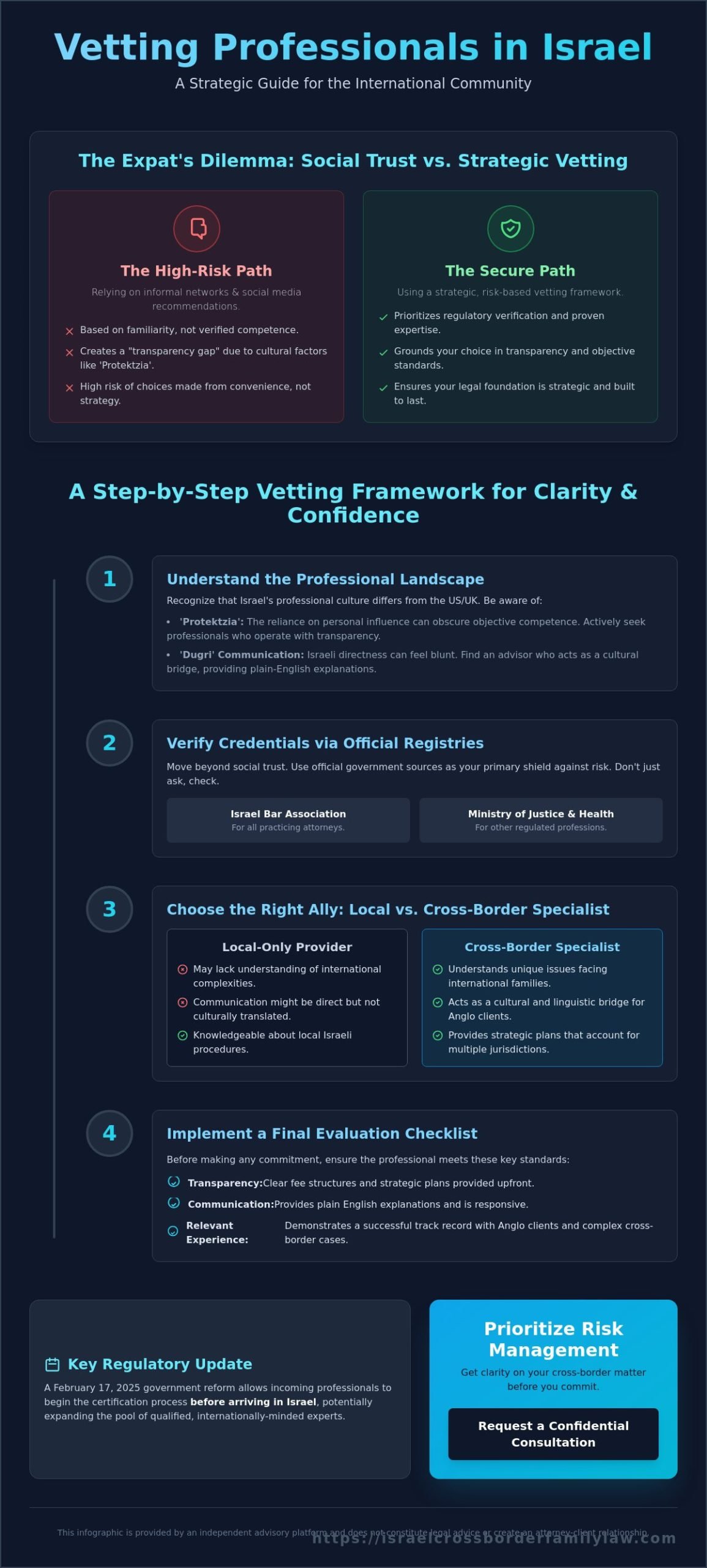
Strategic Risk Management: Moving Forward with Confidence
Finding a trustworthy professional in israel is not a matter of luck; it’s the result of a deliberate, data-driven strategy. For expats and international families, trust shouldn’t be a vague feeling or a social convenience. It must be built on a foundation of verified credentials and cross-border literacy. When you treat professional selection as a form of risk management, you protect your global assets and your family’s future from the complications of an unfamiliar legal system. Moving forward with confidence requires you to prioritize objective verification over the informal social networks that often dominate the local landscape.
Clarity is your most valuable asset before you make any financial or legal commitment. The inherent complexity of managing a life between two countries means that early decisions carry significant weight. Whether you’re dealing with a will, an estate, or a family law matter, the strategy you set today will determine your options tomorrow. To better understand how to approach these professional relationships from a strategic perspective, you can find detailed guidance on the IsraelFamilyLaw YouTube channel, which offers resources specifically tailored for the international community in IL.
Building Your Professional Team in Israel
In many cases, a single professional isn’t enough to handle a multi-jurisdictional life. A sophisticated cross-border situation often requires a team approach, incorporating a bicultural lawyer, a specialized accountant, and a strategic advisor. This collaborative model ensures that no aspect of your case is viewed in a vacuum. An independent advisory approach can be particularly beneficial because it provides a layer of objective oversight that isn’t siloed by a single firm’s perspective. You can learn more about the benefits of this coordinated model by exploring about the advisory and its commitment to guiding clients through complex legal transitions.
Next Steps: Taking Action Safely
As you move forward, your role is to remain an active participant in your own legal strategy. Documentation is essential in a professional culture that often favors verbal directness. Always keep meticulous records of your interactions and ensure that all strategic advice is provided in writing. If a situation feels overly complex or if the proposed path seems to carry high risks, seeking a second opinion is a standard and responsible practice. This is especially true for matters involving international family law or assets located in multiple countries. Taking these proactive steps ensures that your choices are grounded in strategy rather than haste. Get clarity before you commit. Request a confidential consultation to review your case and begin your vetting process with authority.
Securing Your Future Through Strategic Selection
The process of finding a trustworthy professional in israel is a strategic endeavor that requires moving beyond the “Anglo bubble” of social media recommendations. By utilizing the 2024 regulatory updates and government registries, you can transition from uncertainty to informed decision-making. You now have the tools to distinguish between a practitioner who simply speaks English and one who possesses the multi-jurisdictional literacy required for complex US-Israel matters. Trust is built through verification and a structured vetting framework, ensuring your representative aligns with both Israeli standards and your personal expectations.
This platform serves as an independent advisory, not a law firm, dedicated to providing the international community with risk-based strategic guidance. We prioritize clarity and transparency, helping you understand the impact of early legal decisions before they become permanent. Protecting your global interests starts with a proactive approach to your professional relationships. Get clarity before you commit. Request a confidential consultation. Taking this step ensures you have a steady guide to navigate the inherent complexities of a life lived across borders.
This article is published on an independent advisory platform (not a law firm) and does not imply an attorney-client relationship. Legal services are only provided by licensed attorneys under a separate engagement.
Frequently Asked Questions
Is it safe to hire a professional in Israel who doesn’t speak English as their first language?
Yes, it’s safe as long as the professional demonstrates high bicultural literacy and professional proficiency. Many top practitioners in IL are non-native speakers who have spent decades navigating the local system effectively. The priority is their ability to translate complex Israeli procedures into plain English for your benefit. You should verify their communication style during an initial meeting to ensure they can bridge the gap between your expectations and local realities.
How do I verify if an Israeli lawyer is actually licensed to practice?
You can verify a license by visiting the official Israel Bar Association website at israelbar.org.il. Use the tool to search by name or license number to confirm they are in good standing. This registry is the only objective way to ensure an attorney is legally permitted to practice. Verification is a critical step in finding a trustworthy professional in israel because it moves beyond the risks of social recommendations.
What is the average cost for a professional consultation in Israel?
Consultation costs vary significantly based on the professional’s expertise and the complexity of your matter. While the Knesset approved a 20% reduction in Bar membership dues for 2025, individual firm rates remain independent of government fees. You should always request a written fee estimate before your meeting. This transparency helps you avoid the common pitfall of vague pricing often found in informal professional networks that rely on social connections.
Can I use a US-based lawyer for my legal issues in Israel?
A US-based lawyer cannot represent you in Israeli courts unless they hold an active IL license. Israeli law requires practitioners to be members of the local Bar to provide legal services. However, a US-based lawyer can collaborate with your Israeli team to manage cross-border assets. The most effective strategy is finding a trustworthy professional in israel who is dual-qualified or has a dedicated team on the ground in both jurisdictions.
What should I do if I have a dispute with a professional in Israel?
If a dispute arises, your first step is to reference your written engagement letter for agreed terms. If the issue remains unresolved, you can file a formal complaint with the Israel Bar Association’s Ethics Committee or the relevant government ministry. For matters involving financial misconduct, the Israeli court system provides specific channels for redress. Keeping detailed records of all interactions from the start of your engagement is the best way to protect your interests.
Are online reviews for Israeli professionals reliable?
Online reviews should be treated with caution because they often reflect personal feelings rather than professional competence. In IL, these reviews can be influenced by social circles or personal influence. While many expats start their search on social media, reviews should never replace registry verification. Use them as a starting point to gauge a reputation, but always cross-reference credentials with official government databases to ensure the professional meets legal standards.
How do I check if a professional has experience with US-Israel cross-border matters?
Ask the professional for a specific number of cross-border cases they have handled in the last 24 months. A qualified expert should be familiar with the August 8, 2024, amendments to the Bar Association Law regarding foreign-trained lawyers. They should also demonstrate a clear understanding of US-Israel treaties. If they cannot explain how these international agreements impact your specific case, they likely lack the necessary cross-border literacy to protect your global interests.
Is a verbal agreement with a professional binding in Israel?
Verbal agreements are technically binding under Israeli contract law; however, they are notoriously difficult to enforce in court. Without a written document, proving the specific terms of your agreement during a dispute is nearly impossible. Professional ethics in IL strongly encourage written engagement letters to protect both parties. You should never make a financial commitment or begin a legal process based solely on a verbal promise; strategic safety requires a written record.

Article by
Gabriel Lior
A Personal Journey That Became a Mission
The advisory was founded by an American father Gabriel Lior, LLB, MBA , global entrepreneur, and cross-border advisor who spent more than a decade navigating the Israeli family court system firsthand and now lives in Singapore with his son.
As a divorced parent in a cross-border family, Gabriel faced nearly every legal challenge a foreign parent can encounter in Israel — including child custody disputes, child support proceedings, property matters in Israel and abroad, false accusations, and complex immigration and relocation proceedings.
Over the years, he learned the hard way how difficult it is for non-Israeli parents to understand the system, identify the right legal strategy, and choose the right legal representation — especially when language, culture, and jurisdictional differences are involved. He also witnessed how foreign parents and new immigrants are often disadvantaged or taken advantage of by service providers and institutions simply because they lack local knowledge or fluency.
From Client to Advisor
To truly understand — and survive — the system, Gabriel pursued formal legal education in Israel, completing two Israeli law degrees, alongside a BA and MBA earned in the United States. This was never about becoming a practicing attorney, but about gaining a deep, structural understanding of how the system works — and where it breaks down for foreign parents.
This rare combination of:
Firsthand client experience
Israeli legal and US business education
International business and negotiation training
Decades of commercial execution
created a unique perspective – one that understands both sides of the table.
After years of litigation, persistence, and at times self-representation, he ultimately succeeded in securing custody of his son and relocating abroad through a rare legal victory in the Israeli Supreme Court — becoming one of the first fathers in Israel to do so under these circumstances.
Disclaimer
Important Disclaimer:
The information provided on this website and in its content is for general informational and educational purposes only and does not constitute legal advice, legal opinion, or legal representation.
Gabriel Lior is not licensed to practice law in Israel (nor is he interested in doing so) and does not provide legal services, despite having completed 2 Law Degrees. The services offered are advisory in nature and are intended to provide general guidance, strategic insight, and information regarding cross-border family law considerations.
No attorney-client relationship is formed by accessing this website, reading its content, or communicating with us.
Any decisions made based on this information are at your own discretion and risk. For legal advice specific to your situation, you should consult a licensed attorney in the relevant jurisdiction.
Where appropriate, we may refer clients to independent, licensed attorneys or professionals. Such referrals do not constitute legal representation and no liability is assumed for services provided by third parties.