What if the 6,000 miles between the US and Israel isn’t just a physical gap, but a tool used to systematically erase you from your child’s life? For many parents, the realization that an ex-partner is actively turning a child against them is a source of profound emotional distress. You likely feel a growing sense of panic as communication drops and “brainwashing” seems to take hold during long legal delays. Consulting an international parental alienation lawyer becomes essential when you’re caught between two different legal systems. It’s natural to feel overwhelmed by the choice between Israeli Family Courts and Rabbinical Courts while your bond is at risk.
We understand that you need clarity before you make any commitments. This article explains the legal strategies and jurisdictional complexities involved in managing parental alienation in cross-border cases. You’ll learn about the major June 2026 policy shift in the Rabbinical Courts regarding urgent hearings, the use of “mirror orders” for cross-border enforceability, and how the Hague Convention applies to your situation. We’ll help you understand how to work toward a court-enforced contact plan that protects your bond and provides long-term security.
This content is published on an independent advisory platform and is not legal advice. Legal services are only provided by licensed attorneys under a separate engagement. For more visual guidance on these complex matters, you can visit: https://www.youtube.com/@IsraelFamilyLaw.
Key Takeaways
- Physical distance between the US and Israel can be used to erode parent-child bonds, making structured legal oversight vital for maintaining your relationship.
- The choice between Israeli Family and Rabbinical courts significantly impacts how alienation is addressed, requiring a clear jurisdictional strategy from the start.
- Working with an international parental alienation lawyer helps you navigate the specialized role of court-appointed experts and forensic psychologists in proving behavioral patterns.
- Learn why parental alienation often appears in Hague Convention cases and how to address the potential misuse of international legal exceptions.
- Early intervention and reconnection therapy are essential tools to prevent permanent estrangement while cross-border legal proceedings move forward.
What is International Parental Alienation in a US-Israel Context?
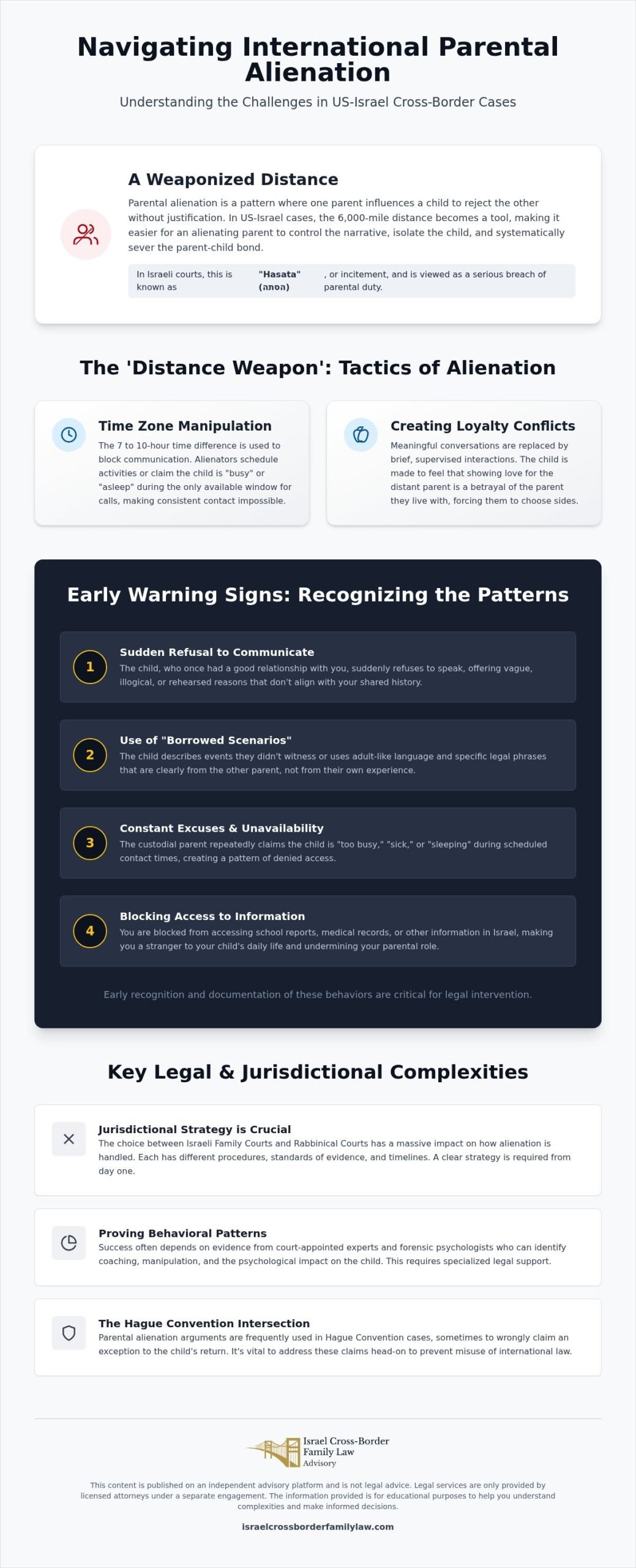
Parental alienation is a psychological and behavioral pattern where one parent influences a child to reject the other parent without a valid justification. In a domestic case, this is already a profound challenge. In a cross-border dispute between the US and Israel, the geographic separation acts as a catalyst for these behaviors. Physical distance makes it easier for the custodial parent to control the narrative, as the child has fewer opportunities to verify the truth through direct interaction. Travel restrictions, such as a nechut yitzia min ha’aretz (stay of exit order) in Israel, can also be misused to keep a child within one jurisdiction indefinitely, further isolating them from the parent in the US.
Israeli courts often refer to this phenomenon as hasata, or incitement. While US courts generally focus on the broad “best interests of the child” standard, the Israeli legal system has developed specific protocols for identifying when a child is being coached. Engaging an international parental alienation lawyer is often necessary because these cases involve more than just psychological manipulation; they involve the strategic use of international borders and time zones to sever the parental bond. In Israeli legal practice, hasata is increasingly viewed as a breach of parental duty, which can lead to court-ordered sanctions or changes in custody arrangements.
To better understand the legal and psychological framework of these cases, watch this discussion with legal experts:
The ‘Distance Weapon’: How Alienators Exploit Borders
Alienators frequently use the eight to ten-hour time difference between the US and Israel to their advantage. They might schedule extracurricular activities or tutoring during your only window for a video call. Over time, meaningful bonding through WhatsApp or Skype is replaced by brief, supervised interactions that feel forced. This creates a “loyalty conflict” where the child feels that loving the parent abroad is a betrayal of the parent they live with every day. The “out of sight, out of mind” phenomenon is rarely accidental. It’s often a calculated strategy to degrade your authority and relevance as a parent while the child is physically located in Israel.
Recognizing the Early Warning Signs
It’s vital to identify these patterns before they become entrenched in the child’s mind. If you notice these signs, consulting an international parental alienation lawyer can help you document these behaviors for the court. Look for these indicators:
- The child suddenly refuses to speak with you, offering vague or illogical reasons that don’t match your past relationship.
- The use of “borrowed scenarios,” where the child describes events they didn’t witness using adult-like legal language or specific phrases used by the other parent.
- The custodial parent repeatedly claims the child is “too busy,” “sick,” or “sleeping” during your scheduled contact time.
- You’re blocked from accessing school or medical records in Israel, effectively making you a stranger to the child’s daily life.
Early recognition allows for quicker intervention in international custody matters. Waiting for things to “settle down” often gives the alienating parent more time to solidify their influence, making legal recovery more difficult. This content is published on an independent advisory platform and is not legal advice. Legal services are only provided by licensed attorneys under a separate engagement.
The Legal Complexity of Alienation Across Jurisdictions
When a child is moved between the US and Israel, the legal landscape shifts immediately. One of the most critical concepts for any parent to understand is the “jurisdictional race.” In cross-border family law, the court that first receives a correctly filed lawsuit often secures the right to decide the case. This is particularly vital in alienation scenarios. If an alienating parent files for custody in Israel before you take action in the US, you may find yourself fighting an uphill battle in a foreign legal system while your relationship with your child continues to erode. An international parental alienation lawyer helps you understand which court is most likely to protect your parental rights based on the child’s “habitual residence.”
The US and Israel approach these disputes through different lenses. While US courts focus on the “best interests of the child,” they also operate under the weight of federal laws like the International Parental Kidnapping Crime Act. This law makes it a federal crime to remove or retain a child outside the US to obstruct parental rights. Israeli courts, however, use the term Nikkur Hori (parental alienation) and have developed specific domestic protocols to address it. Understanding how these two systems interact is the first step in building a defense against the systematic erasure of your role as a parent.
Family Court vs. Rabbinical Court in Israel
Israel maintains a dual court system. Custody cases can be heard in secular Family Courts or religious Rabbinical Courts. Each has a distinct culture and approach to Nikkur Hori. As of June 2026, the Rabbinical Courts have implemented new directives requiring hearings within seven days for urgent alienation claims. Both courts rely heavily on reports from the “Welfare Authorities” (Sia’u). These social workers evaluate the family dynamic and provide recommendations that carry significant weight. You must also be aware of the “Closing of the Gates” doctrine, where one court may lose the authority to hear your case if the other court has already established jurisdiction.
Enforcement of Foreign Custody Orders
If you already have a custody order from a US court, it isn’t automatically enforceable in Israel. You must go through a formal process to register and “validate” the order within the Israeli system. This step is essential to prevent an alienating parent from claiming that no legal framework exists for your parenting time. Even with a registered order, enforcing visitation across an ocean is difficult. Courts may use “mirror orders” to ensure the terms set in the US are respected in Israel. This creates a consistent legal bridge that discourages the alienating parent from exploiting the distance. You can learn more about these strategies in our guide on International Custody & Relocation.
Managing these moving parts requires a clear strategy before you file any documents. If you’re concerned about the direction of your case, you might find it helpful to seek professional clarity on your jurisdictional options. This content is published on an independent advisory platform and is not legal advice. Legal services are only provided by licensed attorneys under a separate engagement.
Proving Parental Alienation: Evidence and Expert Testimony
Proving alienation is often the most difficult stage of a cross-border custody dispute. Because the behavior usually happens behind closed doors, the parent residing in the US is at a distinct disadvantage. You aren’t there to witness the subtle “poisoning” of the child’s mind. To overcome this, an international parental alienation lawyer focuses on building a narrative based on objective patterns rather than emotional accusations. In Israel, the courts look for specific indicators that a child’s rejection of a parent is manufactured rather than a reaction to actual harm. This requires a sophisticated approach to gathering evidence that spans two different legal cultures.
The weight of the “child’s voice” is a key area of difference. While both the US and Israel prioritize the best interests of the child, Israeli judges often interview children directly in their chambers. This is a high-stakes moment. An alienated child may recite “borrowed scenarios” that sound like adult legal arguments. Your strategy must involve showing the court that the child’s stated preference isn’t their own, but rather a reflection of the custodial parent’s influence. This is why the role of forensic experts is so central to these proceedings.
The Role of Psychological Evaluations
In Israel, the court frequently appoints a forensic psychologist to conduct a parental capacity evaluation. These experts are trained to distinguish between “alienation” and “estrangement.” Estrangement is a child’s justified rejection of a parent due to past abuse or neglect. Alienation is an unjustified rejection. During these evaluations, the expert observes interactions and conducts interviews to see if the child’s language is age-appropriate. It’s vital to choose an expert who understands the nuances of cross-cultural families, as cultural misunderstandings can sometimes be mistaken for alienating behavior. Be prepared for a process that can take several months, as wait times for these appointments can be significant.
Essential Evidence for Your Case
You need a documented “alienation trail.” Courts in both the US and Israel respond best to clear, chronological data. Your evidence should include:
- Communication Logs: Detailed records of every missed WhatsApp call, blocked Skype session, or ignored email. If calls are frequently cut short or “monitored,” note the specific dates and times.
- Digital Evidence: Screenshots of social media posts where the other parent disparages you or transcripts of voice messages where the child uses adult-like language.
- Third-Party Testimony: Reports from neutral parties like teachers, doctors, or therapists in Israel who can testify to the child’s behavior or your exclusion from the child’s life.
When presenting this evidence, it’s essential to remain calm. Appearing aggressive in court can inadvertently support the alienating parent’s claim that you’re a “threat” to the child’s peace. Focus on the child’s right to have a relationship with both parents. For more information on how these cases are managed, you can read about international custody relocation strategies. This content is published on an independent advisory platform and is not legal advice. Legal services are only provided by licensed attorneys under a separate engagement.
The Intersection of Parental Alienation and the Hague Convention
The Hague Convention is a powerful treaty designed to resolve international child abduction cases quickly. However, parental alienation has become a frequent and complex defense used to block the return of a child. When one parent wrongfully retains a child in Israel, they may argue that returning the child to the US would cause severe psychological harm. An international parental alienation lawyer must be prepared to address these claims during Hague proceedings, as the court’s priority is the speed of the return rather than a long-term custody evaluation.
The primary purpose of the Hague Convention in 2026 is the prompt return of children to their country of habitual residence to ensure that custody disputes are decided by the appropriate local courts. This treaty doesn’t decide which parent is superior; it decides where the case should be heard. When alienation is present, the abducting parent often attempts to “legalize” the separation by claiming the child has a settled preference to stay in Israel. Managing this overlap requires an international parental alienation lawyer who understands how to counter Article 13b defenses effectively, especially since the average time to resolve a Hague application was 207 days according to 2021 data.
Parental Alienation as a Defense
Under Article 13b of the Convention, a court isn’t required to return a child if there’s a “grave risk” that doing so would expose them to physical or psychological harm. Alienating parents often misuse this exception. They may coach the child to express an intense, irrational fear of the parent in the US. Israeli and US courts are increasingly aware of this tactic. They look for signs of “coached responses” by involving court-appointed experts who can distinguish between a child’s genuine trauma and a manufactured rejection. The burden of proof for “grave risk” remains high. Proving that a child is being alienated can actually strengthen your argument for a return order.
Preventing ‘Legalized’ Alienation
One of the most effective ways to combat alienation is to prevent the child’s removal before it happens. If you suspect your partner intends to relocate with the child under false pretenses, you should seek a “Ne Exeat” or stay of exit order. This legal tool maintains the status quo by preventing the child from leaving the country without both parents’ consent. Without such protections, physical distance can allow alienation to take root, making future Hague Convention & child abduction claims much harder to litigate. If you find yourself facing these challenges, you should consult with a professional advisor to discuss your strategy. This content is published on an independent advisory platform and is not legal advice. Legal services are only provided by licensed attorneys under a separate engagement.
Strategic Guidance: Protecting the Bond Before It Breaks
Time is the most critical factor in any case involving parental rejection. Many parents make the mistake of waiting for things to “settle down” or hoping the child will eventually “see the truth” on their own. In the Israeli legal system, this delay is a significant risk. The courts place immense weight on the “status quo.” If a child spends six months or a year without meaningful contact with you, a judge may be reluctant to disrupt the child’s current routine, even if that routine was established through manipulation. Early intervention is the only way to prevent the alienation from becoming a permanent fixture of the child’s life.
Therapeutic interventions are often the first line of defense used by Israeli courts. Reconnection therapy, known in Israel as tipul l’chidush kesher, is a specialized process where court-appointed therapists work to rebuild the fractured bond. These programs are designed to address the child’s fears while holding the alienating parent accountable for their role in the estrangement. However, therapy is rarely successful without a clear court order that mandates participation and sets consequences for non-compliance. An international parental alienation lawyer helps ensure that these therapeutic efforts are backed by the full authority of the court.
A successful outcome requires more than just aggressive litigation. You need a comprehensive strategy that accounts for the differences between US and Israeli legal cultures. This is what we call the “advisory approach.” It involves coordinating with your US counsel, managing the “jurisdictional race,” and preparing for the specific requirements of the Israeli Welfare Authorities. An international parental alienation lawyer acts as a bridge, ensuring that your actions in one country don’t inadvertently damage your standing in the other.
Immediate Steps if You Suspect Alienation
- Consult early: Speak with a professional to map out your jurisdictional strategy before the custodial parent can establish a new “habitual residence” in Israel.
- Document outreach: Maintain a consistent, calm, and loving stream of communication. Even if the child doesn’t respond, your documented attempts to stay involved are vital for showing the court that you haven’t abandoned the relationship.
- Avoid retaliation: It’s tempting to respond to alienation by withholding financial support or acting out in anger. This is a “retaliation trap” that the other parent can use to justify their claims that you’re a threat to the child’s well-being.
The Israel Cross Border Advisory Advantage
We specialize in helping international families navigate the multi-jurisdictional complexity of US-Israel custody disputes. Our platform focuses on bridging the gap between your expectations and the reality of the Israeli court system. We emphasize long-term family stability and the protection of your parental rights through strategic decision-making. To understand your options and the risks involved in your specific situation, you can request a Confidential Case Review.
This content is published on an independent advisory platform and is not legal advice. Legal services are only provided by licensed attorneys under a separate engagement. Get clarity before you commit. Request a confidential consultation.
Strategic Clarity for Your Family’s Future
Managing a custody dispute between the US and Israel requires more than just reacting to daily crises. It demands a sophisticated understanding of how two distinct legal systems interact. You’ve seen how the “jurisdictional race” and the nuances of the Israeli court system can impact your bond with your child. By prioritizing an advisory-first approach, you can navigate these multi-jurisdictional complexities with greater confidence. Our expertise in US-Israel jurisdictional conflicts ensures you have the guidance needed to protect your relationship before the distance causes permanent damage.
If you’re concerned about the signs of hasata or incitement, engaging an international parental alienation lawyer is a vital step in documenting your case correctly. For additional insights into these processes, we invite you to explore our featured Israel Family Law video series. This content is published on an independent advisory platform and is not legal advice. Legal services are only provided by licensed attorneys under a separate engagement. Your child’s long-term emotional and legal security depends on the strategic decisions you make today.
Get clarity before you commit. Request a confidential consultation to discuss your specific situation. You don’t have to navigate this journey alone.
Frequently Asked Questions
Is parental alienation considered a crime in Israel?
Parental alienation isn’t a criminal offense in Israel, but it carries significant legal consequences in both Family and Rabbinical courts. Under the June 2026 Rabbinical Court protocol, judges have the authority to impose financial sanctions on the alienating parent and require them to cover therapeutic costs. While you won’t see criminal charges like in some US jurisdictions, the court treats incitement as a serious breach of parental duty.
Can an Israeli court change custody if parental alienation is proven?
Yes, Israeli courts have the power to transfer custody to the alienated parent if they determine it’s the only way to protect the child’s well-being. This is typically a last resort used in severe cases where other interventions have failed. An international parental alienation lawyer can help you present the expert psychological evidence required to justify such a significant change in the child’s living arrangements.
How do I prove my child is being coached by the other parent across borders?
Proving coaching involves documenting “borrowed scenarios” where the child uses adult-like legal language that doesn’t match their age. Court-appointed forensic psychologists in Israel are specifically trained to identify these patterns during evaluations. You should also maintain a detailed log of blocked WhatsApp calls and monitored messages to demonstrate a consistent pattern of interference to the judge.
What is ‘reconnection therapy’ and does it work in international cases?
Reconnection therapy, known in Israel as tipul l’chidush kesher, is a court-mandated process designed to repair the fractured bond between a child and the rejected parent. In international cases, this often begins with supervised video sessions to bridge the physical distance. Its success depends heavily on the court’s willingness to enforce the schedule and penalize the custodial parent for any interference.
Can I stop paying child support if my ex-partner is alienating our child in Israel?
You shouldn’t stop paying child support unilaterally, as this can be framed as “financial alienation” and will likely damage your legal standing in court. In very specific circumstances, Israeli courts may reduce support if a child is legally declared “rebellious,” but this is a high bar to meet. Always seek a formal court order before changing any financial commitments to avoid being held in contempt.
How long does a parental alienation case usually take in the Israeli Family Court?
The timeline varies between the dual court systems, but urgency is becoming a priority. Since June 2026, the Rabbinical Courts are required to hold initial hearings for urgent alienation claims within seven days. In the Family Court, the process often takes longer because the judge relies on detailed reports from Welfare Authorities and psychological experts, which can take several months to finalize.
What happens if my child refuses to talk to me despite a court order?
If a child refuses contact, the court may appoint a guardian ad litem or order intensive therapeutic intervention. Judges can also impose daily fines on the custodial parent for every missed visit or phone call. In extreme situations, the court might consider temporary placement in a neutral setting to facilitate reconnection without the alienating parent’s constant influence.
Does the US Embassy help with parental alienation or custody disputes in Israel?
The US Embassy doesn’t provide legal representation or intervene in private custody disputes in Israel. They can provide lists of local attorneys or conduct a welfare check if there are safety concerns, but they cannot overturn Israeli court decisions. You’ll need to work with an international parental alienation lawyer to navigate the complexities of the local legal system and enforce your rights.

Article by
Gabriel Lior
A Personal Journey That Became a Mission
The advisory was founded by an American father Gabriel Lior, LLB, MBA , global entrepreneur, and cross-border advisor who spent more than a decade navigating the Israeli family court system firsthand and now lives in Singapore with his son.
As a divorced parent in a cross-border family, Gabriel faced nearly every legal challenge a foreign parent can encounter in Israel — including child custody disputes, child support proceedings, property matters in Israel and abroad, false accusations, and complex immigration and relocation proceedings.
Over the years, he learned the hard way how difficult it is for non-Israeli parents to understand the system, identify the right legal strategy, and choose the right legal representation — especially when language, culture, and jurisdictional differences are involved. He also witnessed how foreign parents and new immigrants are often disadvantaged or taken advantage of by service providers and institutions simply because they lack local knowledge or fluency.
From Client to Advisor
To truly understand — and survive — the system, Gabriel pursued formal legal education in Israel, completing two Israeli law degrees, alongside a BA and MBA earned in the United States. This was never about becoming a practicing attorney, but about gaining a deep, structural understanding of how the system works — and where it breaks down for foreign parents.
This rare combination of:
Firsthand client experience
Israeli legal and US business education
International business and negotiation training
Decades of commercial execution
created a unique perspective – one that understands both sides of the table.
After years of litigation, persistence, and at times self-representation, he ultimately succeeded in securing custody of his son and relocating abroad through a rare legal victory in the Israeli Supreme Court — becoming one of the first fathers in Israel to do so under these circumstances.
Disclaimer
Important Disclaimer:
The information provided on this website and in its content is for general informational and educational purposes only and does not constitute legal advice, legal opinion, or legal representation.
Gabriel Lior is not licensed to practice law in Israel (nor is he interested in doing so) and does not provide legal services, despite having completed 2 Law Degrees. The services offered are advisory in nature and are intended to provide general guidance, strategic insight, and information regarding cross-border family law considerations.
No attorney-client relationship is formed by accessing this website, reading its content, or communicating with us.
Any decisions made based on this information are at your own discretion and risk. For legal advice specific to your situation, you should consult a licensed attorney in the relevant jurisdiction.
Where appropriate, we may refer clients to independent, licensed attorneys or professionals. Such referrals do not constitute legal representation and no liability is assumed for services provided by third parties.