You have meticulously planned your estate in your home country, but a critical question remains for those with assets in Israel: will your foreign will be sufficient? Relying solely on a US or UK will can expose your heirs to a complex, lengthy, and expensive probate process, navigating a legal system and language that may be entirely unfamiliar. The unfortunate reality is that without the correct legal instrument, your Israeli assets could be frozen or distributed contrary to your wishes. This is why a professionally drafted israeli will for foreign nationals is not just an advantage-it is an essential component of any sophisticated international estate plan. This comprehensive guide provides the clarity you need to protect your legacy. We will delve into the critical differences between Israeli and foreign inheritance laws, outline the definitive steps to safeguard your property and investments, and demonstrate how a bespoke Israeli will ensures a smooth and efficient transfer of assets to your beneficiaries. Our goal is to provide you with the peace of mind that comes from knowing your cross-border affairs are in order, protecting your family from costly and avoidable legal complications.
Why Your Foreign Will May Not Cover Your Israeli Assets
Many foreign nationals who own property or hold financial accounts in Israel operate under the critical misunderstanding that the will drafted in their home country will seamlessly govern their Israeli estate. This assumption, however, overlooks a fundamental principle of international law: jurisdiction. When it comes to the disposition of assets, the physical location of those assets is often the determining factor. An Israeli court holds primary jurisdiction over assets situated within its borders, from real estate in Tel Aviv to a bank account in Jerusalem, creating significant challenges for executors relying solely on a foreign-based testamentary document. Relying on a foreign will for Israeli assets introduces substantial risks, including protracted probate proceedings, costly legal challenges, and the potential for the asset distribution to deviate from your original intent. A purpose-drafted israeli will for foreign nationals is the most effective legal instrument to mitigate these cross-border complexities.
The Principle of ‘Lex Situs’ in Israeli Inheritance Law
The core legal doctrine at play is lex rei sitae, or ‘lex situs’, which translates to “the law of the place where the property is situated.” In simple terms, the laws of the country where an asset is located govern issues of its ownership, transfer, and inheritance. This principle applies with particular force to immovable property (real estate). The transfer of title for an Israeli apartment, for example, is governed exclusively by the Israeli property law framework, and a foreign will must be probated and recognized by an Israeli court to have any effect-a process that is neither guaranteed nor efficient. While the rules for movable property like bank accounts or securities can be more nuanced, they are not immune to complications. Israeli financial institutions will freeze accounts upon the owner’s death and will require an Israeli probate order to release the funds, regardless of what a foreign will dictates.
Common Misconceptions About ‘International Wills’
A prevalent myth is that a will, once legally executed in one country, is automatically and universally valid. This is incorrect. Recognition and enforcement are two distinct and complex legal stages. While an Israeli court may recognize the formal validity of a will from a common law jurisdiction like the United States or the United Kingdom, enforcing its terms can be problematic. Discrepancies between legal systems can create conflicts, particularly when a foreign will’s structure is unfamiliar to Israeli succession law. These issues represent some of the unique challenges faced by expats and foreign nationals in Israel, whose multi-jurisdictional affairs require sophisticated, forward-looking estate planning to ensure their testamentary wishes are honored without undue delay or expense.
Probating a Foreign Will in Israel: A Costly and Complex Process
While it is legally permissible to enforce a foreign will in Israel, this alternative path is fraught with significant procedural hurdles, extended timelines, and substantial costs. For foreign nationals with Israeli assets, relying on a will drafted abroad imposes a considerable burden on their heirs, transforming what should be a straightforward inheritance process into a complex, multi-jurisdictional legal challenge. This stands in stark contrast to the efficiency and certainty provided by a valid Israeli will.
Step-by-Step: The Process of Recognizing a Foreign Will
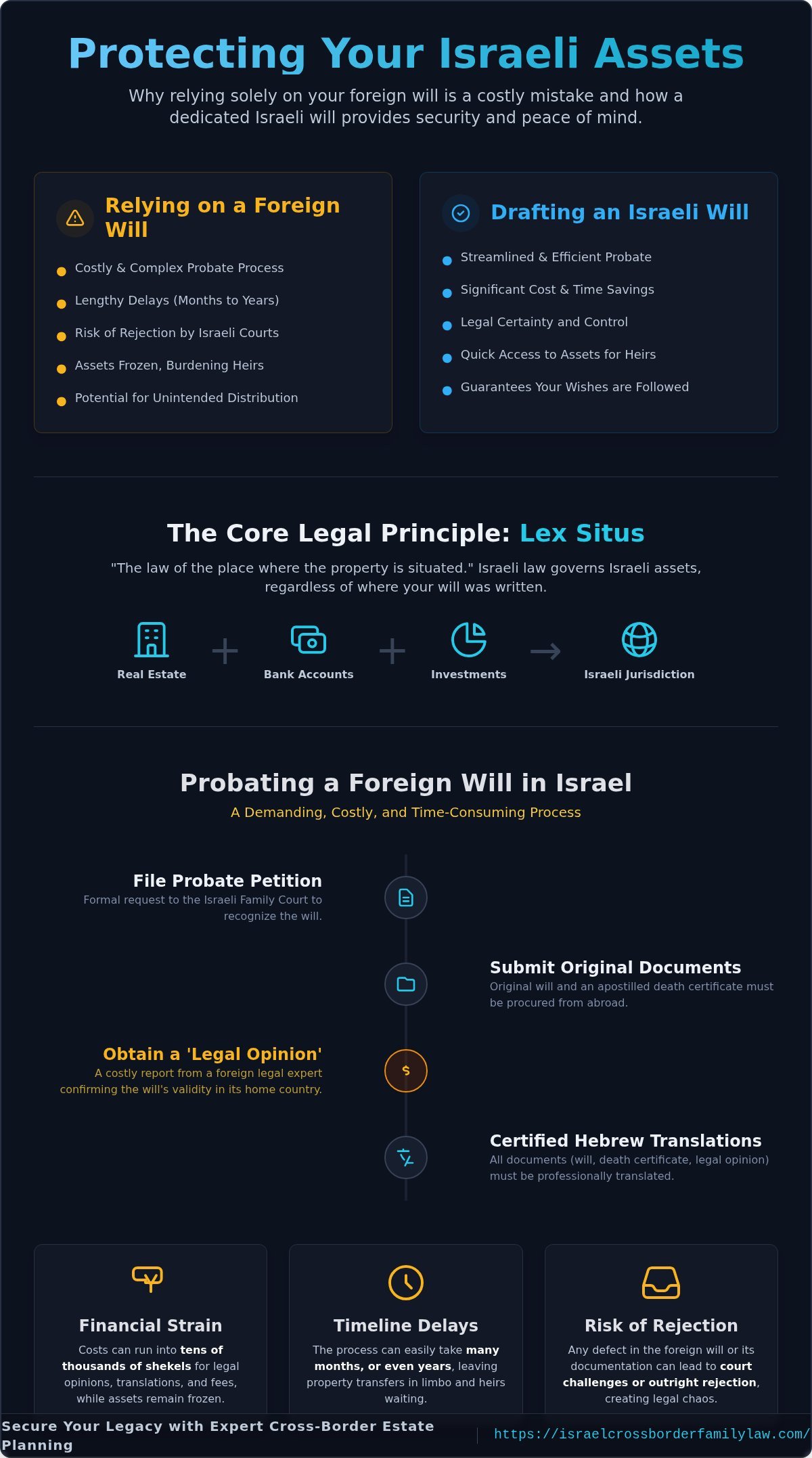
Navigating the Israeli legal system to probate a foreign will is a meticulous and demanding undertaking. Your heirs, guided by Israeli legal counsel, must execute a series of critical steps, each with its own potential for delay and expense:
- Filing a Probate Petition: The process commences with a formal petition to the Israeli Family Court or Registrar of Inheritance Matters to recognize and enforce the foreign will.
- Essential Documentation: The original foreign will must be submitted alongside a certified and apostilled death certificate. Procuring these original documents from abroad can be the first logistical hurdle.
- The ‘Legal Opinion’: This is arguably the most crucial and costly requirement. A legal expert qualified in the jurisdiction where the will was created must provide a formal, written opinion confirming the will’s validity under that country’s laws.
- Certified Hebrew Translations: Every single document submitted to the court-including the will, death certificate, and the foreign legal opinion-must be professionally translated into Hebrew by a certified notary.
Practical and Financial Burdens on Your Heirs
The procedural requirements translate directly into tangible burdens for your beneficiaries. The primary objective of an israeli will for foreign nationals is to avoid these very complications. Heirs face significant disadvantages when probating a foreign will: Financial Strain: The cumulative costs are considerable, often running into tens of thousands of shekels (₪). These expenses include Israeli legal fees, the high cost of the foreign legal expert’s opinion, certified translation services, and court fees. Assets are typically frozen until probate is granted, potentially creating liquidity issues for heirs. Timeline Delays: The process of gathering documents, securing a legal opinion, and navigating court schedules can easily extend for many months, and in complex cases, even years. This protracted timeline leaves assets inaccessible and property transfers in limbo. Risk of Rejection: The Israeli court meticulously reviews these applications. Any perceived defect in the foreign will’s execution or an inadequate legal opinion can lead to challenges or outright rejection, forcing heirs into even more complex litigation. The court’s adherence to specific inheritance laws for property in Israel means that foreign documents are held to an exacting standard, creating a level of uncertainty that a properly executed Israeli will eliminates.
The Strategic Advantage: Drafting a Dedicated Israeli Will
While relying on a foreign will to administer Israeli assets is a possibility, it often introduces significant and costly complexities into the probate process. A far more strategic approach is to proactively draft a dedicated Israeli will. This instrument is precisely tailored to Israeli law and is limited in scope to govern only your assets located within Israel, such as real estate, bank accounts, or securities. This proactive measure provides unparalleled speed, certainty, and significant cost savings, often preventing legal fees and court delays that can amount to tens of thousands of shekels. Executing a purpose-built israeli will for foreign nationals is the most effective method for ensuring your intentions are carried out efficiently, securing your legacy in Israel and providing peace of mind for your heirs.
Types of Wills Recognized Under Israeli Law
The Israeli Succession Law of 1965 provides for several legally valid forms of wills, each with distinct requirements. Understanding these options is the first step in creating a robust and defensible estate plan:
- Will in Front of Witnesses: The most common and secure form, requiring the testator’s signature before two competent witnesses who attest to the signing.
- Handwritten Will: Must be written entirely in the testator’s own hand, including the date and signature. No witnesses are required.
- Will Before an Authority: Made orally or by submitting a written will to a judge, the Registrar of Inheritance, or a notary, who then confirms its validity.
- Oral Will: A “deathbed will” valid only under specific, life-threatening circumstances and in the presence of two witnesses. It becomes void one month after the circumstances cease to apply.
Key Provisions in a Foreign National’s Israeli Will
To be effective, an Israeli will must be drafted with precision. It should not be a mere translation of your primary will but a distinct legal document containing critical provisions. These include a clear declaration that the will applies exclusively to assets situated in the State of Israel, the appointment of an executor who is preferably based in Israel or can act effectively within the jurisdiction, and unambiguous instructions for the nomination of beneficiaries and the distribution of assets. Crucially, it should also state which country’s law will govern the will’s interpretation and substance, providing clarity for the Israeli courts.
Coordinating Your Israeli Will with Your Primary Estate Plan
A dual-will strategy is a sophisticated tool for managing a multi-jurisdictional estate. However, it demands expert legal coordination to ensure the two documents do not conflict with or inadvertently revoke one another. Standard revocation clauses in a primary will must be carefully amended to preserve the Israeli will’s validity. This approach provides absolute clarity for your family and the courts, simplifying the administration process for executors in both countries and ensuring a seamless, efficient, and predictable transfer of your global assets according to your wishes.
Navigating Cross-Border Complexities and Common Pitfalls
For foreign nationals with assets in Israel, particularly those with sophisticated financial portfolios or dual citizenship, effective estate planning extends far beyond standard will drafting. It requires a strategic, multi-jurisdictional approach to anticipate and mitigate the complex legal and financial challenges inherent in cross-border inheritance. A meticulously prepared israeli will for foreign nationals is the cornerstone of a successful strategy, safeguarding assets and ensuring your intentions are honored without costly delays or disputes.
Considerations for Dual Citizens
Dual citizenship, such as for US-Israeli nationals, introduces a significant layer of complexity. While Israeli law generally permits a testator to choose the law that governs their estate, navigating the potential conflicts between differing legal systems is critical. A primary consideration is the divergence between US federal estate tax obligations and Israel’s current lack of inheritance or estate tax. Unified planning is essential to structure the estate in a tax-efficient manner, preventing unintended financial burdens on beneficiaries and ensuring compliance across both jurisdictions.
Appointing an Executor for Your Israeli Assets
The selection of an executor (Menahel Izavon) is one of the most critical decisions in your estate plan. This individual or entity is tasked with navigating the Israeli probate process, a role that demands diligence and local knowledge. Key considerations include:
- Resident vs. Non-Resident: Appointing an Israeli resident often streamlines the process, as they can more easily interact with local banks, government offices like the Land Registry (Tabu), and the Inheritance Registrar. A foreign resident may face significant logistical challenges and could be required by the court to post a substantial bond, potentially valued in the hundreds of thousands of shekels, as a guarantee.
- Practical Duties: The executor is responsible for identifying all estate assets, settling any debts, filing necessary applications for a probate order, and ultimately distributing the assets to the rightful heirs according to the will’s directives.
- Professional Trustees: For complex estates involving business interests, extensive real estate holdings, or the potential for beneficiary disputes, appointing a professional or corporate trustee can provide impartial and expert management, ensuring the estate is administered efficiently and professionally.
Failing to address these advanced topics can lead to common pitfalls that invalidate a will, such as procedural errors in execution, claims of undue influence, or ambiguity in the text. A thoughtfully constructed israeli will for foreign nationals, drafted with expert legal guidance, is the most effective tool for avoiding these complications. Navigating these multi-jurisdictional challenges requires experienced counsel. For guidance on structuring your cross-border estate plan, contact our team of bicultural legal experts.
Why You Need a Specialized Cross-Border Estate Lawyer
Navigating the complexities of multi-jurisdictional estate planning is not a task for a general practitioner in either your home country or in Israel. The intersection of different legal doctrines, inheritance tax laws, and probate procedures creates a sophisticated legal challenge that demands specialized expertise. A local lawyer may understand Israeli probate but lack insight into foreign tax implications, while a lawyer in your home country will likely be unfamiliar with Israel’s unique succession laws. An experienced cross-border estate lawyer acts as a crucial bridge between two distinct legal systems. Their primary role is to ensure your wills are harmonized, preventing legal conflicts, double taxation, or the invalidation of a testamentary document. This specialist ensures your comprehensive estate plan-covering assets in all jurisdictions-functions as a cohesive whole, accurately reflecting your final wishes and protecting your beneficiaries. Crafting an effective israeli will for foreign nationals requires this deep, integrated understanding.
What to Look for in a Cross-Border Law Firm
Selecting the right legal counsel is paramount. Seek a firm with verifiable, extensive experience advising foreign nationals on Israeli estate matters. The ideal team includes dual-qualified attorneys licensed to practice in both jurisdictions (e.g., the U.S. and Israel), ensuring a seamless understanding of both legal cultures. This expertise must extend to a clear grasp of international tax treaties and their direct impact on your estate. As detailed in our firm’s professional advisory, our team is structured to provide this precise, multi-jurisdictional guidance.
The First Step: A Confidential Case Review
The process of creating a comprehensive israeli will for foreign nationals begins with a confidential consultation to assess your unique situation. To make this initial meeting as productive as possible, you should be prepared to discuss:
- A complete list of your Israeli and international assets.
- Key details about your family structure and beneficiaries.
- Any existing wills or trusts you have in place.
This initial review allows an expert to identify potential conflicts and develop a clear, strategic roadmap. Taking this proactive step is the most effective way to protect your assets, preserve your legacy, and prevent costly and emotionally draining disputes for your family in the future. Contact our firm to schedule your confidential case review and secure your cross-border estate plan.
Securing Your Israeli Legacy: A Strategic Imperative
The complexities of multi-jurisdictional estate law underscore a critical reality: relying on a foreign will to govern your Israeli assets introduces significant risk, often leading to a protracted and costly probate process within the Israeli legal system. The strategic creation of a dedicated israeli will for foreign nationals is not merely an administrative step but a foundational component of a robust asset protection strategy, ensuring your legacy is transferred seamlessly and in accordance with your explicit directives. Navigating this intricate legal landscape demands specialized expertise in US-Israel cross-border family and estate law. Our attorneys possess a deep, nuanced understanding of both legal systems, enabling us to develop proactive strategies that protect your assets and profoundly simplify the inheritance process for your loved ones. Do not leave the disposition of your Israeli property to chance. Take the decisive step to safeguard your cross-border legacy. We invite you to request a confidential case review to discuss the optimal strategy for your Israeli assets and gain the peace of mind that comes with proactive planning.
Frequently Asked Questions About Israeli Wills
Does Israel have an inheritance tax or estate tax?
Israel does not currently impose an inheritance tax or estate tax, a policy that has been in effect since 1981. This provides a significant advantage for beneficiaries inheriting Israeli assets. However, it is critical to understand that while the inheritance itself is not taxed, subsequent transactions, such as the sale of inherited real estate, may trigger capital gains tax. Navigating these complex fiscal regulations requires sophisticated cross-border tax planning to ensure full compliance and optimal financial outcomes for heirs.
What happens to my Israeli assets if I die without a will (intestate)?
In the absence of a valid will, your Israeli assets will be distributed according to the default provisions of Israel’s Succession Law of 1965. This statutory framework dictates a specific hierarchy of heirs, typically your surviving spouse and children. For foreign nationals with complex family structures or specific intentions, this default distribution can lead to unintended consequences and potential disputes. A properly executed israeli will for foreign nationals is the only mechanism to override these intestate rules.
Can I appoint a non-Israeli resident as the executor of my Israeli will?
While Israeli law permits the appointment of a non-resident executor, it introduces significant logistical complexities that can impede the administration of the estate. The executor must navigate Israeli court procedures, interact with local banks, and manage property, all of which is challenging from abroad. For seamless and efficient estate administration, we typically advise clients to appoint an Israeli resident, such as a trusted individual or a professional like an Israeli attorney, who can act effectively on the ground.
Do I have to travel to Israel to sign my will?
Traveling to Israel is not a mandatory requirement for executing a valid will. The law provides several alternatives for foreign residents, including signing the document before an Israeli consul at a consulate in your country of residence. Furthermore, a will executed abroad in accordance with local laws can often be recognized in Israel under the principles of private international law. Our firm is adept at guiding international clients through these multi-jurisdictional formalities to ensure their will is legally robust.
How long does the probate process typically take in Israel with a valid Israeli will?
With a valid and unambiguous Israeli will, the probate process, known as obtaining a “Probate Order” (Tzav Kiyum Tzvava), is typically a streamlined administrative procedure. In straightforward cases with no objections, the process can often be completed within two to four months from the date of filing the petition with the Inheritance Registrar. However, estates involving complex assets or international beneficiaries may require additional time. Diligent legal oversight is essential to navigate the process efficiently and preempt potential delays.
Can an Israeli will be challenged or contested in court?
Yes, like in many jurisdictions, an Israeli will can be contested in the Family Court. Common grounds for a challenge include allegations of undue influence, lack of testamentary capacity, or improper execution of the document. This underscores the critical importance of professional legal counsel during the drafting process. A meticulously prepared israeli will for foreign nationals, created with experienced attorneys, significantly minimizes the risk of a successful challenge and ensures your testamentary intentions are protected from future litigation.

Article by
Gabriel Lior
A Personal Journey That Became a Mission The advisory was founded by an American father Gabriel Lior, LLB, MBA , global entrepreneur, and cross-border advisor who spent more than a decade navigating the Israeli family court system firsthand and now lives in Singapore with his son.
As a divorced parent in a cross-border family, Gabriel faced nearly every legal challenge a foreign parent can encounter in Israel — including child custody disputes, child support proceedings, property matters in Israel and abroad, false accusations, and complex immigration and relocation proceedings. Over the years, he learned the hard way how difficult it is for non-Israeli parents to understand the system, identify the right legal strategy, and choose the right legal representation — especially when language, culture, and jurisdictional differences are involved. He also witnessed how foreign parents and new immigrants are often disadvantaged or taken advantage of by service providers and institutions simply because they lack local knowledge or fluency. From Client to Advisor To truly understand — and survive — the system, Gabriel pursued formal legal education in Israel, completing two Israeli law degrees, alongside a BA and MBA earned in the United States. This was never about becoming a practicing attorney, but about gaining a deep, structural understanding of how the system works — and where it breaks down for foreign parents. This rare combination of: Firsthand client experience Israeli legal and US business education International business and negotiation training Decades of commercial execution created a unique perspective – one that understands both sides of the table. After years of litigation, persistence, and at times self-representation, he ultimately succeeded in securing custody of his son and relocating abroad through a rare legal victory in the Israeli Supreme Court — becoming one of the first fathers in Israel to do so under these circumstances.
Disclaimer
Important Disclaimer: The information provided on this website and in its content is for general informational and educational purposes only and does not constitute legal advice, legal opinion, or legal representation. Gabriel Lior is not licensed to practice law in Israel (nor is he interested in doing so) and does not provide legal services, despite having completed 2 Law Degrees. The services offered are advisory in nature and are intended to provide general guidance, strategic insight, and information regarding cross-border family law considerations. No attorney-client relationship is formed by accessing this website, reading its content, or communicating with us. Any decisions made based on this information are at your own discretion and risk. For legal advice specific to your situation, you should consult a licensed attorney in the relevant jurisdiction. Where appropriate, we may refer clients to independent, licensed attorneys or professionals. Such referrals do not constitute legal representation and no liability is assumed for services provided by third parties.