Did you know that the prenuptial agreement you signed in New York or California might be treated as little more than a piece of paper by an Israeli court? For any US citizen living in or moving to Israel, securing a prenuptial agreement for us citizen in israel requires more than just translating a document. It requires a coordinated strategy that satisfies two very different legal systems simultaneously. You likely want to protect the retirement accounts you built in the States while also securing the home you’re purchasing in Tel Aviv. It’s natural to feel anxious about how the Israeli Rabbinical court might view your assets or whether your US-based protections will hold up during a major life transition.
This guide will show you how to achieve legal certainty in both jurisdictions, ensuring your global assets remain protected regardless of where you reside. We’ll walk through the mandatory authentication process in the Israeli Family Court, the “balancing of resources” principle, and the specific steps needed to bridge the gap between US and Israeli law. This content is published on an independent advisory platform and does not constitute legal representation or formal legal advice. Strategy and risk guidance are informational; legal services are provided only by licensed attorneys under a separate engagement.
Key Takeaways
- Understand how to bridge the legal gap between US contracts and Israeli “Property Relations” law to ensure your protections are recognized in both countries.
- Learn how to structure a prenuptial agreement for us citizen in israel to safeguard complex assets like US retirement accounts and Israeli real estate.
- Discover the strategic implications of choosing the right authority, such as a notary or a Family Court judge, to authorize your cross-border agreement.
- Identify the essential steps for coordinating between US and Israeli legal advisors to prevent conflicting jurisdiction issues during asset division.
- Gain a clear roadmap for the 3-to-6-month planning window required to finalize your strategy and achieve legal certainty before your wedding.
Why a Standard US Prenup May Fail in Israel
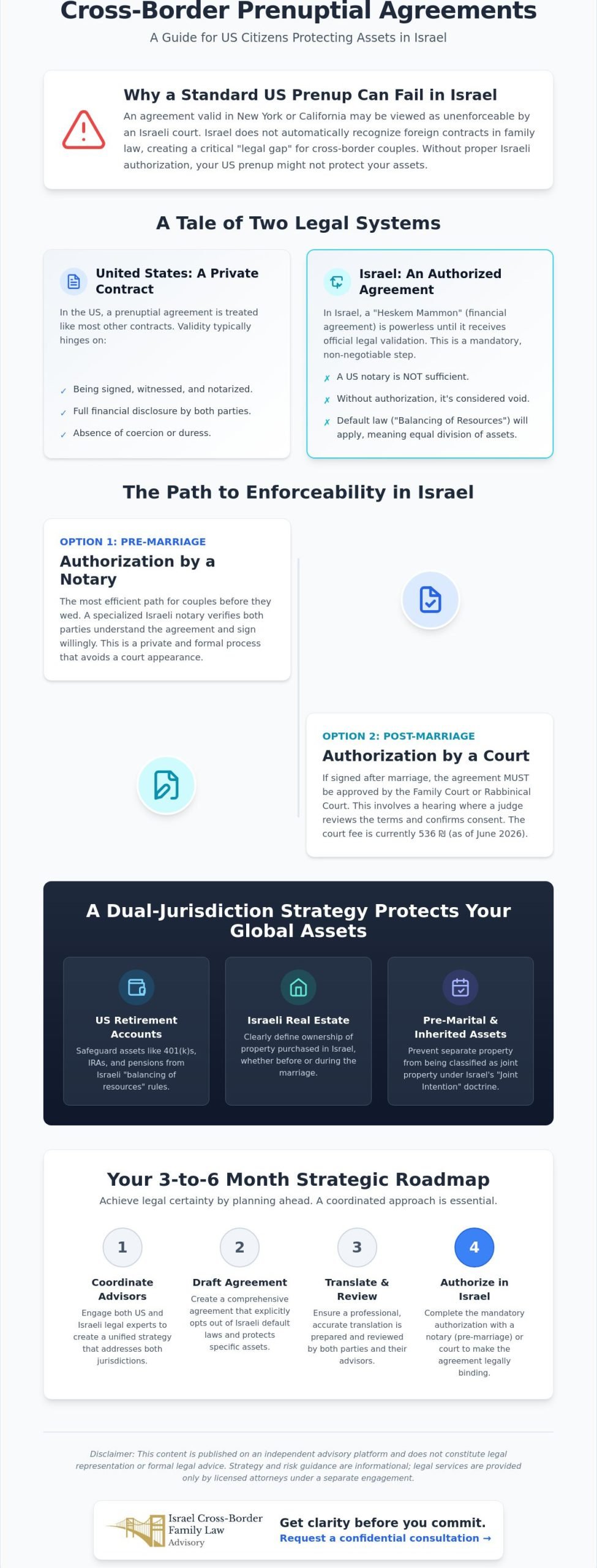
For a US citizen living in Israel, a prenuptial agreement is more than a legal document; it’s a bridge between two distinct legal systems. A cross-border prenuptial agreement for us citizen in israel must account for the reality that what is enforceable in New York or Florida may be viewed as entirely void by an Israeli Family Court. This “legal gap” exists because Israel doesn’t automatically recognize foreign contracts as binding in domestic family law disputes. Understanding what is a prenuptial agreement in an international context is the first step toward protecting assets like US-based 401ks or Israeli real estate.
The primary governing framework in Israel is the Spouses (Property Relations) Law of 1973. This law dictates that for an agreement to be valid, it must be authorized by a specific legal authority who confirms both parties signed of their own free will and understood the consequences. Without this procedural step, even the most detailed US agreement might fail to prevent the “balancing of resources,” which is the Israeli default of dividing assets equally upon divorce. For those navigating these waters, the strategy for expats and foreign nationals must be prioritized early in the planning process.
To better understand the complexities of making your agreement valid in the Israeli system, watch this helpful video:
The Difference Between ‘Contract’ and ‘Authorized Agreement’
In the United States, a prenuptial agreement is often treated as a standard contract. If it’s signed, witnessed, and notarized, it’s usually sufficient. Israel operates differently. A “Heskem Mammon” (financial agreement) isn’t legally binding until a judge or specialized notary authenticates it. Many expats realize too late that their “valid” US document is technically “void” in Israel because it never underwent this mandatory authorization process. This procedural requirement is a significant hurdle that requires local expertise to clear.
Cultural and Legal Clashes: Common Law vs. Israeli Law
Israeli courts apply specific doctrines that can override the literal text of a US contract. For example, the “Joint Intention” doctrine allows a court to decide that separate property, like an inheritance or a pre-marital home, has become joint property because the couple lived there or invested effort into it together. US citizens must explicitly opt-out of these Israeli default rules within their agreement. This content is published on an independent advisory platform and focuses on strategy, risks, and decision-making guidance rather than an attorney-client relationship. Legal services are only provided by licensed attorneys under a separate engagement.
Essential Requirements for Enforceability in Israel
Securing a prenuptial agreement for us citizen in israel requires more than just a signature; it demands a formal act of authorization. Under Israeli law, a prenuptial agreement is not a private contract that becomes valid once signed. It is a legal instrument that only gains power after a specific authority verifies that both parties are entering the arrangement voluntarily. This process is designed to prevent one spouse from pressuring the other into an unfair deal, but for US citizens, it adds a layer of multi-jurisdictional complexity that must be managed with precision.
Authorization Before a Notary
For couples who haven’t yet married, a specialized Israeli notary can authorize the agreement. This is often the most efficient path for US expats who value privacy and wish to avoid the formality of a courtroom. The notary has a legal duty to ensure that both parties understand the agreement’s consequences and are signing of their own free will. However, this option is strictly limited to the period before the wedding. If you wait until after the ceremony, the notary no longer has the authority to validate the document, and you’ll be forced into the court system.
Authorization by the Family or Rabbinical Court
If the agreement is signed after the marriage, or if the couple prefers judicial oversight, the document must be approved by the Family Court or the Rabbinical Court. This involves a brief hearing where a judge reviews the terms. As of June 2026, the court fee for the approval of a spousal agreement, when there is no pending claim, is 536 ₪. This step is particularly important for mitigating the “race to court,” a situation where spouses compete to file for divorce in the venue they believe will be most favorable. A properly authenticated agreement can pre-determine which court has jurisdiction over asset division. For those marrying through the Rabbinate, a “Halachic Prenup” can also be integrated to address specific religious legal concerns. Understanding how the advisory process works can help you decide which authority best fits your specific family dynamic.
The Cross-Border Signing Protocol
In Israel, a prenuptial agreement involving foreign citizens is only legally binding once it is authenticated by a certified authority, such as a judge or notary, who verifies that both parties understand the agreement and have signed it of their own free will. To ensure the document is enforceable in both the US and Israel, it should be drafted as a bilingual document or accompanied by an official translation. Many international families use “Mirror Agreements” to ensure that the legal language used in a US state court doesn’t conflict with Israeli “Property Relations” law. If you’re unsure about the timing of your filing, it’s wise to get professional clarity before you commit to a specific strategy.
Full financial disclosure is the final pillar of enforceability. You must list all global assets, including US-based retirement accounts and Israeli property. Failing to disclose a 401k or a brokerage account in the States can lead an Israeli judge to set aside the entire agreement years later. This content is published on an independent advisory platform and focuses on strategy, risks, and decision-making guidance rather than an attorney-client relationship. Legal services are only provided by licensed attorneys under a separate engagement.
Dual-Jurisdiction Strategy: Protecting Global Assets
Managing assets across two countries requires a strategy that acknowledges the specific tax and legal definitions of both the United States and Israel. A prenuptial agreement for us citizen in israel must do more than simply list bank accounts; it must provide a framework for how different types of wealth are treated under conflicting laws. For international families, assets often fall into a “cross-border” category where a decision made in a Jerusalem courtroom could have significant tax implications for the IRS, or a US court order might be impossible to enforce against Israeli property.
US Retirement and Tax-Advantaged Accounts
Israeli courts may struggle to categorize US-specific retirement vehicles like the 401k, 403b, or IRA. In Israel, these are often viewed as simple savings or pension funds, but in the US, they are governed by strict federal regulations such as the Employee Retirement Income Security Act (ERISA). If your agreement doesn’t account for these federal rules, a US plan administrator might refuse to honor an Israeli divorce decree. It’s essential to draft clauses that satisfy the “reasonableness” standards of Israeli law while remaining compliant with US tax codes to avoid unintended penalties or the loss of separate property status.
Israeli Real Estate and the ‘Apartment Trap’
Owning a home in Israel presents a unique risk known as the “apartment trap.” Even if you purchased a property before the marriage with your own funds, the Israeli “Joint Intention” doctrine can transform that separate asset into marital property. If the couple lives in the apartment, pays for renovations from a joint account, or even just pays the mortgage together, an Israeli judge may rule that the owner intended to share the equity. To prevent this, your strategy should include clear “anti-commingling” provisions that protect your real estate. This is a critical consideration for expats and foreign nationals who often bring significant capital into the country for housing.
Business Interests and M&A Considerations
For founders and investors, a prenuptial agreement acts as a vital business continuity plan. If you hold equity in a startup or an established company, a divorce without a prenup can lead to a spouse claiming a share of the business’s value or even voting rights. This is particularly complex in the “Silicon Wadi” ecosystem, where companies often have dual US-Israel structures. Protecting your interests during a potential exit or merger requires specific language that addresses future valuations. You can find more detail on these complexities in our guide on navigating US-Israel M&A.
This content is published on an independent advisory platform and focuses on strategy, risks, and decision-making guidance rather than an attorney-client relationship. Legal services are only provided by licensed attorneys under a separate engagement. It’s always best to seek clarity before making long-term financial commitments.
Common Pitfalls for US Citizens in the Israeli System
Many US citizens arrive in Israel with a sense of security provided by a prenuptial agreement drafted in their home state. However, the intersection of US contract law and Israeli family law is fraught with technical traps that can render a standard American document ineffective. One of the most significant risks involves the “race to court,” a situation where the first spouse to file determines whether the case is heard in the civil Family Court or the religious Rabbinical Court. If a spouse files for divorce in the Rabbinical Court first, that court may gain the authority to decide on property division, potentially applying religious principles that conflict with your original intent. Securing a prenuptial agreement for us citizen in israel requires planning for these jurisdictional overlaps long before a conflict arises.
The ‘US Lawyer Only’ Mistake
Relying solely on a US-based attorney to draft a prenuptial agreement for us citizen in israel is a frequent error that leads to future litigation. While a New York or California attorney understands state-specific requirements, they aren’t trained in the nuances of the Israeli Property Relations Law. Certain clauses, such as those waiving all future support, can be viewed as “against public policy” in an Israeli court if they leave a spouse without basic means. Unilateral legal drafting by a US attorney without local Israeli counsel often results in an agreement that an Israeli judge refuses to enforce. Choice-of-law clauses, which state that US law should apply, are often ignored by Israeli judges if the document was not properly authorized according to Israeli procedural rules.
The Jurisdiction Trap
The concept of “habitual residence” plays a massive role in international family law. If a couple moves from the US to Israel and lives there for several years, the Israeli legal system may determine that it has primary jurisdiction over their lives and assets. This can happen even if the prenuptial agreement explicitly states that US law governs the marriage. Over time, the connection to the US state fades, and the Israeli court may apply local default rules to assets previously thought to be protected. This shift in jurisdiction doesn’t just affect finances; it also impacts international custody and relocation issues if children are involved.
Ignoring the “Get,” or the Jewish religious divorce, is another common pitfall. In Israel, the Rabbinical Court has exclusive authority over the act of divorce itself. If your prenuptial agreement doesn’t include specific provisions regarding the delivery of the Get, it can be used as a bargaining chip in financial negotiations. Informal side-letters or “gentleman’s agreements” are almost never recognized by Israeli authorities. This content is published on an independent advisory platform and focuses on strategy, risks, and decision-making guidance rather than an attorney-client relationship. Legal services are only provided by licensed attorneys under a separate engagement. Before you rely on an outdated or one-sided document, it’s essential to evaluate your cross-border legal risks with a professional who understands both systems.
Next Steps: Achieving Clarity Before You Commit
Securing a prenuptial agreement for us citizen in israel is not a task that should be rushed in the final weeks before a wedding. Because you’re balancing the requirements of two different legal cultures, you should ideally begin the planning process at least three to six months before your ceremony. This timeline allows for the necessary coordination between your US and Israeli legal advisors, ensuring the final document doesn’t contain conflicting clauses that could lead to future litigation. A “strategy first” approach focuses on identifying potential jurisdictional clashes before the drafting begins; this is far more effective than trying to fix a poorly structured agreement after the marriage has already taken place.
Early decisions carry significant weight in cross-border family law. If you wait until you’ve already relocated or married, your options for choosing a favorable jurisdiction or protecting specific assets may become limited. Coordinating between multi-qualified practitioners who understand both systems ensures that your US-based retirement accounts and your Israeli real estate are handled with equal precision. This proactive planning provides the legal certainty required to move forward with your life transition confidently.
The Consultation Process
When preparing for a cross-border legal strategy session, you should gather a comprehensive list of all global assets. This includes account statements for US-based investments, 401k details, and ownership documents for any property in Israel. The goal is to provide a clear picture of your financial landscape so that risks can be identified honestly and without exaggeration. This advisory platform serves as a bridge, helping you understand how your US protections will be interpreted within the Israeli system. If you have an existing document or are just beginning the process, requesting a confidential case review is a prudent step toward achieving the clarity you need.
Finalizing the Agreement
Once the strategy is set and the document is drafted, you must account for the time required for formal authorization. In the Israeli Family Court, obtaining a hearing for the approval of a spousal agreement can take several weeks depending on the court’s specific schedule. After the judge or notary authorizes the document, it’s vital to ensure the agreement is stored in a secure, accessible location in both the United States and Israel. Having a digital and physical trail in both jurisdictions provides an extra layer of security if the agreement’s validity is ever challenged in either country.
This content is published on an independent advisory platform and focuses on strategy, risks, and decision-making guidance rather than an attorney-client relationship. It is informational and advisory in nature. Legal services are only provided by licensed attorneys under a separate engagement. Get clarity before you commit. Request a confidential consultation.
Securing Your Global Assets
Protecting your future requires more than a simple document; it demands a multi-jurisdictional strategy that addresses the complexities of both US and Israeli law. By understanding the mandatory authorization process and the specific categorization of international assets, you can avoid the common pitfalls that many expats face. A properly structured prenuptial agreement for us citizen in israel serves as a vital safeguard for your US retirement vehicles and Israeli real estate. This platform provides authoritative guidance for expats and international families who need to bridge these legal systems. You can also find additional featured insights on the Israel Family Law YouTube channel to help you navigate these decisions. Legal services are only provided by licensed attorneys under a separate engagement.
Get clarity before you commit. Request a confidential consultation. Taking the time to align your legal interests now will provide the peace of mind you need as you begin your new chapter together.
Frequently Asked Questions
Is my US prenuptial agreement valid in Israel?
A standard US agreement is not automatically binding in Israel without formal domestic authorization. To ensure your prenuptial agreement for us citizen in israel is respected, it must be authenticated by an Israeli judge or notary who confirms both parties understand the terms. Without this step, an Israeli court may apply local default laws to your global assets regardless of what your US contract says. This content is published on an independent advisory platform and focuses on strategy and risks rather than an attorney-client relationship.
Do I need an Israeli lawyer if I already have a US lawyer for my prenup?
Yes, specialized local counsel is essential because US attorneys are not trained in the Israeli Spouses (Property Relations) Law. A US-based lawyer might draft a document that violates Israeli public policy or fails to address local doctrines like “Joint Intention.” Coordinating between advisors in both jurisdictions ensures that your prenuptial agreement for us citizen in israel survives judicial scrutiny in both the US and Israel. Legal services are only provided by licensed attorneys under a separate engagement.
What happens if we sign the prenup but don’t authorize it in court?
The agreement will likely be considered void by an Israeli court if it hasn’t been properly authenticated by a judge or notary. In this scenario, the “balancing of resources” principle applies, meaning most assets accumulated during the marriage are divided equally. This includes property or accounts you might have intended to keep separate if the agreement was never formally authorized. It’s a common procedural trap that can override years of careful planning.
Can a prenuptial agreement protect my US inheritance from an Israeli spouse?
A properly drafted agreement can protect your inheritance, but you must explicitly opt-out of Israeli default rules. Under Israeli law, separate assets can sometimes become marital property if a court finds you intended to share them through actions like joint renovations. Your agreement must clearly define these assets and state they remain separate regardless of how long you live in Israel. Seeking clarity on these “commingling” risks is a vital part of a cross-border strategy.
How does the Israeli Rabbinical Court view prenuptial agreements?
The Rabbinical Court generally respects civil prenuptial agreements regarding the division of assets, provided they were authenticated by a recognized authority. A valid “Heskem Mammon” can prevent the Rabbinical Court from applying different standards to your property. However, the court maintains exclusive jurisdiction over the act of the religious divorce itself. It’s important to understand how these two systems interact before you commit to a specific legal path.
What is a Halachic Prenup and do US citizens need one in Israel?
A Halachic Prenup is a document that addresses the religious divorce process, specifically the delivery of the “Get.” It’s highly recommended for US citizens marrying through the Israeli Rabbinate to prevent “Get-refusal.” It creates financial incentives for a spouse to cooperate with the religious divorce, which is separate from civil asset division. Including these provisions ensures that your religious status is protected alongside your financial interests.
Can we sign a postnuptial agreement if we are already living in Israel?
You can sign a postnuptial agreement, but it requires a more complex approval process through the Family Court once you’re already married. If you’re already living in Israel, your assets may already be subject to “commingling” claims or the “Joint Intention” doctrine. It’s often more difficult to protect separate property after the marriage has begun. This makes early decision-making and professional coordination even more critical for international families.
How much does it cost to authorize a prenuptial agreement in an Israeli court?
The court fee for the approval of a spousal agreement at the Family Court is 536 ₪ as of June 2026. This fee applies when there is no pending claim between the parties and is separate from any legal fees for drafting or strategy. You should also account for potential costs related to official translations or bilingual drafting. Get clarity before you commit to ensure your filing meets all procedural requirements in the Israeli system.

Article by
Gabriel Lior
A Personal Journey That Became a Mission
The advisory was founded by an American father Gabriel Lior, LLB, MBA , global entrepreneur, and cross-border advisor who spent more than a decade navigating the Israeli family court system firsthand and now lives in Singapore with his son.
As a divorced parent in a cross-border family, Gabriel faced nearly every legal challenge a foreign parent can encounter in Israel — including child custody disputes, child support proceedings, property matters in Israel and abroad, false accusations, and complex immigration and relocation proceedings.
Over the years, he learned the hard way how difficult it is for non-Israeli parents to understand the system, identify the right legal strategy, and choose the right legal representation — especially when language, culture, and jurisdictional differences are involved. He also witnessed how foreign parents and new immigrants are often disadvantaged or taken advantage of by service providers and institutions simply because they lack local knowledge or fluency.
From Client to Advisor
To truly understand — and survive — the system, Gabriel pursued formal legal education in Israel, completing two Israeli law degrees, alongside a BA and MBA earned in the United States. This was never about becoming a practicing attorney, but about gaining a deep, structural understanding of how the system works — and where it breaks down for foreign parents.
This rare combination of:
Firsthand client experience
Israeli legal and US business education
International business and negotiation training
Decades of commercial execution
created a unique perspective – one that understands both sides of the table.
After years of litigation, persistence, and at times self-representation, he ultimately succeeded in securing custody of his son and relocating abroad through a rare legal victory in the Israeli Supreme Court — becoming one of the first fathers in Israel to do so under these circumstances.
Disclaimer
Important Disclaimer:
The information provided on this website and in its content is for general informational and educational purposes only and does not constitute legal advice, legal opinion, or legal representation.
Gabriel Lior is not licensed to practice law in Israel (nor is he interested in doing so) and does not provide legal services, despite having completed 2 Law Degrees. The services offered are advisory in nature and are intended to provide general guidance, strategic insight, and information regarding cross-border family law considerations.
No attorney-client relationship is formed by accessing this website, reading its content, or communicating with us.
Any decisions made based on this information are at your own discretion and risk. For legal advice specific to your situation, you should consult a licensed attorney in the relevant jurisdiction.
Where appropriate, we may refer clients to independent, licensed attorneys or professionals. Such referrals do not constitute legal representation and no liability is assumed for services provided by third parties.