What if the law that governed your wedding day isn’t the same one that protects your assets or your children tomorrow? Many couples assume that a marriage license issued in one country provides a universal shield, but the reality of Mixed Nationality Marriages is far more complex. When your life spans the corridor between the United States and Israel, you aren’t just merging two cultures; you’re operating under two distinct, and often conflicting, legal frameworks.
It’s understandable to feel a sense of unease regarding which country’s laws apply to your home, your bank accounts, or your parental rights. You deserve a clear understanding of how these jurisdictional differences impact your family’s security. This article provides a comprehensive overview of the legal and financial implications inherent in cross-border unions, specifically focusing on the unique friction between US and Israeli law. We will examine the strategic steps necessary to protect your assets, the validity of international prenuptial agreements, and how specialized advisory services can help you build a stable future across borders.
Key Takeaways
- Recognize how Mixed Nationality Marriages trigger immediate cross-border legal status that impacts your rights in both the US and Israel.
- Learn why your “habitual residence” often dictates which laws govern your marriage, regardless of where your wedding ceremony took place.
- Understand the necessity of “mirror agreements” to ensure your financial protections and prenuptial arrangements are enforceable in multiple jurisdictions.
- Identify the specific risks regarding international child relocation and how the Hague Convention provides a framework for custody disputes.
- Discover why seeking strategic advisory early can prevent costly jurisdictional conflicts before you make major life commitments.
The Legal Reality of Mixed Nationality Marriages
A Mixed Nationality Marriage occurs when individuals holding different citizenships or domiciles enter into a legal union. From a regulatory perspective, a mixed nationality marriage is a legal intersection of two or more sovereign jurisdictions. This status isn’t just a romantic label; it creates an immediate cross-border legal standing. Every asset you acquire and every child born to the union is instantly subject to the competing rules of multiple nations.
To better understand the social and legal dynamics of these unions, watch this helpful video:
While many couples view their status as “binational,” a term often used in social contexts, the legal reality is often defined by international matrimonial law. A binational marriage describes the identity of the couple, but a cross-border legal dispute describes the friction that occurs when those identities clash with local statutes. Understanding this distinction is the first step toward protecting your interests and ensuring your family’s future remains secure.
Defining Mixed Nationality in a Global Context
Your legal “home” isn’t always where you currently live. In legal terms, “residency” is your physical location, while “domicile” is the place you intend to return to or consider your permanent base. This distinction is critical because your domicile often determines which court has the power to decide your financial future. Citizenship adds another layer of complexity, as foreign family courts may treat a US citizen differently than an Israeli citizen, even if both reside in the same apartment in Tel Aviv. This is why many expats and foreign nationals seek strategic advice before establishing a permanent domicile in Israel. International treaties, such as various bilateral agreements on the recognition of foreign judgments, play a role in how these statuses are recognized. However, these treaties don’t always provide a simple solution for families moving between the US and Israel.
Why the US-Israel Corridor is Unique
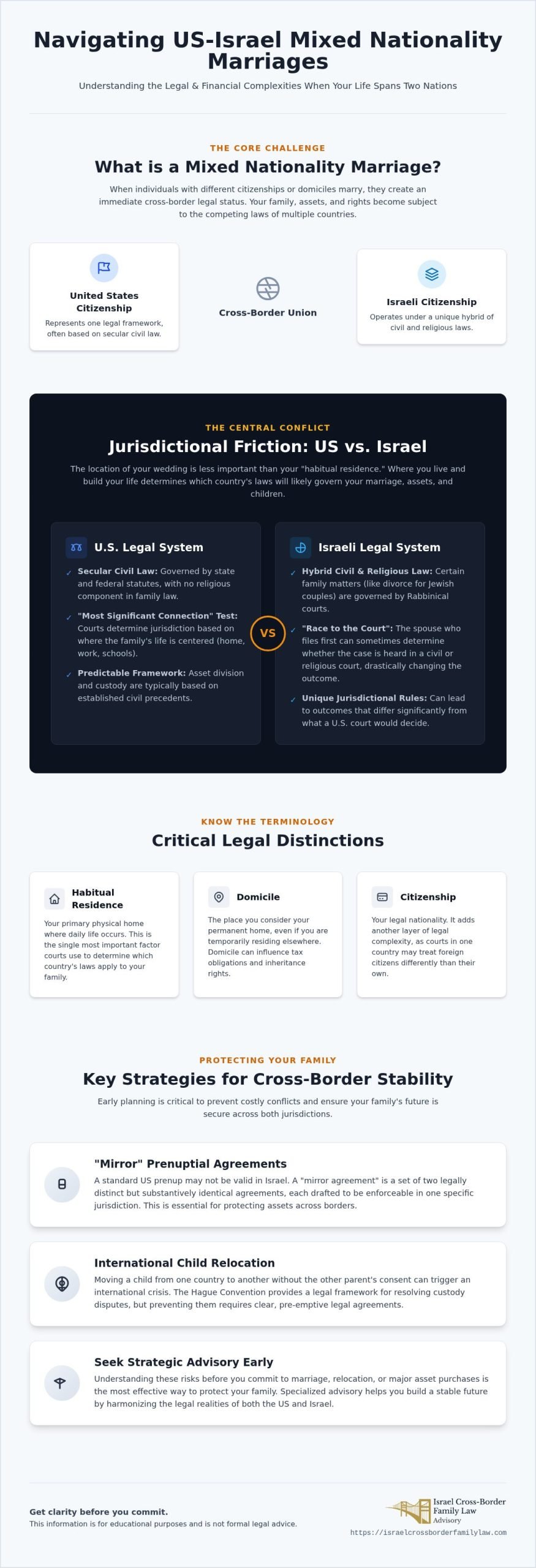
The US-Israel corridor presents specific challenges due to the stark differences between the legal systems. The United States operates on a secular civil law basis, while Israel utilizes a unique hybrid of civil and religious law. For Anglo expats living in cities like Tel Aviv, Jerusalem, or Herzliya, this means their marriage might be governed by Rabbinical courts for some matters and civil courts for others. This creates a “race to the court” scenario where the timing of a filing may determine the legal framework for the entire case. This dual-system friction is why it’s vital to work with practitioners who are licensed or multi-qualified in both jurisdictions. They serve as a bridge, ensuring that decisions made in one country won’t be ignored or overturned by the other. Understanding these risks early is the only way to achieve clarity before you commit to major life changes.
Jurisdictional Friction: Which Law Governs Your Marriage?
Jurisdictional friction is a term describing the clash between two different legal systems trying to govern the same marriage. For those in Mixed Nationality Marriages, this friction isn’t just a legal theory; it’s a reality that influences everything from tax filings to inheritance. Many couples mistakenly believe that the laws of the country where they wed will always follow them. However, in the eyes of most family courts, your place of habitual residence carries far more weight than the location of your wedding ceremony. This means that if you move from New York to Tel Aviv, the legal ground beneath your marriage shifts significantly.
Courts typically use a “most significant connection” test to determine which country has the authority to hear a case. They look at where your primary home is located, where your children are being raised, and where your financial interests are centered. While U.S. immigration law for spouses focuses on the validity of the marriage at its inception, family law courts focus on the current reality of your daily life. Because these factors can change over time, the tactical importance of early advisory cannot be overstated. Mapping out these connections before a conflict arises helps you avoid being caught in an unfavorable forum.
The “Race to the Court” in US-Israel Cases
In the US-Israel corridor, timing is often everything. If a dispute arises, the party who files first in one country may effectively lock out the courts of the other nation. This is particularly significant because the outcomes in an Israeli Rabbinical court can differ drastically from those in a US Family court regarding spousal support or property division. Strategic planning isn’t about being aggressive; it’s about ensuring you aren’t forced into a legal system that doesn’t align with your family’s needs. You might consider a confidential case review to understand these risks before they become urgent.
Choice of Law vs. Choice of Forum
It’s a common misconception that you can simply choose which law applies to your marriage through a contract. While you can include a “Choice of Law” clause in a prenuptial agreement, its enforceability is limited. For example, an Israeli court may be reluctant to apply New York law to a couple that has lived in Jerusalem for a decade. Understanding the difference between where a case is heard (forum) and which laws are used (choice of law) is vital. Israeli courts may consider foreign legal precedents in binational disputes, but they are not bound by them. This content is published on an independent advisory platform and focuses on strategy and risk guidance rather than a formal attorney-client relationship.
If you are feeling uncertain about your situation, it’s helpful to speak with an advisor to gain perspective on your specific circumstances.
Financial Planning for Cross-Border Couples
Financial stability in Mixed Nationality Marriages depends on more than just income; it requires a clear understanding of how assets are treated when they cross an ocean. Standard financial planning often fails to account for the way different countries categorize property. In the United States, your pre-marital assets are generally protected. In Israel, the lines can blur quickly if those assets are used to support your life together. This content is published on an independent advisory platform and focuses on strategy, risks, and decision-making guidance rather than an attorney-client relationship.
Protecting your future requires a strategy that spans both jurisdictions. This often involves creating “mirror agreements” that are drafted to meet the specific legal requirements of both the US and Israel. These documents ensure that your intentions are clear to a judge in New York just as they would be to a judge in Jerusalem. Without these protections, you risk losing assets to unfamiliar legal interpretations that favor the local resident over the foreign national.
Prenuptial Agreements for Binational Couples
US-Israel prenuptial agreements must be precise. They should explicitly define which country’s law will govern property division and spousal support. A common pitfall for expats is failing to account for the way Israeli courts view the “commingling” of funds. For example, using a US-based inheritance to pay down a mortgage on an Israeli home can change the legal status of those funds instantly. You can learn more about Protecting Assets with a Financial Agreement to see how these clauses function in practice and avoid the mistakes that lead to costly litigation.
Cross-Border Asset Protection and Estate Planning
Estate planning for international families is equally complex. Mixed nationality status can complicate inheritance rights, as different countries have different rules about how much of your estate must go to a spouse or children. Structuring trusts for your international assets can help you avoid the lengthy and expensive process of probate in multiple countries. Early decisions about how you hold title to property or where you keep your primary accounts will have a significant impact on your long-term wealth preservation. Obtaining clarity on the current US-Israel tax treaty is also a vital step, as tax obligations can significantly reduce the value of a cross-border inheritance if not managed proactively.
Managing Risks: Divorce, Custody, and Relocation
Families in Mixed Nationality Marriages often encounter high-stakes challenges when a relationship ends or when one parent wishes to move. The most sensitive issues involve the children and the potential for international child abduction. This risk isn’t always about a dramatic, secret flight; it often begins when a parent takes a child on a planned vacation and then refuses to return them to their home country. Both the United States and Israel are signatories to the Hague Convention on the Civil Aspects of International Child Abduction. This treaty provides a specific legal mechanism designed to return a child to their country of habitual residence. However, the process is technically demanding and requires immediate action to be effective.
Relocation in a mixed marriage often requires formal court approval to avoid legal penalties. Even if you believe you have the right to move, taking a child across an international border without a clear legal mandate can have severe consequences. This content is published on an independent advisory platform and focuses on strategy, risks, and decision-making guidance rather than an attorney-client relationship.
International Child Custody and Relocation
Determining where a child should live is one of the most contentious parts of cross-border family law. Courts focus on the concept of “Habitual Residence” to decide which country has the authority to make custody decisions. This isn’t necessarily where the child was born, but rather the place where their life is currently centered, including their school, social ties, and daily routine. If you are considering a move, Understanding International Custody and Relocation is essential for staying within the law. Moving a child between Israel and the US without a written agreement or a court order can lead to accusations of abduction, even if you are the primary caregiver.
Enforcing Alimony and Support Across Borders
Enforcing financial obligations like alimony and child support adds another layer of difficulty for international families. You might wonder if an Israeli court order can be enforced against assets located in the US, or vice versa. While the “Uniform Interstate Family Support Act” (UIFSA) helps US states coordinate support orders, its application in a global context depends on specific reciprocity and the nature of the order. Enforcing Child Support Orders in Israel requires a strategic approach to ensure that the supporting parent remains accountable regardless of where they reside or where their income is earned.
If you are concerned about your rights regarding custody or support in a cross-border context, you should contact an advisor to discuss your options and gain clarity on your specific situation.
Strategic Advisory for International Families
Strategic advisory is the foundation of stability for international families operating across borders. In Mixed Nationality Marriages, the legal and financial stakes of every major life decision are significantly magnified. Seeking clarity before you make a major commitment, such as relocating to Israel or purchasing property in a foreign jurisdiction, is a proactive step that protects your long-term interests. This approach allows you to address jurisdictional friction before it evolves into a costly dispute.
While many families believe a local attorney is sufficient, domestic practitioners often lack the specialized perspective required to navigate multi-jurisdictional complexity. A lawyer in New York may not understand the specific requirements of the Israeli Rabbinical courts, just as a practitioner in Tel Aviv might miss the nuances of US tax treaties or state-specific family law. An independent advisory platform serves as a critical bridge, coordinating between legal teams in both countries to ensure your strategy is cohesive and comprehensive. This content is published on an independent advisory platform and focuses on strategy, risks, and decision-making guidance rather than a formal attorney-client relationship.
The Importance of Early Advisory
Early intervention is the most effective way to identify risks before they become litigious. When evaluating a cross-border professional, it’s vital to look for practitioners who are multi-qualified or have significant experience in both legal systems. This ensures they can anticipate how a decision in one country will resonate in the other. To understand how this process can benefit your family, you can explore How Our Advisory Process Works. This strategic oversight helps you build a roadmap for your family’s future that accounts for the inherent differences between US and Israeli legal cultures.
Coordinating Strategy Between the US and Israel
A unified strategy ensures that your family matters and assets in both countries are managed under a single, consistent vision. Without this coordination, you risk having US and Israeli legal documents that contradict each other, which can lead to significant probate or custody complications. For example, a will drafted in the US must be reviewed to ensure it doesn’t conflict with Israeli inheritance laws or inadvertently trigger unfavorable tax consequences. By aligning your legal protections across borders, you create a stable environment for your household to thrive. Get clarity before you commit. Request a confidential case review.
Secure Your Global Future through Strategic Clarity
Managing the legal landscape of Mixed Nationality Marriages requires more than just local knowledge; it demands a comprehensive strategy that bridges the US and Israeli legal systems. As we’ve explored, the friction between these jurisdictions can impact everything from your daily financial planning to the long-term security of your children. By prioritizing mirror agreements and understanding the nuances of habitual residence, you can mitigate many of the risks associated with international relocation and asset commingling.
Our specialized US-Israel advisory serves as a bridge for Anglo expats who need to navigate these multi-jurisdictional complexities with confidence. Whether you’re addressing international custody concerns under the Hague Convention or structuring a cross-border estate, early strategy is your most powerful tool. This content is published on an independent advisory platform and focuses on strategy and risk guidance rather than a formal attorney-client relationship. Legal services are only provided by licensed attorneys under a separate engagement.
Get clarity before you commit. Request a confidential consultation to discuss your specific needs. Taking the right steps today ensures your family remains protected regardless of where you call home.
Frequently Asked Questions
This FAQ section is published on an independent advisory platform and focuses on strategy, risks, and decision-making guidance. It doesn’t constitute an attorney-client relationship or formal legal representation. Legal services are only provided by licensed attorneys under a separate engagement.
Is a marriage between two different nationalities legally recognized in both countries?
Yes, marriages validly performed in one country are generally recognized in the other. For Mixed Nationality Marriages, the US recognizes foreign marriages that are legal where they were performed, while Israel recognizes civil marriages performed abroad once they’re registered with the Ministry of Interior. It’s important to understand that while the union is recognized, the specific legal rights it grants can vary significantly between the US and Israeli systems.
Which country has jurisdiction if a mixed nationality couple decides to divorce?
Jurisdiction is typically determined by the couple’s “habitual residence” rather than their citizenship. If you live in Israel, the Israeli courts generally have the authority to hear the case, even if both spouses hold US citizenship. However, if one spouse files in a US court first and can prove a significant connection to that state, a jurisdictional conflict may arise that requires strategic coordination.
Can a US prenuptial agreement be enforced in an Israeli court?
A US prenuptial agreement can be enforced in Israel, but it often faces challenges if it wasn’t validated according to Israeli standards. Israeli law usually requires these agreements to be approved by a judge or a notary to be fully binding. To ensure your assets are protected in both countries, it’s often safer to use “mirror agreements” that meet the formal legal requirements of both jurisdictions.
What happens to our children if one parent wants to move back to their home country?
Moving a child to another country requires the written consent of the other parent or a formal order from the court. If a parent relocates with a child unilaterally, they risk being accused of international child abduction. The courts will focus on the child’s habitual residence to decide if they must be returned to their original home to resolve custody matters.
Do mixed nationality marriages face different tax obligations in the US and Israel?
Yes, couples in these unions often deal with overlapping tax requirements because the US taxes its citizens on their worldwide income. Israel uses a residency-based tax system, which means your obligations depend on where you’re physically living. While a US-Israel tax treaty exists to help prevent double taxation, you must still file correctly in both nations to avoid penalties and preserve your wealth.
How does the Hague Convention protect children in mixed nationality families?
The Hague Convention is an international treaty that creates a mechanism to return children who were wrongfully removed from their home country. It doesn’t decide final custody, but it does ensure the child is returned to their place of habitual residence so that the local courts can handle the dispute. Both the US and Israel are active signatories and cooperate to resolve these sensitive cases quickly.
What is the “Race to the Court” and how does it affect binational couples?
The “Race to the Court” happens when spouses file for divorce in different jurisdictions or court systems to gain a tactical advantage. In Israel, this often involves a choice between the Rabbinical courts and the civil Family courts, which may apply different rules to property division. For binational couples, filing first in one country can effectively lock out the courts of the other nation.
Should we have separate wills for our assets in the US and Israel?
Coordinated wills are usually the best way to manage assets located in different countries. The probate process in Israel is quite different from the various state systems in the US, and a single document might not meet the technical requirements of both. Having specific documents for each jurisdiction ensures that your Israeli real estate and US financial accounts are handled according to your wishes without long delays.

Article by
Gabriel Lior
A Personal Journey That Became a Mission
The advisory was founded by an American father Gabriel Lior, LLB, MBA , global entrepreneur, and cross-border advisor who spent more than a decade navigating the Israeli family court system firsthand and now lives in Singapore with his son.
As a divorced parent in a cross-border family, Gabriel faced nearly every legal challenge a foreign parent can encounter in Israel — including child custody disputes, child support proceedings, property matters in Israel and abroad, false accusations, and complex immigration and relocation proceedings.
Over the years, he learned the hard way how difficult it is for non-Israeli parents to understand the system, identify the right legal strategy, and choose the right legal representation — especially when language, culture, and jurisdictional differences are involved. He also witnessed how foreign parents and new immigrants are often disadvantaged or taken advantage of by service providers and institutions simply because they lack local knowledge or fluency.
From Client to Advisor
To truly understand — and survive — the system, Gabriel pursued formal legal education in Israel, completing two Israeli law degrees, alongside a BA and MBA earned in the United States. This was never about becoming a practicing attorney, but about gaining a deep, structural understanding of how the system works — and where it breaks down for foreign parents.
This rare combination of:
Firsthand client experience
Israeli legal and US business education
International business and negotiation training
Decades of commercial execution
created a unique perspective – one that understands both sides of the table.
After years of litigation, persistence, and at times self-representation, he ultimately succeeded in securing custody of his son and relocating abroad through a rare legal victory in the Israeli Supreme Court — becoming one of the first fathers in Israel to do so under these circumstances.
Disclaimer
Important Disclaimer:
The information provided on this website and in its content is for general informational and educational purposes only and does not constitute legal advice, legal opinion, or legal representation.
Gabriel Lior is not licensed to practice law in Israel (nor is he interested in doing so) and does not provide legal services, despite having completed 2 Law Degrees. The services offered are advisory in nature and are intended to provide general guidance, strategic insight, and information regarding cross-border family law considerations.
No attorney-client relationship is formed by accessing this website, reading its content, or communicating with us.
Any decisions made based on this information are at your own discretion and risk. For legal advice specific to your situation, you should consult a licensed attorney in the relevant jurisdiction.
Where appropriate, we may refer clients to independent, licensed attorneys or professionals. Such referrals do not constitute legal representation and no liability is assumed for services provided by third parties.