For a father navigating the complexities of a separation or divorce in Israel, the prospect of determining child custody arrangements can be fraught with uncertainty and apprehension. Concerns over perceived judicial bias, confusion surrounding the historical ‘Tender Years Doctrine,’ and the profound fear of being relegated to a secondary parenting role are both common and valid. However, a comprehensive understanding of the child custody rights for fathers in Israel is the most critical step toward securing a meaningful and central role in your children’s lives and moving forward with confidence. This definitive guide is engineered to provide that clarity. We will demystify the Israeli family court system, offering an authoritative analysis of a father’s legal rights and responsibilities. This article examines the contemporary application of custody principles, differentiates between legal guardianship and physical custody, and provides the actionable, strategic framework necessary to build a compelling case. Our objective is to equip you with the knowledge to protect your parental relationship and actively shape your children’s future.
Understanding the Foundation: A Father’s Legal Status in Israel
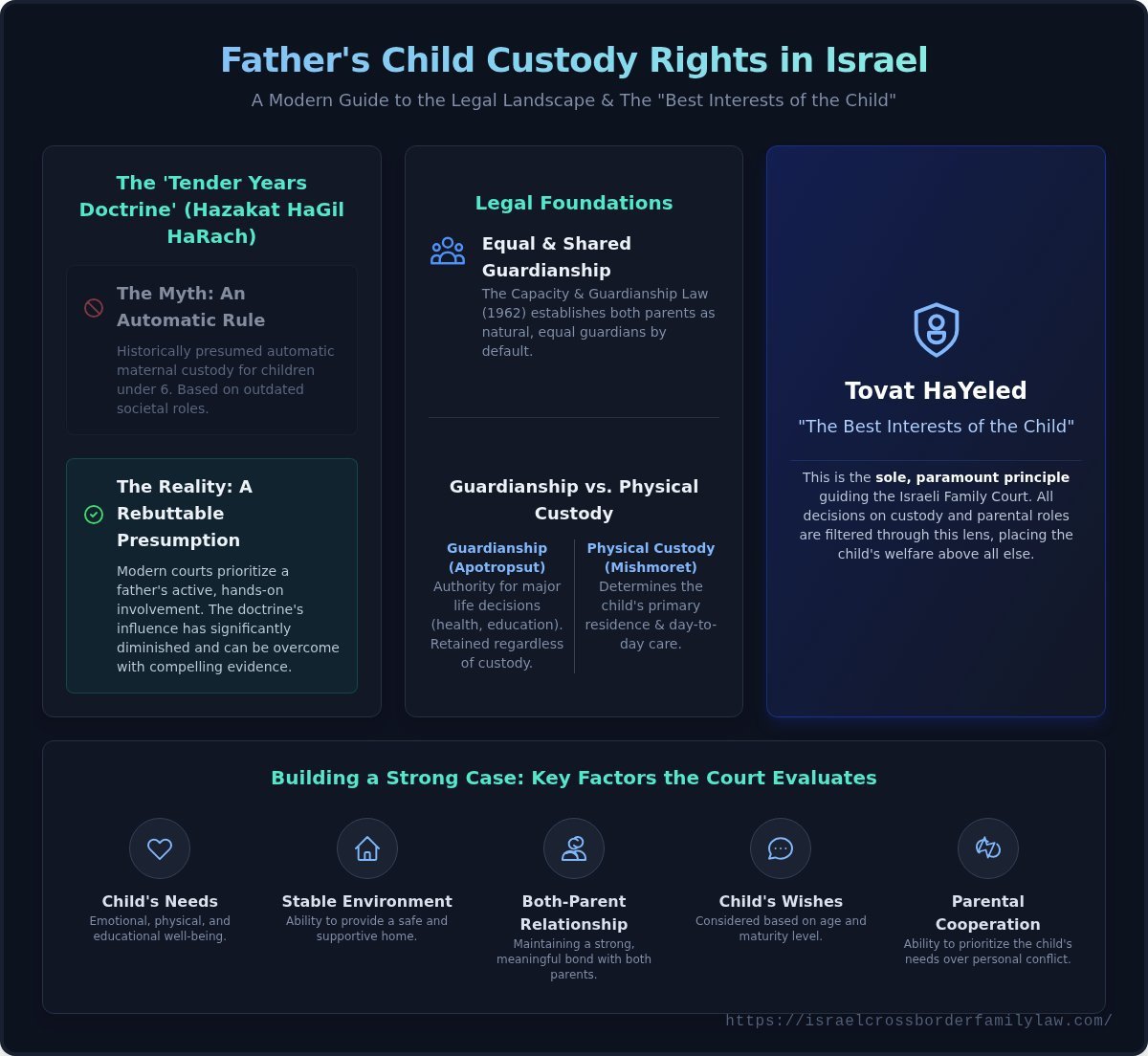
In the State of Israel, the legal framework governing parental rights is founded upon the core principle of equal and shared guardianship. According to the Capacity and Guardianship Law, 1962, both the mother and father are presumed to be the natural and equal guardians of their minor children. This foundational status is not contingent on marriage and grants fathers inherent rights and responsibilities from the moment of birth. However, all subsequent judicial decisions regarding parental roles are guided by one paramount principle: Tovat HaYeled, or the “Best Interests of the Child.” For a detailed perspective on how these principles are applied in practice, the following video offers valuable insights:
Guardianship vs. Physical Custody: What Fathers Need to Know
Navigating family law requires a clear understanding of two distinct yet interconnected concepts. Guardianship (Apotropsut) refers to the legal authority and responsibility to make significant decisions for a child’s welfare, including matters of health, education, and religious upbringing. Crucially, a father retains his full guardianship rights and obligations even if he does not have primary physical custody. Physical Custody (Mishmoret), on the other hand, determines where the child primarily resides and who is responsible for their day-to-day care. Understanding this distinction is vital for fathers seeking to remain actively involved in their children’s lives.
The ‘Best Interests of the Child’: Key Factors Courts Consider
When determining arrangements, the Israeli Family Court’s sole objective is to secure the child’s welfare. While historical precedents often favored maternal custody, particularly for young children, modern judicial interpretation focuses on a holistic assessment. The legal evolution of Divorce and Child Custody in Israel reflects this ongoing shift toward a more gender-neutral evaluation, reinforcing the child custody rights for fathers in Israel. Courts meticulously evaluate numerous factors, including:
- The child’s emotional, physical, and educational needs.
- Each parent’s demonstrated ability to provide a stable, safe, and supportive home environment.
- The importance of maintaining a strong and meaningful relationship with both parents and extended family.
- The child’s own wishes, taking into account their age and level of maturity.
- Each parent’s capacity to cooperate and prioritize the child’s needs over personal conflict.
A father can substantially strengthen his position by proactively demonstrating his commitment to these principles through consistent involvement, responsible co-parenting, and a clear focus on his child’s well-being.
The ‘Tender Years Doctrine’: Myth vs. Modern Reality for Fathers
Many fathers entering custody proceedings in Israel are immediately confronted with the “Tender Years Doctrine” (Hazakat HaGil HaRach), a legal presumption that has historically favored mothers in custody disputes involving children under the age of six. This long-standing principle is a source of significant concern, yet it is crucial to understand that its modern application is far more nuanced than its text suggests. The era of automatic maternal custody for young children has effectively ended; contemporary family law prioritizes the child’s welfare and the father’s substantive involvement above outdated gender-based assumptions.
The Doctrine’s Origins and Its Evolving Role
Rooted in Section 25 of the Legal Capacity and Guardianship Law of 1962, the Tender Years Doctrine was established when societal structures typically positioned mothers as the primary caregivers. The presumption was designed to provide stability for young children based on these traditional family models. However, as Israeli society has evolved-with greater female participation in the workforce and a deeper recognition of the father’s essential role in early development-the doctrine’s relevance has significantly diminished. Influential bodies, such as the Schnit Committee, have recommended its abolition, reflecting a broad consensus among legal and psychological experts that a father’s active presence is equally critical to a young child’s well-being.
How Israeli Courts Apply the Principle Today
In contemporary legal practice, the Tender Years Doctrine is not a conclusive rule but a rebuttable presumption. The guiding principle for Israel’s Family Courts is now unequivocally the “best interests of the child” (tovat hayeled), a comprehensive assessment that shifts the focus from a parent’s gender to their functional role in the child’s life. A father seeking to overcome the presumption must provide compelling evidence of his deep and consistent involvement. The court will weigh several critical factors, including:
- Which parent served as the primary caregiver prior to the separation, handling daily tasks like feeding, bathing, and medical appointments.
- The father’s demonstrated capacity and genuine willingness to provide for the child’s ongoing physical, educational, and emotional needs.
- The ability of both parents to co-parent effectively and facilitate a healthy relationship between the child and the other parent.
- The stability of the home environment each parent can offer.
Ultimately, demonstrating a history of active, hands-on parenting is the most powerful tool for fathers. The modern legal landscape provides significant opportunities to secure favorable outcomes, making a deep understanding of the current child custody rights for fathers in Israel essential for navigating these complex proceedings successfully.
Exploring Custody Arrangements: What Are a Father’s Options?
When navigating a separation or divorce in Israel, understanding the potential custody outcomes is paramount for a father seeking to maintain a central role in his children’s lives. The legal framework has evolved significantly, moving beyond traditional models to embrace arrangements that better reflect modern co-parenting realities. All custody determinations are adjudicated based on the “best interests of the child” principle by the Israeli Family Courts, which carefully evaluate each family’s unique circumstances. For fathers, the two primary arrangements are sole custody with visitation rights and the increasingly prevalent joint physical custody. Each carries distinct implications for parental responsibilities, time with the children, and financial obligations.
Sole Custody with Visitation Rights
In a sole custody arrangement, one parent is designated as the primary custodial parent, responsible for the child’s day-to-day care and residence. The non-custodial father is granted comprehensive visitation rights (hesderei re’iya). A standard schedule often includes one or two midweek visits and overnight stays on alternate weekends, along with a division of holidays and school vacations. Importantly, even without primary physical custody, a father retains his legal status as a natural guardian, granting him the right to be consulted on and participate in major decisions regarding his child’s education, health, and general welfare.
Joint Physical Custody: The Modern Approach
Joint physical custody represents a more contemporary and equitable approach, one that is an increasingly achievable goal for fathers in Israel. This arrangement involves a near-equal division of the child’s time and parental responsibilities between both parents, such as alternating weeks or other structured schedules. Achieving this outcome, which strongly supports the child custody rights for fathers in Israel, typically requires several key prerequisites:
- Effective Communication: The ability for parents to cooperate and communicate constructively regarding the child’s needs.
- Geographical Proximity: Both parents must live close enough to one another to make shared custody practical for schooling and daily life.
- Mutual Desire: A shared commitment from both parents to actively co-parent.
A significant implication of joint custody is its impact on child support. As daily expenses are shared more evenly, the father’s standard child support obligation is often substantially reduced or recalculated to reflect the balanced financial responsibility. This model is widely recognized for fostering strong father-child relationships and providing children with the stability of having both parents actively involved in their lives. [ Download ](https://getautoseo.com/screenshots/getautoseocom_1769132920_ZigAcqNz.jpg) Feedback & Recreate Delete 
A Father’s Strategic Roadmap to a Favorable Custody Outcome
An assertive and well-documented approach is paramount for fathers seeking to protect their parental rights. Success in securing a favorable custody arrangement is rarely the result of courtroom arguments alone; it is built upon a foundation of consistent, demonstrable involvement in a child’s life. Navigating the complexities of child custody rights for fathers in Israel requires a proactive strategy that begins long before any legal petitions are filed and continues with disciplined conduct throughout the legal process.
Building Your Case: Pre-Separation Actions
The Israeli Family Court prioritizes the child’s best interests, which are often evidenced by a parent’s active and consistent participation. Fathers should meticulously document their engagement in all facets of their child’s life to build a compelling record of their role as an essential caregiver.
- Demonstrate Daily Involvement: Actively participate in school routines, homework, medical appointments, and extracurricular activities. Your consistent presence is your strongest asset.
- Create a Verifiable Record: Maintain a detailed calendar, save relevant receipts for child-related expenses, and keep photos that chronicle your involvement. This documentation provides concrete evidence.
- Maintain a Cooperative Stance: A civil and respectful attitude toward the mother is viewed favorably by the court. Avoid conflict, especially in the presence of the children.
- Secure Your Residence: Do not move out of the family home without a formal, written temporary custody and visitation agreement, as this action can be misconstrued as abandonment.
Navigating the Legal Process
Once formal proceedings commence, a strategic understanding of the legal landscape is critical. The initial choice between the secular Family Court and the religious Rabbinical Court can have profound, long-term consequences. A central component of any custody case is the social worker’s report (Tazkir), for which you must prepare to demonstrate a stable, child-centric home environment. While litigation is an option, Israeli law often mandates mediation first, providing a structured opportunity to reach a mutually acceptable agreement. Expert legal guidance is crucial to navigate these complex decisions and protect your rights.
Common Pitfalls for Fathers to Avoid
Certain actions can irrevocably damage a father’s custody case. It is imperative to avoid these common missteps, as they directly contradict the court’s focus on the child’s welfare and parental responsibility.
- Parental Alienation: Never speak negatively about the mother to or in front of the children. The court views this behavior with extreme disfavor.
- Withholding Support: Child support is a distinct legal obligation. Withholding payments, even during a dispute, will severely undermine your credibility and legal position.
- Violating Orders: Adhere strictly to all temporary court orders regarding visitation and communication. Non-compliance demonstrates a disregard for the legal process.
Special Considerations for International and Expat Fathers in Israel
For non-Israeli or expatriate fathers, navigating child custody matters in Israel introduces a layer of significant legal complexity. These multi-jurisdictional disputes require a sophisticated understanding of both Israeli family law and international treaties. Our firm possesses deep expertise in advising international clients, providing the strategic counsel necessary to protect parental rights across borders. We serve as a critical bridge between legal systems, ensuring that the unique child custody rights for fathers in Israel are upheld, regardless of nationality or location.
Jurisdiction: Which Country’s Laws Apply?
The foundational question in any international custody case is which country’s courts have the authority to rule on the matter. Jurisdiction is typically determined by the child’s “habitual residence,” not the parents’ citizenship. This means that if a child’s established home is in Israel, Israeli courts will likely have jurisdiction. For fathers with different nationalities than the mother or child, it is imperative to act swiftly to file a claim and establish jurisdiction, as this initial step can decisively shape the outcome of the entire case.
Relocation and The Hague Convention
One of the most critical issues for international fathers is the risk of parental child abduction. Under Israeli law, one parent cannot unilaterally relocate a child to another country without the express written consent of the other parent or a specific court order. If a child is wrongfully removed from Israel to a signatory country, fathers can seek immediate relief under The Hague Convention on the Civil Aspects of International Child Abduction. This treaty provides an expedited legal framework for the prompt return of the child to their habitual residence in Israel, where custody matters can then be properly decided. Successfully enforcing custody orders between countries, such as between the United States and Israel, is also a complex process governed by international agreements and reciprocity laws. Protecting your relationship with your child in a cross-border context demands precise legal action and experienced representation. For fathers facing these sophisticated international challenges, securing expert legal guidance is paramount. Our team is uniquely positioned to advise and represent you in these complex matters, safeguarding your parental rights at every stage.
Navigating Your Path Forward: Strategic Counsel for Fathers in Israel
Navigating the Israeli family court system requires a sophisticated understanding that the legal landscape has evolved beyond the outdated ‘Tender Years Doctrine.’ Securing favorable child custody rights for fathers in israel is predicated not on antiquated presumptions, but on a meticulously prepared strategic case that demonstrates deep and active involvement in your child’s life. For international and expat fathers, these complexities are magnified, demanding a nuanced approach to multi-jurisdictional legal frameworks. The challenges, particularly in complex US-Israel custody disputes, demand specialized legal counsel. Our team of bilingual attorneys is fluent in the nuances of both legal systems, providing the strategic guidance essential for international and expat fathers to protect their parental bonds. We are dedicated to advising and representing you through every stage of this critical process. Protect Your Parental Rights. Schedule a Consultation with Our Cross-Border Family Law Experts. Your role as a father is invaluable, and with the right legal strategy, it can be protected and preserved for the future.
Frequently Asked Questions
Does a father’s infidelity affect his child custody rights in Israel?
In Israeli family law, the paramount consideration in custody determinations is the “best interest of the child.” A parent’s infidelity is generally considered a matter between the spouses and does not, in itself, impact their custody rights. The court will only consider such conduct if it can be proven to have a direct, negative impact on the parent’s ability to provide a safe and stable environment for the child, which is a high evidentiary threshold to meet.
Can a father get full custody of his children in Israel?
Yes, a father can be awarded sole custody of his children in Israel. While joint custody arrangements are increasingly favored by the courts, sole custody may be granted if it is demonstrably in the child’s best interest. This typically occurs in circumstances where the mother is deemed unfit due to factors such as neglect, substance abuse, or severe mental instability, and the father can prove he is the more suitable and stable primary caregiver for the children.
How is child support calculated for fathers, especially in joint custody?
The calculation of child support has evolved significantly. Under recent Israeli Supreme Court jurisprudence, in joint physical custody arrangements for children aged 6-15 where parental incomes are comparable, direct child support payments may be substantially reduced or eliminated. Instead, parents share specific costs, such as education and medical expenses, proportionally to their incomes. For children under 6, the father traditionally retains the primary financial responsibility, irrespective of the mother’s income or the custody arrangement.
What are a father’s rights if he was never married to the mother?
A father’s marital status does not fundamentally alter his parental rights or responsibilities under Israeli law. Provided paternity is legally established, an unmarried father possesses the same legal standing as a married father in custody proceedings. The court’s adjudication will be based entirely on the principle of the child’s best interest, assessing each parent’s capability and relationship with the child. This ensures that child custody rights for fathers in Israel are determined by parental fitness, not marital history.
At what age can a child decide which parent to live with in Israel?
There is no definitive statutory age at which a child can decide their living arrangements in Israel. However, the Family Court will consider a child’s expressed wishes, with the weight of that preference increasing with the child’s age and level of maturity. Typically, the opinions of children from the age of 10 and older are given significant consideration, but this preference is one of several factors the court evaluates when determining the custody arrangement that best serves the child’s overall welfare.
Do the Israeli Family Courts have a bias against fathers?
Historically, the “Tender Years Doctrine,” which presumed maternal custody for young children, created a perception of bias. However, this legal presumption has been largely abolished for children over six. Contemporary Israeli family law is statutorily gender-neutral, mandating that all decisions be based on the child’s best interests and parental capability. While individual experiences may vary, the legal framework governing custody is designed to provide an equitable assessment of both parents, focusing solely on the child’s welfare.

Article by
Gabriel Lior
A Personal Journey That Became a Mission The advisory was founded by an American father Gabriel Lior, LLB, MBA , global entrepreneur, and cross-border advisor who spent more than a decade navigating the Israeli family court system firsthand and now lives in Singapore with his son.
As a divorced parent in a cross-border family, Gabriel faced nearly every legal challenge a foreign parent can encounter in Israel — including child custody disputes, child support proceedings, property matters in Israel and abroad, false accusations, and complex immigration and relocation proceedings. Over the years, he learned the hard way how difficult it is for non-Israeli parents to understand the system, identify the right legal strategy, and choose the right legal representation — especially when language, culture, and jurisdictional differences are involved. He also witnessed how foreign parents and new immigrants are often disadvantaged or taken advantage of by service providers and institutions simply because they lack local knowledge or fluency. From Client to Advisor To truly understand — and survive — the system, Gabriel pursued formal legal education in Israel, completing two Israeli law degrees, alongside a BA and MBA earned in the United States. This was never about becoming a practicing attorney, but about gaining a deep, structural understanding of how the system works — and where it breaks down for foreign parents. This rare combination of: Firsthand client experience Israeli legal and US business education International business and negotiation training Decades of commercial execution created a unique perspective – one that understands both sides of the table. After years of litigation, persistence, and at times self-representation, he ultimately succeeded in securing custody of his son and relocating abroad through a rare legal victory in the Israeli Supreme Court — becoming one of the first fathers in Israel to do so under these circumstances.
Disclaimer
Important Disclaimer: The information provided on this website and in its content is for general informational and educational purposes only and does not constitute legal advice, legal opinion, or legal representation. Gabriel Lior is not licensed to practice law in Israel (nor is he interested in doing so) and does not provide legal services, despite having completed 2 Law Degrees. The services offered are advisory in nature and are intended to provide general guidance, strategic insight, and information regarding cross-border family law considerations. No attorney-client relationship is formed by accessing this website, reading its content, or communicating with us. Any decisions made based on this information are at your own discretion and risk. For legal advice specific to your situation, you should consult a licensed attorney in the relevant jurisdiction. Where appropriate, we may refer clients to independent, licensed attorneys or professionals. Such referrals do not constitute legal representation and no liability is assumed for services provided by third parties.