This article is published on an independent advisory platform and is not a law firm. This content is for informational and advisory purposes only and does not constitute legal representation or legal advice. Legal services are only provided by licensed attorneys under a separate engagement; this information does not imply an attorney-client relationship.
What if your private WhatsApp messages or sensitive financial records become public record in a country where you don’t even reside? When you’re managing a separation across borders, the fear of your digital life being exposed globally is a valid concern, and protecting personal data in international divorce becomes a primary objective. You’re likely facing significant anxiety over which country’s privacy laws apply to your digital evidence and bank statements.
This article helps you understand the critical differences in privacy laws between the US and Israel so you can safeguard your sensitive information during cross-border proceedings. We’ll explore the strategic differences in discovery limits, the impact of Israel’s 2025 privacy law overhaul, and the multi-jurisdictional complexity of maintaining control over your digital assets. By understanding these systemic nuances, you can reduce the risk of identity theft or reputational damage throughout your litigation.
Key Takeaways
- Understand why protecting personal data in international divorce is a complex challenge when your digital life is stored across multiple servers and legal systems.
- Compare the broad, intrusive discovery process in the US with the more restrictive Israeli approach that focuses on proportionality and relevance.
- Recognize the risks of the fragmented US privacy framework versus Israel’s updated Protection of Privacy Law to better safeguard your financial and medical records.
- Learn practical steps to secure your digital footprint, from managing shared account access to identifying potential unauthorized tracking software.
- See how a cross-border advisory strategy helps you coordinate between different legal systems to prevent sensitive data from becoming a public record.
This article is published on an independent advisory platform and is not a law firm. This content is for informational and advisory purposes only and does not constitute legal representation or legal advice. Legal services are only provided by licensed attorneys under a separate engagement; this information does not imply an attorney-client relationship.
The Intersection of International Divorce and Data Privacy
Personal data in the context of family law goes far beyond simple contact information. It encompasses your entire private history, including detailed financial records, sensitive medical evaluations, and years of private communications. In a domestic case, these records stay within one system. However, in a cross-border scenario, your most intimate details are often scattered across multiple jurisdictions, making them vulnerable to conflicting regulations.
Protecting personal data in international divorce requires a strategy that accounts for how different nations view privacy. While you might be familiar with US Legal Standards, these protections don’t always cross the border into Israel. Understanding where your data is stored and which laws govern it is the first step toward maintaining your digital security.
To better understand the global shift in data protection and how it influences your privacy, watch this helpful video:
Many families face a “Privacy Paradox” during litigation. Courts require transparency to ensure a fair division of assets and appropriate support orders. Yet, this need for disclosure often clashes with your fundamental right to keep your personal life private. For those navigating divorce and separation for international families, early decisions about disclosure can have permanent consequences. Once sensitive data is entered into the court record in one country, it may become accessible in another through judicial cooperation or international treaties.
Why Cross-Border Cases are High-Risk
Cross-border cases are inherently high-risk because data transfers between jurisdictions can sometimes bypass local protections. Protecting personal data in international divorce is further complicated by the role of third-party service providers. Banks, social media platforms, and cloud storage companies often operate under the laws of the country where they are headquartered rather than where the user lives. This creates a risk of “forum shopping,” where a spouse might choose to file in a specific jurisdiction simply to gain access to information that would be protected elsewhere.
Digital Footprints in Modern Litigation
The days of physical files and paper documents are largely over. Modern litigation focuses on metadata, encrypted messaging logs, and location history. Israeli and US courts have different thresholds for what is considered admissible evidence, particularly when it comes to private digital interactions. While one system might prioritize the search for truth, the other might place a higher value on the right to privacy, leading to significant tactical differences in how your data is handled. In 2026, a digital footprint in family law is the persistent, searchable trail of metadata and encrypted interactions that serves as a permanent record of an individual’s financial and personal conduct.
This article is published on an independent advisory platform and is not a law firm. This content is for informational and advisory purposes only and does not constitute legal representation or legal advice. Legal services are only provided by licensed attorneys under a separate engagement; this information does not imply an attorney-client relationship.
Comparing Privacy Frameworks: US Legal Standards vs. Israeli Privacy Law
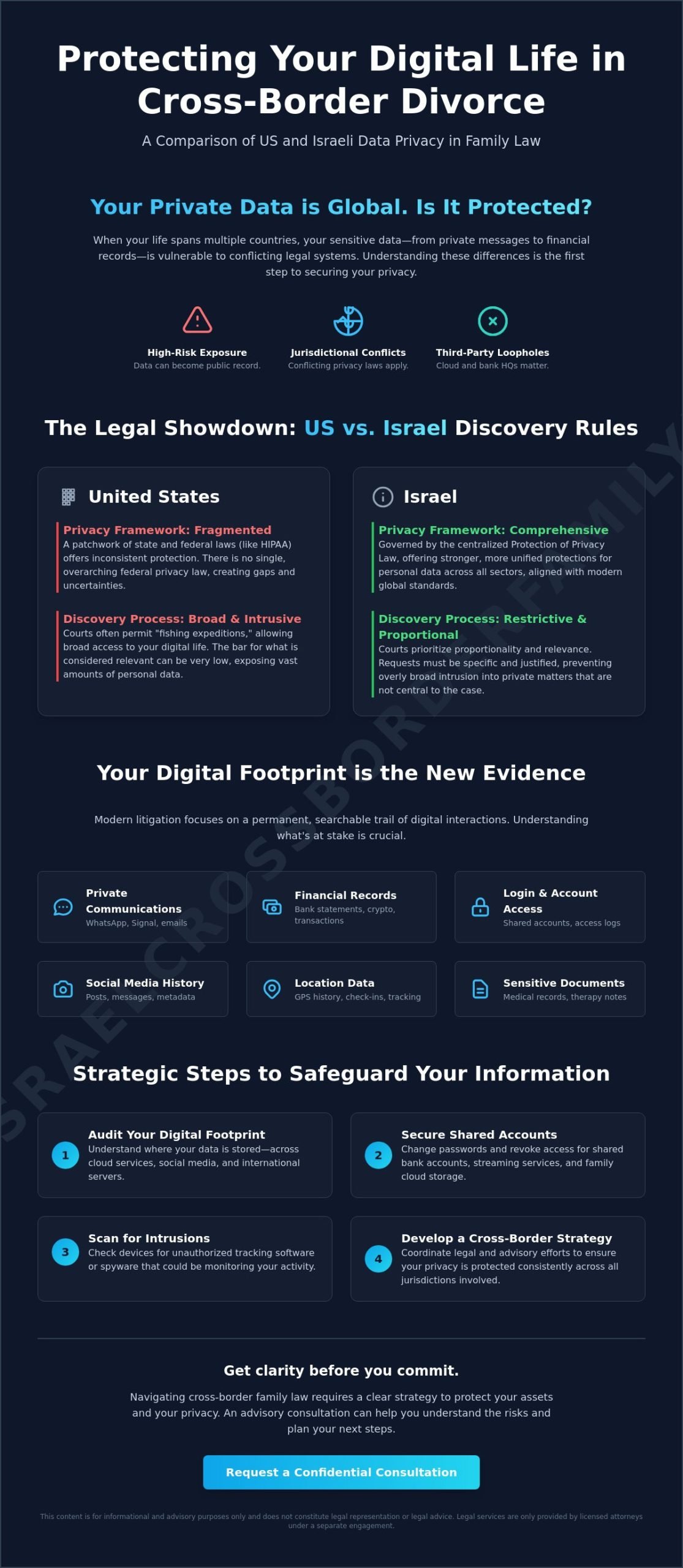
Protecting personal data in international divorce requires a clear understanding of two fundamentally different legal philosophies. In the United States, privacy is often viewed through a commercial or sector-specific lens. In contrast, the Israeli legal system treats privacy as a fundamental human right with constitutional protection. These differing foundations dictate how your private information is treated once it enters a courtroom, especially when sensitive digital evidence is at stake.
The Israeli Protection of Privacy Law
The cornerstone of Israeli data protection is the Protection of Privacy Law (1981). This framework was significantly modernized by Amendment 13, which went into effect on August 14, 2025. This update aligned Israeli standards with global norms like the GDPR, introducing stricter requirements for data processing and the mandatory appointment of Data Protection Officers in many organizations. The Israeli Privacy Protection Authority (PPA) actively oversees these standards and published a comprehensive position paper on February 25, 2026, clarifying the requirements for “informed” and “freely given” consent for data usage.
Crucially, the “Basic Law: Human Dignity and Liberty” elevates privacy to a constitutional status in Israel. This means that in an Israeli divorce, the court has a high threshold for admitting evidence that was obtained by violating someone’s privacy. If data is collected through unauthorized access or spyware, Section 32 of the Privacy Protection Law generally makes that evidence inadmissible. Violations can have both civil and criminal implications, creating a strong deterrent against aggressive data collection tactics.
The US Patchwork System
The US approach is often described as a patchwork system because it lacks a single, comprehensive federal privacy law. While the SECURE Data Act was introduced in April 2026 to create a unified federal standard, the current reality remains fragmented. Federal protections like HIPAA for medical records and the Gramm-Leach-Bliley Act (GLBA) for financial data coexist with a growing list of state laws. For instance, a divorce involving a California resident may trigger protections under the California Privacy Rights Act (CPRA) or the “Delete Act” effective August 1, 2026. Other states like Indiana, Kentucky, and Rhode Island also implemented new privacy laws on January 1, 2026.
This fragmentation can lead to confusion during discovery. The rules for accessing digital evidence often change depending on which state’s law applies. The Stored Communications Act also plays a critical role, limiting how third-party providers can disclose your private emails or messages without a specific warrant or consent. Navigating these conflicting standards is a core challenge for expats and international families, as decisions made in one jurisdiction can inadvertently waive protections in another. You can reach out for a strategy session to clarify how these frameworks might interact in your specific case.
This article is published on an independent advisory platform and is not a law firm. This content is for informational and advisory purposes only and does not constitute legal representation or legal advice. Legal services are only provided by licensed attorneys under a separate engagement; this information does not imply an attorney-client relationship.
Discovery and Evidence: How Sensitive Data is Handled in Court
While legal frameworks establish the ground rules, the actual process of gathering information is where theory meets reality. Protecting personal data in international divorce becomes particularly difficult during the evidence-gathering phase. You might find that what is considered standard procedure in one country is viewed as a significant violation of privacy in another. This conflict often centers on the difference between the broad discovery norms of the US and the more restrictive evidence rules in Israel.
US Discovery Norms
In the US, the discovery process is designed to be exhaustive. Requests for Production allow one party to ask for almost any document that could lead to relevant evidence. This often includes years of bank statements, tax returns, and even private correspondence. In high-conflict cases, it’s common for forensic experts to be hired to mirror hard drives or cloud accounts to ensure no data has been deleted. While US courts use protective orders to limit who can see this data, the information is still technically “discoverable” and enters the legal sphere, increasing the risk of exposure.
Israeli Procedural Protections
Israel takes a much narrower approach. Judges in IL family courts prioritize the principles of relevance and proportionality. They don’t typically allow “fishing expeditions” where one party searches through vast amounts of data hoping to find something useful. Instead, the court often applies a “Privacy by Design” mentality, limiting financial audits to specific timeframes or accounts directly related to the dispute. Specific protections also exist for medical and psychological records, which are rarely disclosed without a compelling reason and a specific court order.
The Israeli system also grapples with the “Right to be Forgotten,” though its application in family law remains limited to protecting the dignity of the parties and their children. Judges must constantly balance the search for truth against the constitutional right to privacy. This balance often favors the protection of sensitive records unless the evidence is critical to the case’s outcome. Understanding how it works when these two systems collide is essential for anyone managing a cross-border separation.
A significant risk in these cases is “Self-Help” evidence. This occurs when one spouse accesses the other’s emails, WhatsApp messages, or social media accounts without permission. While a US court might occasionally admit such evidence if it’s highly relevant, an Israeli court is far more likely to exclude it entirely. Accessing accounts without authorization not only risks making the evidence inadmissible in Israel but can also lead to criminal investigations under the Protection of Privacy Law. Protecting personal data in international divorce means being cautious about how you collect information as much as how you shield your own.
This article is published on an independent advisory platform and is not a law firm. This content is for informational and advisory purposes only and does not constitute legal representation or legal advice. Legal services are only provided by licensed attorneys under a separate engagement; this information does not imply an attorney-client relationship.
Strategic Steps for Protecting Your Digital Footprint
Managing the security of your information requires immediate and methodical action. When you’re involved in divorce and separation for international families, the risk of data exposure is amplified by physical distance and the use of shared digital environments. Protecting personal data in international divorce begins with a comprehensive audit of your digital entry points. You should secure all passwords and enable multi-factor authentication (MFA) or two-factor authentication (2FA) immediately. However, simply changing a password may not be enough if a device is already compromised or if accounts remain linked across different jurisdictions.
One of the most overlooked risks is the “syncing” of cloud storage. If your US-based laptop is syncing data to an Israeli-based tablet used by your spouse, your private files may be transferring across borders in real-time. You must ensure that cloud services like iCloud, Google Drive, or Dropbox are restricted to your personal devices only. Additionally, be aware of the danger of unauthorized tracking software, often called “spyware.” If your battery drains quickly or your data usage spikes unexpectedly, your device might be compromised. Using a legal “Safe Harbor” by having counsel facilitate data exchange rather than communicating directly with your spouse can prevent accidental leaks and provide a layer of professional oversight.
Securing Your Communications
Shared family mobile plans present a significant privacy vulnerability. In many cases, the primary account holder can access detailed call logs and data usage patterns. Transitioning to a secure, independent mobile plan and a non-synced email account for legal correspondence is a critical step for expats and foreign nationals in Israel. While it’s tempting to delete old messages or files to protect your privacy, you must be extremely cautious. In both the US and Israel, deleting potential evidence can be interpreted as “spoliation of evidence,” which can lead to severe penalties or negative inferences in court.
Financial Privacy Management
Financial institutions require formal notification when your domestic situation changes. You should review all authorized users on joint accounts and notify banks in both the US and Israel of your separation. This is particularly important for protecting personal data in international divorce involving multi-currency accounts or cross-border transfers. Crypto-assets present a unique challenge; while the blockchain offers a level of anonymity, the public nature of the ledger means that once a wallet address is linked to your identity, your entire transaction history may become visible. Managing these assets requires a sophisticated strategy that balances transparency with personal security.
If you’re concerned about how to secure your accounts without risking legal repercussions, you can schedule a confidential consultation to discuss your digital strategy.
This article is published on an independent advisory platform and is not a law firm. This content is for informational and advisory purposes only and does not constitute legal representation or legal advice. Legal services are only provided by licensed attorneys under a separate engagement; this information does not imply an attorney-client relationship.
Navigating Jurisdictional Conflicts with Cross-Border Advisory
A local attorney in a single jurisdiction is an expert in their own domestic rules, but they may not fully grasp how a disclosure in one system triggers a vulnerability in the other. Protecting personal data in international divorce requires a unified strategy that bridges the gap between US broad discovery and Israeli privacy protections. Without this coordination, you risk a situation where data protected in Israel is inadvertently surrendered during a US deposition, or vice versa. This often happens because counsel in one country is unaware of the specific privacy shields available in the other.
The role of a cross-border advisor is to act as a bridge between these two legal cultures. By implementing strategic gatekeeping, an advisor helps you control the flow of information to prevent over-exposure. This involves vetting every data request to ensure it meets the standards of both jurisdictions. Building a “Privacy Shield” through an integrated strategy allows you to comply with court orders while still maintaining the highest possible level of digital security. You can learn more about how it works when managing these complex multi-jurisdictional requirements.
The Importance of Strategy Before Commitment
Early decisions on where to file your case can dictate your privacy rights for years. If you file in a US state with expansive discovery rules, you may be required to produce documents that would be strictly protected under Israeli law. Conversely, filing in Israel might offer stronger protections for your digital history but could impact other tactical areas of your case. Identifying “red flags” in your digital footprint before the discovery process begins is essential. This proactive approach allows you to address potential vulnerabilities in your financial or communication records before they become part of a public court record.
When a US court issues a request for data located in Israel, it often creates a direct conflict with Israeli privacy regulations. Handling these “IL” specific data requests requires a nuanced understanding of how Israeli judges balance the search for truth against constitutional privacy rights. An advisor ensures that any information leaving Israel for a US courtroom is transferred through secure, legally recognized channels that respect the protections established by the Israeli Privacy Protection Authority.
Conclusion: Clarity and Protection
Protecting personal data in international divorce is a complex task that involves navigating a fragmented US patchwork of laws and a constitutional right to privacy in Israel. While the US system often pushes for total transparency through exhaustive discovery, the Israeli system emphasizes proportionality and human dignity. Balancing these two approaches requires a calm, authoritative strategy that prioritizes your digital security without compromising your legal standing.
Success in cross-border litigation depends on making informed choices early in the process. By understanding the risks and implementing a clear strategy for your digital assets, you can reduce the anxiety associated with global data exposure. Get clarity before you commit. Request a confidential case review.
This article is published on an independent advisory platform and is not a law firm. This content is for informational and advisory purposes only and does not constitute legal representation or legal advice. Legal services are only provided by licensed attorneys under a separate engagement; this information does not imply an attorney-client relationship.
Securing Your Future Through Informed Decision-Making
The journey of separation is complex enough without the added fear of global data exposure. You’ve seen how the US patchwork system and Israel’s constitutional right to privacy create a unique set of challenges and opportunities. Protecting personal data in international divorce isn’t just about changing passwords; it’s about understanding the procedural rules that govern your information once it enters a courtroom. Early decisions on jurisdiction and disclosure can have lasting effects on your digital footprint.
Our advisory platform offers a specialized focus on US-Israel family law, grounded in decades of cross-border experience. With practitioners licensed in multiple jurisdictions, we provide the steady guidance necessary to navigate this multi-jurisdictional complexity with confidence. By focusing on strategy and risks, you can navigate these systemic differences while minimizing the threat of reputational damage or identity theft. We are here to help you bridge the gap between these two legal cultures.
Get clarity before you commit. Request a confidential consultation.
You can move forward with confidence knowing that your privacy is a priority. Taking the right steps today ensures your sensitive information remains protected throughout the legal process.
This article is published on an independent advisory platform and is not a law firm. This content is for informational and advisory purposes only and does not constitute legal representation or legal advice. Legal services are only provided by licensed attorneys under a separate engagement; this information does not imply an attorney-client relationship.
Frequently Asked Questions
Is my spouse allowed to read my private emails in an international divorce?
Unauthorized access to private communications is generally illegal in both jurisdictions. In Israel, this is a direct violation of the Protection of Privacy Law (1981), which carries both civil and criminal penalties. In the US, the Stored Communications Act provides similar protections. If you’ve shared passwords in the past, you should change them immediately to prevent claims of “implied consent” for your spouse to view your data.
Can a US court order the release of my Israeli bank records?
Yes, a US court can order you to produce any records within your control, regardless of where the servers or banks are located. While an Israeli bank might not respond to a direct US subpoena, the court can hold you in contempt if you refuse to provide the documents yourself. Managing these requests is a critical part of protecting personal data in international divorce and requires a coordinated strategy between both legal systems.
Does the Israeli Protection of Privacy Law apply if I live in the US?
The law can apply if the data is stored on Israeli servers or if the processing is handled by Israeli entities. Following Amendment 13, which took effect on August 14, 2025, Israel has aligned its standards more closely with global norms like the GDPR. Proposed legislation in early 2026 further suggests that Israel intends to assert extraterritorial reach over foreign businesses or individuals handling the data of people in Israel.
What happens if evidence is obtained illegally through hacking or spyware?
In Israel, Section 32 of the Privacy Protection Law generally makes evidence obtained through a privacy violation inadmissible in court. US courts also have rules against using illegally obtained information, though the thresholds for “illegal” can vary by state. Beyond the courtroom, using spyware can lead to criminal investigations in both countries. It’s a high-risk tactic that often damages the credibility of the person who used it.
How can I protect my medical records from being used in a custody battle?
Medical records receive high levels of protection in IL family courts under the “Basic Law: Human Dignity and Liberty.” A judge will typically only order the release of these records if they’re essential to determining the best interests of the child. In the US, HIPAA provides a federal framework for medical privacy, but family court judges still maintain broad discretion to order limited disclosures during custody evaluations.
Can I delete my social media accounts once a divorce starts?
You should not delete accounts or content if you anticipate litigation, as this is often flagged as “spoliation of evidence.” Both US and Israeli courts can impose severe penalties or draw “negative inferences” if they believe you destroyed data to hide information. Instead of deleting, it’s safer to deactivate accounts or adjust privacy settings after consulting with an advisor to ensure you stay compliant with discovery rules.
Is WhatsApp considered a secure form of communication for legal matters?
WhatsApp uses end-to-end encryption, but it’s not a complete solution for protecting personal data in international divorce strategy. Backups stored on cloud services like iCloud or Google Drive are often discoverable in US proceedings. Additionally, if your spouse has access to a linked device or your desktop computer, your messages may be compromised. For sensitive legal discussions, you should use dedicated secure platforms or non-synced email accounts.
What is the difference between “privacy” and “confidentiality” in Israeli courts?
Privacy is your legal right to keep your personal data and private life out of the public domain. Confidentiality refers to the professional obligation of individuals like lawyers, doctors, or therapists to keep your information secret. While Israeli family court hearings are generally closed to the public to ensure confidentiality, you still maintain your personal privacy rights against your spouse during the evidence-sharing process.
Get clarity before you commit. Request a confidential consultation.

Article by
Gabriel Lior
A Personal Journey That Became a Mission
The advisory was founded by an American father Gabriel Lior, LLB, MBA , global entrepreneur, and cross-border advisor who spent more than a decade navigating the Israeli family court system firsthand and now lives in Singapore with his son.
As a divorced parent in a cross-border family, Gabriel faced nearly every legal challenge a foreign parent can encounter in Israel — including child custody disputes, child support proceedings, property matters in Israel and abroad, false accusations, and complex immigration and relocation proceedings.
Over the years, he learned the hard way how difficult it is for non-Israeli parents to understand the system, identify the right legal strategy, and choose the right legal representation — especially when language, culture, and jurisdictional differences are involved. He also witnessed how foreign parents and new immigrants are often disadvantaged or taken advantage of by service providers and institutions simply because they lack local knowledge or fluency.
From Client to Advisor
To truly understand — and survive — the system, Gabriel pursued formal legal education in Israel, completing two Israeli law degrees, alongside a BA and MBA earned in the United States. This was never about becoming a practicing attorney, but about gaining a deep, structural understanding of how the system works — and where it breaks down for foreign parents.
This rare combination of:
Firsthand client experience
Israeli legal and US business education
International business and negotiation training
Decades of commercial execution
created a unique perspective – one that understands both sides of the table.
After years of litigation, persistence, and at times self-representation, he ultimately succeeded in securing custody of his son and relocating abroad through a rare legal victory in the Israeli Supreme Court — becoming one of the first fathers in Israel to do so under these circumstances.
Disclaimer
Important Disclaimer:
The information provided on this website and in its content is for general informational and educational purposes only and does not constitute legal advice, legal opinion, or legal representation.
Gabriel Lior is not licensed to practice law in Israel (nor is he interested in doing so) and does not provide legal services, despite having completed 2 Law Degrees. The services offered are advisory in nature and are intended to provide general guidance, strategic insight, and information regarding cross-border family law considerations.
No attorney-client relationship is formed by accessing this website, reading its content, or communicating with us.
Any decisions made based on this information are at your own discretion and risk. For legal advice specific to your situation, you should consult a licensed attorney in the relevant jurisdiction.
Where appropriate, we may refer clients to independent, licensed attorneys or professionals. Such referrals do not constitute legal representation and no liability is assumed for services provided by third parties.