This article is published on an independent advisory platform and does not constitute an attorney-client relationship or legal advice. Legal services are only provided by licensed attorneys under a separate engagement.
What if the immediate arrest of your former partner isn’t the fastest way to get your child back? When a parent refuses to return a minor or threatens to leave the country, the first question many ask is: can my ex be arrested for taking my child? While the Israeli Penal Law of 1977 does classify parental abduction as a criminal offense for children under 16, the reality on the ground is often more complex than a simple police intervention. You likely feel a deep sense of urgency and fear that the legal system won’t move fast enough to protect your family. We understand that navigating the differences between international laws and Israeli family court can feel overwhelming during such a crisis.
This guide provides a clear strategy to help you understand the legal consequences of parental abduction in IL and the specific actions required to protect your rights. You’ll learn why securing a “Stay of Exit” order from the Family Court, which involves a fee of approximately 3,447 NIS for related property matters as of January 2026, is often the most critical first step. We also examine how Israeli courts apply the Hague Convention, the narrow “grave risk” exceptions, and why acting within the first 12 months is vital for a child’s return. By the end of this article, you’ll have an actionable plan to navigate this cross-border challenge with confidence. Get clarity before you commit. Request a confidential consultation.
Key Takeaways
- Understand that while the Israeli Penal Code classifies unauthorized removal as a crime, the question of can my ex be arrested for taking my child usually leads to civil proceedings rather than immediate police detention.
- Learn why determining your child’s “habitual residence” is the most critical legal factor in deciding which country’s courts have the authority to rule on custody matters.
- Discover how to secure a “Tzav Ikuv Yetzia,” or Stay of Exit Order, to prevent your child from being taken out of Israel and how to register their passport with border control.
- Explore the strategic implications of the Hague Convention’s one-year rule and why filing your petition immediately is essential to avoid claims that the child has settled in a new environment.
- Gain insights into choosing between the Israeli Family Court and the Rabbinical Court to ensure your case is handled by the most appropriate jurisdiction for your specific family situation.
Understanding Parental Child Abduction Under Israeli Law
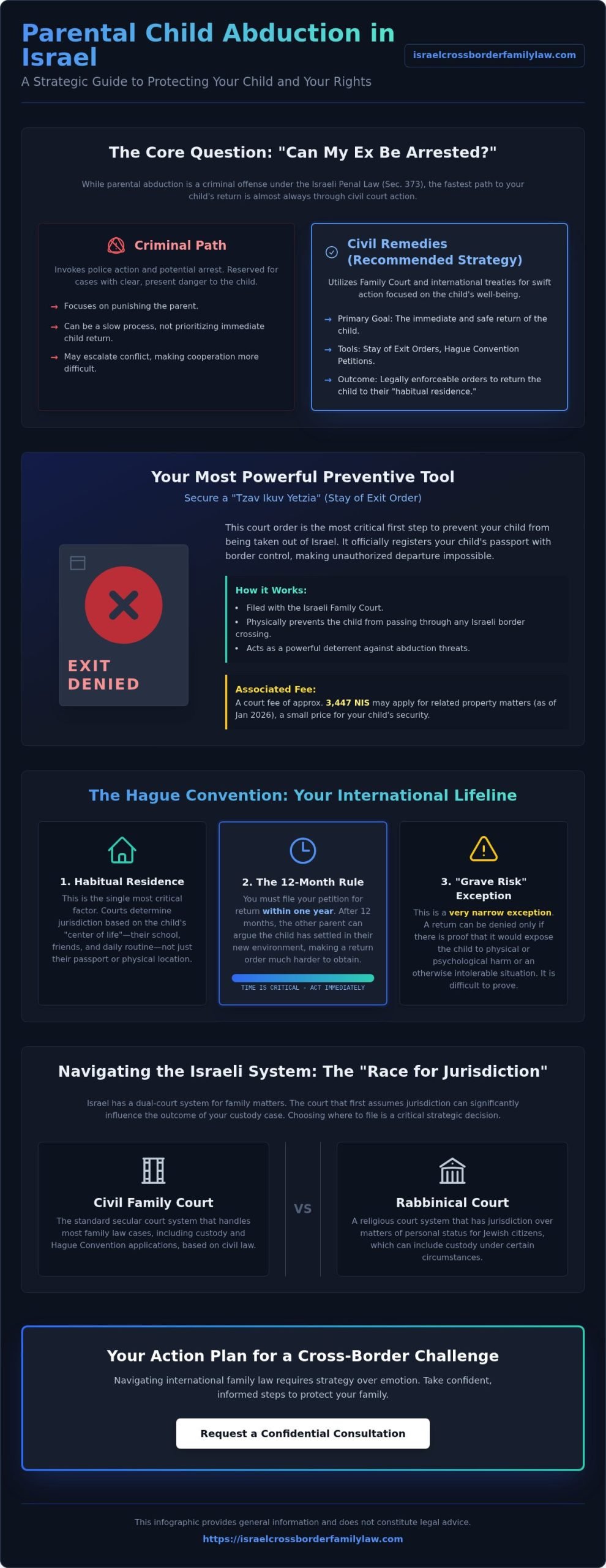
In Israel, parental abduction is defined as the removal or retention of a child from their “habitual residence” without the express consent of the other parent or guardian. This often leaves parents in a state of panic, asking the urgent question: can my ex be arrested for taking my child? While Section 373 of the Israeli Penal Law of 1977 does categorize kidnapping from lawful custody as a criminal offense punishable by imprisonment, the Israeli legal system frequently treats these cases through civil channels first. The primary goal of the courts is the immediate return of the child rather than the immediate incarceration of a parent, unless there’s a clear and present danger.
A unique complexity within the IL legal landscape is the dual-court system. Both the Civil Family Court and the Rabbinical Court may have jurisdiction over custody matters. This creates a “race for jurisdiction” where the legal definition of “wrongful” can be influenced by which court hears the case first. For international families, this means that an action that seems legal in one jurisdiction might be viewed as a “wrongful retention” in Israel if it violates a parent’s custody rights under Israeli law. Understanding these nuances is the first step in building a strategy to protect your parental rights.
To better understand this concept, watch this helpful video:
The Concept of Habitual Residence in Israel
Israeli courts determine jurisdiction by identifying the child’s “center of life.” This is not merely about physical presence; it involves an analysis of the child’s schooling, medical care, and social ties. If a child has lived in Israel for a significant period, IL courts will likely claim jurisdiction, even if the child holds a foreign passport. A temporary vacation can turn into a legal abduction case if one parent decides to stay without the other’s permission. Habitual Residence is the legal anchor for custody disputes in IL.
Consent and Parental Rights for Expats
For expats and international families, the risk of “implied consent” is high. You might believe a verbal agreement for a summer trip is sufficient, but without formal documentation, that trip can become a permanent relocation. If you are concerned about can my ex be arrested for taking my child, you must first ensure your custody rights are clearly defined. Seeking clarity through international custody and relocation agreements can prevent future claims. Most cases involving the Hague Convention on the Civil Aspects of International Child Abduction hinge on whether the left-behind parent actually consented to the child’s move. Early legal strategy is your best defense against the inherent complexity of cross-border family life.
Criminal Charges vs. Civil Remedies: Can Your Ex Be Arrested?
The Israeli Penal Code, specifically Section 373, addresses the crime of “Kidnapping from Lawful Custody.” This statute applies when a person takes or entices a minor under 16 years of age away from their lawful guardian. While the law allows for severe penalties, including significant imprisonment in extreme cases, the actual application within family dynamics is nuanced. When a parent asks, can my ex be arrested for taking my child, they’re often looking for the fastest route to safety. However, a criminal arrest focuses on punishing the offender, whereas your primary goal is likely the safe return of your child. In the Israeli legal landscape, criminal charges and civil remedies move on separate tracks, and choosing the wrong one can lead to unnecessary delays.
Police in Israel often hesitate to make arrests in family disputes. They generally view these situations as civil custody disagreements rather than criminal abductions unless there’s a clear, documented violation of a court order or a direct threat to the child’s safety. Without a specific warrant or a “Stay of Exit” order already in place, the police may advise you to settle the matter in Family Court. This hesitation isn’t due to a lack of concern, but rather a procedural requirement to remain neutral in domestic conflicts. For many international families, the realization that the police won’t immediately intervene is a source of significant anxiety.
When the Israeli Police Will Intervene
The Israeli police will typically only take action if there’s an “immediate risk of harm” or if a parent is in blatant contempt of a specific judicial decree. To trigger police involvement, you must provide clear evidence, such as a certified copy of a custody order or proof that the other parent is attempting to flee the country with the child. If the situation involves physical violence or threats, the police can issue a temporary protection order. However, their power is limited in cases where both parents still technically share legal guardianship under IL law.
The Civil Alternative: Hague Convention Proceedings
Civil litigation is often faster and more effective than seeking a criminal arrest. In cross-border cases, the Hague Convention provides a structured mechanism for the prompt return of children. Instead of a criminal warrant, you seek a “Return Order” through the Family Court. This process is overseen by the Central Authority in Israel, which is part of the Ministry of Justice. A civil return order is focused entirely on the child’s welfare and their return to their habitual residence, which avoids the complexities of a criminal trial. If you’re unsure which path to take, it’s vital to request a confidential case review to assess your strategic options.
The Hague Convention: US-Israel Cross-Border Dynamics
While parents often ask, “can my ex be arrested for taking my child,” the most effective legal tool for an international return is usually the Hague Convention on the Civil Aspects of International Child Abduction. This treaty, which both the United States and Israel have ratified, creates a collaborative framework to return children to their country of habitual residence. It treats abduction as a jurisdictional issue rather than a custody battle. This means an Israeli judge won’t decide who is the “better” parent, but rather whether the child should be sent back to the US for that determination. The focus remains on reversing the wrongful removal rather than punishing the parent through the criminal justice system.
Timing is the most critical element of a Hague case. Under the “One-Year Rule,” if you file your petition within 12 months of the wrongful removal, the Israeli court is generally mandated to order the child’s return. If you wait longer than a year, the abducting parent can argue that the child has become “settled” in their new environment in Israel. This defense is much harder to overcome. Acting immediately is essential to prevent the “settlement” defense from taking root in the child’s new daily life.
Filing a Hague Petition in Israel
Common Pitfalls for US Parents
Many US parents mistakenly believe that a US custody order or a criminal warrant for kidnapping will automatically lead to an arrest in Israel. While these documents are helpful evidence, they don’t override the Hague process. A common mistake is attempting “self-help” or re-abducting the child from Israel. This is a dangerous strategy that can lead to your own arrest in IL and severely damage your legal standing. To navigate these risks, it’s vital to engage a cross-border family lawyer who understands the procedural friction between US and Israeli law. Strategy and risk-based decision-making are your best tools in these high-stakes situations. Get clarity before you commit. Request a confidential consultation.
Immediate Steps: From Port Alerts to Stay of Exit Orders
When the threat of a child being taken abroad becomes a reality, the question often shifts from can my ex be arrested for taking my child to “how can I stop them right now?” In Israel, the most potent tool at your disposal is the Tzav Ikuv Yetzia, or Stay of Exit Order. Unlike a criminal warrant, which requires the police to meet a high burden of proof before making an arrest, a Stay of Exit is a civil preventative measure designed to freeze the status quo. Speed is the most critical factor in these situations. The first 48 hours after discovering a potential plan to flee are vital for securing the child’s presence within the country’s borders.
Gathering “evidence of intent” is the foundation of a successful emergency application. This evidence can include documented airline ticket purchases, emails discussing permanent relocation, or the sudden packing of household goods. While some foreign jurisdictions rely on informal “port alerts,” the Israeli border control system is highly centralized and digitized. Once a court issues a Stay of Exit, it is typically registered with the Border Police within a few hours. This registration flags the child’s passport at all airports and seaports, including Ben Gurion Airport and the Haifa port, ensuring that any attempt to board a craft is immediately blocked.
How to Obtain an Emergency Stay of Exit Order
Parents can apply for an “ex-parte” order, which means the court hears the request immediately without the other parent being present. This prevents the abducting parent from fleeing the moment they learn of the legal action. The Israeli Family Court handles these as urgent matters, often providing a ruling within the same day. A Stay of Exit order in IL is a preventative civil measure, not a criminal one. It acts as a digital barrier that remains in place until the court formally cancels it, providing a necessary layer of security while the broader custody issues are litigated.
Preventing Abduction Before it Happens
The most effective strategy is to address risks before a crisis erupts through the strategic use of international custody and relocation agreements. For US-Israel families, including a “Ne Exeat” clause in your custody decree is vital. This clause explicitly forbids the child’s removal from Israel without written, notarized consent or a specific court order. Monitoring passport applications and maintaining possession of the child’s travel documents are simple but powerful deterrents. If you suspect your child is at risk of being taken, you should contact us immediately to discuss a preventative strategy. Get clarity before you commit. Request a confidential consultation.
Navigating the Israeli Legal System: Strategy Over Emotion
Successful resolution of a cross-border dispute requires a shift from emotional reaction to strategic precision. While you may urgently wonder, can my ex be arrested for taking my child, you must recognize that an arrest is a tool of the state, whereas a return order is a tool for the parent. Focusing solely on criminal prosecution can sometimes slow down the recovery process by creating procedural friction. In the Israeli legal system, the first 72 hours are foundational. The decisions you make in this window, such as which court to approach and whether to engage in mediation, will dictate the trajectory of your litigation for the next 12 months.
A common pitfall for international families is the pressure to enter mediation immediately. While mediation is often helpful in standard divorces, it can be a dangerous stalling tactic in abduction cases. An abducting parent may use the mediation period to further “settle” the child in Israel or to hide travel documents while you’re distracted by negotiations. You must prioritize securing your legal standing in court before considering alternative dispute resolution. Choosing between the Family Court and the Rabbinical Court is another critical decision. In Israel, the “race for jurisdiction” means that whichever court is seized first often retains control over the case. A risk-based decision-making approach helps you evaluate which venue offers the most stable environment for your specific circumstances.
Seeking Clarity and Expert Guidance
Navigating these waters alone is high-risk for any expat. The role of an independent advisory is to provide a clear roadmap for international families who find themselves caught between two legal cultures. You need a strategist who bridges the gap between US and IL law, ensuring that actions taken in Israel don’t negatively impact your standing in American courts. It’s essential to understand the specific Hague Convention nuances before filing any paperwork. Missteps in the early stages can lead to the “grave risk” defense being used against you effectively. When asking can my ex be arrested for taking my child, remember that a strategic civil filing is often the more reliable path to a reunion.
Next Steps for the Left-Behind Parent
Your actions in the coming days must be deliberate and well-documented. Consider these immediate priorities:
- Document every interaction with your ex-partner and child meticulously, using time-stamped emails or texts rather than verbal agreements.
- Maintain a calm, authoritative stance in all communications to avoid providing the other side with evidence for “grave risk” or psychological harm allegations.
- Gather all records of the child’s “habitual residence” in the US, including school enrollment, medical records, and social activities.
The complexity of cross-border situations requires a steady hand and a deep understanding of the Israeli marketplace. Get clarity before you commit. Request a confidential consultation to begin building your strategy.
Securing Your Parental Rights in Cross-Border Disputes
Protecting your child’s safety in a multi-jurisdictional dispute requires a transition from emotional urgency to legal precision. While the question of can my ex be arrested for taking my child is a common starting point, the most effective outcomes in Israel often stem from civil remedies like the Tzav Ikuv Yetzia. You now understand that the Hague Convention and the specific 72-hour window for strategic filing are the most reliable tools for ensuring a child’s return or preventing their unauthorized removal. Relying on the criminal justice system alone often introduces procedural delays that a sophisticated civil strategy can avoid.
Our advisory offers specialized expertise in US-Israel cross-border family law and a deep understanding of the Hague Convention and the Israeli Family Court. We provide authoritative guidance tailored for international families and expats who require a steady hand to navigate these complex legal landscapes. By adopting a risk-based decision-making approach, you can move forward with confidence and clarity. Get clarity before you commit. Request a confidential consultation. Your family’s future depends on the strength of your strategy today.
Frequently Asked Questions
Can my ex-partner be arrested immediately if they take my child in Israel?
Immediate arrest is rare because Israeli police typically treat parental taking as a civil custody matter rather than a criminal act unless there is an immediate risk of physical harm. While the 1977 Penal Law classifies abduction as a crime, officers usually require a specific judicial warrant or evidence of a breached “Stay of Exit” order before making an arrest. You should prioritize obtaining an emergency civil order from the Family Court to secure the child’s presence.
What is the difference between parental kidnapping and a custody dispute in IL?
Parental kidnapping in IL involves the wrongful removal or retention of a minor from their habitual residence without the other guardian’s legal consent. A custody dispute generally refers to disagreements over visitation rights or daily upbringing within the same jurisdiction. When asking can my ex be arrested for taking my child, it is important to understand that “wrongful retention” after a vacation is legally treated as abduction under the Hague Convention protocol.
How do I stop my ex from taking my child out of Israel without my permission?
You can prevent a child from leaving the country by securing an emergency “Tzav Ikuv Yetzia,” which is a Stay of Exit Order. As of early 2026, these orders are digitally transmitted to border control at Ben Gurion Airport and all seaports within hours of the court’s decision. This order flags the child’s passport in the national system, ensuring they cannot clear security for any departing flight or vessel.
Does the Hague Convention apply if my child is taken from the US to Israel?
Yes, the Hague Convention applies because both the United States and Israel are active signatories to this international treaty. The convention creates a standardized legal framework to return children to their original country of habitual residence so custody can be decided there. This civil mechanism bypasses the complexities of international extradition and focuses on the child’s swift return to their primary center of life.
What should I do if my ex refuses to return our child after a scheduled visit in IL?
If a parent refuses to return a child after an agreed visit, you should immediately file a motion in the Family Court for “wrongful retention.” Delaying action for more than a few days can complicate your case, as the other parent may attempt to establish a new “habitual residence” in Israel. You must act decisively to ensure the court views the retention as a breach of your existing parental rights.
Can a US court order be enforced to get my child back from Israel?
A US court order is not automatically enforceable in Israel and requires a process called “exequatur” or integration into a Hague Convention petition. Israeli judges will give weight to the US findings, but they must issue a local decree to authorize Israeli law enforcement to intervene. Navigating the friction between these two distinct legal systems requires a strategy that bridges both US and Israeli procedural requirements.
What are the legal consequences for a parent who abducts their child to Israel?
A parent who abducts a child faces potential imprisonment under the 1977 Penal Law and significant civil fines. Beyond criminal liability, the abducting parent often loses their standing in future custody proceedings due to their lack of cooperation with the court. When investigating can my ex be arrested for taking my child, remember that the court’s primary objective is the child’s welfare, and abduction is viewed as a severe violation of that principle.
How long does a Hague Convention case typically take in the Israeli courts?
Hague Convention cases are fast-tracked in Israel and typically reach a resolution within six weeks to three months. This accelerated timeline is designed to prevent the child from becoming settled in a new environment, which could trigger a legal defense against their return. While appeals to higher courts can extend this timeframe, the initial hearings are handled with extreme urgency by the Family Court system.

Article by
Gabriel Lior
A Personal Journey That Became a Mission
The advisory was founded by an American father Gabriel Lior, LLB, MBA , global entrepreneur, and cross-border advisor who spent more than a decade navigating the Israeli family court system firsthand and now lives in Singapore with his son.
As a divorced parent in a cross-border family, Gabriel faced nearly every legal challenge a foreign parent can encounter in Israel — including child custody disputes, child support proceedings, property matters in Israel and abroad, false accusations, and complex immigration and relocation proceedings.
Over the years, he learned the hard way how difficult it is for non-Israeli parents to understand the system, identify the right legal strategy, and choose the right legal representation — especially when language, culture, and jurisdictional differences are involved. He also witnessed how foreign parents and new immigrants are often disadvantaged or taken advantage of by service providers and institutions simply because they lack local knowledge or fluency.
From Client to Advisor
To truly understand — and survive — the system, Gabriel pursued formal legal education in Israel, completing two Israeli law degrees, alongside a BA and MBA earned in the United States. This was never about becoming a practicing attorney, but about gaining a deep, structural understanding of how the system works — and where it breaks down for foreign parents.
This rare combination of:
Firsthand client experience
Israeli legal and US business education
International business and negotiation training
Decades of commercial execution
created a unique perspective – one that understands both sides of the table.
After years of litigation, persistence, and at times self-representation, he ultimately succeeded in securing custody of his son and relocating abroad through a rare legal victory in the Israeli Supreme Court — becoming one of the first fathers in Israel to do so under these circumstances.
Disclaimer
Important Disclaimer:
The information provided on this website and in its content is for general informational and educational purposes only and does not constitute legal advice, legal opinion, or legal representation.
Gabriel Lior is not licensed to practice law in Israel (nor is he interested in doing so) and does not provide legal services, despite having completed 2 Law Degrees. The services offered are advisory in nature and are intended to provide general guidance, strategic insight, and information regarding cross-border family law considerations.
No attorney-client relationship is formed by accessing this website, reading its content, or communicating with us.
Any decisions made based on this information are at your own discretion and risk. For legal advice specific to your situation, you should consult a licensed attorney in the relevant jurisdiction.
Where appropriate, we may refer clients to independent, licensed attorneys or professionals. Such referrals do not constitute legal representation and no liability is assumed for services provided by third parties.