The prospect of a court-ordered psychological evaluation can be one of the most daunting aspects of a complex cross-border child relocation case. For parents navigating the intricate legal systems of both the United States and Israel, the process often feels like an opaque and high-stakes examination, fraught with anxiety over how one’s parenting will be judged and whether the outcome will deny a life-changing move. This apprehension, while understandable, can be significantly mitigated with strategic preparation and a clear understanding of the proceedings. This comprehensive guide is designed to demystify the psychological evaluation for a child relocation case. Here, we provide an authoritative overview of the evaluation’s fundamental purpose, outline the step-by-step process you can expect, and illuminate the key factors that psychologists and courts in both jurisdictions consider. Our objective is to equip you with the knowledge to navigate this critical stage with clarity and confidence, empowering you to present your case effectively and in the paramount best interest of your child.
Key Takeaways
- Understand that a psychological evaluation for a child relocation case is not a test of your parenting but a formal, impartial assessment designed to advise the court on the child’s best interests.
- Learn the specific triggers that lead a court to order this type of assessment, as a formal psychological evaluation for a child relocation case is typically reserved for high-conflict or particularly nuanced disputes.
- Discover the key factors an evaluator scrutinizes during the psychological evaluation for a child relocation case, which extend beyond general parental fitness to the specific logistical, emotional, and developmental impacts of the proposed move.
- Develop a strategy for preparing for the process, focusing on how to present your case consistently and transparently to support a favorable outcome in the psychological evaluation for a child relocation case.
The Role of a Psychological Evaluation in an International Relocation Case
In the sophisticated and often contentious arena of international family law, particularly in cases involving a proposed child relocation between Israel and the United States, the court requires objective, specialized insight. A psychological evaluation for a child relocation case is a forensic assessment conducted by a qualified mental health professional. Its primary purpose is not to determine which parent is superior, but to provide the court with an impartial, expert opinion on how the proposed international move would likely affect the child’s psychological well-being. This assessment is fundamentally guided by the “best interests of the child” standard, a legal principle that is the cornerstone of family law in both Israeli and U.S. jurisdictions. To better understand the complex dynamics at play in these matters, the following video offers valuable insights:
It is crucial to distinguish this targeted assessment from both therapeutic intervention and a standard Custody evaluation. While it shares certain methodologies, the focus of a relocation evaluation is significantly narrower: it is laser-focused on the multifaceted impact of the proposed move itself. The evaluator is not acting as a therapist for the family but as a neutral investigator tasked with analyzing the potential benefits and detriments of the relocation on the child.
Why Relocation Cases Are Unique
International relocation petitions are inherently complex because they propose a fundamental and often permanent alteration to the child’s life and their access to one parent. The court must meticulously weigh the relocating parent’s reasons and the potential advantages of the move-such as enhanced economic opportunity or proximity to extended family-against the profound potential harm of diminishing the child’s relationship with the non-relocating parent and their established community.
The Evaluator’s Role: An Independent Expert for the Court
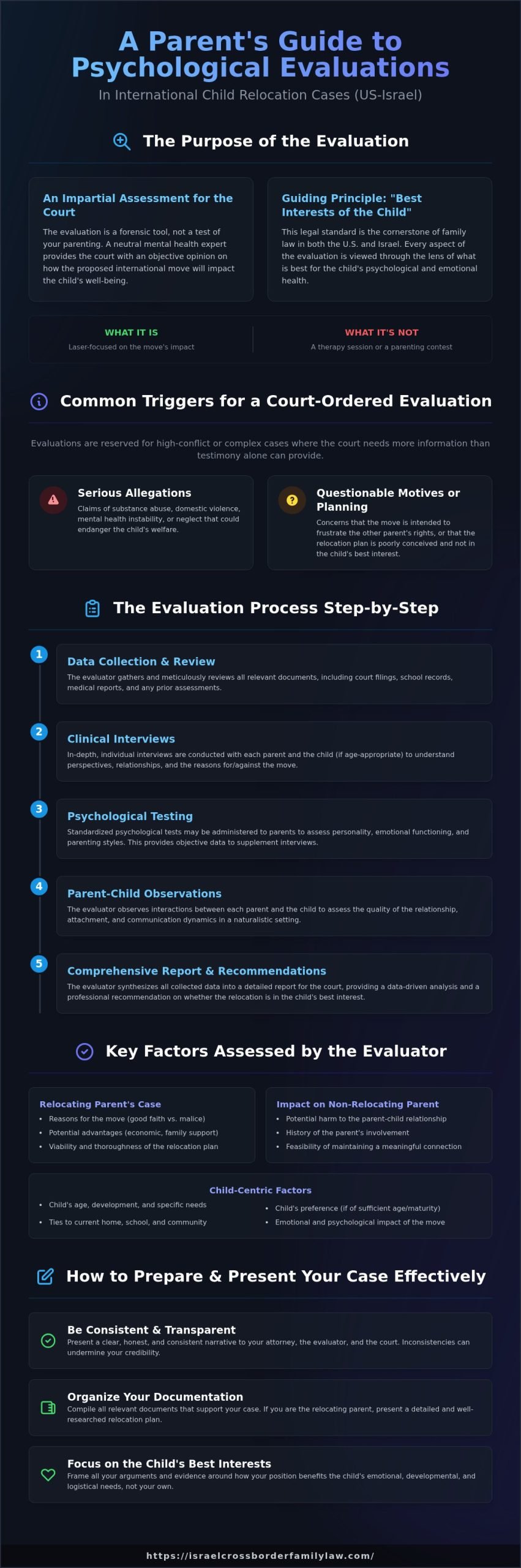
The evaluator functions as a neutral, independent expert for the court, not as an advocate for either parent. Their duty is to the court and to the child’s best interests. This process involves extensive data collection, including clinical interviews with both parents and the child, psychological testing, observation of parent-child interactions, and a review of all relevant documents. The resulting comprehensive report provides the judge with data-driven analysis and recommendations, serving as a critical tool in navigating these high-stakes decisions.
When Is an Evaluation Ordered in a US-Israel Relocation Dispute?
In a high-stakes US-Israel relocation dispute, a psychological evaluation is not an automatic step. Courts reserve this intensive measure for the most complex and high-conflict situations where parental claims are sharply contested and the child’s best interests are difficult to ascertain from testimony alone. Given the invasive nature of the child custody evaluation process, judges require a substantial showing of need before compelling a family to undergo this level of scrutiny. While one parent can motion the court to request an evaluation-often as a strategic tool to validate their position or challenge the other parent’s fitness-the court maintains ultimate discretion, ordering it only when essential information cannot be obtained through other means.
Common Triggers for a Court-Ordered Evaluation
A court is more likely to order a psychological evaluation for a child relocation case when specific, serious concerns are raised that directly impact the child’s welfare. The decision to proceed is typically triggered by one or more of the following factors:
- Serious Allegations: Claims of substance abuse, domestic violence, mental health instability, or neglect against either parent that could endanger the child.
- Questionable Motives or Planning: Concerns that the relocating parent’s motivations are intended to frustrate the other parent’s custody rights, or that their relocation plan is poorly conceived and fails to address the child’s needs.
- Disputes Over Attachment: Significant disagreement about the strength of the child’s bond with each parent, their siblings, extended family, and their current community, school, and social network.
- A Child with Special Needs: When a child has unique educational, medical, or psychological needs, an evaluation can provide critical insight into which environment can better support their development.
The Cross-Border Dimension: US-Israel Specifics
The complexities of a custody evaluation are magnified exponentially in a US-Israel relocation. The vast geographical and cultural distance means a court’s decision carries immense weight, as it fundamentally alters the non-relocating parent’s ability to maintain a meaningful, consistent relationship. Courts are acutely aware of how such moves can lead to future jurisdictional disputes, including those governed by The Hague Convention on Child Abduction, and therefore apply heightened scrutiny. A standard domestic evaluation is often insufficient. An effective assessment in this context demands a professional with sophisticated, multi-jurisdictional expertise-a deep understanding of both American and Israeli family law, cultural norms, and support systems. Successfully navigating these intricate challenges is central to our firm’s approach to international custody and relocation cases.
The Evaluation Process: What to Expect Step-by-Step
A comprehensive psychological evaluation for a child relocation case is a meticulous, multi-stage process designed to provide the court with an objective, in-depth understanding of the family’s dynamics. It is not a brief assessment; clients should anticipate a timeline spanning several months. Full, transparent cooperation from both parents is paramount, as honesty and engagement are critical to ensuring the evaluator can form a complete and accurate picture for their final recommendations.
Phase 1: Selecting the Evaluator and Initial Interviews
The process commences with the appointment of a qualified forensic psychologist, typically chosen by mutual agreement of legal counsel or appointed directly by the court. In complex US-Israel matters, an evaluator with cross-border experience is essential. Each parent then undergoes individual clinical interviews to discuss their background, parenting history, the rationale for the proposed move, and their overall psychological state, which often includes a formal Mental Status Examination.
Phase 2: Data Gathering and Observation
This phase focuses on objective data collection through several key components. The evaluator will administer sophisticated psychological tests to the parents, such as the Minnesota Multiphasic Personality Inventory (MMPI), to assess personality and emotional functioning. Concurrently, they will conduct age-appropriate interviews and assessments with the child to understand their developmental needs and attachments. A critical step is the direct observation of parent-child interactions, which provides invaluable insight into the quality and nature of each relationship.
Phase 3: Collateral Contacts and Cross-Border Challenges
The evaluator will contact collateral sources-third parties like teachers, therapists, or family members who can provide additional context. In multi-jurisdictional cases between the US and Israel, this presents unique challenges. Secure video conferencing is utilized for interviews across continents, and significant effort is required to coordinate with professionals and obtain official records, such as school transcripts from Tel Aviv or therapeutic notes from New York, to complete the evaluation.
Key Factors Assessed by the Evaluator in Relocation Cases
A psychological evaluation for a child relocation case is a forensic, multi-faceted investigation, not merely an assessment of general parenting skills. The evaluator’s mandate is to scrutinize the specific circumstances of the proposed move and provide the court with a sophisticated analysis of how it will impact the child’s best interests. This requires a deep dive into three core areas: the plans of the parent proposing the move, the unique needs of the child, and the established role of the non-relocating parent.
The Relocating Parent’s Plan and Motives
The court and the evaluator will meticulously examine the substance and sincerity behind the relocation request. A well-researched, tangible plan is paramount. This includes demonstrating secured employment, suitable housing arrangements, and a detailed educational plan for the child in the new location. The parent’s motivations are also scrutinized to ensure they are in “good faith”-such as a significant career advancement or proximity to a critical family support system-rather than a veiled attempt to frustrate the other parent’s contact. A credible proposal must include a proactive and generous plan to facilitate the child’s ongoing relationship with the non-relocating parent.
The Child’s Needs, Attachments, and Preferences
The child is the central figure in any custody evaluation. The expert will assess factors unique to the child, including their age, developmental stage, emotional resilience, and specific needs. A primary focus is the strength and nature of the child’s attachment to each parent, as well as to siblings, grandparents, and their wider community of friends, school, and extracurricular activities. The child’s own stated preference will be considered, but its weight is carefully calibrated against their age, maturity, and the potential for influence by either parent.
The Non-Relocating Parent’s Role and the Post-Move Relationship
The evaluation thoroughly considers the potential loss the child may suffer if separated from the non-relocating parent. The evaluator will investigate the historical level of involvement and the quality of the relationship this parent has maintained. The central question is whether a meaningful, consistent, and loving relationship can be realistically sustained post-relocation, considering the practical and financial burdens of travel and the limitations of digital communication. These complex issues of maintaining parental bonds across distances are central to many international divorce and separation cases and demand sophisticated legal guidance.
How to Prepare for the Evaluation and Present Your Case Effectively
Navigating a custody evaluation requires a strategic, composed, and child-centric approach. The objective is not to “win” a contest against the other parent but to provide the evaluator with a clear, accurate, and comprehensive understanding of why the proposed relocation serves your child’s best interests. Undergoing a psychological evaluation for a child relocation case can be an intimidating experience, but meticulous preparation and a composed demeanor are paramount to presenting your position effectively.
Dos: What You Should Do
Your conduct and preparation are critical components of the evaluation. To present yourself as a responsible and organized parent who is focused on the child’s welfare, adhere to the following principles:
- Be Organized: Compile all relevant documentation, including school records, communication logs with the other parent, and a clear timeline of key events. This demonstrates foresight and respect for the process.
- Be Honest and Consistent: Credibility is essential. Provide truthful and consistent information across all interviews, questionnaires, and interactions. Any discrepancies can severely damage your case.
- Focus on Your Child’s Needs: Frame your motivations and answers around your child’s well-being, stability, and future opportunities. Articulate how the relocation benefits them specifically, not just you.
- Be Punctual and Dress Appropriately: Treat every meeting with the evaluator as a formal, professional engagement. Punctuality and appropriate attire show that you take this critical matter seriously.
Don’ts: Mistakes to Avoid
Certain actions can irreparably harm your credibility and negatively influence the evaluator’s final report. It is imperative to avoid these common but serious pitfalls:
- Do Not Coach Your Child: Evaluators are highly trained to detect when a child has been told what to say. This can be viewed as manipulation and is profoundly detrimental to your case.
- Avoid Criticizing the Other Parent: Refrain from making negative or disparaging remarks about the other parent. Focus on objective facts and behaviors, and demonstrate your capacity to support the child’s relationship with both parents.
- Do Not Be Defensive or Record Sessions: Maintain a cooperative and open demeanor. Defensiveness can be misinterpreted as hiding information, and attempting to record sessions creates an adversarial environment.
- Never Misrepresent Facts: Do not lie, exaggerate, or withhold requested information. The discovery of any dishonesty will undermine your entire position before the court.
Working with Your Attorney
Engaging experienced legal counsel is a strategic necessity. Your attorney provides indispensable guidance throughout the psychological evaluation for a child relocation case, helping you organize evidence, prepare for the evaluator’s questioning, and understand the legal standards at play. Following the evaluation, your counsel will meticulously review the final report for any inaccuracies or biases, which is crucial for developing a strategy for how the report will be presented in court. If you are facing a complex cross-border relocation case, it is crucial to have expert guidance to navigate the process. Request a confidential case review to discuss your legal options and strategy.
Navigating Your Relocation Case with Strategic Counsel
Successfully managing an international child relocation dispute between the United States and Israel requires a meticulous understanding of both legal systems. As this guide has detailed, the court-ordered evaluation is a critical juncture where the child’s best interests are comprehensively assessed across cultural and jurisdictional lines. How you prepare for and present your position during the psychological evaluation for child relocation case can fundamentally influence the court’s final determination, making expert legal guidance not just beneficial, but essential for a favorable outcome. Our firm is uniquely positioned to provide this essential support. Leveraging our specialized expertise in US-Israel cross-border family law and an in-depth understanding of international relocation standards, we deliver the strategic guidance required to navigate these complex multi-jurisdictional legal proceedings. We are committed to protecting your parental rights while pursuing the best possible outcome for your family. To ensure your case is positioned for success, we invite you to Schedule a Confidential Case Review to Discuss Your International Relocation Matter. Taking this decisive step can provide the clarity and confidence you need to move forward.
Frequently Asked Questions
Who pays for a psychological evaluation in a relocation case?
In the Israeli legal system, the court typically determines how the costs are allocated. The expense for a psychological evaluation for a child relocation case may be divided equally between the parents or assigned to one party based on financial capacity or who initiated the request. It is considered a court-ordered expense, with comprehensive cross-border evaluations often ranging from ₪15,000 to ₪30,000 or more, depending on the complexity of the international issues involved.
How long does a cross-border evaluation typically take from start to finish?
A comprehensive cross-border evaluation is a multi-stage process, and timelines can vary. Generally, you should anticipate a period of three to six months from the initial appointment to the submission of the final report to the court. This timeframe accommodates the necessary interviews with both parents and children, psychological testing, review of extensive documentation from multiple jurisdictions, consultation with collateral contacts like teachers, and the detailed drafting of the expert opinion.
Is the evaluator’s report and recommendation binding on the judge?
While not legally binding, the recommendations of a court-appointed evaluator carry substantial weight within the Israeli family court system. The evaluator serves as an expert witness, providing a professional opinion to guide the court’s decision-making process. A judge will typically only deviate from the evaluator’s recommendation if compelling, contradictory evidence is presented or if a significant flaw in the evaluation methodology is proven during cross-examination in court.
What can I do if I disagree with the findings in the final report?
Should you disagree with the report’s conclusions, your legal counsel has strategic avenues to challenge the findings. The primary mechanism is the rigorous cross-examination of the evaluator during court proceedings, where your attorney can question their methodology, sources, and potential biases. It is also possible to retain a private expert to review the report and provide a counter-opinion, though its admission as evidence is subject to the court’s discretion.
Will an evaluation conducted by a US-based psychologist be accepted in an Israeli court?
Navigating multi-jurisdictional evidentiary standards is a critical aspect of these complex cases. While a report from a U.S.-based psychologist can be submitted as supporting material, Israeli family courts will almost invariably appoint their own local expert. The court’s reliance on an Israeli-appointed professional is a key factor in a psychological evaluation for a child relocation case, as this expert is versed in the specific legal and cultural standards relevant to the Israeli judicial system.
How will the evaluator interview my child without causing them stress?
Court-appointed evaluators are highly trained clinical professionals skilled in child psychology. They employ specialized, age-appropriate techniques to create a low-stress, neutral environment. For younger children, this may involve observation during play, while older children engage in carefully structured, open-ended conversations. The primary objective is to understand the child’s world and perspective, not to conduct a formal interrogation, ensuring their emotional well-being is protected throughout the process.

Article by
Gabriel Lior
A Personal Journey That Became a Mission The advisory was founded by an American father Gabriel Lior, LLB, MBA , global entrepreneur, and cross-border advisor who spent more than a decade navigating the Israeli family court system firsthand and now lives in Singapore with his son.
As a divorced parent in a cross-border family, Gabriel faced nearly every legal challenge a foreign parent can encounter in Israel — including child custody disputes, child support proceedings, property matters in Israel and abroad, false accusations, and complex immigration and relocation proceedings. Over the years, he learned the hard way how difficult it is for non-Israeli parents to understand the system, identify the right legal strategy, and choose the right legal representation — especially when language, culture, and jurisdictional differences are involved. He also witnessed how foreign parents and new immigrants are often disadvantaged or taken advantage of by service providers and institutions simply because they lack local knowledge or fluency. From Client to Advisor To truly understand — and survive — the system, Gabriel pursued formal legal education in Israel, completing two Israeli law degrees, alongside a BA and MBA earned in the United States. This was never about becoming a practicing attorney, but about gaining a deep, structural understanding of how the system works — and where it breaks down for foreign parents. This rare combination of: Firsthand client experience Israeli legal and US business education International business and negotiation training Decades of commercial execution created a unique perspective – one that understands both sides of the table. After years of litigation, persistence, and at times self-representation, he ultimately succeeded in securing custody of his son and relocating abroad through a rare legal victory in the Israeli Supreme Court — becoming one of the first fathers in Israel to do so under these circumstances.
Disclaimer
Important Disclaimer: The information provided on this website and in its content is for general informational and educational purposes only and does not constitute legal advice, legal opinion, or legal representation. Gabriel Lior is not licensed to practice law in Israel (nor is he interested in doing so) and does not provide legal services, despite having completed 2 Law Degrees. The services offered are advisory in nature and are intended to provide general guidance, strategic insight, and information regarding cross-border family law considerations. No attorney-client relationship is formed by accessing this website, reading its content, or communicating with us. Any decisions made based on this information are at your own discretion and risk. For legal advice specific to your situation, you should consult a licensed attorney in the relevant jurisdiction. Where appropriate, we may refer clients to independent, licensed attorneys or professionals. Such referrals do not constitute legal representation and no liability is assumed for services provided by third parties.