Relocating to Israel isn’t just a lifestyle change; for a global family, it’s a significant cross-border legal event that effectively splits your life between two or more jurisdictions. International Families Living in Israel often find that laws governing their marriage, their children, and their wealth don’t stop at the border. Instead, these systems often collide. You might feel a deep sense of uncertainty as you realize that the legal protections you took for granted in your home country may not apply, or they might conflict directly with Israeli statutes. It’s a heavy realization that early decisions made without local context can have lasting consequences for your assets and your rights.
We understand that managing these dual legal systems feels like a constant balancing act. This guide provides the clarity you need to navigate this complex intersection, offering strategies to harmonize your cross-border interests and protect your family’s future. We will examine the critical differences in divorce and custody laws, the nuances of estate planning with assets in multiple countries, and the proactive steps you can take to secure your legacy. By understanding the risks honestly and early, you can move forward with confidence and peace of mind.
Key Takeaways
- International Families Living in Israel must adopt a dual-lens strategy to ensure their local legal status remains compliant with the regulations of their home jurisdiction.
- Learn why foreign prenuptial agreements often require a formal Israeli approval process to be enforceable and how a local Financial Agreement protects global assets.
- Understand the critical implications of the Hague Convention on international child custody and how Israeli courts evaluate relocation and visitation across borders.
- Discover why a standard foreign will may be insufficient for assets held in Israel and how to navigate the local probate process for beneficiaries residing abroad.
- Gain insights into strategic decision-making that prioritizes risk mitigation and legal clarity before making major family or financial commitments.
Understanding the Legal Landscape for International Families in Israel
Residency in Israel creates a complex legal profile for International Families Living in Israel that extends far beyond simple visa status. When a family moves across borders, they don’t leave their home country’s legal obligations behind; instead, they enter a space where two distinct systems overlap. This residency effectively splits your legal identity. Your marriage, your children’s rights, and your global assets suddenly fall under the shadow of two different jurisdictions. Understanding this reality is the first step toward protecting your family’s future.
We advocate for a “dual-lens” approach to managing these complexities. This strategy requires you to evaluate every major life decision through both Israeli law and the requirements of your home country. For example, a financial decision that seems sound in a US context might trigger unexpected tax or inheritance consequences in Israel. Harmonizing these divergent legal cultures is essential to prevent conflicting court orders or the loss of rights in one jurisdiction while attempting to exercise them in another.
The Israeli legal framework differs significantly from the common law systems found in the United States. While Israel’s system has roots in British common law, it’s a unique hybrid that incorporates civil law principles and religious court jurisdiction over personal status matters. This complexity can be daunting for those used to a more singular legal tradition. However, the Israeli Supreme Court serves as a vital guardian in this landscape. It consistently acts to protect the rights of foreign nationals, ensuring that due process is upheld and that international treaties are respected even within the intricacies of the local system.
The Status of Expats and Foreign Nationals
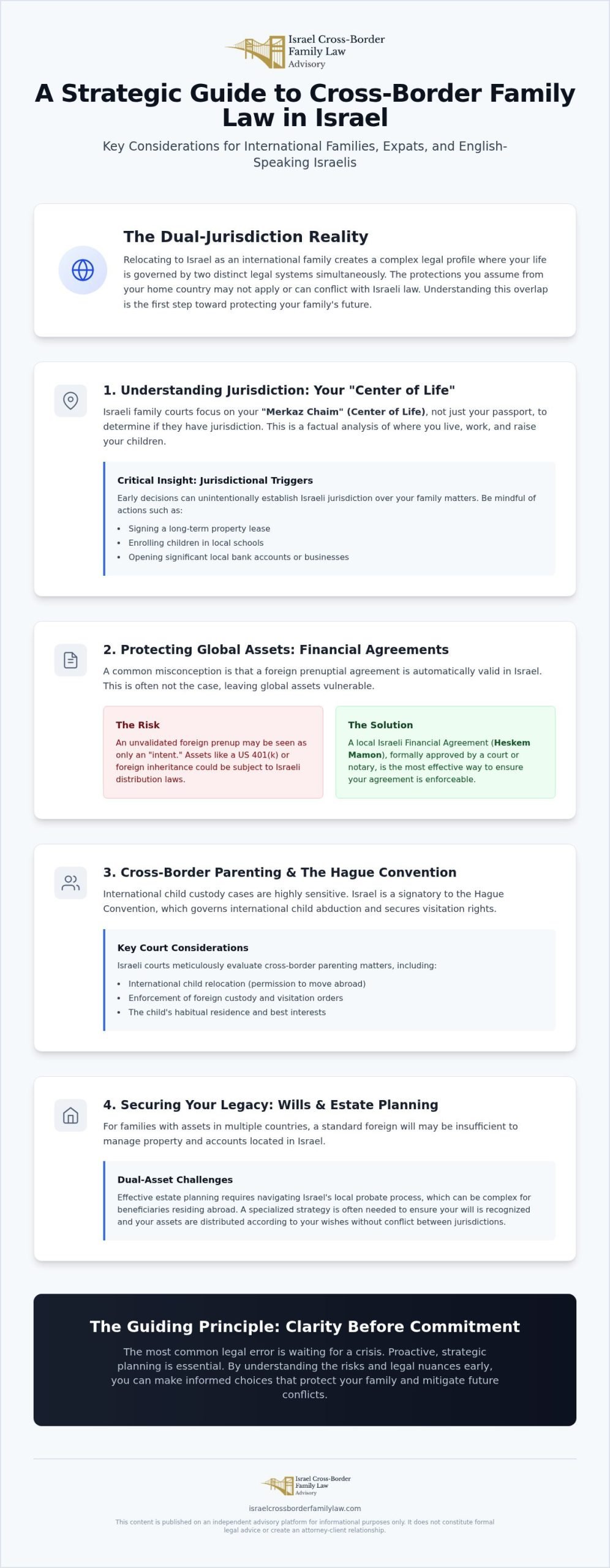
Israeli family courts focus less on your passport and more on your “Merkaz Chaim,” or Center of Life. This test determines whether the court has jurisdiction over your family disputes or estate. It’s a factual analysis of where you live, work, and raise your children. Understanding the distinction between being a resident and being a citizen is critical for International Families Living in Israel. For a detailed breakdown of how your specific status impacts your rights, you can review our guidance For Expats and Foreign Nationals.
The Importance of Early Strategic Planning
Waiting for a crisis to occur is the most frequent legal error international families make. Jurisdictional triggers, such as signing a long-term lease or enrolling children in schools, can cement Israeli jurisdiction over your family matters before you realize it. Early decisions in IL carry permanent weight in cross-border disputes, often dictating which country’s laws will apply to a divorce or custody case years down the line. Identifying these triggers early allows you to make informed choices rather than reactive ones.
Marriage and Financial Agreements in a Cross-Border Context
A common misconception among expats is that a signed US prenuptial agreement remains a static, ironclad shield. In Israel, it doesn’t. The Israeli Spousal Property Relations Law (1973) dictates that financial agreements between spouses must be formally approved by a court or a qualified notary to be legally binding. For International Families Living in Israel, an unvalidated foreign prenup may be viewed as merely an “intent” rather than a binding contract. This leaves global assets, from US 401(k) accounts to family inheritances, vulnerable to local distribution laws that favor the “equalization of resources” principle.
Drafting a local Financial Agreement, known as a Heskem Mamon, is the most effective way to harmonize your international interests with Israeli requirements. This document acts as a bridge, ensuring that the terms you agreed upon in your home country are recognized by the Israeli judicial system. If you’ve already relocated without an agreement, a postnuptial Heskem Mamon can still be drafted and approved by the Family Court to provide the same level of security for your multi-jurisdictional estate.
Harmonizing Prenups and Postnups
Effective cross-border agreements require dual-language drafting and a deep understanding of dual-jurisdiction standards. An agreement that satisfies a New York judge might fail in Israel if it doesn’t account for the specific authority of the Rabbinical Courts. In Israel, the “race for jurisdiction” is a real risk. If a divorce is filed in the Rabbinical Court before the Family Court, the religious tribunal may gain the authority to decide on property matters. Ensuring your agreement explicitly addresses which court has the authority to handle disputes is essential for maintaining control over your financial future.
Protecting Foreign Assets and Inheritance
For families moving to hubs like Ra’anana or Tel Aviv, ring-fencing pre-marital or foreign assets is a priority. Israeli law generally excludes “pre-marital” assets from division, but the lines blur when foreign income is commingled with local Israeli bank accounts. Consider this checklist for reviewing your existing US prenup:
- Does the agreement explicitly define “separate property” in a way that aligns with Israeli legal definitions?
- Has the document been translated and reviewed by a practitioner qualified in both systems?
- Is there a clear mechanism for handling assets acquired in Israel using foreign funds?
Strategic planning allows you to address these overlaps before a conflict arises. Requesting a confidential strategy session can help you identify these risks before they become legal hurdles for International Families Living in Israel.
Cross-Border Parenting: Custody and Child Support
Parenting across borders introduces legal variables that many families overlook until a dispute arises. For International Families Living in Israel, the concept of “Habitual Residence” is the most critical factor in determining which country’s courts have the authority to make decisions about your children. Habitual residence isn’t a fixed date or a simple box to check on a visa application. Instead, it’s a factual determination made by a judge based on where a child’s life is centered. Once a child is integrated into Israeli society through school, healthcare, and social ties, Israeli law may govern their future, regardless of their original citizenship.
This shift in jurisdiction has profound implications for custody and visitation. Israeli courts prioritize the “best interests of the child,” but their interpretation of this standard may differ from what you expect in your home country. For example, visitation schedules must account for the logistical challenges of international travel and the potential for conflicting school calendars. Managing these expectations requires a proactive approach that addresses the reality of living in a different legal culture while maintaining ties to a family’s country of origin.
The Hague Convention and Relocation
The Hague Convention on the Civil Aspects of International Child Abduction is a treaty designed to protect children from the harmful effects of being unilaterally moved across international borders. In the context of International Families Living in Israel, “wrongful removal” occurs when one parent takes a child out of Israel, or keeps them outside of Israel, without the legal consent of the other parent or a court order. This applies even if you are simply trying to “return home” to the United States.
Before moving children permanently out of the country, a parent must obtain a formal “Leave to Relocate” from an Israeli Family Court. Failing to do so can trigger a Hague Convention application, which is a high-stakes, fast-tracked legal proceeding intended to return the child to their habitual residence. You can find more detailed information on these risks in our guide to the Hague Convention Child Abduction protocols.
Child Support Enforcement
Enforcement of child support is another area where systems often collide. Israeli support calculations are not based on the same percentage-of-income models used in many US states. Instead, they often include specific costs for “essential needs” and housing, known as medur. The United States and Israel maintain reciprocal agreements that facilitate the international collection and enforcement of support payments, ensuring that obligations are met even when a parent resides abroad. For families dealing with unpaid support or seeking to modify an existing order, understanding the mechanics of Child Support Cross-Border Enforcement is vital for financial stability.
Estate Planning and Wills for Dual-Asset Families
Many International Families Living in Israel operate under the assumption that a comprehensive US-based estate plan provides global coverage. This is a risky oversight. While a US will may be valid in theory, the practical hurdles of executing a foreign document in an Israeli court are significant. Israeli authorities require specific formalities and translations that can delay the distribution of assets for months or even years. Without a strategy that accounts for both legal systems, your heirs may face conflicting instructions and unnecessary bureaucratic friction.
Structuring your estate requires a nuanced understanding of how Israeli and international laws intersect. For instance, while Israel does not currently impose a local inheritance tax, US citizens remain subject to federal estate taxes on their worldwide assets. Navigating the US-Israel tax treaty is essential for beneficiaries to avoid double taxation or missed exemptions. Properly structured trusts can offer a layer of protection, but they must be carefully aligned with Israeli tax reporting requirements to remain effective and efficient.
The Dual-Will Strategy
A dual-will strategy is often the most reliable method for managing cross-border estates. This approach involves creating separate, complementary documents for each jurisdiction. First, you must identify all assets held in Israel, such as property in Jerusalem or Tel Aviv, and distinguish them from your US holdings. Second, you draft an Israeli will that specifically governs local assets without contradicting your US will. Finally, ensure your executors are prepared for multi-jurisdictional requirements. This clarity prevents the “revocation” traps that occur when a later will inadvertently cancels an earlier one in a different country.
Probate and Inheritance Law
The Israeli Succession Law (1965) governs how estates are managed, even for non-residents with local property. All probate matters must pass through the Registrar of Inheritance Affairs, a process that can be complex for Anglos inheriting property in cities like Herzliya or Netanya. If a decedent was not an Israeli citizen, the court may require a legal opinion explaining the inheritance laws of their home country. This extra step highlights the importance of having a clear, localized plan in place. To ensure your legacy is protected across both borders, you can schedule a strategy review to evaluate your current estate plan.
Strategic Decision-Making for Expats in Israel
Strategic decision-making is the most effective tool for International Families Living in Israel to manage the inherent risks of a cross-border life. Most families only seek legal counsel once a crisis has already erupted, which often forces them into a reactive, high-conflict litigation cycle. By contrast, Israel Cross Border Law Firm prioritizes strategic foresight. It allows you to weigh potential risks before signing contracts or making major life changes, such as moving children or investing in local property. This proactive stance helps bridge the significant gap between the Anglo cultural mindset and the practical realities of the Israeli legal system.
The Israeli legal environment rewards those who seek clarity before they commit to a course of action. Whether you are navigating a complex divorce or simply restructuring your global estate, the weight of early decisions cannot be overstated. An advisory-first approach focuses on risk mitigation and long-term stability rather than immediate conflict. This method ensures that your family’s future is defined by informed choices rather than the unpredictable outcomes of a courtroom battle. This content, provided by Israel Cross Border Law Firm, offers strategic legal guidance focused on risk mitigation and informed decision-making for international families.
Our Approach to Cross-Border Complexity
We provide a bridge between legal systems by utilizing the expertise of cross-cultural and multi-qualified practitioners who understand the nuances of both Israeli and international law. Our advisory process is designed to walk you through the logical progression of credibility-building information, ensuring you understand how each local regulation impacts your global profile. You can learn more about our specific how it works advisory process to see how we help families harmonize their interests. For additional visual insights and expert breakdowns of these topics, we recommend reviewing the resources available on the Israel Family Law YouTube Channel.
Next Steps for Your Family
Securing your family’s future as International Families Living in Israel requires a diligent review of your current legal standing. We recommend taking the following proactive steps:
- Review all existing foreign prenups, wills, and custody orders for potential cross-border gaps.
- Identify “jurisdictional triggers” in your current residency status that could impact your assets.
- Evaluate the long-term consequences of any pending financial or family commitments in Israel.
Early intervention is the key to preventing multi-jurisdictional disputes that can take years to resolve in the courts. Get clarity before you commit. Request a confidential consultation to begin building a dual-lens strategy that protects your interests on both sides of the border.
Securing Your Family’s Global Future
Living as a cross-border family requires more than just cultural adaptation; it demands a strategic alignment of your legal rights across multiple nations. International Families Living in Israel benefit most from a dual-lens approach that anticipates how local decisions impact foreign assets and future custody rights. Whether you are validating a US prenuptial agreement through the Israeli courts or structuring a dual-will strategy, the objective is to prevent the high-cost friction of multi-jurisdictional disputes. Proactive planning ensures that your home country’s intentions aren’t lost in translation when they reach the Israeli system.
Our advisory platform acts as a specialized US-Israel legal bridge, offering decades of multi-jurisdictional expertise. We prioritize a calm, advisory approach that empowers you to make informed choices before a crisis occurs. By addressing these complexities today, you ensure that your family, assets, and future remain protected under both legal systems. Get clarity before you commit. Request a confidential consultation. You can move forward with confidence when you have a clear roadmap for your international life in Israel.
Frequently Asked Questions
Are US prenuptial agreements valid in Israel?
Foreign prenuptial agreements are not automatically enforceable in the Israeli legal system. To be valid, these documents must undergo a formal approval process by an Israeli court or a qualified notary under the Spousal Property Relations Law. Without this local validation, an Israeli judge may view your US agreement as a non-binding statement of intent rather than a contract, potentially exposing your global assets to local distribution rules.
Can I enforce a US child support order if the other parent is in Israel?
Yes, you can enforce a foreign child support order through the Israeli judicial system. The United States and Israel maintain reciprocal agreements that allow for the recognition and collection of support across borders. You will typically need to file a request through the Israeli Ministry of Justice. This process ensures that financial obligations are met even when parents reside in different jurisdictions.
What happens if I move to Israel with my kids and then want to move back to the US?
You must obtain formal consent from the other parent or a court order for “Leave to Relocate” before moving. For International Families Living in Israel, unauthorized removal can trigger a Hague Convention application for child abduction. Once a child is integrated into local life, Israel becomes their habitual residence. This makes any unilateral move back to the US a significant legal risk.
Do I need a separate will for my assets in Israel?
It is highly advisable to draft an Israeli will to cover your local property and bank accounts. While Israeli courts may recognize a foreign will, the probate process is often much slower and requires expensive legal opinions on foreign law. A localized document ensures that the Registrar of Inheritance Affairs can distribute your Israeli assets efficiently without the need for complex multi-jurisdictional verification.
Is there inheritance tax in Israel for US citizens?
Israel does not currently impose a local inheritance tax on estates. However, US citizens are still subject to US federal estate taxes on their worldwide assets, regardless of where they live. It’s essential to navigate the US-Israel tax treaty carefully. This ensures that your beneficiaries don’t face unexpected reporting requirements or tax liabilities when inheriting assets located within the State of Israel.
How does the Israeli Rabbinical Court affect secular international families?
The Rabbinical Court has exclusive authority over marriage and divorce for Jewish residents in Israel. Even secular couples can find themselves under this jurisdiction if one spouse files for divorce there before a case is opened in Family Court. This “race for jurisdiction” can significantly impact property division and alimony. Understanding how religious and civil systems overlap is vital for every international couple.
What is “habitual residence” and why does it matter for my family?
Habitual residence is the country where a child’s life is factually centered based on their school, social ties, and daily routine. It determines which country has the legal authority to decide custody and visitation. For International Families Living in Israel, this shift in jurisdiction often happens automatically after a period of residency. It effectively changes which laws govern your parental rights.
Can I use a US trust to manage my Israeli property?
You can use a US trust, but it must be carefully aligned with Israeli tax and reporting regulations. Israel has specific rules for foreign settlor and beneficiary trusts that differ from US standards. If your trust isn’t properly structured for the Israeli context, it could lead to double taxation. It might also create difficulties when transferring the title of Israeli real estate to your heirs.

Article by
Gabriel Lior
A Personal Journey That Became a Mission
The advisory was founded by an American father Gabriel Lior, LLB, MBA , global entrepreneur, and cross-border advisor who spent more than a decade navigating the Israeli family court system firsthand and now lives in Singapore with his son.
As a divorced parent in a cross-border family, Gabriel faced nearly every legal challenge a foreign parent can encounter in Israel — including child custody disputes, child support proceedings, property matters in Israel and abroad, false accusations, and complex immigration and relocation proceedings.
Over the years, he learned the hard way how difficult it is for non-Israeli parents to understand the system, identify the right legal strategy, and choose the right legal representation — especially when language, culture, and jurisdictional differences are involved. He also witnessed how foreign parents and new immigrants are often disadvantaged or taken advantage of by service providers and institutions simply because they lack local knowledge or fluency.
From Client to Advisor
To truly understand — and survive — the system, Gabriel pursued formal legal education in Israel, completing two Israeli law degrees, alongside a BA and MBA earned in the United States. This was never about becoming a practicing attorney, but about gaining a deep, structural understanding of how the system works — and where it breaks down for foreign parents.
This rare combination of:
Firsthand client experience
Israeli legal and US business education
International business and negotiation training
Decades of commercial execution
created a unique perspective – one that understands both sides of the table.
After years of litigation, persistence, and at times self-representation, he ultimately succeeded in securing custody of his son and relocating abroad through a rare legal victory in the Israeli Supreme Court — becoming one of the first fathers in Israel to do so under these circumstances.
Disclaimer
Important Disclaimer:
The information provided on this website and in its content is for general informational and educational purposes only and does not constitute legal advice, legal opinion, or legal representation.
Gabriel Lior is not licensed to practice law in Israel (nor is he interested in doing so) and does not provide legal services, despite having completed 2 Law Degrees. The services offered are advisory in nature and are intended to provide general guidance, strategic insight, and information regarding cross-border family law considerations.
No attorney-client relationship is formed by accessing this website, reading its content, or communicating with us.
Any decisions made based on this information are at your own discretion and risk. For legal advice specific to your situation, you should consult a licensed attorney in the relevant jurisdiction.
Where appropriate, we may refer clients to independent, licensed attorneys or professionals. Such referrals do not constitute legal representation and no liability is assumed for services provided by third parties.