This article is published on an independent advisory platform (not a law firm) and must not imply an attorney-client relationship.
When you are managing a legal matter from abroad, the document your lawyer presents for signature should be more than just a formality. For many expats and international families, achieving a thorough understanding the retainer agreement is the most critical step toward preventing financial anxiety and ensuring that expectations align with Israeli legal reality. It’s natural to feel concerned about being overcharged due to the complexity of international billing, especially when you are unfamiliar with how local norms differ from the standards you know in the US. This fear often stems from the inherent difficulty of navigating two different legal cultures simultaneously.
You will learn how to navigate legal retainer agreements in the US-Israel context to ensure transparency, manage costs, and protect your interests. This guide provides an honest explanation of billing structures, key components of cross-border contracts, and the specific red flags you should identify before making a commitment. By adopting a strategy-based approach to your legal paperwork, you can move forward with clarity. Get clarity before you commit. Request a confidential consultation.
Key Takeaways
- Identify the specific legal resources and expertise being committed to your case to bridge the gap between US and Israeli legal norms.
- Gain clarity on billing increments and the scope of work to ensure that understanding the retainer agreement serves as a protection against unexpected costs.
- Evaluate whether an hourly structure or flat-fee milestones better suit your strategy for family law matters such as divorce or estate planning.
- Recognize critical red flags, including vague service descriptions, that could lead to administrative confusion or unmanaged expenses.
- Establish a disciplined review process that allows you to prepare informed questions before committing to a long-term legal partnership.
What is a Retainer Agreement in the US-Israel Context?
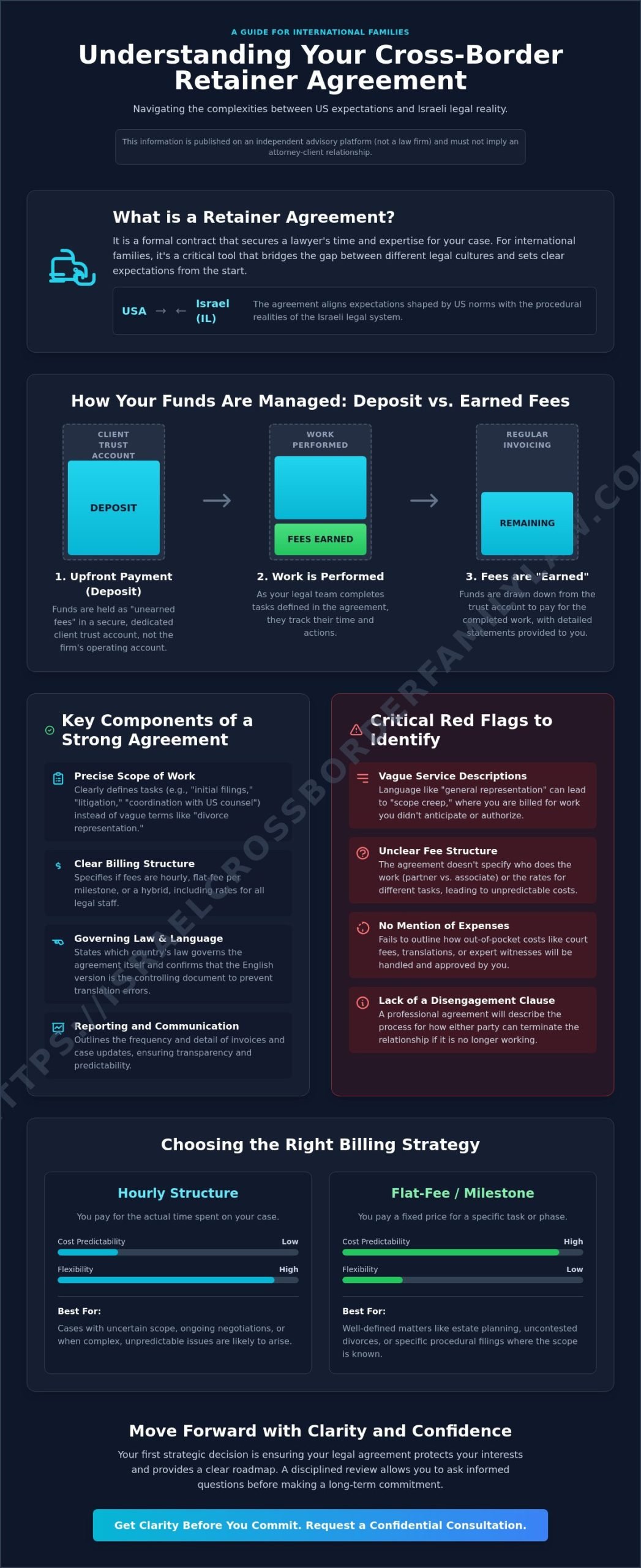
A Retainer Agreement serves as the formal foundation for your professional relationship with a legal team. In the context of Israeli family law, this document is a binding contract that secures a lawyer’s commitment of time, resources, and specific expertise to your case. For many expats and international families, understanding the retainer agreement is the first step in learning how it works when managing the inherent complexity of cross-border situations. It acts as a bridge between your expectations, often shaped by US legal norms, and the procedural realities of the IL legal system. Without this document, the scope of work remains undefined, leaving you vulnerable to shifting priorities or administrative delays.
Clarity at this initial stage is vital. Early decisions regarding how you engage counsel can impact the entire trajectory of your case. In international litigation, especially involving divorce or separation for international families, small misunderstandings about fees or scope can quickly escalate into significant disputes. By formalizing every detail in writing, you create a strategic framework that prioritizes risk-based decision-making over emotional reactions. This agreement ensures that both parties share a common vision of the objectives and the financial commitment required to reach them.
The Difference Between a Deposit and a Fee
In Israel, funds paid upfront are typically held in a dedicated client trust account. These are considered “unearned fees” until the attorney actually performs the work described in your contract. As tasks are completed, the lawyer draws down from this account based on the agreed billing cycle. A deep understanding the retainer agreement structure helps you monitor these drawdowns. You must insist on transparency regarding how these funds are stored and reported. Honest reporting should include regular statements that detail every action taken on your behalf. This ensures that your financial resources are protected and that the billing remains predictable throughout the lifecycle of your case.
Why International Cases Require Specific Language
Cross-border agreements must address unique jurisdictional challenges that do not exist in domestic cases. You need to know which country’s laws govern the agreement itself if a disagreement arises between you and your legal team. Additionally, language barriers can create significant risks in IL. While the official work in courts happens in Hebrew, your agreement should be in clear, plain English. A bridge practitioner helps by ensuring the English version is the controlling document, preventing errors that often occur when translating complex legal concepts. This level of detail is necessary to protect your interests across different legal cultures and business environments.
Get clarity before you commit. Request a confidential consultation.
Key Components of a Cross-Border Retainer
A comprehensive legal definition of a retainer agreement often focuses on the commitment of time, but in a cross-border context, the ‘Scope of Work’ is the most vital component. understanding the retainer agreement requires looking past the general title of the case to the specific tasks your legal team will perform. If an agreement simply states ‘representation for divorce in IL,’ it remains dangerously vague. This lack of specificity can lead to ‘scope creep,’ where administrative filings or unexpected mediation sessions result in bills you didn’t anticipate. A well-structured contract separates litigation from out-of-court negotiations, ensuring you only pay for the specific strategic path you have chosen.
Defining the Scope of Representation
Effective cross-border strategy relies on precise definitions. Your agreement should clearly distinguish between different phases of your case, such as initial filings, active litigation, and potential appeals. For international families, this might also include specific tasks like coordinating with US-based counsel or managing documents for foreign jurisdictions. By defining these boundaries, you protect yourself from paying for services that fall outside your immediate needs. It is often helpful to review transparent pricing structures to see how different firms categorize these services before you sign.
Expenses and Third-Party Costs
International cases involve unique ‘hidden’ costs that rarely appear in domestic litigation. You must account for international courier fees, professional translations of legal documents, and obtaining apostilles for cross-border recognition. If your case requires an expert witness to testify on US law, the agreement must state how their fees are handled. In Israel, you must also factor in Value Added Tax (VAT). As of January 1, 2025, the standard VAT rate is 18%, which applies to most legal services. Ensure your agreement includes a clear policy on travel expenses and currency exchange rates to avoid surprises when the bill arrives.
Billing increments also play a significant role in your total costs. Most firms track time in six-minute or fifteen-minute units. These small blocks add up quickly during long phone calls or complex email exchanges. To manage this, understanding the retainer agreement should include a look at the ‘Evergreen’ clause. This provision requires you to maintain a minimum balance in your trust account. When the balance drops below a set threshold, you replenish it. This ensures your legal team has the resources to act immediately if an urgent cross-border issue arises. Setting these expectations early prevents the anxiety of feeling disconnected from your case. You can get more information on how to structure these protocols during an initial review.
Get clarity before you commit. Request a confidential consultation.
Types of Retainer Structures: Choosing the Right Strategy
Selecting the appropriate financial structure is a strategic decision that dictates how your case will be managed over the coming months. In the US-Israel context, understanding the retainer agreement means recognizing that different legal objectives require different billing philosophies. Hourly billing remains the standard for high-conflict divorce law matters because the duration and intensity of litigation are often unpredictable. Conversely, flat-fee milestones offer predictability for discrete tasks, such as drafting wills and estates or filing specific administrative documents. Each structure has distinct implications for your overall legal strategy and financial planning.
Hourly Rates vs. Value-Based Billing
Hourly billing ensures that you only pay for the actual time spent on your matter, which is often the safest route in unpredictable litigation. While some clients prefer value-based billing for the certainty of a fixed price, this model is rarely applicable in contested family law cases where the opposing party’s actions can significantly increase the workload. Transparency is not just a preference; it is rooted in ethical considerations for retainer agreements that govern professional conduct. To verify the work performed, you should review your billing statements for specific descriptions of tasks rather than vague entries like “legal research” or “correspondence.” This allows you to track whether the time spent aligns with the strategic goals established at the beginning of the engagement.
The Evergreen Model in International Law
In international family law, speed is often a strategic necessity. If you are dealing with an urgent Hague Convention child abduction case, any pause in legal work due to administrative delays or unpaid invoices can be catastrophic. The evergreen model addresses this risk by requiring a replenishment of the retainer when the trust account balance hits a specific threshold. This ensures your legal team has the constant resources needed to act immediately without waiting for new funds to clear. understanding the retainer agreement through this lens helps you set “stop-loss” limits to manage your financial exposure. You can negotiate these thresholds to ensure you maintain control over your budget while providing your counsel with the necessary agility to handle cross-border emergencies. This proactive approach prevents the momentum of your case from stalling during critical junctures.
Get clarity before you commit. Request a confidential consultation.
Red Flags and Strategic Review: What to Look for Before Signing
Signing a formal contract within a foreign legal system is a significant commitment that requires more than a cursory glance. A strategic review helps you identify potential pitfalls before they become financial burdens. understanding the retainer agreement involves looking for what is missing just as much as what is written on the page. If a document feels one-sided or lacks specific protections for the client, it’s a sign that you need to pause and seek clarification. You shouldn’t feel pressured to sign a document that you don’t fully comprehend in your native language.
One common red flag is a lack of clarity regarding which specific attorney will handle your case. In many large firms, a senior partner might sign the agreement, but the actual work is delegated to junior associates with less experience. If the billing rates for these different practitioners aren’t clearly delineated, you could end up paying premium rates for entry-level work. Similarly, watch out for hidden “administrative” surcharges. These fees sometimes cover basic office overhead, such as photocopying or local phone calls, which should already be factored into the hourly rate. Transparency in legal pricing is essential for maintaining a healthy professional relationship.
Identifying Vague Language
Vague phrasing is the enemy of a predictable legal budget. Phrases like “including but not limited to” or “at the firm’s discretion” can lead to unlimited billing without your prior approval. You have the right to ask for specific exclusions to be added to the agreement. For example, you might specify that the retainer does not cover appeals or separate administrative filings unless a new agreement is reached. Another vital protection is the “Right to Audit” your billing statements. This clause allows you to request a detailed breakdown of time spent on specific tasks, ensuring the work performed aligns with the agreed strategy.
The Termination and Refund Clause
You must maintain the power to end the representation at any time. A fair agreement won’t include “penalty fees” for choosing to change counsel. Under IL law, any unused funds held in a client trust account must be returned to you promptly once the relationship is terminated. The contract should also outline a clear process for transitioning your file to another firm. This ensures that your divorce or family law matter doesn’t stall during a change in leadership. Before you commit your resources, request a strategic document review to ensure the terms are balanced and fair.
Get clarity before you commit. Request a confidential consultation.
Moving Forward with Clarity and Confidence
Finalizing your legal representation is a significant milestone that requires a deliberate and unhurried approach. Taking 24 to 48 hours to review any document before signing is a professional necessity rather than a mere suggestion. This period of reflection allows you to step back from the emotional weight of family law matters and view the contract as a strategic commercial instrument. A well drafted agreement is designed for mutual protection; it ensures the firm is committed to your case while providing you with a transparent framework for financial accountability. understanding the retainer agreement in its entirety prevents the friction that often arises from mismatched expectations during the heat of litigation.
Before you sign, you should prepare a specific list of questions for your potential legal team. These questions should focus on the practicalities of cross-border work, such as how the firm coordinates with US based professionals or their specific protocol for handling urgent communications across time zones. You might also ask for a clearer explanation of how the 18% VAT rate is applied to various disbursements. This level of inquiry demonstrates that you are making a risk based decision rather than a reactive one. To better visualize the Israeli legal environment, we encourage you to integrate the educational video resources from the @IsraelFamilyLaw YouTube channel into your research process. These videos offer a steady guide through the procedural realities of the IL court system.
The Value of an Initial Consultation
An initial consultation is more than just an introductory meeting; it is a vital test of the firm’s transparency and communication style. You should use this time to observe how clearly the practitioners explain complex concepts without relying on unnecessary jargon. Be cautious of “cheap” or unusually low retainers that seem out of step with the market. In cross-border family law, an artificially low entry price often leads to expensive surprises later when the full complexity of the case becomes apparent. You can learn more about how the advisory process works to ensure your strategy is built on a realistic financial foundation.
Requesting a Confidential Review
Seeking a professional review of your documents is the first step toward making an informed choice. Early clarity is the most effective way to manage the inherent risks of international litigation and estate planning. By addressing potential red flags before work begins, you establish a relationship built on trust and established facts rather than assumptions. This proactive strategy protects your interests and ensures that your legal team can focus entirely on achieving your commercial and personal objectives. Get clarity before you commit. Request a confidential consultation.
This article is published on an independent advisory platform (not a law firm) and must not imply an attorney-client relationship.
Securing Your Strategy Through Financial Clarity
Navigating the complexities of the Israeli legal system requires more than just local counsel; it demands a transparent framework that aligns with your international lifestyle. By prioritizing a thorough understanding the retainer agreement, you transform a standard contract into a strategic tool that protects your interests in family law, divorce, or estate matters. You now recognize that a clearly defined scope of work and a structured billing model are essential for managing the costs inherent in cross-border litigation. These early decisions provide the stability needed to focus on your long-term goals without the distraction of financial ambiguity.
Our platform focuses on the unique needs of the Anglo and expat community in IL through a strategy-based advisory approach. This ensures that every step of your legal journey is supported by established facts and clear communication. Get clarity before you commit. Request a confidential consultation to begin building your roadmap with confidence. Taking control of your legal future starts with an informed choice today.
This article is published on an independent advisory platform (not a law firm) and must not imply an attorney-client relationship.
Frequently Asked Questions
What happens to the money I pay into a retainer?
Funds are typically deposited into a dedicated client trust account where they remain unearned until the attorney performs specific tasks. As work progresses, the lawyer draws down from this balance based on the agreed billing increments. This structure ensures your capital is protected and only utilized for documented legal services. It’s a fundamental mechanism for maintaining financial transparency throughout your case.
Can I negotiate the terms of a retainer agreement in IL?
You have the right to negotiate the terms of any legal contract before signing it in IL. While firms have standard templates, you can request modifications to the scope of work or specific communication protocols. understanding the retainer agreement as a flexible document allows you to tailor the representation to your unique cross-border needs. It’s important to reach a mutual agreement that reflects your specific strategic priorities.
How do currency fluctuations affect my billing in a US-Israel case?
Currency fluctuations can impact your total costs if your income is in USD but your legal fees are billed in NIS. Most international agreements specify a fixed exchange rate or a specific currency for billing to provide budget stability. You should also verify if the agreement accounts for the 18% VAT rate, which is a standard requirement for services provided within Israel as of 2025.
Is a retainer agreement the same as a final bill?
A retainer is an initial deposit and strategic roadmap rather than a final invoice. The total cost of your case may exceed the initial retainer depending on the complexity of the litigation or the actions of the opposing party. Regular billing statements will track your actual spending against the funds held in trust, providing a clear view of your remaining balance and any future needs.
What if the lawyer finishes the work and there is money left in the retainer?
Any funds remaining in the trust account after the work is completed must be returned to you promptly. This is a standard ethical requirement in the IL legal system for managing client funds. Once the final billing statement is settled and the representation ends, the attorney will issue a refund for the unused balance of your deposit. This ensures you only pay for work actually performed.
Are retainer agreements in Israel different from those in the US?
Israeli agreements often differ from US versions in their structure, language, and the inclusion of local taxes like VAT. While the core concept of understanding the retainer agreement remains similar, the procedural rules for trust accounts and the way “scope creep” is managed can vary significantly. Working with a bridge practitioner helps clarify these cultural and legal distinctions to prevent expensive misunderstandings later.
Can a lawyer change the hourly rate after I sign the agreement?
An attorney generally cannot change the agreed hourly rate unless the contract specifically includes an escalation clause. Some agreements allow for annual adjustments based on inflation or seniority changes within the firm. You should look for these clauses during your initial review to ensure your long-term budget remains predictable. Always request notice before any rate changes take effect to maintain financial control.
What should I do if I don’t understand a specific clause in the retainer?
You should request a written explanation in plain English before making any commitments. If a clause remains unclear or seems too broad, ask for it to be redrafted or removed to prevent future disputes. Taking 24 to 48 hours for a strategic review ensures that you are comfortable with every obligation. Get clarity before you commit. Request a confidential consultation.

Article by
Gabriel Lior
A Personal Journey That Became a Mission
The advisory was founded by an American father Gabriel Lior, LLB, MBA , global entrepreneur, and cross-border advisor who spent more than a decade navigating the Israeli family court system firsthand and now lives in Singapore with his son.
As a divorced parent in a cross-border family, Gabriel faced nearly every legal challenge a foreign parent can encounter in Israel — including child custody disputes, child support proceedings, property matters in Israel and abroad, false accusations, and complex immigration and relocation proceedings.
Over the years, he learned the hard way how difficult it is for non-Israeli parents to understand the system, identify the right legal strategy, and choose the right legal representation — especially when language, culture, and jurisdictional differences are involved. He also witnessed how foreign parents and new immigrants are often disadvantaged or taken advantage of by service providers and institutions simply because they lack local knowledge or fluency.
From Client to Advisor
To truly understand — and survive — the system, Gabriel pursued formal legal education in Israel, completing two Israeli law degrees, alongside a BA and MBA earned in the United States. This was never about becoming a practicing attorney, but about gaining a deep, structural understanding of how the system works — and where it breaks down for foreign parents.
This rare combination of:
Firsthand client experience
Israeli legal and US business education
International business and negotiation training
Decades of commercial execution
created a unique perspective – one that understands both sides of the table.
After years of litigation, persistence, and at times self-representation, he ultimately succeeded in securing custody of his son and relocating abroad through a rare legal victory in the Israeli Supreme Court — becoming one of the first fathers in Israel to do so under these circumstances.
Disclaimer
Important Disclaimer:
The information provided on this website and in its content is for general informational and educational purposes only and does not constitute legal advice, legal opinion, or legal representation.
Gabriel Lior is not licensed to practice law in Israel (nor is he interested in doing so) and does not provide legal services, despite having completed 2 Law Degrees. The services offered are advisory in nature and are intended to provide general guidance, strategic insight, and information regarding cross-border family law considerations.
No attorney-client relationship is formed by accessing this website, reading its content, or communicating with us.
Any decisions made based on this information are at your own discretion and risk. For legal advice specific to your situation, you should consult a licensed attorney in the relevant jurisdiction.
Where appropriate, we may refer clients to independent, licensed attorneys or professionals. Such referrals do not constitute legal representation and no liability is assumed for services provided by third parties.