This article is published on an independent advisory platform (not a law firm). It provides strategic guidance and does not constitute legal advice or an attorney-client relationship.
What if the most critical decision in your legal journey happens before you even consult a litigator? For many international families, the complexities of expat family law Tel Aviv begin with a high-stakes “race for jurisdiction” between the civil Family Court and the Rabbinical Court. You likely feel overwhelmed by the prospect of managing a dual-court system in a language you don’t fully master, especially when your global assets and parental rights are on the line. It’s a valid concern; the choice of where to file first can fundamentally alter the outcome of property division and support obligations.
We’re here to provide a clear strategic roadmap to help you regain control. This guide explains how the Israeli system operates in 2026, including the mandatory 60-day mediation period and the 119 ₪ initial filing requirements. You’ll learn how to protect cross-border assets, understand which court holds the advantage for your specific situation, and see why early strategy outweighs aggressive litigation. We will walk through the jurisdictional nuances and the importance of securing qualified, English-speaking expertise to bridge the cultural gap.
Key Takeaways
- Understand the unique intersection of international treaties and Israeli domestic regulations within the context of expat family law Tel Aviv to avoid common procedural pitfalls.
- Learn how the “Race for Jurisdiction” between Civil and Rabbinical courts impacts your case and why your first filing determines the governing legal framework.
- Discover the essential steps for securing financial records across borders and protecting assets held in both Israel and your home country before litigation begins.
- Identify the specific criteria for selecting an English-speaking expert who understands both the Israeli legal system and the cultural expectations of the Anglo community.
- Gain clarity on the mandatory Settlement of Dispute application and how the 2026 mediation requirements can be used to your strategic advantage.
This article is published on an independent advisory platform (not a law firm). It focuses on strategy, risks, and decision-making guidance. Do NOT use language that implies attorney-client relationship, legal representation, or giving legal advice. Soft CTA to advisory call / WhatsApp.
Understanding the Landscape of Expat Family Law in Tel Aviv
Expat family law in Tel Aviv represents the complex intersection where Israeli domestic statutes meet international treaties and bilateral agreements. For US citizens, this legal landscape is rarely a straightforward application of local rules. Instead, it involves reconciling the Israeli legal code with American tax obligations and international custody standards. When Understanding Israel’s Marriage and Divorce Laws, it becomes clear that the system is built on religious foundations that can feel alien to those from Western secular backgrounds. Cross-border jurisdiction is the authority of a court to hear a case involving multiple countries.
The primary challenges for Anglos in Tel Aviv often stem from significant language barriers and procedural differences. While many Israelis speak English, the language of the court is Hebrew. All filings, evidence, and protocols are managed in Hebrew, which can leave expats feeling sidelined in their own cases. Standard Israeli legal advice often fails in these scenarios because it may overlook the long-term implications for US-based assets or the specific requirements of the US-Israel tax treaty. Without a strategy that accounts for both jurisdictions, a favorable ruling in a Tel Aviv court could inadvertently trigger a massive tax liability or an unenforceable order in the United States.
To better understand this concept, watch this helpful video:
Why Tel Aviv is a Unique Legal Hub for Expats
Tel Aviv serves as the epicenter for international families in Israel, with high concentrations of expats living in the city and neighboring hubs like Herzliya and Ra’anana. This density has made the Tel Aviv District Court particularly experienced in handling international family disputes. The judges here are accustomed to cases involving foreign prenuptial agreements and complex corporate structures. However, the influence of the US-Israel tax treaty remains a critical factor. Strategic planning must ensure that alimony or property transfers are structured to remain compliant with both Israeli law and IRS regulations to avoid double taxation.
Common Cross-Border Legal Triggers
Most expat family law Tel Aviv cases are triggered by specific events that require a multi-jurisdictional approach. These include:
- Divorce with Global Assets: Managing properties, 401(k) accounts, or stock options located in both Israel and the US.
- International Custody: Navigating Hague Convention protocols when one parent wishes to relocate with a child.
- Support Enforcement: Ensuring that child support orders issued in US courts are recognized and enforced by Israeli authorities.
For those navigating these hurdles, our resources for expats and foreign nationals provide further clarity on the initial steps required to protect your interests.
The Dual-Court System: Civil vs. Rabbinical Jurisdiction
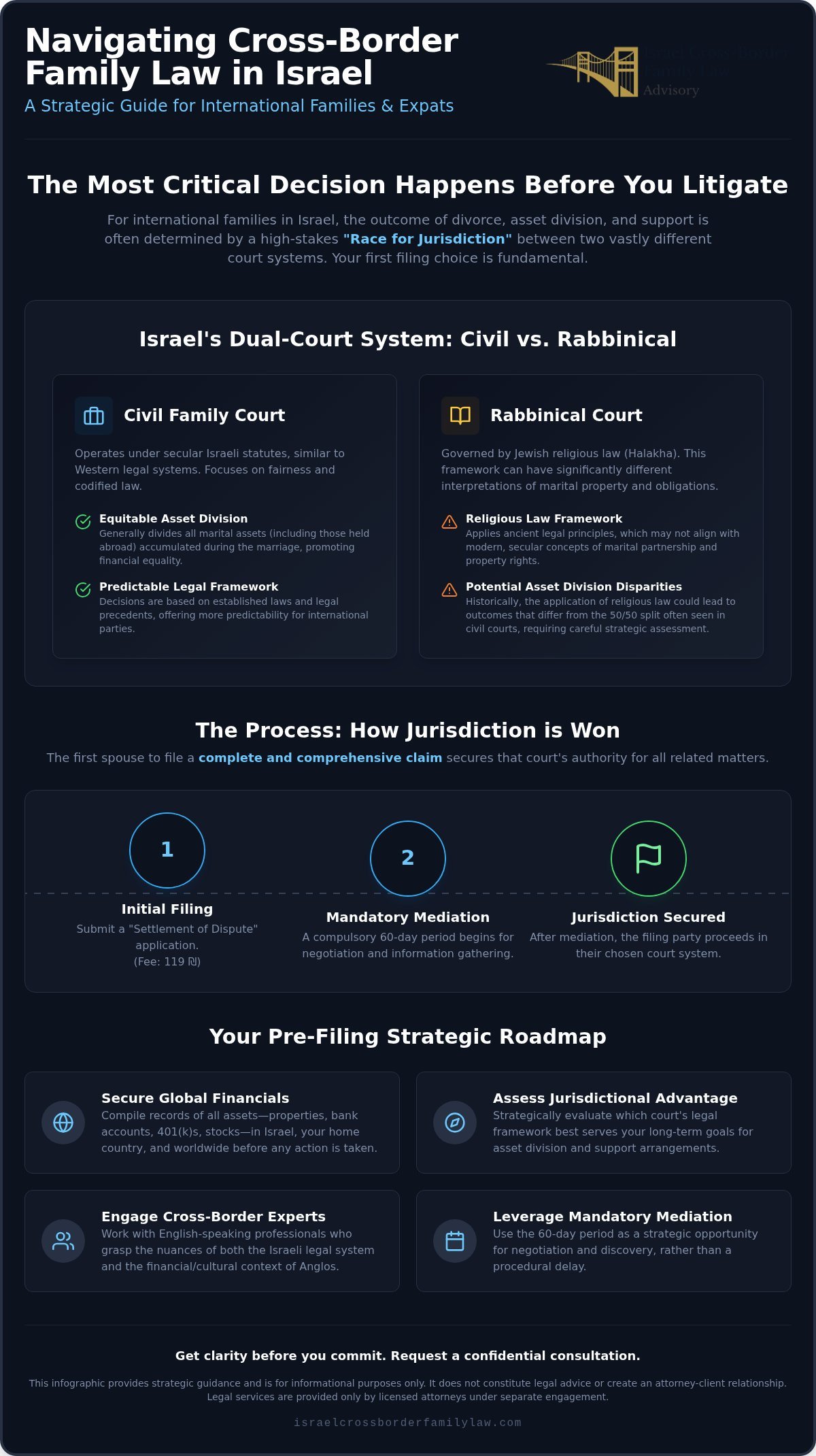
Israel operates a unique legal framework where two separate court systems have concurrent jurisdiction over family matters. This creates a high-stakes environment often referred to as the “Race for Jurisdiction.” In this scenario, the court where a comprehensive divorce claim is filed first typically secures the authority to rule on related issues like property division and alimony. For those navigating expat family law Tel Aviv, understanding this race is critical because the legal principles applied by each court can differ significantly. According to this International Guide to Israeli Family Law, the jurisdictional rules for foreign nationals are distinct and require careful navigation.
Many secular US citizens assume religious courts won’t apply to them. However, if one spouse “binds” property or custody issues to a divorce claim in the Rabbinical Court, that court may take control of the entire process. This can lead to unpredictable outcomes for non-Jewish partners or those unfamiliar with halakhic principles. Ending up in the “wrong” court for your specific case can jeopardize your rights to foreign assets or result in custody arrangements that don’t align with international standards.
Family Court (Civil) Dynamics
The Family Court is a secular institution that focuses on civil rights, child welfare, and the equitable distribution of assets. Before any litigation can proceed, parties must file a mandatory “Settlement of Dispute” application, which currently carries a 119 ₪ fee. This filing triggers a 60-day “cooling off” period where the Unit for the Settlement of Disputes (Mahut) attempts to facilitate mediation. Most expats prefer this track for complex asset division, as the court’s reliance on civil statutes aligns more closely with Western legal expectations and provides a more predictable environment for high-net-worth cases.
Rabbinical Court (Religious) Dynamics
The Rabbinical Court holds exclusive jurisdiction over the “Get” (the religious divorce decree) for Jewish citizens. While its primary focus is religious status, a party can strategically pull property and custody matters into this forum. Recent 2026 legislation has expanded the ability of these courts to arbitrate certain civil disputes if both parties provide consent. However, for foreign nationals and women, the Rabbinical system can present specific risks. These may include different interpretations of marital “fault” or complexities in how the court views assets held outside of Israel. Before making a move, it is wise to explore a strategic review of your options to ensure you file in the court that best protects your global interests.
This article is published on an independent advisory platform (not a law firm). Soft CTA to advisory call / WhatsApp.
Choosing an International Family Law Expert in Tel Aviv
Selecting a professional to manage your interests in expat family law Tel Aviv is a decision that extends far beyond local reputation. The intersection of Israeli statutes and international treaties requires a specific set of qualifications that standard domestic practitioners may lack. To protect your global interests, your representative must possess dual-qualification or significant experience in both the US and Israeli legal systems. This ensures they understand the long-term impact of an Israeli ruling on US-based assets, such as 401(k) accounts or real estate holdings. The Israeli Family Law for Foreign Nationals guide highlights the specific procedural hurdles that expats face, reinforcing the need for a strategic first step.
The distinction between a standard litigator and a specialized cross-border advisor is fundamental to protecting your rights. While a litigator focuses on courtroom performance, an advisory platform like Israel Cross Border Law Firm prioritizes the overarching strategy. This involves ensuring that every move made in Tel Aviv aligns with your global financial and parental goals. Your expert must demonstrate fluency in English and a deep understanding of Anglo cultural norms. Misunderstandings regarding parenting styles or financial transparency can lead to friction in a system that already feels foreign.
Questions to Ask a Potential Attorney
Before committing to representation, you must vet a professional’s specific experience with international cases. Use the following questions to gauge their proficiency:
- How many Hague Convention cases have you handled in the last three years?
- Do you understand the US tax implications of this Israeli property division?
- What is your specific strategy for avoiding a jurisdictional race between the Family and Rabbinical courts?
- How do you coordinate with legal teams in the United States to ensure consistency?
The Role of an Advisory Platform
Advisory platforms provide a neutral environment to develop a strategy before you commit to the high costs of litigation. By using a confidential case review, you can gain clarity on your position without the immediate pressure of a courtroom battle. This approach serves as a bridge between US and Israeli legal teams, ensuring a unified front. It allows you to evaluate the risks of expat family law Tel Aviv cases from a commercial and strategic perspective, focusing on settlement opportunities that preserve assets and minimize emotional strain on the family unit.
This article is published on an independent advisory platform (not a law firm).
Strategic Steps for Expats Before Filing for Divorce
In the complex environment of expat family law Tel Aviv, the actions you take before a single document is filed often dictate the ultimate success of your case. Unlike domestic cases, cross-border disputes require a synchronized approach that accounts for two different legal systems simultaneously. You must begin by securing comprehensive financial records from both the United States and Israel. This includes tax returns, bank statements, and pension valuations. Early strategic decisions determine the next decade of your financial life, and rushing into a filing without this data can leave you vulnerable during the discovery phase.
Determining the optimal jurisdiction is your next priority. You need to evaluate whether your specific goals, such as asset protection or child custody, are better served in the Israeli Family Court or through a US-based forum. Consult with a cross-border advisor to map out the “Mahut” process. This mandatory 60-day mediation track, which begins with a 119 ₪ application fee, is a critical window for negotiation. Understanding how to navigate these meetings without compromising your long-term strategy is essential for avoiding the “Race for Jurisdiction” traps discussed previously.
Asset Protection and Discovery
Identifying assets in cross-border accounts is a significant challenge for international families. It is common for one party to have a clearer picture of Israeli holdings while the other manages US-based investments. You must account for the role of pre-nuptial and post-nuptial agreements, which are treated with high regard in Israeli courts but may require validation. For a deeper look at how these elements interact, see A Guide to Cross-Border US-Israel Family Law. Proper discovery ensures that equitable distribution actually reflects the total global marital estate.
Child Custody and International Relocation
Tel Aviv courts prioritize the “best interests of the child,” but their interpretation of this standard can differ from US expectations. For expats, the risk of “wrongful retention” under the Hague Convention is a constant concern. You should never attempt to relocate a child outside of Israel without a formal agreement or a court order, as this can trigger immediate and severe legal consequences. For more information on managing these sensitivities, review our guidance on International Custody & Relocation. Strategic planning helps you frame relocation requests in a way that respects Israeli law while protecting your parental rights.
This article is published on an independent advisory platform (not a law firm).
Conclusion: Moving Forward with Clarity and Confidence
Successfully resolving matters of expat family law Tel Aviv requires a mindset that prioritizes long-term strategy over immediate, reactive litigation. For international families, the impulse to file quickly in hopes of securing a jurisdictional advantage can often backfire if the broader implications for US tax treaties or global asset protection aren’t fully analyzed. Informed choices, made with a clear understanding of both the Israeli and American legal landscapes, lead to more sustainable outcomes for the entire family unit. By taking a measured approach, you ensure that your parental rights and financial security remain protected across borders, regardless of where your future takes you.
The value of English-speaking, cross-border expertise cannot be overstated when navigating a system rooted in Hebrew and religious tradition. Having a guide who speaks your language, both literally and culturally, reduces the risk of miscommunication that can lead to unfavorable court orders. This expertise acts as a buffer, ensuring that your intentions are accurately represented in a legal environment that may prioritize different values than those you are accustomed to in the United States. Clarity before commitment is not just a slogan; it’s a necessary safeguard for your global interests.
Strategy Over Litigation
A calm, advisory-led approach preserves significant emotional energy and financial resources that are often wasted in aggressive courtroom battles. Working with an advisory platform that understands your specific cultural and professional background allows for a more nuanced resolution. This method focuses on identifying common ground and resolving property disputes before they escalate into high-cost litigation. To understand how we bridge the gap between these two distinct legal worlds, you can explore how it works in detail. Moving from a position of knowledge rather than fear is the most effective way to navigate the Israeli dual-court system and its unique “Race for Jurisdiction.”
Your Next Steps in Tel Aviv
Preparation is the most critical element of a successful strategic review. Before your first consultation, you should organize all relevant documentation, including marriage certificates, cross-border financial statements, and any existing pre-nuptial agreements. Bringing a clear list of your primary objectives, whether they concern child relocation or the division of specific US-based investments, allows for a more productive session. For more practical tips on navigating this transition and understanding the 2026 court updates, you can watch our guidance on the Israel Family Law YouTube channel. Taking these proactive steps ensures that you are ready to engage with the system from a position of strength and clarity.
Get clarity before you commit. Request a confidential consultation.
This article is published on an independent advisory platform (not a law firm).
Securing Your Global Interests with Strategic Precision
Navigating the intersection of two legal systems requires more than just local knowledge; it demands a comprehensive strategy that respects both Israeli statutes and your international obligations. We have explored the critical importance of the jurisdictional race and the necessity of specialized expertise when managing cross-border assets. By prioritizing strategy over immediate litigation, you can protect your family’s interests and avoid the high costs of procedural misalignment in the 2026 legal landscape. This proactive approach allows you to manage the mandatory mediation window with a clear focus on settlement rather than conflict.
Mastery of expat family law Tel Aviv ensures that your decisions today don’t create unintended consequences for your financial life in the decade to come. Whether you are addressing international custody under the Hague Convention or complex property division involving US tax treaties, informed choices are your most powerful tool. Expert guidance provides the bridge between disparate legal systems and secure futures.
You can move forward with confidence when you have a clear roadmap. We are here to help you navigate these complexities and secure a stable, predictable outcome for your family and your assets.
This article is published on an independent advisory platform (not a law firm).
Frequently Asked Questions
Can a US citizen divorce in Israel if they were married in the United States?
Yes, US citizens residing in Israel can divorce locally regardless of where the marriage was performed. The Israeli system recognizes foreign civil marriages for the purpose of dissolution, though the process differs depending on whether the couple is Jewish. Strategic planning is required to ensure the Israeli decree is also recognized in the US. This is a common scenario in expat family law Tel Aviv, where global residency meets local jurisdictional rules.
What is the ‘Race for Jurisdiction’ in Israeli family law?
The “Race for Jurisdiction” is a strategic competition where the spouse who files first determines which court system will hear the case. In Israel, the civil Family Court and the religious Rabbinical Court have concurrent jurisdiction over property, alimony, and custody. Because these courts apply different legal principles, the choice of forum can significantly influence the final division of assets and parenting arrangements, making early decision-making a high priority for expats.
How are US-based assets, like 401ks or property, handled in an Israeli divorce?
Israeli courts generally view the marital estate as global, meaning US-based assets like 401(k) accounts, IRAs, and real estate are subject to equitable distribution. However, enforcing an Israeli order against US financial institutions requires specialized knowledge of both systems. Strategic guidance ensures that property division is structured to remain compliant with the US-Israel tax treaty, preventing the unintended tax liabilities that often arise when international assets are divided without cross-border oversight.
Do I need a separate lawyer in the US if my divorce is happening in Tel Aviv?
While not always mandatory, it’s highly recommended to have US legal or tax counsel when your divorce involves significant American assets. An Israeli court order may not be directly enforceable by a US bank or pension fund without a domestic mirror order. An advisory platform acts as a bridge, coordinating between your Tel Aviv team and US experts to ensure that your global financial strategy is unified and legally sound in both nations.
What happens if my spouse files in the Rabbinical Court before I file in the Family Court?
If a spouse files a comprehensive divorce claim in the Rabbinical Court first, that court typically gains jurisdiction over all “bound” matters, such as property and support. This can be a significant shift for secular expats who expected a civil process. In such cases, your strategy must immediately pivot to address the specific procedural requirements of the religious court system while continuing to protect your rights under international treaties and Israeli civil law.
Can I relocate back to the US with my children after a divorce in Israel?
Relocating with children requires either the written consent of the other parent or a specific relocation order from the Israeli court. Unilateral relocation back to the US can be classified as “wrongful retention” under the Hague Convention, leading to an immediate return order. Tel Aviv courts apply the “best interests of the child” standard, which involves a complex evaluation of the child’s ties to both Israel and their home country before granting permission.
How long does the mandatory mediation (Mahut) process take in Tel Aviv?
The mandatory “Settlement of Dispute” (Mahut) process involves a 60-day waiting period during which no litigation can proceed. This “cooling off” period is designed to encourage mediation through the court’s social services unit. In Tel Aviv, this process begins with a 119 ₪ filing fee. It provides a critical window for those navigating expat family law Tel Aviv to develop a settlement strategy without the immediate pressure of courtroom battles.
Is a US prenuptial agreement enforceable in an Israeli court?
A US prenuptial agreement is not automatically enforced in Israel and typically requires validation by an Israeli court to be legally binding locally. If the agreement was not originally drafted with Israeli law in mind, it may face challenges regarding its fairness or procedural history. Expats should have their foreign agreements reviewed early in the process to determine how they will be interpreted by the Family Court or Rabbinical Court during a divorce.

Article by
Gabriel Lior
A Personal Journey That Became a Mission
The advisory was founded by an American father Gabriel Lior, LLB, MBA , global entrepreneur, and cross-border advisor who spent more than a decade navigating the Israeli family court system firsthand and now lives in Singapore with his son.
As a divorced parent in a cross-border family, Gabriel faced nearly every legal challenge a foreign parent can encounter in Israel — including child custody disputes, child support proceedings, property matters in Israel and abroad, false accusations, and complex immigration and relocation proceedings.
Over the years, he learned the hard way how difficult it is for non-Israeli parents to understand the system, identify the right legal strategy, and choose the right legal representation — especially when language, culture, and jurisdictional differences are involved. He also witnessed how foreign parents and new immigrants are often disadvantaged or taken advantage of by service providers and institutions simply because they lack local knowledge or fluency.
From Client to Advisor
To truly understand — and survive — the system, Gabriel pursued formal legal education in Israel, completing two Israeli law degrees, alongside a BA and MBA earned in the United States. This was never about becoming a practicing attorney, but about gaining a deep, structural understanding of how the system works — and where it breaks down for foreign parents.
This rare combination of:
Firsthand client experience
Israeli legal and US business education
International business and negotiation training
Decades of commercial execution
created a unique perspective – one that understands both sides of the table.
After years of litigation, persistence, and at times self-representation, he ultimately succeeded in securing custody of his son and relocating abroad through a rare legal victory in the Israeli Supreme Court — becoming one of the first fathers in Israel to do so under these circumstances.
Disclaimer
Important Disclaimer:
The information provided on this website and in its content is for general informational and educational purposes only and does not constitute legal advice, legal opinion, or legal representation.
Gabriel Lior is not licensed to practice law in Israel (nor is he interested in doing so) and does not provide legal services, despite having completed 2 Law Degrees. The services offered are advisory in nature and are intended to provide general guidance, strategic insight, and information regarding cross-border family law considerations.
No attorney-client relationship is formed by accessing this website, reading its content, or communicating with us.
Any decisions made based on this information are at your own discretion and risk. For legal advice specific to your situation, you should consult a licensed attorney in the relevant jurisdiction.
Where appropriate, we may refer clients to independent, licensed attorneys or professionals. Such referrals do not constitute legal representation and no liability is assumed for services provided by third parties.