The prospect of a cross-border divorce is uniquely challenging, fraught with uncertainty over which country’s laws will apply and profound concerns about child custody. For individuals living abroad with connections to Israel, these anxieties often converge on a single, critical question: can I be forced to return to Israel for divorce? The fear of being legally compelled to re-enter the country, potentially becoming trapped in lengthy and intimidating proceedings, is a significant burden for many facing the dissolution of an international marriage. This guide is specifically designed to address these complex issues head-on.
We will provide a definitive analysis of the sophisticated legal principles that govern jurisdiction in multi-national family law cases. You will gain a clear understanding of your rights, the strategic options for managing your case from abroad, and the pathways to securing a resolution without compromising your freedom of movement. Our goal is to empower you with the authoritative information needed to navigate this process confidently and protect your interests across international borders, ensuring you feel in control of your situation.
Key Takeaways
- Understand the critical distinction between physical compulsion and the severe legal and financial consequences of ignoring Israeli court jurisdiction in your divorce proceedings.
- For Jewish couples, a civil divorce is insufficient; navigating the authority of the Rabbinical Court to secure a religious divorce (Get) is a mandatory and distinct legal process.
- While the answer to “can i be forced to return to israel for divorce” is typically no, specific legal actions by your spouse concerning child custody or assets can create powerful incentives that may compel your return.
- A proactive legal strategy is paramount when living abroad, as inaction is the most detrimental approach and can severely compromise your rights and financial interests.
Jurisdiction: The Deciding Factor in Your Cross-Border Divorce
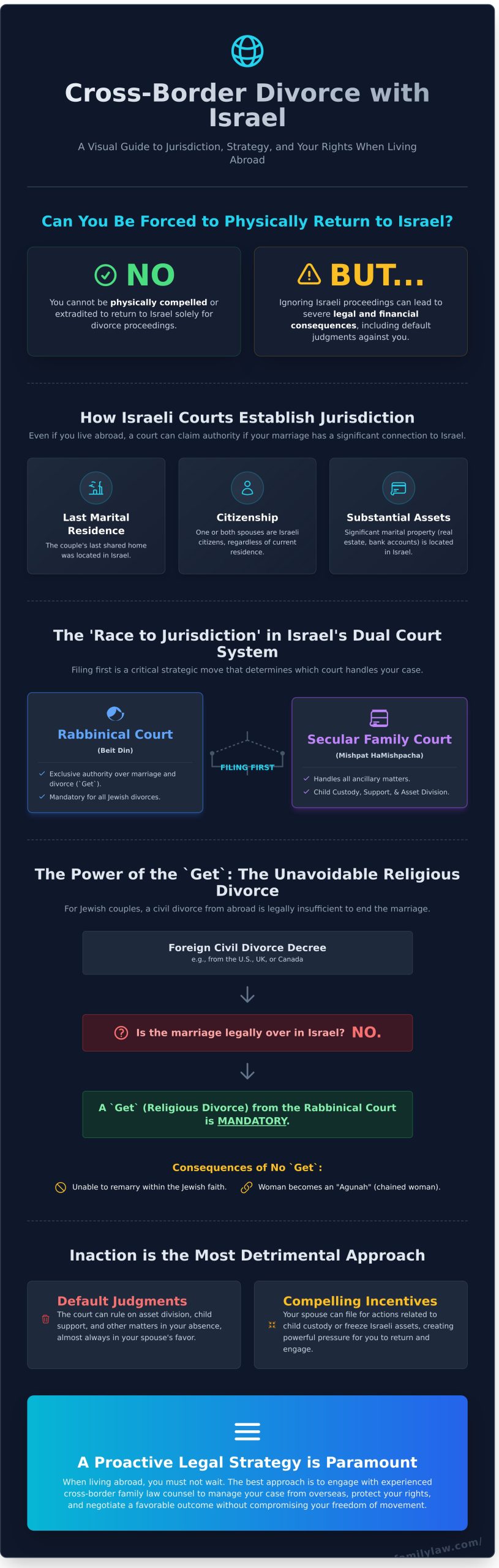
For individuals residing overseas, the primary concern is often, can I be forced to return to Israel for divorce? The direct answer is that you cannot typically be physically compelled to return. However, this does not mean you can simply ignore legal proceedings initiated in Israel. Doing so can result in severe legal and financial consequences, including default judgments on asset division and child support. The critical legal principle at play is ‘jurisdiction’-the authority of a court to hear and decide a case. It is crucial to understand that an Israeli court can possess jurisdiction over your divorce even if you reside in another country.
To better understand the complexities and potential consequences of ignoring Israeli court orders, this video provides a valuable overview:
How Israeli Courts Establish Jurisdiction
An Israeli court’s authority in a cross-border divorce case is not arbitrary. Jurisdiction is typically established if one or more of the following conditions are met, creating a significant connection between the marriage and the State of Israel:
- Last Marital Residence: The couple’s last shared home was located in Israel.
- Citizenship: One or both spouses are Israeli citizens, even if they currently live abroad.
- Substantial Assets: Significant marital assets, such as real estate, investments, or bank accounts, are held within Israel.
The ‘Race to Jurisdiction’: Filing First Matters
In multi-jurisdictional family law, the spouse who files for divorce first often gains a significant strategic advantage by securing their preferred legal venue. This ‘race to jurisdiction’ is particularly critical in Israel due to its dual court system. The initial filing can be in a secular Family Court or a religious Rabbinical Court. Each has different procedures and potential outcomes for matters like property division and spousal support, making the first move a decisive factor in the trajectory of your international divorce proceedings.
Civil vs. Rabbinical Courts: A Dual System
Israel operates a unique parallel system for family law. The Rabbinical Courts hold exclusive authority over the act of marriage and divorce for Jewish citizens. This includes the issuance of a Jewish Divorce (‘Get’), which is the religious document required to formally dissolve a Jewish marriage. Conversely, the secular Family Courts handle all ancillary matters, such as child custody, visitation rights, child support, and the equitable division of marital property. Understanding which court has authority over specific aspects of your case is fundamental to navigating the process effectively.
The Power of the Rabbinical Court and the Jewish Divorce (`Get`)
For Jewish couples married in Israel or under Jewish law, securing a civil divorce in a foreign court represents only half of the legal process. The dissolution of the marriage is not considered complete without a religious divorce, known as a `Get`, which falls under the exclusive jurisdiction of the Israeli Rabbinical Court (Beit Din). This dual requirement is a critical factor in cross-border divorce proceedings and is central to understanding why Israeli jurisdiction cannot be easily disregarded. The authority of the Beit Din to compel cooperation from both spouses, even those residing abroad, directly impacts the answer to the question, can I be forced to return to Israel for divorce?
What is a `Get` and Why is it Necessary?
A `Get` is the official, ritually prescribed bill of divorce that formally terminates a marriage according to Jewish law (`Halacha`). Without the granting and acceptance of this document, a couple remains married in the eyes of the Jewish faith, regardless of any civil decree issued by another country. This status carries severe and lasting consequences, most notably rendering both parties unable to remarry within the Jewish faith. A woman who cannot obtain a `Get` is known as an agunah (“chained woman”), a status that carries significant social and religious stigma.
Sanctions for Refusing to Cooperate (`Get` Refusal)
The Rabbinical Court wields substantial power to enforce its authority and prevent situations of `Get` refusal. Recognizing the profound implications of a spouse being denied a religious divorce, the court is empowered to impose a range of coercive sanctions on a recalcitrant party. This authority is not merely theoretical; recent legislation has expanded the Jurisdiction of Rabbinical Courts to better address complex international cases. If a spouse under its jurisdiction refuses to cooperate, the court may order measures including:
- Financial Penalties: Imposing significant fines or ordering the seizure of assets.
- Restriction of Liberties: Issuing orders to freeze bank accounts, revoke a driver’s license, or place a hold on the spouse’s Israeli passport.
- Social Shaming: Publicizing the individual’s refusal to cooperate within their community.
- Imprisonment: In the most extreme cases of non-compliance, the court can sentence a recalcitrant spouse who is physically present in Israel to prison until they agree to grant or accept the `Get`.
These powerful enforcement mechanisms underscore the gravity of proceedings before the Beit Din and illustrate the serious, tangible consequences of ignoring its summons.
When Your Physical Presence in Israel May Be Required
While the direct answer to the question, “can I be forced to return to Israel for divorce,” is typically no, this does not mean your absence is without significant legal consequences. Your spouse’s legal maneuvers within the Israeli judicial system can create high-stakes situations that strongly compel your return. Understanding these scenarios is fundamental to forming a robust legal strategy for a divorce for international families and protecting your interests from abroad.
Child Custody and International Relocation
When children are involved, the complexities of a cross-border divorce multiply. Israeli Family Courts prioritize the child’s best interests, which often involves a direct assessment of both parents through parental evaluations and in-person hearings. A judge may be highly reluctant to issue final custody orders without meeting the parent residing abroad. Furthermore, if you wish to relocate a child from Israel, you will require either the explicit consent of the other parent or a court order, a process that is exceptionally difficult to navigate from overseas. Understanding the laws governing international custody and relocation is the first step in addressing these critical matters.
The Risk of a Travel Ban (Ikuv Yetzia)
One of the most powerful and coercive tools in Israeli divorce proceedings is the Ikuv Yetzia, or ‘stop exit order.’ Your spouse can petition the court to issue this order, often based on claims of outstanding child support or to secure the division of assets. This creates a serious risk: if you travel to Israel for any reason-even for a short family visit or business trip-you could be legally prevented from leaving the country until the underlying legal dispute is resolved. This tactic is frequently used as leverage to force a settlement on unfavorable terms.
Division of Israeli Assets
Significant marital assets located in Israel, such as real estate, bank accounts, or business interests, add another layer of complexity. While some actions can be managed via a power of attorney, matters like court-ordered appraisals, property sales, and contentious financial discovery often demand direct involvement. Ignoring these proceedings is not a viable strategy. It could result in the court making default judgments that forfeit your claims to your share of the marital property. The scope of the court’s authority in these matters is detailed within comprehensive Israeli Divorce Laws, which grant jurisdiction over all assets located within the country, regardless of where the parties reside.
Your Legal Options and Strategy When Living Abroad
Receiving notice of divorce proceedings in Israel while living overseas can be profoundly unsettling. However, the most detrimental course of action is inaction. Ignoring the summons will not make the issue disappear; instead, it can lead to default judgments that severely compromise your financial and parental rights. For individuals confronting the complex question, can I be forced to return to Israel for divorce, the answer lies in decisive and strategic legal engagement from abroad. You have powerful options to protect your interests without disrupting your life overseas.
Representation by Proxy: Hiring an Israeli Lawyer
The cornerstone of managing an Israeli divorce from another country is securing expert legal representation within Israel. By granting a specific Power of Attorney (Yipui Koach) to a qualified Israeli family law attorney, you empower them to act fully on your behalf. Your legal counsel can file all necessary motions, represent you at hearings before the Rabbinical Court or Family Court, and conduct negotiations. This mechanism ensures your voice is heard and your rights are defended throughout the process, allowing you to participate completely without the need for international travel.
Contesting Jurisdiction
A critical initial strategy is to challenge the Israeli court’s jurisdiction over your divorce. An experienced attorney can file a motion arguing that Israel is not the appropriate forum (forum non conveniens) for the proceedings. The success of this motion hinges on demonstrating that the “center of your life” is now firmly established in another country. Key factors the court will consider include:
- Your current country of residence and for how long you have lived there.
- The citizenship of you, your spouse, and your children.
- Where your marital home and primary assets are located.
- The location and primary language of your children’s school.
If successful, this can result in the case being dismissed in Israel, allowing it to be adjudicated in your home jurisdiction.
Negotiation, Mediation, and Settlement
Many complex, cross-border divorce cases are ultimately resolved not through litigation but through a negotiated settlement. Your attorney can initiate discussions with your spouse’s counsel to reach a comprehensive divorce agreement. Modern mediation services, often conducted via secure video conferencing, provide a neutral and effective platform for resolving disputes over asset division, child custody, and the terms of the religious divorce (the Get). A mutually accepted agreement can then be presented to the Israeli court for ratification, providing a swift and final resolution while avoiding a protracted and costly legal battle.
Navigating these multi-jurisdictional challenges requires sophisticated legal guidance. To understand how these strategies apply to your specific situation and ensure your rights are protected, it is essential to consult with a firm experienced in international Israeli family law.
Strategic Counsel for Your Cross-Border Divorce
Navigating an international divorce presents a sophisticated legal challenge where jurisdiction is the paramount factor. As we have explored, the authority of the Israeli Rabbinical Courts and the specific requirements for a Jewish divorce (Get) can significantly impact proceedings, creating situations where your presence may be legally compelled. The answer to the critical question, can i be forced to return to israel for divorce, is contingent upon a complex interplay of legal statutes and the unique circumstances of your case.
Protecting your rights requires strategic guidance from counsel with proven expertise in this highly specialized field. Our firm is uniquely positioned to assist, offering a proven track record in handling complex US-Israel cross-border family law matters. Our team of dual-qualified attorneys, licensed in both the United States and Israel, provides the nuanced, bicultural legal representation necessary to navigate both legal systems effectively.
Facing a cross-border divorce? Request a Confidential Case Review to understand your options. With dedicated and experienced representation, you can move forward with confidence and clarity.
Frequently Asked Questions
What happens if I ignore a divorce summons from an Israeli court?
Ignoring a summons from an Israeli Rabbinical or Family Court carries severe consequences. The court may issue a default judgment, potentially deciding on critical matters such as child custody, spousal support, and the division of marital assets in your absence. This can create significant legal and financial complications that are far more difficult to contest later. Proactive engagement through qualified legal counsel is paramount to protecting your rights and interests in these complex cross-border proceedings.
Is my US divorce decree automatically recognized in Israel?
A US divorce decree is not automatically recognized in Israel and requires a formal legal process to be validated. For civil matters, you must petition the Israeli Family Court for recognition of the foreign judgment. For Jewish couples, a US civil divorce is insufficient to dissolve the religious marriage; you must still obtain a religious bill of divorce, known as a `Get`, through the Rabbinical Court to be considered divorced under Israeli law and be free to remarry.
Can my spouse prevent me or my children from leaving Israel if we visit?
Yes, this is a significant risk in multi-jurisdictional family law disputes involving Israel. Your spouse can petition an Israeli court for a “stay of exit” order (עיכוב יציאה מהארץ), which can be granted swiftly, preventing you and/or your children from leaving the country while legal matters are pending. These orders can be issued even during a short visit, effectively trapping you in Israel until the underlying dispute, such as divorce or custody, is resolved by the courts.
How can I get a `Get` if I live in the United States and cannot travel?
Navigating the `Get` process from abroad is a complex but manageable procedure. You are not necessarily forced to return to Israel for a divorce solely for this purpose. The process can often be facilitated through a power of attorney, allowing a designated agent (a proxy) to act on your behalf in the Israeli Rabbinical Court. Alternatively, proceedings may sometimes be conducted through a recognized Rabbinical Court (`Beit Din`) in the United States, which coordinates with the Chief Rabbinate in Israel.
Can child support orders from the US be enforced in Israel, and vice versa?
Yes, both the United States and Israel are signatories to international conventions that facilitate the cross-border enforcement of such orders. A US child support order can be domesticated and enforced in Israel through the Israeli court system, and likewise, an Israeli order can be enforced in the US. This multi-jurisdictional enforcement requires a sophisticated legal strategy to navigate the specific procedural requirements of each country’s legal system to ensure compliance and collection of payments.
How long does an international divorce with Israel typically take?
The timeline for a cross-border divorce involving Israel is highly variable and depends on the complexity of the case. Factors include the level of cooperation between spouses, disputes over jurisdiction, and the intricacies of asset division. An amicable divorce with pre-agreed terms may conclude within a year, whereas a contested case, especially one where a party disputes if they can be forced to return to Israel for divorce proceedings, can extend for two to three years or longer.

Article by
Gabriel Lior
A Personal Journey That Became a Mission
The advisory was founded by an American father Gabriel Lior, LLB, MBA , global entrepreneur, and cross-border advisor who spent more than a decade navigating the Israeli family court system firsthand and now lives in Singapore with his son.
As a divorced parent in a cross-border family, Gabriel faced nearly every legal challenge a foreign parent can encounter in Israel — including child custody disputes, child support proceedings, property matters in Israel and abroad, false accusations, and complex immigration and relocation proceedings.
Over the years, he learned the hard way how difficult it is for non-Israeli parents to understand the system, identify the right legal strategy, and choose the right legal representation — especially when language, culture, and jurisdictional differences are involved. He also witnessed how foreign parents and new immigrants are often disadvantaged or taken advantage of by service providers and institutions simply because they lack local knowledge or fluency.
From Client to Advisor
To truly understand — and survive — the system, Gabriel pursued formal legal education in Israel, completing two Israeli law degrees, alongside a BA and MBA earned in the United States. This was never about becoming a practicing attorney, but about gaining a deep, structural understanding of how the system works — and where it breaks down for foreign parents.
This rare combination of:
Firsthand client experience
Israeli legal and US business education
International business and negotiation training
Decades of commercial execution
created a unique perspective – one that understands both sides of the table.
After years of litigation, persistence, and at times self-representation, he ultimately succeeded in securing custody of his son and relocating abroad through a rare legal victory in the Israeli Supreme Court — becoming one of the first fathers in Israel to do so under these circumstances.
Disclaimer
Important Disclaimer:
The information provided on this website and in its content is for general informational and educational purposes only and does not constitute legal advice, legal opinion, or legal representation.
Gabriel Lior is not licensed to practice law in Israel (nor is he interested in doing so) and does not provide legal services, despite having completed 2 Law Degrees. The services offered are advisory in nature and are intended to provide general guidance, strategic insight, and information regarding cross-border family law considerations.
No attorney-client relationship is formed by accessing this website, reading its content, or communicating with us.
Any decisions made based on this information are at your own discretion and risk. For legal advice specific to your situation, you should consult a licensed attorney in the relevant jurisdiction.
Where appropriate, we may refer clients to independent, licensed attorneys or professionals. Such referrals do not constitute legal representation and no liability is assumed for services provided by third parties.