This article is published on an independent advisory platform and is not a law firm; this content is for informational purposes only and does not imply an attorney-client relationship.
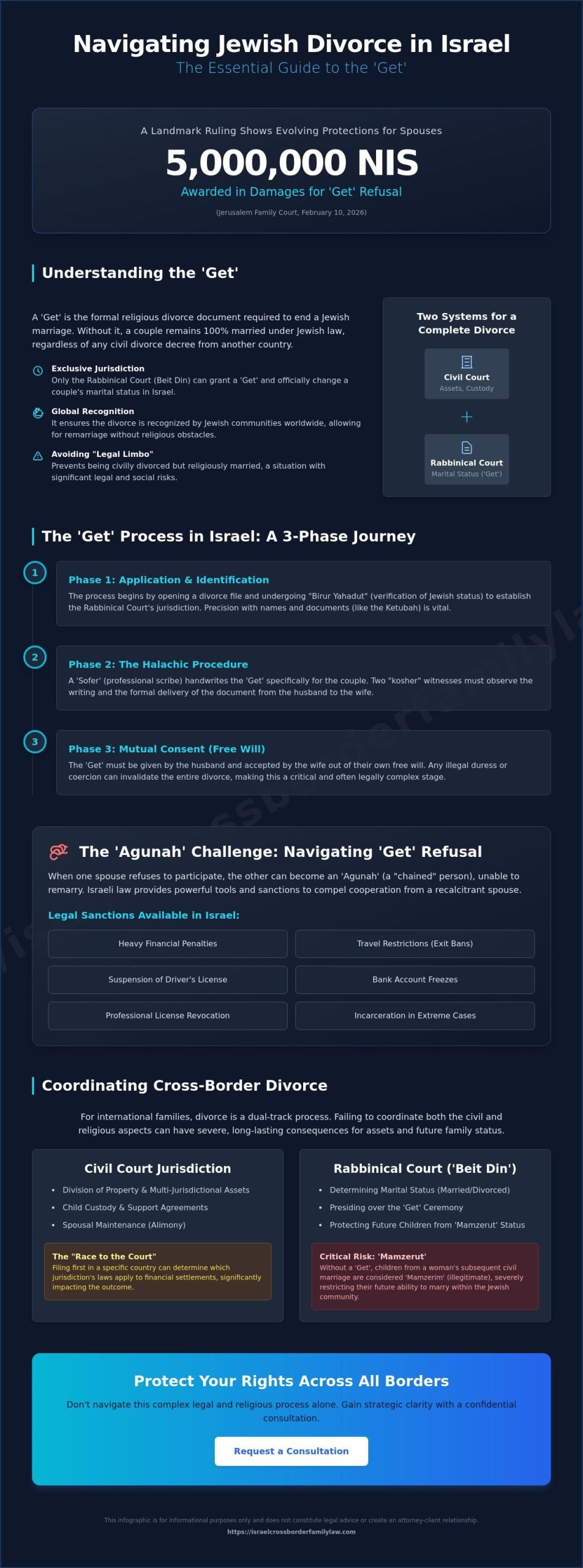
Could a refusal to grant a religious divorce result in a 5 million NIS penalty? On February 10, 2026, the Jerusalem Family Court proved it could by awarding that exact amount in damages, showing how the legal path to get jewish divorce is evolving to protect spouses. You likely recognize that ending a marriage in Israel is a multi-layered process, especially when you’re balancing international assets with the strict requirements of the Rabbinical Court. It’s natural to feel anxious about the power of the Beit Din or the risk of becoming ‘chained’ to a marriage that has already ended in your heart.
This guide will help you understand the essential religious and legal steps while coordinating them with your civil proceedings to protect your rights in both Israel and your home jurisdiction. We’ll examine the 2026 legal shifts in property division, the current costs of the process, and the strategic steps necessary to ensure your religious status matches your civil reality without compromising your financial future.
Key Takeaways
- Understand why a civil decree alone isn’t enough and how the ‘Get’ serves as the essential religious document to end a marriage.
- Learn the procedural requirements to get jewish divorce in the Israeli Rabbinical Court, including how to open a file and prepare for the formal ceremony.
- Discover the specific sanctions and legal tools available in Israel to manage the risk of spouse refusal and ‘Agunah’ status.
- Identify the strategic implications of the ‘race to the court’ and how filing priorities influence the division of multi-jurisdictional assets.
- Gain clarity on how to coordinate religious and secular legal systems to ensure your rights are protected across all borders.
This article is published on an independent advisory platform and is not a law firm; this content is for informational purposes only and does not imply an attorney-client relationship.
What is a Get? Understanding the Jewish Divorce Document
In the Israeli legal system, the termination of a Jewish marriage is not achieved through a civil decree alone. Instead, it requires a specific religious document known as a Get. This document serves as a formal bill of severance, physically handed from the husband to the wife under the supervision of a Rabbinical Court (Beit Din). For international families, understanding What is a Get? is the first step toward resolving a complex multi-jurisdictional separation. Without it, the state of Israel and Jewish communities worldwide consider the couple 100% married, even if a secular court in London or New York has already issued a final divorce order.
The Beth Din maintains exclusive jurisdiction over the marital status of Jewish residents in IL. This means that while a civil court might handle your property or custody arrangements, only the Rabbinical Court can change your status from married to single. To successfully get jewish divorce, both parties must participate in a ritual that has remained largely unchanged for centuries. This process ensures that your new status is recognized globally, allowing you to remarry within the Jewish community without legal or religious obstacles. Failing to secure this document can lead to a state of “legal limbo,” where you are civilly single but religiously bound, a situation that carries significant social and legal risks.
The Essential Requirements of a Halachic Divorce
A halachic divorce is a precise procedure that demands strict adherence to traditional laws. The Get must be a unique document, handwritten by a professional scribe (Sofer) specifically for the couple in question. Two “kosher” witnesses must observe the writing and the subsequent delivery to validate the transmission. Most importantly, the exchange must be a product of free will. If the court determines that the Get was given or received under illegal duress, the entire divorce may be deemed void. This requirement for voluntary consent is often where the most complex legal challenges arise in cross-border cases.
Why International Families Need a Get Even if Secular
Even for families who do not lead a religious lifestyle, the Get remains a vital legal safeguard. If a woman remarries civilly without a religious divorce, any children born from the new relationship are considered “Mamzerim” (illegitimate) under Jewish law, which severely restricts their ability to marry within the community in the future. Furthermore, obtaining a Get ensures universal recognition of your single status. This prevents future complications with inheritance, social benefits, or residency applications in IL. You can learn more about how these religious requirements interact with secular law on our page regarding divorce and separation for international families. Seeking clarity early in the process helps prevent the emotional and social toll of remaining “chained” to a marriage that has functionally ended.
Get clarity before you commit. Request a confidential consultation.
This article is published on an independent advisory platform and is not a law firm; this content is for informational purposes only and does not imply an attorney-client relationship.
The Step-by-Step Process of Obtaining a Get in Israel
Navigating the Israeli Rabbinical Court (Beit Din Rabani) requires a clear understanding of administrative procedures that differ significantly from civil systems. While the goal is to get jewish divorce finalized, the path involves specific religious and bureaucratic hurdles. Unlike the 90-minute process often cited in US-based contexts, the Israeli experience typically requires multiple stages of verification and coordination. Each step is designed to ensure the divorce is halachically sound and legally binding across both religious and civil jurisdictions.
Phase 1: Application and Identification
The journey begins with opening a divorce file and paying the relevant fees. For foreign nationals and expats, this stage often includes a “Birur Yahadut,” which is a formal verification of Jewish status. The court requires original documents, such as your Ketubah and proof of your parents’ Jewish heritage, to establish its jurisdiction. Precision is vital during the initial interview with the Dayanim (Rabbinical Judges). They’ll confirm your Hebrew names and those of your fathers, as any misspelling on the final document could invalidate the entire process. If you’re feeling overwhelmed by these requirements, you might want to request a case review to understand your specific position.
Phase 2: The Ceremony and Transmission
Once the court approves the petition, the “Seder HaGet” ceremony takes place. This ritualized procedure involves a professional scribe (Sofer) who writes the 12-line document by hand. The husband must explicitly state that the document is being written for his wife of his own free will. For a deeper look at Understanding the Jewish Divorce Document from a halakhic perspective, historical context shows why these precise declarations are mandatory. The husband drops the folded document into the wife’s hands, and she walks away with it to symbolize her new independence. The judges then “cut” the Get with a knife to ensure it cannot be used again, signaling the marriage’s final termination.
Phase 3: Post-Divorce Certification
After the ceremony, the court doesn’t immediately hand over the final decree. You’ll eventually receive the “Ma’aseh Bet Din” (Certificate of Divorce), which is the official legal proof of your change in status. International families must then update their records with the Ministry of Interior (Misrad Hapnim) to reflect their single status in IL. For those with ties to the US or UK, ensuring this certificate is recognized by local religious bodies like the Beth Din of America is a critical final step. This coordination prevents “limbo” situations where your status is inconsistent across different borders.
Get clarity before you commit. Request a confidential consultation.
This article is published on an independent advisory platform and is not a law firm; this content is for informational purposes only and does not imply an attorney-client relationship.
Navigating Get Refusal and the ‘Agunah’ Challenge
A woman whose husband refuses to grant a religious divorce is known as an ‘Agunah’, or a chained woman. This status leaves her in a state of legal and personal suspension where she cannot remarry under Jewish law. While the challenge is global, the tools available to resolve it vary significantly between jurisdictions. Organizations like the Navigating Get Refusal and the ‘Agunah’ Challenge coalition highlight these difficulties, but Israel’s legal system offers some of the most robust enforcement mechanisms in the world. During 2025, a special unit of the Rabbinical Courts Administration successfully secured a Get for 198 women whose husbands had disappeared or refused to comply, demonstrating the high level of specialized intervention available on the ground.
In Israel, the Rabbinical Court has the power to impose civil sanctions to compel a spouse to grant or accept the Get. These are not merely symbolic. They’re designed to disrupt the refuser’s daily life until they comply. During 2025, the court imposed 156 sanctions on 36 men and 41 sanctions on 12 women who refused to finalize the divorce process. These actions show the state’s commitment to ensuring individuals aren’t held captive by a failed marriage. When you seek to get jewish divorce in IL, you’re tapping into a system that can back religious decrees with the full weight of civil law.
Legal Sanctions Against Get Refusal in IL
The Israeli courts use several high-impact tools to break a deadlock. One of the most effective is the ‘Stay of Exit’ order, which prevents a spouse from leaving the country. Other sanctions include the closure of bank accounts, revocation of driver’s licenses, and even the cancellation of professional licenses. In extreme cases, the Rabbinical Court can even order imprisonment. A landmark decision on February 10, 2026, saw the Jerusalem Family Court order a husband to pay nearly 5 million NIS in damages for a 30-year refusal. This shift treats Get refusal as a tort, allowing secular courts to provide financial relief to victims and framing the refusal as a form of domestic abuse.
International Implications of Refusal
Managing a refusal becomes more complex when one spouse resides outside Israel, such as in the US. American Rabbinical Courts lack the state-sanctioned coercive power found in IL. They can issue a ‘Seruv’ (contempt order), but they can’t seize passports or freeze bank accounts. This often means international families must use civil divorce settlements as leverage to secure the Get. For example, a spouse might agree to specific property division terms only upon the successful delivery of the religious document. An integrated cross-border strategy ensures that civil leverage and religious sanctions work in tandem to minimize the risk of a prolonged refusal.
Strategic preparation, such as signing a halachic prenuptial agreement, remains the most effective preventative measure. These documents create a financial obligation that makes refusal costly from day one. If you’re already in the midst of a dispute, understanding the pricing and structure of professional guidance can help you regain control. Get clarity before you commit. Request a confidential consultation.
This article is published on an independent advisory platform and is not a law firm; this content is for informational purposes only and does not imply an attorney-client relationship.
Coordinating Religious and Civil Divorce in Cross-Border Situations
For families with lives spanning multiple countries, the decision to get jewish divorce isn’t an isolated religious ritual. It’s a strategic move that can dictate the future of your finances and child custody arrangements. In Israel, a “race to the court” exists between the Rabbinical Court and the secular Family Court. The party that files first often determines which legal body will hear the civil aspects of the divorce. If you have significant assets in the US or Europe, the choice of jurisdiction is critical. Filing in the wrong court at the wrong time could subject your pre-marital property to division rules you didn’t anticipate.
Jurisdictional Overlap: Rabbinical vs. Secular Courts
In IL, the Rabbinical Court can gain authority over civil matters through a process called “Kricha,” where issues like alimony or property are “wrapped” into the divorce lawsuit. This is particularly relevant following the March 24, 2026 law that expanded the power of rabbinic courts to act as arbitrators in certain civil matters with the consent of all parties. For expats, this means an early decision to enter the religious court system could inadvertently hand over control of your global financial portfolio. If children are involved, international custody relocation plans must be coordinated with both systems to prevent conflicting orders. You should always seek clarity before signing an “agreement to mediate” within the Beit Din, as these early commitments can be difficult to reverse once the court asserts its jurisdiction.
Enforcing Your Rights Across Borders
Ensuring that a US court recognizes the terms of an Israeli decree requires meticulous planning. Many international families choose to link religious compliance directly to their civil settlements in the US. By making certain financial transfers or custody rights contingent upon the successful delivery of the Get, you create a self-enforcing mechanism that bridges the two legal systems. This approach is a core part of divorce and separation for international families who want to avoid the risks of being civilly divorced but religiously “chained.”
Recent changes in 2026 have made asset division more complex. Following a Supreme Court decision on January 14, 2026, pre-marital inheritances and real estate owned before marriage are now more likely to be included in the equal division of assets in IL. This contradicts the expectations many Anglos have based on their home country’s laws. If you’re navigating these conflicting rules, you should contact us to discuss your jurisdictional strategy. Understanding how these systems intersect is the only way to protect your rights across borders.
Get clarity before you commit. Request a confidential consultation.
This article is published on an independent advisory platform and is not a law firm; this content is for informational purposes only and does not imply an attorney-client relationship.
Strategic Clarity: Preparing for Your Divorce Journey
The decision to get jewish divorce is often overshadowed by the immediate emotional weight of a separation. However, in an international context, your early moves determine the long-term viability of your global financial and parental rights. Success requires a transition from emotional reactions to risk-based decision-making. Because the Israeli system operates in Hebrew and follows ancient religious protocols, international families often find themselves at a disadvantage. This is where an independent advisory platform provides a critical bridge, offering strategic clarity before you enter a courtroom.
Seeking Strategy Before Commitment
Language barriers represent one of the most significant risks for Anglos in IL. You should never sign a document written in Hebrew without a comprehensive English explanation of its long-term consequences. Standard Rabbinical Court forms often contain clauses that can “trap” an unwary spouse into consenting to jurisdictional terms they don’t fully understand. For instance, a simple agreement to discuss “related matters” can inadvertently grant the Beit Din authority over your US-based retirement accounts or property. To gain a visual understanding of these procedural nuances, you can watch the educational content on the Israel Family Law YouTube channel.
Next Steps for International Families
Strategic planning must also account for the Hague Convention and its implications on international travel and relocation. If one parent intends to move back to their home country, the timing of the Get and the civil filing must be perfectly synchronized to avoid claims of child abduction. Preparing to get jewish divorce requires more than just religious compliance; it demands a sophisticated understanding of how two different legal systems will view your final decree.
The most effective way to map these specific risks is through a confidential case review. This allows you to build a strategy that respects both the “start-up nation” legal environment and your home jurisdiction’s requirements. Finding a bicultural attorney who is qualified in both Israel and the US ensures that your representation understands the nuances of both business and legal cultures. This collaborative approach prevents the common “lost in translation” errors that plague international family law cases.
Get clarity before you commit. Request a confidential consultation.
This article is published on an independent advisory platform and is not a law firm; this content is for informational purposes only and does not imply an attorney-client relationship.
Securing Your Future Across Borders
The path to get jewish divorce requires balancing ancient religious protocols with the fast-moving legal changes of 2026. As the Jerusalem Family Court demonstrated on February 10, 2026, the intersection of civil and religious law is becoming increasingly sophisticated. This evolution offers new protections against refusal while demanding careful jurisdictional planning. You now understand that the Get is a critical legal document that must be strategically coordinated with your international civil status to prevent legal or social limbo.
By prioritizing strategy over immediate litigation, you can navigate the complexities of the Beit Din and the secular courts without compromising your financial security or parental rights. Our specialized advisory for Anglos ensures that you aren’t navigating these multi-jurisdictional challenges alone. We provide the bicultural expertise necessary to bridge the gap between US and IL legal cultures, focusing on a risk-based approach that protects your interests in both countries.
Get clarity before you commit. Request a confidential consultation to map out your specific risks and build a robust cross-border strategy. You can move forward with the confidence and the protection your family deserves.
This article is published on an independent advisory platform and is not a law firm; this content is for informational purposes only and does not imply an attorney-client relationship.
Frequently Asked Questions
Is a civil divorce from the US recognized as a Jewish divorce?
A civil divorce decree from a US court isn’t recognized as a religious divorce in Israel. For Jewish couples, the state of IL only acknowledges the termination of a marriage through a Get. Until this religious process is complete, you remain legally married under Jewish law. This status prevents you from remarrying within the community and can impact the legal status of future children.
Can a woman initiate the Get process in Israel?
A woman can certainly initiate the process to get jewish divorce by opening a file at the Israeli Rabbinical Court. While the husband must physically deliver the document of his own free will, the wife has the legal right to petition the court to order him to do so. In 2025, Israeli courts even imposed 41 sanctions on women who refused to accept a Get, showing that the system oversees both parties.
What happens if my husband lives in the US and refuses to give a Get?
If a husband in the US refuses to grant a Get, the process becomes more complex because Israeli Rabbinical Courts can’t exercise direct civil authority over someone outside IL. In these cases, families often use civil divorce settlements in the US as leverage. You might make specific financial transfers or custody arrangements contingent upon the successful delivery of the religious document to the wife through a local Beth Din.
How much does it cost to get a Get in the Israeli Rabbinical Court?
The cost of obtaining a Get varies by jurisdiction and the specific needs of the case. As of May 2026, the Beth Din of America charges a standard fee of $750, while the Rabbinical Council of New England charges $550. In Israel, you’ll encounter administrative filing fees at the Rabbinical Court. These are separate from any costs associated with the scribe or witnesses required for the ceremony.
Do I need a lawyer for the Get ceremony itself?
You don’t strictly need a lawyer for the 90-minute Get ceremony itself, as the procedure is a religious ritual overseen by the Dayanim and a scribe. However, having an advisor is vital during the preceding hearings where civil and financial matters are often discussed. Decisions made during these earlier sessions can have a permanent impact on your international assets and your long-term custody rights.
What is a ‘Ma’aseh Bet Din’ and why is it important for expats?
The ‘Ma’aseh Bet Din’ is the official certificate issued by the Rabbinical Court confirming that a divorce has taken place. It’s the essential document expats need to update their marital status with the Israeli Ministry of Interior (Misrad Hapnim). Without this certificate, you won’t be able to prove your single status to foreign governments or religious bodies when applying for residency or marriage licenses abroad.
Can the Rabbinical Court decide on my child support or property?
The Rabbinical Court can decide on child support or property division if these issues are linked to the divorce lawsuit or if both parties consent. A law passed on March 24, 2026, expanded the power of these courts to act as arbitrators in civil matters. This makes it critical to seek strategy before filing, as the court’s decisions on assets can differ from secular family court rulings.

Article by
Gabriel Lior
A Personal Journey That Became a Mission
The advisory was founded by an American father Gabriel Lior, LLB, MBA , global entrepreneur, and cross-border advisor who spent more than a decade navigating the Israeli family court system firsthand and now lives in Singapore with his son.
As a divorced parent in a cross-border family, Gabriel faced nearly every legal challenge a foreign parent can encounter in Israel — including child custody disputes, child support proceedings, property matters in Israel and abroad, false accusations, and complex immigration and relocation proceedings.
Over the years, he learned the hard way how difficult it is for non-Israeli parents to understand the system, identify the right legal strategy, and choose the right legal representation — especially when language, culture, and jurisdictional differences are involved. He also witnessed how foreign parents and new immigrants are often disadvantaged or taken advantage of by service providers and institutions simply because they lack local knowledge or fluency.
From Client to Advisor
To truly understand — and survive — the system, Gabriel pursued formal legal education in Israel, completing two Israeli law degrees, alongside a BA and MBA earned in the United States. This was never about becoming a practicing attorney, but about gaining a deep, structural understanding of how the system works — and where it breaks down for foreign parents.
This rare combination of:
Firsthand client experience
Israeli legal and US business education
International business and negotiation training
Decades of commercial execution
created a unique perspective – one that understands both sides of the table.
After years of litigation, persistence, and at times self-representation, he ultimately succeeded in securing custody of his son and relocating abroad through a rare legal victory in the Israeli Supreme Court — becoming one of the first fathers in Israel to do so under these circumstances.
Disclaimer
Important Disclaimer:
The information provided on this website and in its content is for general informational and educational purposes only and does not constitute legal advice, legal opinion, or legal representation.
Gabriel Lior is not licensed to practice law in Israel (nor is he interested in doing so) and does not provide legal services, despite having completed 2 Law Degrees. The services offered are advisory in nature and are intended to provide general guidance, strategic insight, and information regarding cross-border family law considerations.
No attorney-client relationship is formed by accessing this website, reading its content, or communicating with us.
Any decisions made based on this information are at your own discretion and risk. For legal advice specific to your situation, you should consult a licensed attorney in the relevant jurisdiction.
Where appropriate, we may refer clients to independent, licensed attorneys or professionals. Such referrals do not constitute legal representation and no liability is assumed for services provided by third parties.